
The Nova (Figure 1) is a hybrid of Clementine tangerine crossed with Orlando tangelo that was released in 1964 by the U.S. Department of Agriculture. This is the same cross that produced the Robinson, Osceola and Lee tangerines.
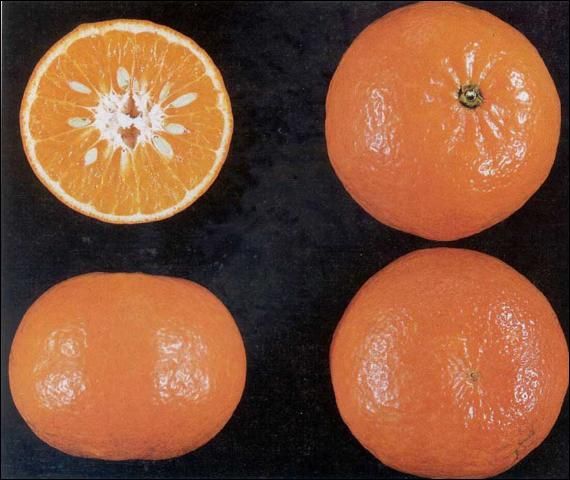
Credit: UF/IFAS CREC
Fruit Characteristics
Nova fruit when grown in Florida resembles early-ripening Orlando tangelo in size and shape. The average diameter of the fruit is 2¾ - 3 inches, has an open central axis and an orange color flesh. Seed number will vary depending on cross-pollination and will vary from one seed to as many as thirty seeds per fruit. When the fruit is fully matured the rind is about 1/8 inch thick, slightly pebbly, leathery, easily removed and has an orange color. Commercial harvest season is from November to December with some color break occurring by mid October.
The fruit has a tendency to prematurely dry out when produced on the more vigorous rootstocks such as rough lemon and Carrizo citrange. The fruit will not withstand extended degreening and maintain the necessary quality for shipping.
Nova is self-incompatible and must be planted with adequate number and type of pollen source trees to provide sufficient pollen for cross pollination. The use of annual girdling or the application of gibberellic acid (GA) has also been able to increase fruit set and yields.
Tree Characteristics
The tree is mandarin-like in general appearance with thornless twigs.
Commercial Production
While this variety has very good appearance and taste it has never been planted extensively. Growers should be aware of several production factors particular to this variety.
- Nova is self-incompatible and must have pollen from compatible varieties to set an adequate fruit crop. Choices of pollenizer varieties include Temple, Orlando, Lee, and Sunburst all being very good choices. While Orlando is acceptable as a pollen source for Nova, Nova will not produce adequate pollen to be used as a pollenizer for Orlando since insufficient pollen is produced to set acceptable Orlando crops.
- The use of gibberellic acid (GA) sprays at full bloom or annual girdling can also increase fruit set.
- Caution should be used when harvesting Nova before adequate color break as this variety does not respond well and will not withstand long periods of degreening.
- The fruit tends to prematurely dry out when planted on vigorous rootstocks such as rough lemon, lemon types or on Carrizo citrange.
More Information
Brown, H.D. and A.H. Krezdorn. 1969. "Hand Pollination Tests and Field Evaluation of Pollinators for Citrus." Proc. Fla. State Hort. Soc. 82:43-48.
Futch, S.H. and L.K. Jackson, 2021, Cross-Pollination Planting Plans, UF IFAS HS170.
Futch, S.H. and L.K. Jackson, 2021, Pollination of Citrus Hybrids, UF IFAS HS182.
Hutchison, D.J. and C.J. Hearn. 1977. "The Performance of Nova and Orlando Tangelos on 10 Rootstocks." Proc. Fla. State Hort. Soc. 90:47-49.
Krezdorn, A.H. 1981. "Fruit Setting of Citrus." Proc. Int. Soc. Citriculture. p. 249-253.
Reece, P.C., C.J. Hearn and F.E. Gardner. 1964. "Nova Tangelo — An Early Ripening Hybrid." Proc. Fla. State Hort. Soc. 77:109-110.
Saunt, James. 2000. Citrus Varieties of the World. Sinclair International Limited, Norwich, England. pp. 69-70.