
Lee (Figure 1) is one of the released citrus hybrids arising from a cross of Clementine mandarin by Orlando tangelo made by Gardner and Bellows in 1942 at the United States Department of Agriculture Laboratory in Orlando. It was officially released as a new variety in 1959 but has never attained important commercial status. The fruit is 3/4 tangerine and 1/4 grapefruit and most closely resembles a tangerine or tangelo. There has been renewed interest in Lee following the freezes of the 1980's since the fruit matures early and the trees are fairly cold hardy.
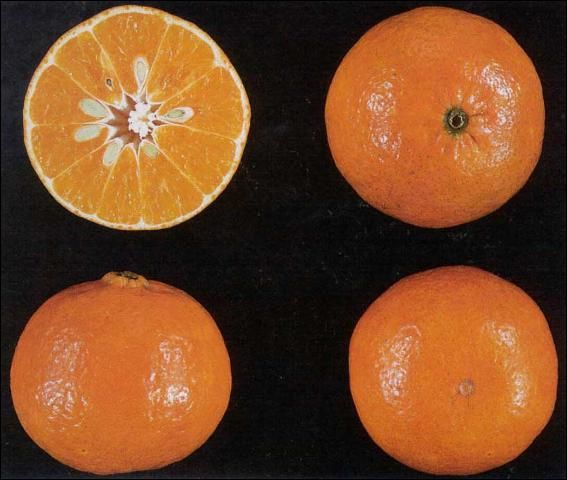
Credit: UF/IFAS CREC
Fruit Characteristics
Lee produces a medium-sized fruit averaging 2¾–3 inches in diameter. The yellowish-orange rind is thin and adherent, therefore, not easy to peel. The flesh is orange, tender, and flavorful. Seed numbers vary, but usually number from 10–25 per fruit. Cross-pollination is apparently not necessary, but yields might be enhanced if pollenizers such as Orlando, Page, or Temple were nearby. The fruit has a low acid level which many consumers find quite appealing. The peel color develops slowly after fruit maturity and does not peak until the fruit is nearly over-mature. Degreening the fruit often results in post-harvest problems and is one of the reasons the variety has never been commercially successful.
The fruit shape is somewhat flattened, as is typical with most tangerines and their hybrids. Commercial maturity in most years is attained in November–December.
Tree Characteristics
Lee trees are not greatly different than other similar citrus varieties. They have rather dense foliage borne on nearly thornless branches. Leaves are medium-sized and lanceolate in shape. Trees have shown good cold-hardiness during the freezes of the 1980s, however, the thin-skinned fruit is not particularly hardy. The earliness of the fruit would allow harvest in most years before the danger of damaging cold. While the Lee may not ever be commercially important in Florida, it is worthy of consideration in small plantings and certainly for dooryards.
Cultivation
Lee is one of the easier tangerine types to grow and has few problems that require special attention. Two possible problems previously mentioned are reiterated below:
- Peel color of Lee is slow to develop, and the flesh may be fully mature before good peel color occurs. The fruit do not respond well to degreening.
- Nearby pollenizer trees may help productivity. Orlando, Page, and Temple seem to do well.
More Information
Reece, P.C. and F.E. Gardner. 1959. "Robinson, Osceola and Lee — New Early Maturing Tangerine Hybrids." Proc. Fla. State Hort. Soc. 72:40-51.2.
Saunt, James. 2000. Citrus Varieties of the World. Sinclair International Limited, Norwich, England. p. 68.