
Introduction
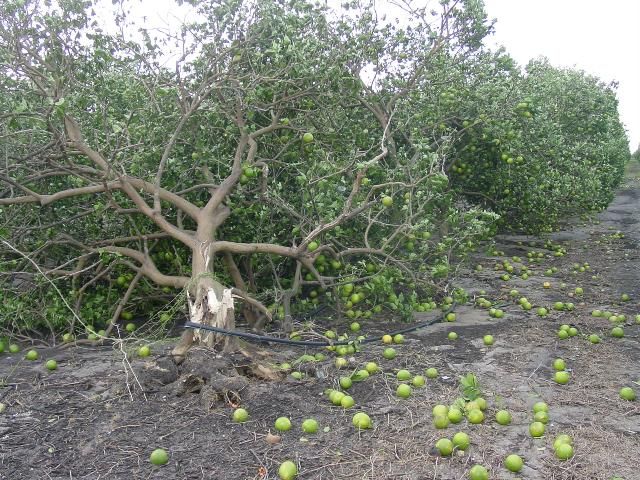
Each year, growers look forward to the rainy season because it helps their young trees grow fast and their mature trees produce good crops. Growers hope for good distribution of rains following the usual dry spring season. However, along with the anticipation of the rainy season, there is also the reality that tropical storms or hurricanes may bring too much rain and wind, causing devastations to citrus groves (Figure 1). The hurricane season is June 1 through November 30. Any hurricane or severe tropical storm poses a threat to all of Florida with additional issues for south Florida shallow-rooted citrus trees. Strong winds blow fruit off trees. Tree damage resulting from wind and 10–20 inches of rain could be the most severe and lasting injury. In addition to rain, high tides caused by wind blowing toward land may cause saltwater flooding several miles inland. Grove flooding may also be caused by the damaging effect of high tides, which raise the level of water in bays, estuaries, and rivers and prevent excess water from running off groves. While a hurricane has the potential to inflict heavy damage on any grove, growers who have developed hurricane plans prior to the event have the best chance of minimizing losses. They will be the ones most likely to save groves by quickly replanting uprooted and blown-over trees and by removing excess water within 72 hours to avoid root damage caused by suffocation from lack of oxygen.
Plan and Prepare
It is best to devise a hurricane plan and use it to make preparations far before June, the start of the hurricane season. Although hurricanes can strike at any time during the June–November period, they are most likely to occur in August and September, at the end of the rainy season when the soil and water retention areas are least able to accommodate more water. The hurricane plan should provide for both protection from a storm and recovery after the storm. Little can be done to protect trees and fruit from wind; but growers can take steps to protect the people, equipment, and supplies that will be needed in the recovery process to include adequate insurance for groves, buildings, and equipment. Additional information can be obtained from local county offices of Emergency Management, Sheriff, Chamber of Commerce, and Economic Development. Following are some things to consider in a pre-storm preparation plan and a post-storm recovery plan.
Pre-Storm Preparation
Personnel assignments—A major part of the hurricane plan is ensuring that all managers know their responsibilities prior to, during, and after a hurricane. Make a list of all tasks that will need to be performed so there are no last-minute, unanticipated gaps to plug. Identify and maintain an updated list of the members of a damage inspection team, which will determine where storm damage occurred and how extensive it is. Make sure each team member knows his or her responsibilities. Specific workers should be assigned to fix ditches, prop up trees, fix roadways, and perform other tasks after the storm. Make sure you know how to contact workers at their place of safety, and that they have a way to call in after the storm.
Safety training—Workers should be trained in the safe operation of unfamiliar equipment that they may have to use if a hurricane hits. For instance, drivers may wind up using chain saws to remove a downed tree that is blocking a road.
Liquid tanks—Tanks containing fuel, fertilizer, and other materials should be kept full so they do not move in the wind and rain, and to ensure that sufficient fuel is available for machinery used in recovery efforts after the storm.
Ditches—Ditches should be kept clean and pumped down to help maximize water removal efforts after the storm.
Cultural Practices—Trees should be pruned regularly to reduce broken limbs and minimize toppled or uprooted trees. Windbreaks can also reduce tree damage and the spread of citrus canker bacterium.
Emergency equipment—Make sure that all emergency equipment—including generators, chain saws, torches, and air compressors— is on hand and in good repair. Emergency generators should be available for use in headquarters and equipment maintenance shops. Large diesel powered generators with 25 to 60 kilowatt capacity can be rented or leased by the month during the hurricane season.
Communications equipment—Ensure that radios are in good working order. Have hand-held portable radios with extra charged battery packs available for workers who will need them in the field after the storm. Direct truck-to-truck radio communication is most reliable when phone lines are down, but cellular phones with radio capabilities and standard cellular phones can help workers save valuable time during the recovery process, as opposed to communication systems that require messages to be relayed through a base unit.
Hazardous materials—Hazardous materials should be secured prior to a storm, and gasoline pumps should be shut down.
Emergency contacts—Have a list of phone numbers you might need in an emergency, including numbers for the phone and electric companies, sheriff, and medical facilities.
Post-Storm Recovery
Activity check list—An activity check list will help ensure that all essential damage assessment and recovery operations are carried out. Additionally, a plan that prioritizes the importance of individual blocks makes grove recovery efficient. With a priority plan, managers can quickly determine where to begin recovery operations.
Employee call-in—Maintain a current list of employee locations and phone numbers. As soon as it is safe to do so, call in those who will be needed for damage inspection and grove recovery work.
Damage inspection—If roads are passable, inspection of tree and equipment damage may be conducted from trucks. Since flooding, downed trees, and electrical poles may have blocked roads, large growers should consider making prior arrangements for a helicopter or flying service to transport the grove manager to survey grove damage. Aerial surveillance can also determine routes of passage through the grove.
Clear road access—Have crews clear all roads leading to parts of the grove where trees must be reset or other recovery activities must be conducted. Having a clear path for workers will speed the recovery effort.
Water removal—Remove excess water from tree root zones as soon as possible. It is essential to accomplish this task within 72 hours to avoid feeder root damage due to insufficient oxygen.
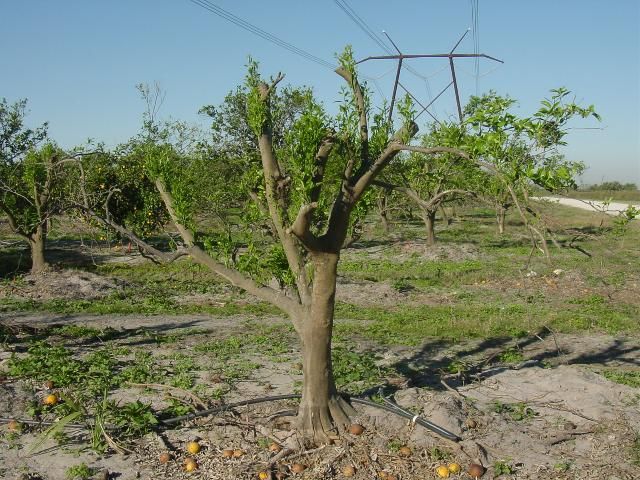
Tree rehabilitation (Figure 2)—Resetting of trees to an upright position should be accomplished as soon as possible after the storm. Ensure that employees know how to properly upright toppled trees and that appropriate equipment is available. Such equipment might include pruning saws, chain saws, front-end loaders, backhoes, and shovels. Toppled trees should be pruned back to sound wood. Painting exposed trunks and branches with white latex paint helps prevent sunburn.
Tropical Depressions, Tropical Storms, and Hurricanes
Florida experiences an average of two tropical cyclones each year. "Tropical cyclone" is a term that includes tropical depressions, tropical storms, and hurricanes. The difference between each of these is determined by the strength of its maximum winds.
Tropical depression—The sustained winds for a tropical depression are less than 39 miles per hour (mph). Wind damage to trees usually begins when the winds exceed 40 mph; only tropical storms and hurricanes will pose a wind damage threat to citrus groves. However, because tropical depressions frequently bring more rainfall than storms and hurricanes, they pose a flooding risk to citrus trees.
Tropical storms—Tropical storm winds are sustained between 39 and 73 mph. At these velocities, light damage to groves will occur in the form of twigs and branches broken off trees, fruit knocked off, and the first and/or second row of trees on the windward side may have an occasional tree pushed over.
Hurricanes—Hurricane winds are sustained at greater than 73 mph velocities and are further categorized from 1 through 5 according to the speed of maximum sustained winds (Table 1). For categories 1 and 2 (sustained wind speeds of 74 to 110 mph), moderate damage to groves will occur. The first five rows of trees to windward may have trees snapped or broken, or blown over. Mobile homes may be overturned and outbuildings demolished. For categories 3 and 4 (sustained wind speeds of 111 to 155 mph), considerable damage to groves will occur. The first 10 rows of trees to windward may be snapped or uprooted. Roofs may be torn off of frame houses, outlying buildings may be lifted and moved, and mobile homes demolished. For category 5 (sustained winds in excess of 155 mph), catastrophic damage to groves will occur. Whole groves may be uprooted and trees carried some distances. Well-constructed houses likely will be destroyed, heavy vehicles lifted and thrown, and pavement pulled from roads.
Wind gusts and tornadoes—Wind gusts are generally 30% stronger than the sustained winds in storms and hurricanes and greatly increase the potential for damage. There is an increased threat of tornadoes during hurricanes.
How much rain?—The amount of rainfall from a tropical depression, tropical storm, or hurricane is dependent on the cyclone's speed of movement. A rule of thumb to determine how much rainfall is possible is to divide 100 by the forward movement speed of the cyclone (in mph). For example, the maximum amount of rainfall from a 10 mph moving storm would be 10 inches, and for a 5 mph moving storm, 20 inches. Because tropical depressions move relatively slowly, they frequently bring more rainfall than tropical storms and hurricanes.
Conclusion
Planning for a hurricane will help reduce damage to citrus trees and enhance recovery of the grove operation. The most important pre-hurricane practice is the maintenance of a regular pruning program to limit tree size. After a hurricane, being prepared for clearing debris, repairing the irrigation system, resetting toppled trees, protecting trees from sunburn when significant portion of the canopy has been removed, and irrigating and fertilizing trees frequently will increase chances of tree recovery.