
Introduction
Ornamental grasses create interest and excitement in the landscape with their unique characteristics. The availability of many species and cultivars makes these plants very versatile, with many potential uses in the landscape. The diversity of grasses leads to many questions concerning the proper selection and use of ornamental grasses. The following information should assist the first-time gardener as well as the experienced landscaper in the selection and use of ornamental grasses in Florida.
Types of Ornamental Grasses
The term "ornamental grass" is a catch-all phrase used to describe not only true grasses but related "grass-like" plants as well. True grasses are in the plant family Poaceae, while grass-like plants generally fall into one of four families: the rushes (Juncaceae), the sedges (Cyperaceae), narrow-leaved sweetflag species (Acoraceae) and the horsetails (Equisetaceae). All of these plant families contain plants adapted to a wide variety of environments and planting conditions. Within each of these plant families are individual species adapted to a wide variety of landscape sites (i.e., wet or dry, sun or shade, hot or cold climates, varied salt tolerance or any combination thereof). Growth habits range from low ground covers to intermediate shrub-like plants to very tall hedge-like plants. Ornamental grasses are very dynamic; the size, shape, texture, and color of grass changes with every season. Tables 1 and 2 demonstrate the diversity of species commonly used as ornamental grasses or grass-likes in Florida landscapes.
Characteristics to Consider
When contemplating the addition of ornamental grasses into the landscape, first consider their characteristics, such as:
- Annual or perennial
- Evergreen or deciduous
- Warm season or cool season interest
- Winter characteristics
- Growth form
- Clump-forming or creeping (spreading by stolons or rhizomes)
- Mature shape and height
- Foliage color
- Flowering season
- Cultural requirements
- Invasive potential
Seasonality
The first characteristic to consider is whether the plant is annual or perennial. A perennial grass will live for many years, while an annual grass will only last one season and die after flowering or be killed when exposed to freezing temperatures.
Determine if the foliage is winter hardy (evergreen) or not (deciduous). This may not be an easy process, because many grasses behave differently in different climates. Grasses are classified as warm season or cool season. Warm-season grasses are active in the warmer months and tend to go dormant in the winter. Dormant warm-season grasses may remain green, or the foliage may freeze, die and remain intact until pruned. Cool-season grasses are active in the cooler months and are more likely to remain evergreen during the winter. A hard freeze may affect even "evergreen" grasses by damaging the foliage, but when warmer conditions return, new foliage will usually regrow quickly. Grasses with foliage that dies in the winter and remains dormant until the weather warms in the spring are considered deciduous.
Winter Characteristics
The winter appearance of an ornamental grass will differ with the winter hardiness of the foliage. In terms of landscape design, evergreen grasses function similarly to evergreen shrubs, while deciduous grasses may function similarly to herbaceous perennials. For many gardeners, the winter character of deciduous ornamental grasses is much more important than the spring and summer foliage or flowers. The mature flowers of grasses may remain intact through the winter, or they may shatter. Regardless, these dead, dry features add tremendous interest to the winter garden when contrasted with evergreen plants or structures such as walls or fences. The dried foliage of deciduous grasses creates sound as it expands and contracts in response to changes in temperature or moisture, while interaction with wind creates movement in the garden. For these reasons, pruning of the dead foliage and inflorescences is not recommended until growth resumes in the early spring. Dried grasses are also a popular addition to flower arrangements.
Growth Form and Mature Size
The growth form and mature size will influence how an ornamental grass should be used in the landscape. Ornamental grasses can be characterized as either clump-forming or creeping. Clump-forming grasses, also called bunch grasses, grow in compact tufts, the width at the base slowly increasing over time. Mountain oats (Chasmanthium latifolium) is an example of a clump-forming grass (Figures 1 and 2). Creeping grasses, also called running or spreading grasses, spread by aboveground stems, called stolons, or underground stems, called rhizomes. Grasses that spread by stolons or rhizomes form roots along these stems, making many of them difficult to maintain within a confined area. Be sure to select the growth form best suited to your garden site.
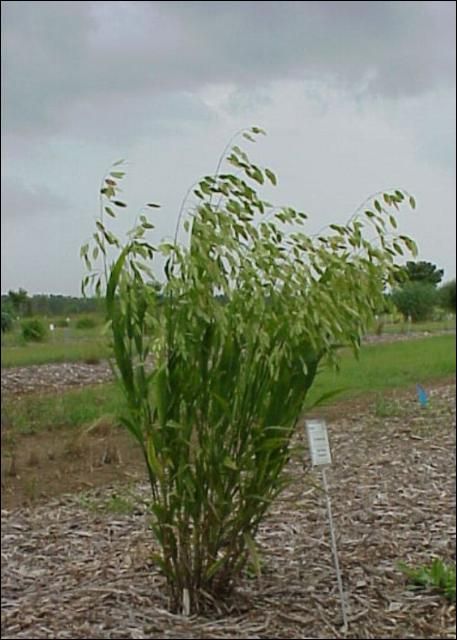
Credit: Mack Thetford, UF/IFAS
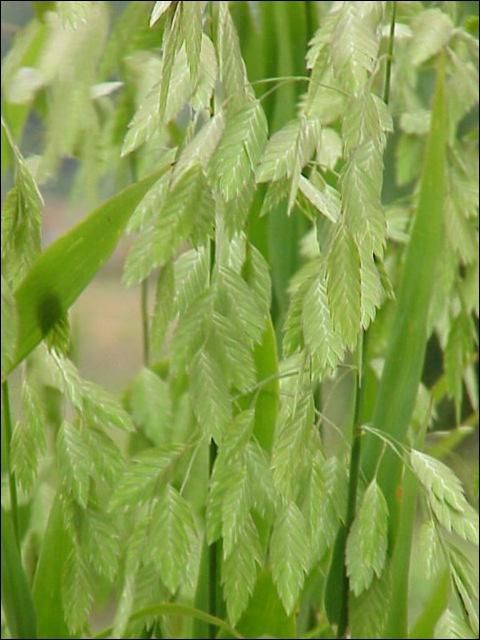
Credit: Mack Thetford, UF/IFAS
The mature size of a grass should be used as a guide to determine where it should be placed in the garden. In particular, water and nutrient availability will influence plant size. An important consideration to remember is that although the mature size of the grass is important in selection and placement in the garden, a majority of our grasses are dynamic and do not remain the same height throughout the growing season, because of pruning of deciduous foliage or flowering characteristics.
Color and Flowering
Grasses are not always green; there are many cultivars of ornamental grasses in shades of blue, purple, orange and red. Others are variegated and boast several colors; a combination of green and creamy white colors come together in stripes or splotches in a number of grasses. The blooms also can vary in color and form and can occur at different times of the year. Consider the interplay of color of ornamental grasses with surrounding trees, shrubs and perennials.
Cultural Requirements
The first principle of Florida-Friendly Landscaping™ is to put the right plant in the right place to optimize the health of the plant and the success of your landscape plan. Each plant species has naturally adapted to thrive in certain environmental conditions. Make sure that the grasses you choose are adapted and recommended for the environment you have.
At the outset, before you make your grass selections, consider the environmental conditions in your landscape. Determine your soil type, how long your soil retains moisture, how much sunlight there is in different areas of the landscape, and whether you are affected by salinity. To determine your soil type and for a discussion of other factors relating to soil, see SL322, Preplant Soil Assessment for New Residential Landscapes in Florida (https://edis.ifas.ufl.edu/publication/ss534). If you are within one-eighth of a mile of saltwater, you will want to choose plants that are at least somewhat salt tolerant; see the UF/IFAS Gardening Solutions page (https://gardeningsolutions.ifas.ufl.edu/design/landscaping-for-specific-sites/coastal-landscape/) for further discussion and links to resources on coastal landscaping.
Invasive Potential
The invasive potential of ornamental grasses has been of concern for a long time. In Florida, the issue is broader because many of our native areas are fire-dependent ecosystems dominated by grass species. The escape of non-native grasses into these areas might displace native species. Also, non-native grasses in native ecosystems may alter natural fire regimes. The temperature at which a non-native grass burns, or the ability of the non-native grass to carry fire across an ecosystem, may be different from that of native species. Invasive plant species may also crowd out our native plants, which our songbirds and other wildlife depend on.
There remains concern in other areas of the United States with regard to grass species listed in previous versions of this article. Gardeners should be concerned about the potential invasiveness of non-native grasses when selecting an ornamental grass species and determine if it is considered invasive in Florida. Pampas grass (Cortaderia selloana) and related cultivars as well as Ribbon Grass (Phalaris arundinaceae) and related cultivars are now classified as invasive species in Florida and are no longer recommended. Initially pampas grass was recognized as a problem species in California while remaining a popular plant for Florida landscapes, but new information now places it on Florida's list of invasive species. Similarly, volunteer seedlings of Japanese silver grass (Miscanthus sinensis) have been reported in several northern states, but silver grass and its cultivars remain a popular grass for Florida landscapes. Japanese blood grass is a showy cultivar of cogan grass (Imperata cylidrica), which is not vigorous and does not reproduce by seed in more northern climates. However, Japanese blood grass has been banned in the state of Florida because it does flower in our long growing season. Cogan grass is an invasive species considered to be among the world's worst weeds, and seedlings from Japanese blood grass have the invasive characteristics of the parent species. This information shows that a grass can be invasive in one climate and perfectly acceptable in another climate or region. What this means to the Florida gardener is the information derived from local growers and regional experts will be important and the most desirable selections for their region may also include regionally native grasses. Gardeners concerned with the invasiveness of ornamental grasses should contact their local county Extension office or consult either the UF/IFAS Assessment of Non-Native Plants in Natural Areas (https://assessment.ifas.ufl.edu/) or the most recent list published by the Florida Exotic Pest Plant Council (https://floridainvasivespecies.org/plantlist.cfm) for the latest available information on plants considered invasive in Florida.
Availability
Ornamental grasses are a relatively popular group of plants for Florida landscapes, but many local garden centers may not have many of the tall or very large-growing selections. Don't be bashful: if you don't find what you're looking for, ask your local garden center to locate and stock these plants. For those selections you do find locally, be prepared to see plants that may not be as attractive as those pictured in catalogs, magazines and online. Many grasses, especially those that quickly reach heights above 3 to 4 feet, may require pruning during the production cycle to prevent the wind from toppling the plants. Tall plants are also difficult to ship from the grower/producer to the garden center, so this may make some of the larger, taller selections a bit more difficult to locate. Remember, the way a grass looks in a pot at the garden center may not reflect the ultimate appearance or size it will have once established in the garden.
Use of Ornamental Grasses
We will consider three arbitrary size groupings, short, medium and tall, to provide examples of how grasses can be used. The distinctions between these groups may vary according to gardeners' perceptions of height and growing conditions.
Short Grasses
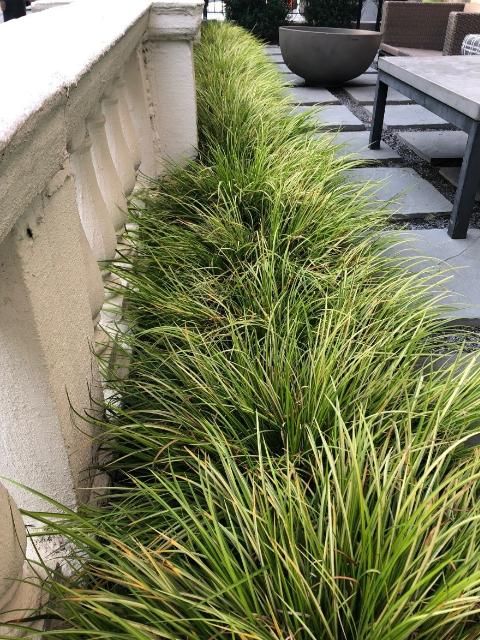
Short grasses can be used in small groups for a massing effect or in large groups as a living ground cover. Small clumping grasses, such as dwarf selections of silver grass or fountain grass (Figure 3), provide an excellent border between plant beds and walkways, while small spreading grasses, such as the grass-like plant dwarf horsetail (Equisetum scirpoides), make an excellent ground cover. Grass-likes such as sweetflag (Acorus spp.) may also be useful in tough garden spots like narrow spaces or water gardens (Figures 4 and 5). These plants also make good accent plants among other short annual or perennial species. The weeping effect of grass leaves over the edges of pots and planters softens and hides container edges, so don't forget to consider short grasses as candidates for mixed planters or individual pots.
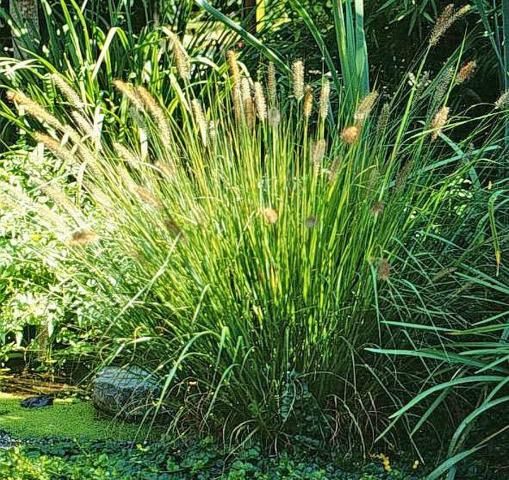
Credit: Mack Thetford, UF/IFAS
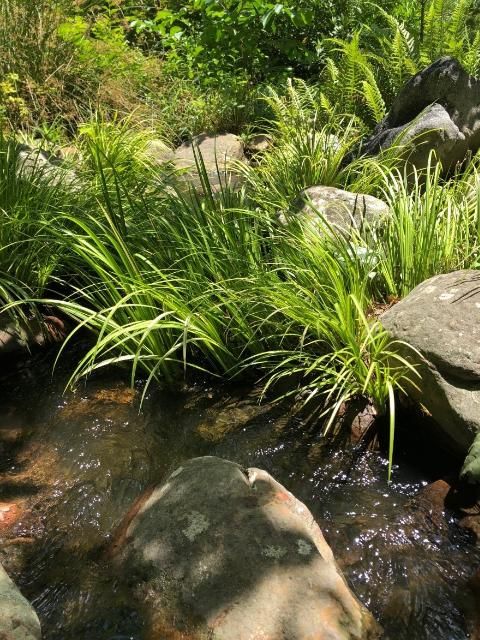
Credit: Mack Thetford, UF/IFAS
Credit: Mack Thetford, UF/IFAS
Medium Grasses
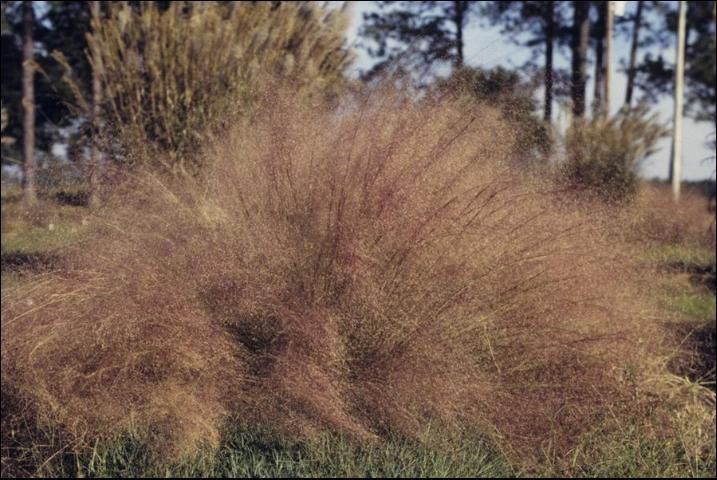
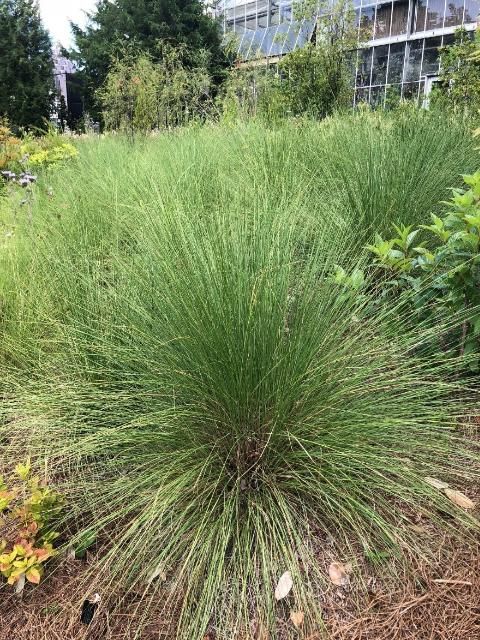
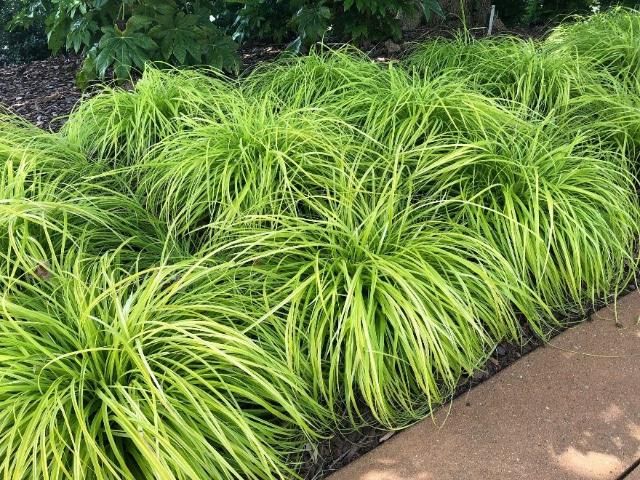
Medium grasses can also be used as accents among shrubs or herbaceous perennials or annuals. The shrubs serve as the permanent vertical elements of the planting design, while the height and shape of the grasses will vary with the season. Medium grasses may also be used to define areas within the landscape that do not require a solid screen. An example would be a hedge of zebra grass used as a wind block near a seating area. In the early spring the plants are only a few inches tall and will not affect the spring and summer breezes. As the plants grow to a height of 4 to 5 feet by fall, they provide fall and winter wind protection. Other medium grass selections include muhly grass (Muhlenbergia capillaris) (Figures 6 and 7) and Evercolor Sedge (Carex oshimensis 'Everillo') (Figure 8), which may be used in mass plantings or as ground cover, and leather leaf sedge (Carex buchananii), which can be used as an accent plant within plantings of annuals such as wax begonia.
Credit: Mack Thetford, UF/IFAS
Credit: Mack Thetford, UF/IFAS
Credit: Mack Thetford, UF/IFAS
Tall Grasses
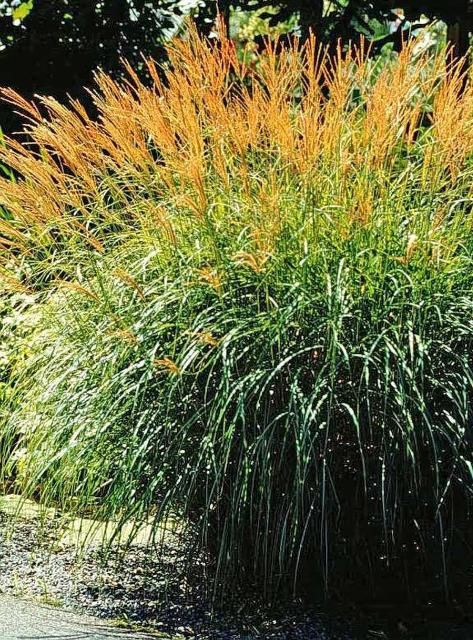
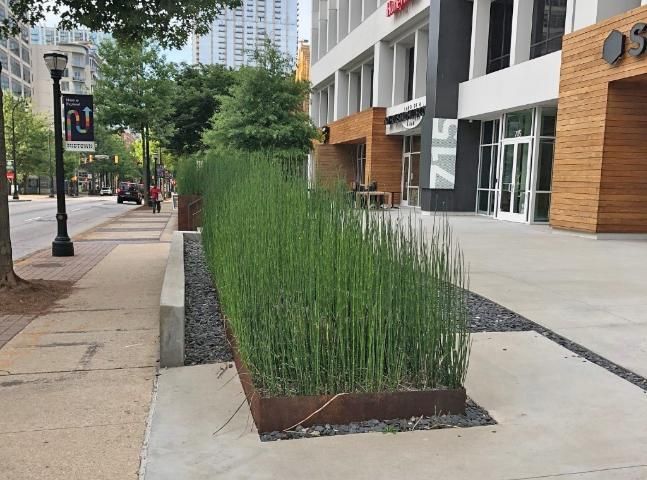
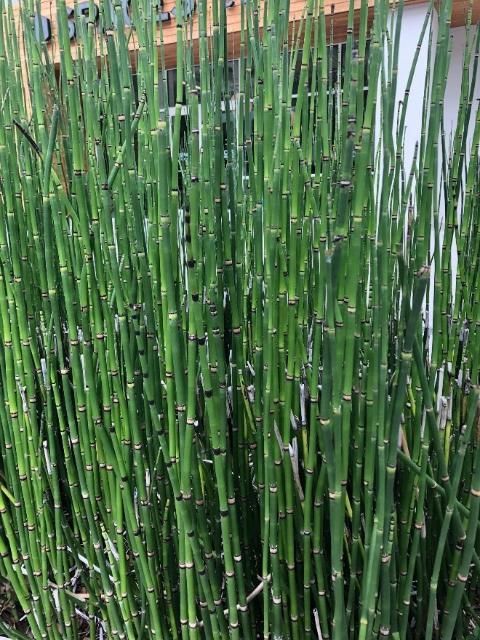
Tall grasses provide a strong vertical element in the garden. Tall grasses with arching leaf tips can also be used to help soften the harsh vertical lines of structures. Evergreen grasses such as tall growing cultivars of Japanese silver grass (Figure 9) can be used to divide the garden into sections or as a transitional plant between a tall hedge and shorter shrubs or perennials. Many of the Japanese silver grasses also work well in the mixed shrub and perennial borders. Because of their short stature, these plants do not dominate this type of planting early in the season. As the season progresses into the hot summer, they grow and become a more dominant element. Tall grasses with distinct vertical lines may also be used to accentuate the lines of the landscape, as with the evergreen foliage of the grass-like scouring horsetail (Equisetum hyemale) (Figures 10 and 11). During the fall months, when little else is flowering or drawing attention, a grass like 'Burgundy Giant' fountain grass (Pennisetum × 'Burgundy Giant') with its burgundy foliage and rose purple flowers will take center stage.
Credit: Mack Thetford, UF/IFAS
Credit: Mack Thetford, UF/IFAS
Credit: Mack Thetford, UF/IFAS
Managing Ornamental Grasses in the Landscape
Ornamental grasses, once established, are relatively easy to manage in the landscape because of their minimal fertility, irrigation and pruning needs. Maintenance considerations may differ depending on local rainfall patterns, native soil texture and nutrient holding capacity of the soil.
Watering
Irrigation may not be necessary for ornamental grasses once they are established in the landscape. In many areas of Florida rainfall is sufficient for most ornamental grasses, particularly those native to the state. After planting, grasses should be watered as frequently as any other containerized ornamental, with the irrigation applied directly to the root ball. After several weeks, the roots of the grass plant should extend beyond the root ball into the surrounding soil. At this point the plant will normally require irrigation only during extremely dry periods. Most grasses should be irrigated with a drip-type irrigation system, which will keep the foliage and flowers dry and reduce the potential for leaf diseases.
Fertilizing
Grasses should obtain sufficient nutrients from the soil if the basic soil fertility recommendations from a soil test are followed. A minimal nitrogen application of 1 lb N/1000 ft2 per year is more than sufficient to meet the nitrogen requirements of most grasses. Beyond these basic recommendations, no additional application of fertilizer nutrients should be necessary to promote growth of healthy foliage or flowering. In fact, excessive application of fertilizer nutrients will result in weak, floppy growth of foliage and weak flowering stems that will not stand up even to mild winds. Timing of fertilizer applications should correspond to periods preceding rapid foliar growth of the plants.
Pruning
Pruning of ornamental grasses should be done in late winter or early spring, just prior to new shoot growth. Many of the ornamental grasses have spectacular winter characteristics that should be preserved through the winter months. In north and central Florida, gardeners may target the months of February and March as appropriate times to prune ornamental grasses. South Florida gardeners may wish to cut back or trim ornamental grasses in January or February prior to new growth.
For deciduous grasses, such as Japanese silver grass (Miscanthus sinensis), the old foliage may be completely removed within inches of the soil. For evergreen grasses, such as muhly grass, the ragged, dead tips of leaves can be removed to neaten the appearance of the plant. This type of light pruning to remove old flower stalks and seed heads may be scheduled any time these plants no longer have a neat appearance. Most evergreen grasses recover quickly from a heavier spring pruning after dormancy; however, these grasses cannot tolerate sever pruning prior to winter dormancy. Sever losses and reduced vigor can be experienced when all green foliage is removed from evergreen grasses in the fall.
Dividing
Propagation of ornamental grasses is relatively easy and can be done at the time of pruning. Clumping grasses may be dug, divided into several pieces, and replanted. Rapid regrowth will immediately follow. Divisions of creeping grasses may be done also at this time and planted in a container or new location. Division of ornamental grasses is not a requirement for sustained landscape performance, but many Pennisetum, Miscanthus, and Panicum species may exhibit less vigor as they become older. Often this is a result of the buildup of the dead aboveground parts accumulating over time. Simple division and replanting is an easy way to rejuvenate these older plants. Named cultivars of ornamental grasses should only be propagated by division because seedlings from these plants may express the broader characteristics of the species rather than the specific desirable characteristics of the named cultivar. Grasses can be easily started by sowing seeds in flats or pots in early spring in an area with bright light. Seedling growth is usually rapid, and the seedlings may be transplanted directly to containers or the garden.
Table 1. Ornamental grass selections suitable for Florida gardens.
Table 2. Ornamental grass-like selections suitable for Florida gardens.