
A healthy lawn is an important component of an urban landscape. Not only do lawns increase the value of a property, but they also reduce soil erosion, filter stormwater runoff, cool the air, and reduce glare and noise. A healthy lawn effectively filters and traps sediment and pollutants that could otherwise contaminate surface waters and groundwater. This publication is intended for homeowners who maintain their own lawns and landscapes.
Management of home lawns is often not well understood by residents and can often have adverse effects on turf health. Loss of turf health can render it less able to filter stormwater runoff and reduce soil erosion, which can lead to increased nonpoint source pollution. Misuse of fertilizers can result in direct deposition of granules into water bodies or increased risk of leaching into groundwater. In either case, the result can be unhealthy turf and increased nonpoint source pollution. Therefore, it is very important that homeowners who do their own lawn care use Best Management Practices (BMPs) when maintaining their lawns. Best Management Practices follow Florida Friendly Landscaping™ principles, developed for maintenance of a healthy landscape that reduces nonpoint source pollution. Following BMPs can reduce potential pollution of Florida's surface or groundwater resources because of lawn and landscape maintenance. Here are some easy-to-follow tips on Florida-Friendly lawn maintenance.
Plant Nutrition
All landscape plants including turfgrass require proper nutrition ensuring that all the essential nutrients are available to the growing plants. These essential nutrients are naturally occurring and can come from many different sources including atmospheric deposition (rain), mineralization from soil and organic residues, reclaimed water, and fertilizer. When one or more of the nutrients become limiting, fertilizer is applied to eliminate the deficiency. The goal of proper nutrient management should be to apply the minimum necessary nutrients to achieve an acceptable quality and to apply these nutrients in a manner that maximizes their plant uptake. When fertilizer is applied, it is important to adhere to the “4R’s” of nutrient management: right time, right source, right rate, and right place.
Right Time
Lawns require nutrients throughout the growing season to be healthy. The growing season will vary depending upon location in the state. Warm-season grasses grow in response to both increasing temperature and day length, making summertime the season of most active growth. This is when grasses have the best ability to take up the nutrients and have the most need for them. It is important to avoid fertilizing when grasses are not growing, as this can increase the possibility of nutrients leaching through the soil. This occurs largely because the root systems of warm-season grasses "slough off" during the winter months (Figure 1), rendering them less able to assimilate nutrients from applied fertilizer. This is especially true in north and central Florida and becomes less common as you move further south in the state. University of Florida research on nitrate leaching from various lawngrass species found that the potential for nitrate leaching in north central and northwest Florida is greatest in the months of January through March, when the root system has the least mass and the grass may be in some stage of cold-induced dormancy. It is therefore important to wait until growth begins in the spring to fertilize. For north Florida and the panhandle, this would be around the middle of April. For north-central and central Florida, it would be early April.
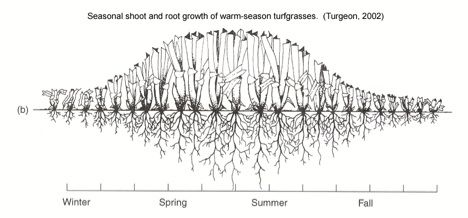
Credit: A. J. Turgeon
The last fertilizer application should be around the middle or end of September in north Florida and early October in central Florida. In south Florida, fertilizer can be applied throughout the year when needed.
What if you live in an area where lawn fertilization is prohibited from June 1 through September 30?
A number of cities and counties in Florida have passed fertilizer ordinances that do not allow for application of nitrogen or phosphorus fertilizers during the summer. These ordinances are passed out of concern for nutrient leaching due to potential heavy rainfall, but research has shown that this is the time of least nitrate leaching (Trenholm, Unruh, and Sartain 2012). You can verify whether or not you live in an area impacted by fertilizer ordinances here: https://ffl.ifas.ufl.edu/fertilizer/. If you are in one of these restricted areas, fertilize with a long-term, controlled-release product prior to the beginning of the restricted period. The grass will receive low doses of nitrogen over a period of 3–4 months, depending on the product used. When the restrictive period is over, fertilize again with a product that has a more soluble nitrogen component. This will reduce the potential for the fertilizer to release nitrogen during the winter months when the ability to take up the nutrients is reduced.
Fertilizing Newly Planted Turf
Research has shown that the risk of nutrient leaching is much greater on newly planted sod than on established turfgrass. This is due to the lack of a deep root system on newly planted grass and due to import of some nutrients from the sod farm. Wait at least 30 to 60 days after planting to apply nitrogen fertilizer to turfgrass. Preplant fertilizers should not be applied unless a soil test taken prior to planting indicates that the soil is low in phosphorus. Nitrogen fertilizers should never be applied prior to planting.
Right Source
In June of 2007, the Florida Department of Agriculture and Consumer Services (FDACS) passed a rule to regulate labeling requirements for urban turf (home lawn) fertilizers (Urban Turf Fertilizer Labeling Rule (RE-1.003(2) FAC). This rule requires fertilizer manufacturers to place specific language on fertilizer bags with the intent of reducing potential nonpoint source pollution that might result from the misapplication of fertilizer to lawns. The rule regulates the maximum amount of nitrogen and phosphorus that is in the bag and directs users to follow UF/IFAS recommendations for annual fertilizer application rates. The rule is based on scientific research conducted by UF/IFAS.
Fertilizers sold in Florida are regulated by the Florida Department of Agriculture and Consumer Services (FDACS). These regulations require that all fertilizer labels contain certain information. (See Ask IFAS publication #SL-3, “The Florida Fertilizer Label,” for more information.) Two important pieces of information on the label include the “guaranteed analysis” and the “derived from” section. The "guaranteed analysis" section of the label provides the percentage of total (sum of all forms of) nitrogen (first number, 15-2-15), available phosphate (second number, 15-2-15), and soluble potassium (third number, 15-2-15), as well as a statement of each secondary plant nutrient present in the mixture. The "Derived from" section details a list of the actual source materials that constitute the primary and secondary plant nutrients guarantees.
The labeling requirements make it easier for homeowners to find appropriate lawn fertilizers in the retail market. Select only a fertilizer that says for use on urban turf. Do not use a fertilizer for flower or vegetable gardens on lawns. For homeowners doing their own fertilizing, these products will contain both slow-release nitrogen and low or no phosphorus. Slow-release nitrogen will provide a longer-lasting response from the grass and reduces the potential for burning from excess application. The low phosphorus will not be harmful for many lawns in Florida because many Florida soils are already high in phosphorus and turf requirements for this nutrient are low relative to nitrogen and potassium. However, there have been increased phosphorus deficiencies in a number of lawns throughout Florida and soil tests may be warranted if deficiency symptoms occur. These symptoms include reduced growth and dark green followed by purple shoot color of lower leaves. A soil test is required to identify a phosphorus deficiency and allows for supplemental phosphorus to be applied when a deficiency exists.
Right Rate
The amount of fertilizer needed annually will primarily depend on the grass species, geographical location, and underlying soil-nutrient availability. No matter what species of grass you have or where you live in the state, you should apply only up to 1 pound of nitrogen for every 1000 square feet of lawn each time you apply fertilizer. To see how much fertilizer 1 pound of nitrogen is, refer to Table 1, which lists the amount of fertilizer needed by percentage of nitrogen in the bag. For example, if you have a fertilizer that has 15% nitrogen (first of the 3 numbers on the bag), you will apply 6.5 pounds of that product per 1,000 square feet to apply the correct amount of nitrogen.
Rates for annual fertilization should follow the UF/IFAS recommendations found in Table 2 for your grass species. Applying fertilizer at rates greater than listed can contribute to increased disease or insect problems and may increase the potential for increased environmental impact. This will determine how many applications you will make annually. For example, if you live in central Florida and have St. Augustinegrass, you can apply anywhere from 2–5 pounds of nitrogen on a yearly basis. This means that you might apply fertilizer anywhere from 2–5 times a year.
Soil Test
It is important to test your soil to determine phosphorus and other nutrient levels. An easy-to-use UF/IFAS soil test kit is now available at local Extension offices throughout Florida or online at https://soilkit.com/product-page/university-of-florida-soil-test-kit/). The local UF/IFAS Extension office also has information on how to submit soil samples for testing to the UF/IFAS Extension Soil Testing Laboratory (https://soilslab.ifas.ufl.edu/ESTL%20Home.asp).
An important part of figuring out how much fertilizer to apply is knowing the size of your lawn. It is easiest to do this by breaking it into the front, back, and sides of the house and adding those amounts of fertilizer to the spreader. This will help you apply the right amount. A useful instructional video on this topic can be viewed here: https://vimeo.com/724977334.
Right Place
To reduce environmental impact, it is important to apply fertilizer only to areas with plants and to avoid spreading fertilizer on streets, sidewalks, and other impervious surfaces.
Fertilizer Spills and Storage
If you spill fertilizer on the driveway or sidewalk, sweep it up and put it back in the bag. Always sweep up spilled fertilizer rather than rinsing it away, even when the spill is on the lawn. Spilled fertilizer easily finds its way down storm drains or into the ground and from there into the water supply.
Store your unused fertilizer where it will stay dry. Do not store it next to pesticides, fuel, or solvents.
Fertilizing Small Strips of Grass and Around Water Bodies
If you have a small strip of lawn that adjoins impervious surfaces, such as a sidewalk or pavement, use a spreader equipped with a deflector shield that will spread the fertilizer in a 90º arc to keep it away from the paved area. Use the same shield when you are fertilizing areas next to water bodies. Leave a 10-ft strip of turf unfertilized around the water body to avoid spreading fertilizer into the water.
Other Important Fertilization BMPs for Homeowners
Watering Fertilizer In
After applying fertilizer, you should irrigate long enough to move the fertilizer granules off of the leaf blades and into the soil, where they will be taken up for use by the plant. This will avoid leaf burn and reduce potential runoff of nutrients. Apply only enough water to moisten the top 1/2 inch of soil. This will wash most of the fertilizer into the top few inches of the soil, where it will best be taken up. More water than this may lead to leaching of the nutrients past the root zone, which will result in potential groundwater contamination.
Weather and Fertilization
Do not fertilize if the National Weather Service has issued a flood, tropical storm, or hurricane watch or warning, or if heavy rains (greater than 2 inches) are likely within 24 hours.
Mowing
Mowing may seem like a never-ending chore during the summer months, but it is one of the most important practices that can influence the health of your lawn. Follow these suggestions for a healthy lawn:
- Mow at the highest recommended height for your grass species and cultivar. For St. Augustinegrass standard cultivars, this is 3.5–4 inches. If you have St. Augustinegrass "dwarf" cultivars 'Delmar', 'Seville', or 'Captiva', mow at 2–2.5 inches. Coarse-textured zoysiagrass cultivars such as 'Empire,’ ‘JaMur,’ and ‘Icon’ should be mowed at 2 inches. Fine-textured zoysiagrass cultivars such as ‘Emerald,’ ‘CitraZoy,’ and ‘Zeon’ should be mowed less than 2 inches. Mow bahiagrass at 3–4 inches and centipedegrass and bermudagrass at 1–2 inches. Mowing at these heights promotes a deep root system, which makes grass more stress tolerant.
- Never remove more than 1/3 of the leaf blade at any one time. Removing too much of the leaf blade can stress your lawn and leave it susceptible to insect or disease invasion. If you miss a scheduled mowing event, raise the mower height and bring the grass back down to the recommended level gradually over the next few mowing events.
- Leave grass clippings on the lawn. They do not contribute to thatch and return a small amount of nutrients and organic matter back to the lawn.
- Keep your mower blades sharp. Dull mowers tear the leaf blades. This makes the lawn look bad and leaves it susceptible to insect or disease invasion.
- Do not mow your lawn when it is wet. This may be dangerous for you if you slip and can be tough on the mower.
- Always wear heavy, closed-toed shoes and eye protection when mowing.
Irrigation
Improper irrigation practices damage more lawns than any other single cultural practice. Most lawn grasses will persist in the absence of rain or irrigation. However, the aesthetics will decline and may become unacceptable as the turfgrass transitions from green to blue gray to yellow to brown in color. When supplemental irrigation is used, watering on an as-needed basis when drought symptoms occur is the best way to irrigate any established, mature grass, as long as the proper amount of water is applied when needed. Drought symptoms on lawn grasses generally appear as folded or wilted leaf blades that turn blue gray in color. Additionally, footprints may remain visible after walking on the grass.
Train your grass to be more drought tolerant using the following methods:
- When irrigating, apply ½–¾ inch of water per application. This applies water to roughly the top 8 inches of soil where most of the roots are. Be sure to follow any local watering restrictions. Refer to EDIS publication #ENH9, “Watering Your Florida Lawn," for additional information about proper watering techniques.
- Turn your automatic sprinkler system to the "off" position and turn it on when your lawn shows signs of needing irrigation. Adjust your timer seasonally. Irrigation frequency will vary depending on where you are in the state, as well as on the amount of shade in the landscape, soil type, etc. Many areas of the state have mandated watering restrictions, so be aware of and follow any regulations regarding when you can irrigate your lawn. A lawn is ready for water when the leaf blades show at least one of the three wilt signs: when leaf blades start to fold in half lengthwise, when the grass takes on a bluish cast, or when footprints remain visible in the lawn long after being made. Unless restrictions do not allow, irrigate when about 50 percent of the lawn shows one of these signs, unless rain is forecast in the next 24 hours.
- In most parts of Florida, irrigate to apply ½–¾ inch of water. If you live in an area with a hard pan layer right below the soil surface, you will likely get runoff before that amount of water can be delivered. In that case, irrigate to the point of runoff, let the water drain, and then apply the remainder of the needed amount a short time later. Do not continue to let the irrigation system run past the point of runoff; this only wastes water. Coastal areas that experience sea breeze may require more frequent irrigation.
- To determine how long you need to run your irrigation system to apply ½–¾ inch of water to the whole lawn, place straight-sided cans around the perimeter of each irrigation zone. Turn on the irrigation system and monitor the cans to see how long it takes to fill them to ½–¾ inch. Each zone will likely have different run-times; therefore, time irrigation intervals for the zones accordingly. For additional information refer to EDIS publication #CIR1421, “Operation of Residential Irrigation Controllers”.
- If you are in an area with very sandy soil, you may need to apply a higher amount of water. Heavier clay soils may only need the ½-inch rate.
- Irrigate around sunrise or in the early morning hours. The leaf blades must dry out fully during the day to reduce disease.
Reference
Trenholm, L. E., J. B. Unruh, and J. B. Sartain. 2012. "Nitrate Leaching and Turf Quality in Established 'Floratam' St. Augustinegrass and 'Empire' Zoysiagrass." Journal of Environmental Quality 41 (3): 793–799. https://doi.org/10.2134/jeq2011.0183
Table 1. Application rates for turfgrass fertilizers to Florida lawns to apply 1.0 pound of nitrogen per 1,000 square feet.
Table 2. UF/IFAS recommendations for annual nitrogen application rates in pounds of nitrogen per 1,000 square feet of lawn.