University of FloridaSolutions for Your Life

Download PDF 
Publication #ENH1007

2003 Survey of the Florida Caladium Tuber Production Industry1

Z. Deng, B.K. Harbaugh, R.K. Schoellhorn, and R.C. Andrews2

Caladiums are popular tropical plants because of their bright colorful leaves and tolerance to both heat and shade. Potted and landscape caladium plants are grown from tubers (they are often called bulbs). Most of the tubers (over 90%) used in the world are produced by Florida caladium growers in Lake Placid and Sebring, Highlands County. These growers and their tuber production industry have been an important component of the state's environmental horticulture industry and have a worldwide impact.

A survey of the Florida caladium growers and industry was conducted from June to August 2003. Objectives of the survey were 1) to gather basic demographic information about the Florida caladium tuber production industry, 2) to understand the industry's needs for new varieties, research and informational resources, and 3) to determine caladium cultivars that are currently grown commercially and to identify the leading cultivars. Similar surveys were conducted in 1979 and 1997.

Survey forms were mailed to 20 business operations, of which 14 are currently growing caladiums for tuber production. A total of 13 growers returned their surveys. The responses represented at least 95% of the total acreage currently in caladium tuber production.

Industry-Wide General Information

Respondents reported 1258 acres and 1330 acres in caladium tuber production in 2002 and 2003, respectively. These acreages are close to the 1311 acres reported in the 1997 survey. The average number of years in business was 23 years. Growers employed an average of 7 full-time employees plus 11 seasonal part-time workers. Multiple marketing channels are being used by all the responding growers.

Industry Perceptions of the Need for Improved Caladium Cultivars

Thirteen new cultivars have been released from the University of Florida /IFAS's caladium breeding program at the Gulf Coast Research and Education Center. They were grown on over 130 acres in 2002-2003. The industry indicated a high demand for new cultivars with improved resistance or tolerance to major diseases, especially Fusarium tuber rot and Pythium root rot, and root-knot nematodes. In addition, improved tuber yield and quality were considered as priority breeding objectives.

Industry Perceptions of Needs in Other Research Areas

Several areas have been identified as research needs. These areas include: 1) fertilization recommendation as related to the fertilizer analysis, rate, frequency and timing of application; 2) disease management for grassy tubers and leaf blight; 3) new herbicides for weed control in production fields; 4) tuber curing, storage, and postharvest physiology; and 5) application of plant growth regulators to replace the costly manual de-eyeing process.

Industry Perceptions of Needs for Information on the Internet

The majority of respondent growers expressed their interest in being listed on the web pages in the website that is developed at the Gulf Coast Research and Education Center. They encouraged researchers to use the Internet and websites to deliver information related to tuber quality, container forcing, greenhouse production of pot plants, and correct landscape use to brokers, greenhouse growers, wholesale customers, homeowners, and other end users. Promoting the use of caladiums in the landscape is viewed as a high priority.

Caladium Cultivars Grown in Florida

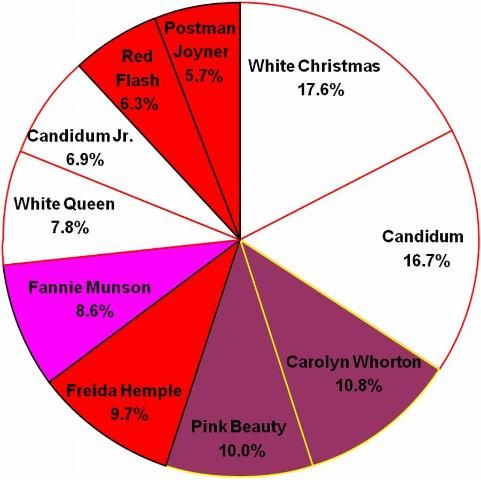
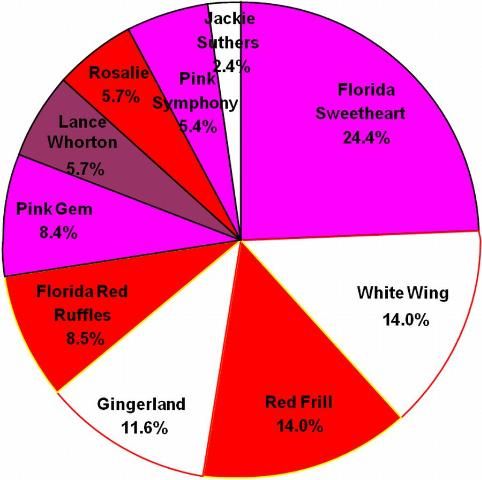
A total of 108 distinct cultivars were listed in the survey form. Respondent growers identified 92 cultivars as presently being grown (Table 1). Seventy-six and 16 of the currently grown cultivars were fancy and lance-leaved, respectively. The majority of growers each grew 20-30 cultivars while 35 of the 92 cultivars were exclusively grown by a single grower. Over 99% of the acreage currently utilized by the industry was used to propagate 53 cultivars. The top 10 fancy-leaved cultivars were 'White Christmas' (11.6% of the total fancy acreage), 'Candidum' (11.0%), 'Carolyn Whorton' (7.1%), 'Pink Beauty' (6.6%), 'Frieda Hemple' (6.4%), 'Fannie Munson' (5.7%), 'White Queen' (5.1%), 'Candidum Jr.' (4.6%), 'Red Flash' (4.2%), and 'Postman Joyner' (3.8%) (Figure 1). The top 10 lance-leaved cultivars were 'Florida Sweetheart' (26.8% of the total lance acreage), 'White Wing' (15.4%), 'Red Frill' (15.4%), 'Florida Red Ruffles' (9.4%), 'Pink Gem' (9.2%), 'Lance Whorton' (6.3%), 'Rosalie' (6.3%), 'Pink Symphony' (5.9%), 'Jackie Suthers' (2.6%), and 'White Knight' (1.3%) (Figure 2).


Figure 1. Top 10 fancy cultivars as a percentage of total fancy cultivar acreage.


Figure 2. Top 10 lance-leaved cultivars as a percentage of the total lance acreage.

Literature cited

Bell M.L., G.J. Wilfret, and D.A. DeVoll. 1998. Survey of caladium tuber producers for acreage of cultivars grown. Proceedings of the Florida State Horticultural Society 111:32-34.

Wilfret, G.J. and G.T. Hurner Jr. 1982. A survey of caladium cultivars grown in Florida and their characteristics as potted plants. Proceedings of the Florida State Horticultural Society 95:190-194.

Tables

Table 1. Acreage and overall rank of caladium cultivars grown in Florida.

Cultivar


Leaf shape


Leaf color


Acreage


Overall rank


Aaron

Fancy


White


40.8


12


Ace of Hearts

Fancy


Pink


<0.1


-


Apple Blossom

Fancy


Pink


<0.1


-


Attala

Fancy


Pink


<0.1


-


Autumn Beauty

Fancy


Novelty


<0.1


-


Big Red

Fancy


Red


0.2


-


Blaze (= Dr. T.L. Meade)

Fancy


Red


9.6


34


Brandywine (=Irane Dank)


Fancy


Red


13.0


24


Buck

Fancy


Red


10.9


28


Candidum

Fancy


White


120.6


2


Candidum Jr.

Fancy


White


50.0


8


Carolyn Jane

Fancy


Pink


<0.1


-


Carolyn Whorton

Fancy


Pink


77.7


3


Crescent Queen

Fancy


Novelty


<0.1


-


Crimson Wave

Fancy


Pink


0.1


-


Dawn (=Day Break)

Fancy


Pink


0.1


-


Dr. Groover

Fancy


Pink


1.0


53


Edith Meade

Fancy


Pink


<0.1


-


Elizabeth Lou

Lance


Pink


<0.1


-


Etta Moore


Lance


Novelty


<0.1


-


Fannie Munson

Fancy


Pink


61.8


6


Festivia

Fancy


Red


2.7


44


Fire Chief

Fancy


Pink


24.3


17


Fire Nymph

Fancy


Red


<0.1


-


Florida Beauty

Fancy


Pink


0.6


-


Florida Blizzard

Fancy


White


0.5


-


Florida Calypso

Fancy


Novelty


2.5


46


Florida Cardinal

Fancy


Red


37.5


13


Florida Elise

Fancy


Pink


11.6


27


Florida Fantasy

Fancy


Novelty


9.7


33


Florida Irish Lace

Lance


Novelty


<0.1


-


Florida Moonlight

Fancy


White


0.2


-


Florida Red Ruffles

Lance


Red


15.0


21


Florida Roselight

Fancy


Pink


6.5


38


Florida Sunrise

Fancy


Novelty


9.7


33


Florida Sweetheart

Lance


Pink


42.7


10


Cultivar


Leaf shape


Leaf color


Acreage


Overall rank


Florida White Ruffles

Lance


White


0.4


-


Florida Whitewater

Lance


White


1.9


48


Fred Bause

Fancy


Red


<0.1


-


Frieda Hemple

Fancy


Red


69.8


5


Galaxy

Fancy


White


1.2


51


Gingerland


Fancy


Novelty


20.2


20


Grey Ghost


Fancy


White


7.1


37


Gypsy Rose

Fancy


Pink


4.1


40


Ivory

Fancy


White


<0.1


-


Jackie Suthers

Lance


White


4.1


41


Jesse Thayer

Fancy


<0.1


-


John Peed

Fancy


Red


22.6


18


Jubilee

Fancy


Novelty


0.1


30


June Bride

Fancy


White


9.8


32


Kathleen

Fancy


Pink


10.5


29


Lance Whorton

Lance


Novelty


10.1


30


Lee Stokes

Fancy


Pink


<0.1


-


Lord Derby

Fancy


Pink


1.7


50


Madam Truall

Fancy


Pink


<0.1


-


Marie Moir


Fancy


Novelty


1.2


52


Miss Chicago

Fancy


Pink


0.1


-


Miss Louisiana

Fancy


Pink


0.1


-


Miss Muffet

Fancy


Novelty


22.2


19


Mrs. Arno Nehrling

Fancy


Novelty


14.0


23


Mrs. F. Sanders

Fancy


Pink


<0.1


-


Mrs. F.M. Joyner

Fancy


Pink


3.8


42


Mrs. W.B. Halderman

Fancy


Pink


1.7


49


New John Peed

Fancy


Red


<0.1


-


Pink Beauty

Fancy


Pink


72.0


4


Pink Cloud

Fancy


Pink


11.9


25


Pink Gem

Lance


Pink


14.6


22


Pink Glow

Fancy


Pink


<0.1


-


Pink Symphony

Lance


Pink


9.4


35


Poecile Anglais

Fancy


Red


11.8


26


Postman Joyner

Fancy


Red


41.4


11


Cultivar


Leaf shape


Leaf color


Acreage


Overall rank


Pothos

Fancy


Novelty


<0.1


-


Red Flare

Fancy


Novelty


<0.1


-


Red Flash

Fancy


Red


45.6


9


Red Frill

Francy


Red


24.5


16


Rosalie

Lance


Red


10.0


31


Rosebud

Fancy


Pink


33.8


14


Royal White Robe

Fancy


White


<0.1


-


Ruby Smith

Fancy


Red


<0.1


-


Scarlet Beauty

Fancy


Red


9.0


36


Scarlet Pimpernell

Fancy


Red


2.8


43


Sea Gull

Fancy


White


<0.1


-


Texas Beauty

Fancy


Red


0.1


-


Tom Tomlinson

Fancy


Pink


5.9


39


Torchy

Fancy


Red


0.5


-


Triumph de L' Exposition

Fancy


Novelty


<0.1


-


White Christmas

Fancy


White


126.6


1


White Knight (=Lady of Fatima)

Lance


White


2.0


47


White Princess

Lance


White


<0.1


1


White Queen

Fancy


Novelty


56.0


7


White Wing


Lance


White


24.5


15


Zo Munson

Fancy


Pink


<0.1


-


Footnotes

1. This document is ENH1007, one of a series of the Environmental Horticulture Department, Florida Cooperative Extension Service, Institute of Food and Agricultural Sciences, University of Florida. Original publication date August 8, 2005. Visit the EDIS Web Site at http://edis.ifas.ufl.edu.

2. Z. Deng, assistant professor; B.K. Harbaugh, professor, Environmental Horticulture Department, Gulf Coast Research and Education Center; R.K. Schoellhorn, associate professor, Environmental Horticulture Department, University of Florida; R.C. Andrews, horticultural extension agent, Highlands County Cooperative Extension Service, IFAS, University of Florida, Gainesville, FL 32611.


The Institute of Food and Agricultural Sciences (IFAS) is an Equal Opportunity Institution authorized to provide research, educational information and other services only to individuals and institutions that function with non-discrimination with respect to race, creed, color, religion, age, disability, sex, sexual orientation, marital status, national origin, political opinions or affiliations. For more information on obtaining other extension publications, contact your county Cooperative Extension service.

U.S. Department of Agriculture, Cooperative Extension Service, University of Florida, IFAS, Florida A. & M. University Cooperative Extension Program, and Boards of County Commissioners Cooperating. Larry Arrington, Dean.