
Description and Use
Gardenias are prized for their very fragrant white flowers and glossy, dark green leaves (Figure 1). This fact sheet provides a brief look at this popular plant. Many cultivars of Gardenia jasminoides exist that offer considerable variation in plant size, flower form, and blooming time and duration. Good performers for Florida include 'Miami Supreme', 'Mystery', and 'Belmont' (larger blooms; spring flowering), 'Mary Ann' and 'Aimee' (big flowers; later blooming), 'Veitchii' (compact plant with small flowers produced 2–3 times/year), and 'Radicans' (dwarf form 20–24 inches tall). Other popular cultivars are 'Frostproof', 'August Beauty', and the single-flowered 'Viet Nam' which blooms 7 months/year. Depending on their size and form, gardenias can be used as container plants, hedges, ground covers, mass plantings, or free-standing specimens. Enjoy their fragrance indoors and out by planting them near patios, doors, or windows.
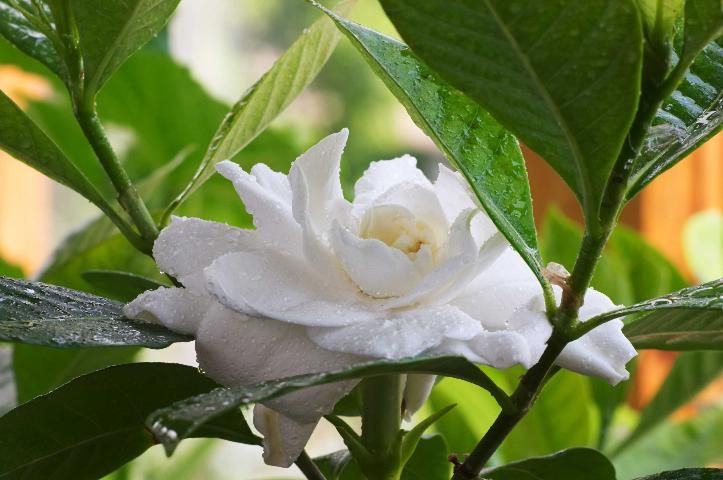
Credit: Igor Zhorov/Hemera/Thinkstock, © Igor Zhorov
In Florida, gardenias are grown on their own root systems ("own root") or grafted on Gardenia thunbergia—a nematode-resistant rootstock. Grafted plants are usually more vigorous and produce more and larger flowers than "own root" plants, but they are not cold hardy below 28°F.
Cultural Requirements
Light
For best flower production, plant gardenias in full sun, partial shade, or shifting shade. Prolonged shade may reduce flowering. Gardenias do not tolerate coastal conditions or water with high salts (e.g., water from water softeners, or irrigation water from certain reclaimed water systems or salt-intruded wells).
Soil
Gardenias grow in a variety of soil conditions in Florida, but they do best in well-drained soil amended with organic matter. An acidic soil pH between 5.0 and 6.5 is required or their foliage will yellow. Your local UF/IFAS Extension office can provide information on how to take a soil sample and have it analyzed for pH: https://sfyl.ifas.ufl.edu/find-your-local-office/.
Fertilization
Most established gardenias grow well with two or three applications of fertilizer per year. Applications are normally scheduled around February and October (south Florida) or March and September (north Florida). A third application may be made during the summer.
A granular fertilizer formulated for landscape plants or an "acid-forming" product is suitable. Follow label directions. Ideally, 30%–50% of the nitrogen should be slow-release. In south Florida, or where soil potassium is inadequate, a fertilizer containing 30%–50% slow-release potassium should be used.
Pruning
Gardenias only need to be pruned to keep them full, well-shaped, and in scale with the landscape. Pruning should be done just after the plant finishes blooming (usually mid-summer). Vigorously growing plants can be lightly pruned and shaped up throughout the summer; however, hard pruning after October 1 will decrease next year's blooms.
Problems
Yellowing Leaves
Yellow and dropping older leaves are normal, especially in early spring and fall. If new leaves become yellow (chlorotic), a deficiency of a micronutrient—usually iron—is often the cause. The primary problem causing the deficiency may be related to soil pH (the soil may not be acidic enough for gardenias) or root dysfunction due to nematode or disease infestation. Soil pH, nematodes, and diseases are difficult to correct, so the best approach is to supply the nutrient in an acid-forming fertilizer or as a foliar spray.
Insects
Many insect pests attack gardenias in Florida and often warrant control. The most injurious insects include scales, aphids, spider mites, flower thrips, and whiteflies. Fortunately, these pests can be managed with environmentally safe insecticides like soap and oil sprays. Refer to https://hgic.clemson.edu/factsheet/gardenia-insects-related-pests/ and contact your local UF/IFAS Extension office for information on pest management: https://sfyl.ifas.ufl.edu/find-your-local-office/.
Black Sooty Mold
Sooty mold is a black, smut-like substance that grows in the sugary secretion of sucking insects such as aphids, scales, mealybugs, and whiteflies. Sooty mold is best managed by controlling these insects. Check with your local UF/IFAS Extension office for the safest and most effective recommendations on pest management.
Nematodes
These microscopic pests attack the roots and cause premature wilting of the leaves and overall loss of vigor. No chemical treatments are currently available for nematode infestations on landscape plantings. The best practices are to plant gardenias that are grafted on resistant rootstock (in central and south Florida) and to apply a 3-inch-thick layer of organic mulch.
Bud Drop
Numerous stresses cause green, unopened flower buds to drop. Dry, hot, or unusually cool weather, pests such as nematodes and flower thrips, or cultural problems such as too much fertilizer or poor drainage can all contribute to bud drop. Flower thrips also feed on open flowers, causing them to brown prematurely.
Propagation
Gardenia can be propagated from cuttings, air layers, or by grafting. Softwood tip cuttings can be taken any time during the year, but rooting is usually most successful in June, July, and August. Use a rooting hormone and root cuttings under continuous or intermittent mist, or in a pot covered with a plastic bag for 6–8 weeks. The rooting media should be a 50:50 combination of clean, sharp builders' sand and peat moss; or a 50:50 combination of peat moss and perlite.
Air layering is another technique for propagating Gardenias. It involves starting a new plant while it is still attached to the parent plant and results in a larger cutting which can then be potted up. Refer to the following for detailed instructions:
https://blogs.ifas.ufl.edu/clayco/2018/02/20/propagation-methods-air-layering/#:~:text=How%20to%20Air%20Layer,heart%20wood%20of%20that%20branch.&text=Step%202%3A%20Wrap%20sphagnum%20moss,aluminum%20foil%20or%20plastic%20wrap.&text=Step%203%3A%20Secure%20the%20area%20of%20foil%20with%20string%20or%20wire.
To graft a gardenia for planting in south and central Florida, take a cutting of a desired cultivar (scion) and graft it to a rooted cutting or seedling of Gardenia thunbergia (rootstock). This rootstock should be approximately 6 inches tall and pencil-thick. The most successful grafts are the splice-graft and inverted saddle graft. More information on budding and grafting can be found in Propagating Fruit Crops in Florida (SP171), a for-sale booklet from the UF/IFAS Extension Bookstore (http://ifasbooks.ifas.ufl.edu/).
Reference
Gardenia Insects & Related Pests. HGIC 2059. Home and Garden Information Center—Clemson University. https://hgic.clemson.edu/factsheet/gardenia-insects-related-pests/