
White Butterfly™ was released initially in 2008 under the name 'UF-340'. White Butterfly™ develops a large number of wide lance leaves with a large bright-white center surrounded by green margins.
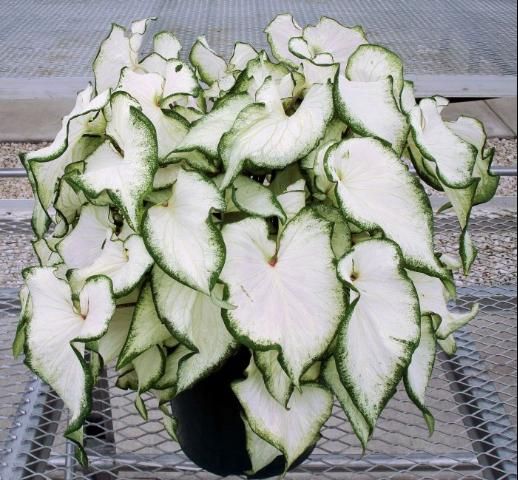
Credit: Zhanao Deng, UF/IFAS
Its performance in container forcing and landscape use is also improved in comparison to other white lance-leaved varieties (e.g., 'Florida White Ruffles' and 'White Wing'). In tuber yield, both of these varieties were similar to or better than the currently available commercial white lance-leaved varieties. White Butterfly™ produces multi-branched tubers that do not require de-eyeing for container forcing.
Origin
White Butterfly™ was developed from a cross between 'Florida Moonlight' and 'Florida Sweetheart'.
Description
White Butterfly™: Leaves are lance-shaped and have a white penniform venation. The central and main veins and the interveinal areas are white, and the margins are green (Figure 1). Plants grown for approximately four months in full sun in ground beds had an average height of 10.5 inches. Jumbo-size tubers (2½–3½ inches in diameter) are multi-branched and bear five to nine dominant buds.
Tuber Production
White Butterfly™ was evaluated for tuber production at the UF/IFAS Gulf Coast Research and Education Center in Wimauma, FL, in 2006 and 2007. The soil was fine sand containing approximately 1 percent organic matter and having a pH of 6.2. In 2006, raised ground beds (32 inches wide and 8 inches high) were fumigated with a mixture of methyl bromide and chloropicrin at the rate of 175 lb per acre and covered with white-on-black plastic mulch. Caladium seed pieces (tuber pieces) were planted in the beds with 6-inch spacing between rows and in rows. A constant water table was maintained below the beds, using the seepage irrigation system. Osmocote controlled-release fertilizer (18-6-12, eight to nine months) was applied to the bed surface when shoots were emerging from the soil and the rate was 300 lb nitrogen per acre. In 2007, the beds (28 inches wide and 8 inches high) were fumigated using the same fumigant mixture. Caladium seed pieces were planted with 10-inch between-row spacing and 6-inch in-row spacing. A drip irrigation system was used to provide water (approximately 6 mm per day) and fertilizer (6-2-8 soluble fertilizer, an average of approximately 1.7 lb nitrogen per acre per day and a total of 259 lb per acre per growing season).
Thirty seed-tuber pieces were planted in each plot in April 2006 and April 2007, and tubers were harvested in Dec. 2006 and Jan. 2008, respectively. Tubers were graded by their maximum diameter: No. 2 (1–1½ inches), No. 1 (1½–2½ inches), Jumbo (2½–3½ inches), Mammoth (3½–4½ inches), and Super Mammoth (more than 4½ inches).
A production index was calculated for each plot as follows: number of No.2 tubers x 1 + number of No. 1 tubers x 2 + number of Jumbo tubers x 4 + number of Mammoth tubers x 6 + number of Super Mammoth tubers x 8. 'Florida White Ruffles', 'White Wing' (the two major white, lance-leaved varieties) and 'Candidum Junior' (a semi-dwarf, fancy-leaved variety that had a similar venation and coloration pattern) were included in the field trials as checks.
The tuber weight of White Butterfly™ was lower than that of 'White Wing', but was similar to that of 'Florida White Ruffles' and 'Candidum Junior' in 2006 (Table 1). In 2007, the average tuber weight of White Butterfly™ was 67–289 percent greater than that of the three checks. The production index of White Butterfly™ was similar to that of 'Florida White Ruffles' and 'White Wing', but 22 percent greater than that of 'Candidum Junior' in 2006. In 2007, White Butterfly™ was 1.2-fold to 2.8-fold greater than the commercial checks. In both 2006 and 2007, White Butterfly™ consistently produced the greatest number of marketable tubers, significantly higher than any of the checks. The majority of the tubers produced by White Butterfly™ were in the No. 1, No. 2, and Jumbo categories, with few in the Mammoth size category.
Container Forcing and Performance
The suitability for container forcing was evaluated by forcing tubers in 4½-inch containers. No. 1 tubers were planted either intact or de-eyed in a peat/vermiculite mix on 26 March 2007. The trial was conducted in a greenhouse with 45 percent light exclusion in Wimauma, FL. Daily temperatures in the greenhouse were from 60°F to 84°F during the trial. 'Florida White Ruffles', 'White Wing', and 'Candidum Junior' were included as checks.
White Butterfly™ sprouted 26 (intact) to 28 (de-eyed) days after planting, four to seven days earlier than the checks, regardless of tuber treatments (Table 2). White Butterfly™ was similar to 'Florida White Ruffles' and 'White Wing' in height when tubers were intact or de-eyed. White Butterfly™ produced a similar number of leaves as 'Florida White Ruffles' and 'Candidum Junior', but nearly twice as many leaves than all three checks when tubers were de-eyed. White Butterfly™ produced high-quality plants in small pots (4½ inches in diameter) even without de-eyeing (Table 2). When tubers were de-eyed, White Butterfly™ plants were of even higher quality.
Landscape Performance
Landscape performance was evaluated in 2006 and 2007 on the same plots used for evaluating tuber production. The overall plant performance was rated multiple times (July, August, and September) in each growing season, on a scale of 1–5, with 1 being very poor (few leaves and lack of vigor), and 5 being excellent (full plants, numerous leaves, and bright color display). Similarly, leaf tolerance to sunburn was also evaluated multiple times in each growing season on a scale of 1–5, with 1 being very susceptible to sunburn and showing numerous sun-damaged areas or holes on leaves and 5 being resistant to sunburn and not showing any sun-damaged areas.
White Butterfly™ was 10.6 inches tall, similar to 'White Wing' (9.4 inches tall), but taller than 'Florida White Ruffles' (7 inches, a very prostrate variety). (See Table 3). White Butterfly™ was shorter than 'Candidum Junior', a semi-dwarf fancy-leaved variety. White Butterfly™ produced the greatest number of leaves (33), exceeding both 'Florida White Ruffles' (27) and 'White Wing' (20). Leaves of White Butterfly™ were similar to those of 'White Wing' in length, but longer than those of 'Florida White Ruffles' and wider than both varieties. The performance ratings of White Butterfly™ were 3.9–4.4, higher than that of 'Florida White Ruffles' and 'White Wing'.
Recommendation
White Butterfly™ is intended for use in containers and landscapes. Its performance was outstanding both in pots and landscapes and superior to 'Florida White Ruffles', 'White Wing', and 'Candidum Junior'. De-eyeing is not required but can help produce shorter potted plants with more leaves. White Butterfly™ performs better in partially shady locations.
Availability
A plant patent was issued by the United States Patent and Trademark Office for White Butterfly™ (PP21,347) and the plant patent right was assigned to the Florida Foundation Seed Producers, Inc. Propagation and distribution will be licensed by the Florida Foundation Seed Producers, Inc., PO Box 110200, Gainesville, FL 32611. Information on tuber availability and propagation agreements can be obtained from the Florida Foundation Seed Producers, Inc. (http://ffsp.net/).
References Cited
Deng, Z., B.K. Harbaugh, and N.A. Peres. 2008. "'UF-331' and 'UF-340' - New Dwarf Caladium Cultivars for Landscape and Pot Plants." HortScience 47(7):2231-2235.
Wilfret, G.J. 1991. Florida Sweetheart, a Rose Lance Caladium for Landscape and Containers. Circ. S-380. Gainesville: University of Florida Institute of Food and Agricultural Sciences.
Tables
Tuber weight, production index, and tuber grade distribution of caladium varieties harvested in 2006 and 2007. Values presented are means of three replications with 30 propagules per 13.5-square-foot plot per year.
Plant performance for caladium varieties grown from No. 1 tubers in 4½-inch containers in a 50-percent-shaded greenhouse, 2007, Wimauma, FL. Values represent the means of 10 plants produced from intact or de-eyed No. 1 (>1½ and <2½ inches in diameter) tubers planted individually per container.
Plant characteristics, performance, and sun tolerance from planting 1-inch caladium tuber propagules in ground beds in full sun (2006 and 2007). Values presented for plant height, leaf number, length and width are means of three replications with three plants measured per plot per year. Ratings of performance and sunburn tolerance are means of three replications based on whole-plot evaluation.


