
This document is a part of a series originally written by Edward F. Gilman.
Introduction
Chenille plant is a vigorous, upright, coarse-textured shrub with a height of 4 to 6 feet (Figure 1). Older specimens can grow taller with some support. The stems are heavily foliated with 6- to 8-inch-long ovate medium-green leaves (Figure 2). The showy red flowers of chenille plant are attractive and droop in cattail-like, narrow pendent clusters up to 18 inches in length (Figure 3). Chenille plant flowers year-round, with peak flowering season during the summer. This plant is dioecious—only the female plant produces the notable flowers; however, the plants grown and available in the horticultural trade are all female.
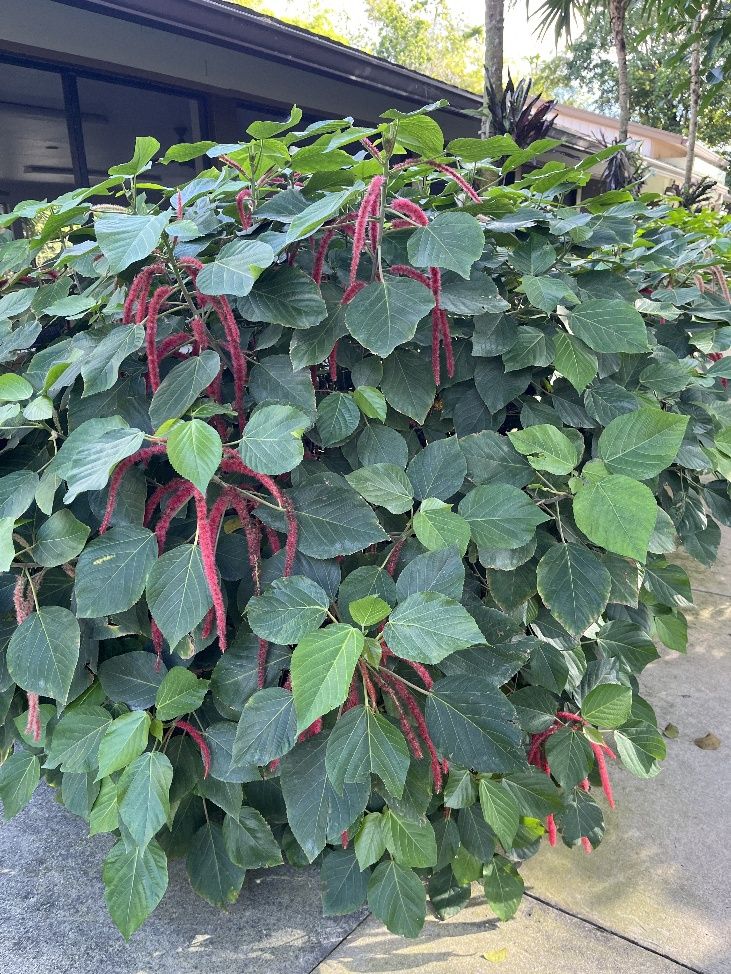
Credit: Keighly Graves, UF/IFAS
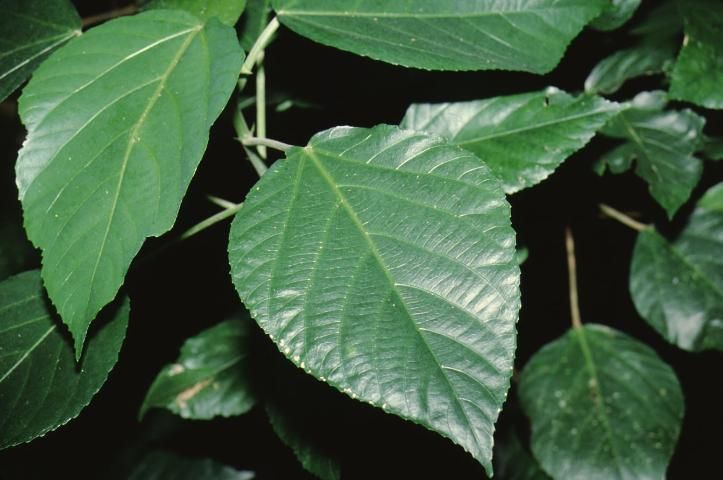
Credit: UF/IFAS
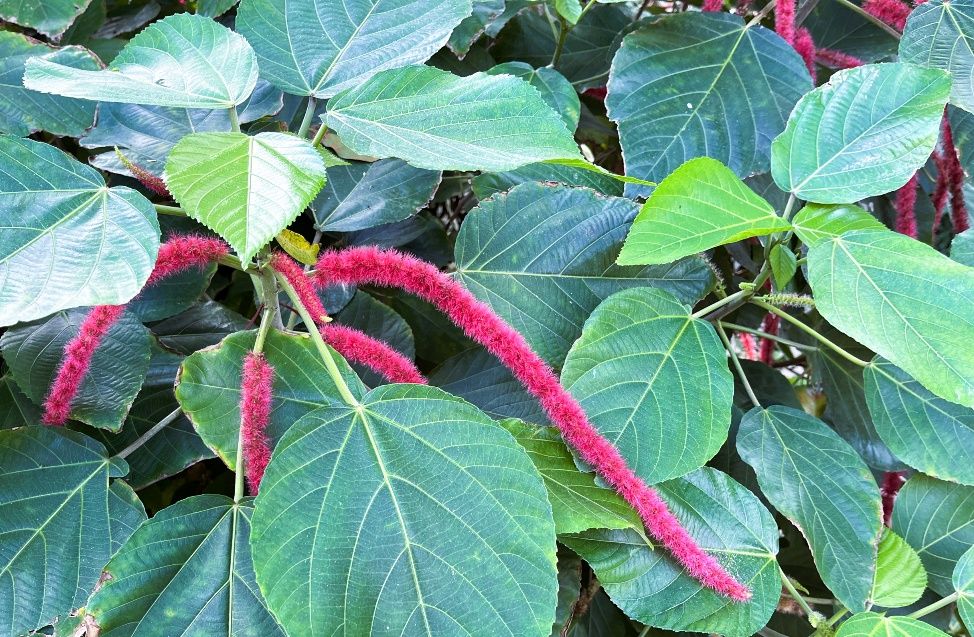
Credit: Keighly Graves, UF/IFAS
General Information
Scientific name: Acalypha hispida
Pronunciation: ack-uh-LIFE-uh HISS-pid-uh
Common name(s): chenille plant; foxtail; red-hot cattail
Family: Euphorbiaceae
Plant type: shrub
USDA hardiness zones: 9B through 11B (Figures 4 and 5)
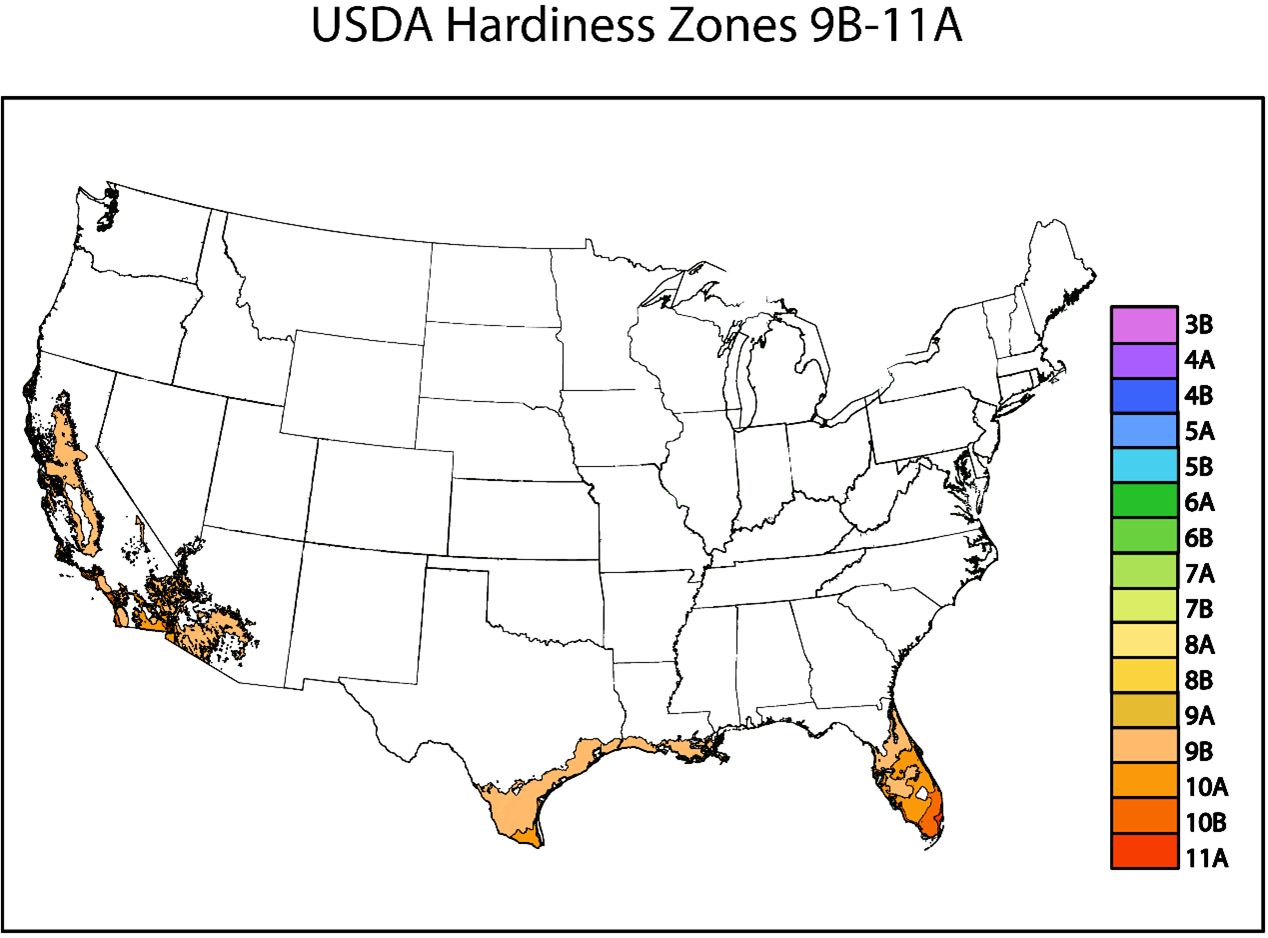
Credit: This map is based on the 2023 USDA Plant Hardiness Zone Map. Visit https://planthardiness.ars.usda.gov/ for specific zone information.
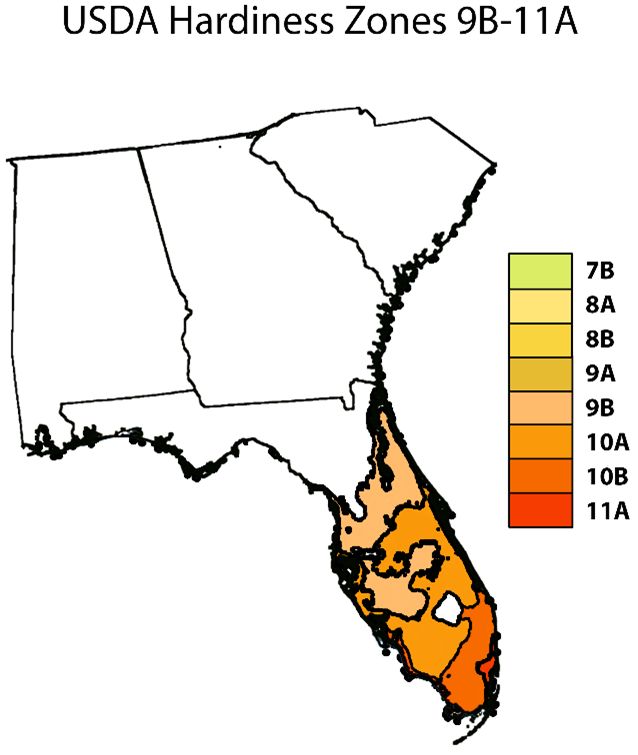
Credit: This map is based on the 2023 USDA Plant Hardiness Zone Map. Visit https://planthardiness.ars.usda.gov/ for specific zone information.
Planting month for zone 9B: year-round
Planting month for zones 10 and 11: year-round
Origin: not native to North America
Invasive potential: not known to be invasive
Uses: hedge; specimen; foundation; border; mass planting; accent
Availability: somewhat available, may have to go out of the region to find the plant
Description
Height: 4 to 6 feet
Spread: 6 to 8 feet
Plant habit: upright; spreading
Plant density: moderate
Growth rate: fast
Texture: coarse
Foliage
Leaf arrangement: alternate
Leaf type: simple
Leaf margin: serrate
Leaf shape: ovate
Leaf venation: pinnate; arcuate
Leaf type and persistence: evergreen
Leaf blade length: 4 to 8 inches
Leaf color: green
Fall color: no fall color change
Fall characteristic: not showy
Flower
Flower color: red
Flower characteristic: year-round flowering; showy long drooping red blooms; up to 18" in length
Fruit
Fruit shape: no fruit
Fruit length: no fruit
Fruit cover: no fruit
Fruit color: no fruit
Fruit characteristic: no fruit
Trunk and Branches
Trunk/bark/branches: typically multi-trunked or clumping stems; not particularly showy
Current year stem/twig color: green
Current year stem/twig thickness: medium
Culture
Light requirement: plant grows in full sun; plant grows in partial shade
Soil tolerances: acidic; slightly alkaline; sand; loam; clay
Drought tolerance: moderate
Soil salt tolerance: poor
Plant spacing: 36 to 60 inches
Other
Roots: usually not a problem
Winter interest: plant has winter interest due to unusual form and winter flowers
Pest resistance: long-term health usually not affected by pests
Use and Management
The chenille plant is a beautiful flowering shrub that is commonly used as an accent, hedge, specimen, or container plant. Its long period of bloom makes it a showy centerpiece for any tropical or subtropical garden. It is well suited for a container planting near a deck or patio.
This plant performs well in many types of well-drained landscape soils. It grows and flowers best in full sun, with little care other than irrigation needed to maintain the plant once it is established. After the plant finishes flowering, pruning may be needed to keep it to the desired size.
Propagation is by cuttings.
Design Considerations
The long red flowers of the chenille plant are a striking feature that can be used to bring color to a shrub border. Red shows best in full sun when paired with other shrubs with white and pink flowers to make the red look more intense. Shrubs with dark green glossy leaves would also contrast well with the leaves of the chenille plant. Foreground plants could include purple and white flowers and fine or medium textures such as narrow strap blades in a clumping form, or tall spiky forms with narrow leaves.
Pests and Diseases
Scales, mites, whitefly, and aphids may be troublesome pests in some landscapes, especially when the plants are grown in partial shade. No diseases of major concern.