
This is one in a series of fact sheets discussing common foodborne pathogens of interest to food handlers, processors, and retailers. For related publications, visit https://edis.ifas.ufl.edu/topic_foodborne_illness.
What causes an E. coli O157:H7-associated foodborne illness?
According to the Centers for Disease Control and Prevention (CDC) Escherichia coli or E. coli is a bacterium from the family Enterobacteriaceae usually found in the digestive system of healthy humans and warm-blooded animals and transmitted by oral-fecal route. (Meng et al. 2007; CDC 2015). There are hundreds of known E. coli strains, with E. coli O157:H7 being the most recognized (CDC 2016a). This is a shiga-toxin-producing E. coli (or STEC) strain that is responsible for an estimated 265,000 cases of infection and 30 deaths in the United States annually and causes approximately $255 million in losses each year (CDC 2016a). E. coli can be isolated from the environment but is mostly found in animals, including human digestive systems and residues from those systems (fecal materials). It is important to thoroughly wash (preferable with soap and/or sanitizing agent) anything that comes into contact with animals and/or surfaces they contact. It is also currently associated with fresh produce such as leafy greens. Poimenidou et al. (2016) reported a high reduction of E. coli O157:H7 when vegetables were washed with vinegar (6% acetic acid) for 2–5 mins.
Based on reports from the CDC (2017), E. coli O157:H7 outbreaks are not limited to any particular type of food. In the last 10 years, there have been outbreaks associated with meats (cooked and raw), salads, cheese, nuts, pizza, and even cookie dough. This widespread contamination has caused a large effort by the scientific community to determine precisely how E. coli O157:H7 is perpetuated (CDC 2017).
While typically associated with meat products, lettuce and other leafy greens have often been associated with foodborne outbreaks linked to E. coli O157:H7. One of the largest outbreaks of E. coli O157:H7 was associated with fresh spinach in 2006. Almost 200 people in 26 states were sickened, 31 developed hemolytic uremic syndrome (HUS), and three people died (CDC 2013).
Credit: Aunt_Spray/iStock.com
Outbreaks associated with E. coli O157:H7
Recently, an outbreak linked to E. coli O157:H7 was reported by the CDC during summer to fall of 2016. The likely source of the outbreak was beef products from a slaughterhouse in Athol, MA (CDC 2016b). The outbreak was attributed to contaminated ground beef; however, veal and bison were also recalled. The outbreak led to 11 cases of foodborne illness, with ages ranging from 1 to 74 years old. Seven people were hospitalized, though no deaths were reported. One person was reported to have developed hemolytic uremic syndrome (HUS).
Additional E. coli O157:H7 Outbreaks
Fall 2015: an outbreak of E. coli O157:H7 was linked to a rotisserie chicken salad. The FDA investigated the regulated ingredients used in the chicken salad but did not identify a common source of contamination. The outbreak led to 19 cases in seven states. Two people developed HUS, but no deaths were reported (CDC 2015).
Fall 2013: an E. coli O157:H7 outbreak reported by the CDC was linked to ready-to-eat salads. Investigations revealed that the source of contamination came from a catering company in Richmond, CA. The outbreak led to 33 cases in four states. Seven people were hospitalized, and two people developed HUS. No deaths were reported (CDC 2013).
Fall 2012: an E. coli O157:H7 outbreak reported by the CDC was traced to pre-packaged leafy greens. Thirty-three people became ill, and two people developed HUS. However, no deaths were reported (CDC 2013).
What type of bacterium Is E. coli O157:H7?
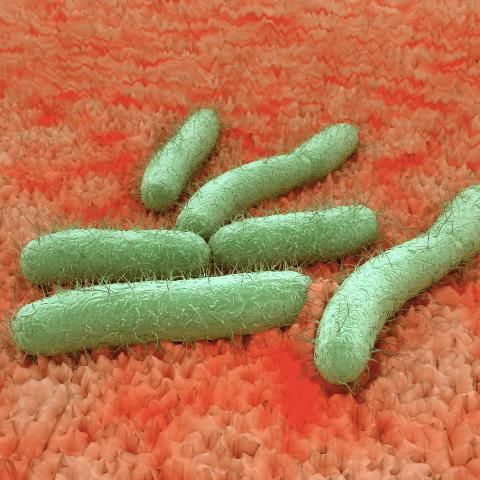
E. coli O157:H7 are Gram-negative rods that have been described as verocytotoxin-producing E. coli (VTEC) or enterohemorrhagic E. coli (EHEC) (CDC 2015). Most recently, the designation has been simplified to shiga-toxin-producing E. coli (STEC) in recognition of the similarities of the toxins produced by E. coli O157:H7 and Shigella dysenteriae (Fischer Walker et al. 2012; Murray et al. 2007). These potent toxins are the cause of severe damage to the intestinal lining of those infected. The toxins produced by E. coli O157:H7 are responsible for the symptoms associated with infection such as HUS, hemorrhagic colitis, and even death (Fischer Walker et al. 2012). The organism can survive at low temperatures and under acidic conditions, making it difficult to eradicate in nature (Paton and Paton 1998). The organism has a low infective dose and can be transmitted from person to person, as well as in food products (Besser et al. 2001).
How is the E. coli O157:H7 bacterium spread?
Sources of E. coli O157:H7 infections include undercooked or raw hamburgers, sheeps, pigs, goats, poultry, game meat, alfalfa sprouts, unpasteurized fruit juices, dry-cured salami, lettuce, cheese curds, unpasteurized or raw milk, contaminated water and ice, and person-to-person transmission (Armstrong et al. 1996; Kassenbord et al. 2004; Tilden et al. 1996). Fruits and vegetables can cause infection from contact with contaminated water. The most common source of infection is caused by consuming undercooked or raw meats (Armstrong et al. 1996; Tuttle et al. 1999). Because there appears to be a low infective dose for this organism (10–100 cells), adequate sanitation and/or proper processing of foods is critically important (Mathusa et al. 2010).
Symptoms of E. coli O157:H7 Infection
The acute disease associated with this organism is named hemorrhagic colitis. The symptoms characteristic to this disease are watery and/or bloody diarrhea, fever, nausea, severe abdominal cramping, and vomiting (Fischer Walker et al. 2012; Tarr 1995). Because most people recover from this infection on their own, treatment is usually not necessary. Symptoms can appear within hours or up to several days after ingestion of the bacteria, and the illness usually lasts 5–10 days. Some individuals may develop HUS. In the very young, this disorder can cause renal failure, hemolytic anemia, or even permanent loss of kidney function (Fischer Walker et al 2012; Tarr 1995). The elderly can develop these symptoms as well as thrombotic thrombocytopenic purpura (TTP) and HUS with additional neurological dysfunction and/or fever (Tarr 1995).
High-risk Populations for E. coli O157:H7 Infections
E. coli O157:H7 infections can be serious for healthy people of any age, but it is more likely to cause severe illness in young children, elderly, and immunocompromised patients (Tarr 1995). There is also a higher risk of infection for workers in certain industries; those working in slaughterhouses, farms, hospitals, nursing homes, nursery schools, and food preparation facilities are more susceptible to infection than the rest of the population (Kassenborg et al. 2004).
Minimizing the Risk of E. coli O157:H7 in Plants or Food Establishments
Sanitation Methods
Clean
Use hot, soapy water and a sanitizer to wash hands and surfaces that contact food often. Wash hands, cutting boards, dishes, and utensils after they come in contact with raw food. Do not use cutting surfaces that have been exposed to raw meat to process raw fruits or vegetables such as for salads. Clean liquid spills in the refrigerator, especially spills from products potentially associated with E. coli.
- Ensure employees wash hands before, during, and after handling any food, particularly raw meat and poultry.
- Sanitize all utensils, cutting boards, and work surfaces before and after use, using an approved sanitizing agent made for use on food or food contact surfaces.
- Clean food contact surfaces, such as refrigerator shelving, if they come in contact with possible sources of E. coli contamination.
- Wash all vegetables and fruits thoroughly before consumption.
Separate
Treat all ready-to-eat (RTE) foods, raw meat, poultry, and seafood as possible sources of contamination. Keep these foods separate from items that traditionally do not get cooked or potentially can be eaten raw, such as vegetables, fruits, breads, and other already-prepared, edible foods. This reduces the chance of cross-contamination.
- Use separate utensils for raw and cooked foods.
- Store meats and other potential sources of contamination in areas below foods that may be consumed raw.
- Rewrap open packages carefully or store in leak-proof containers to prevent cross-contamination.
Cook
Always heat foods to safe temperatures. The 2013 FDA Food Code recommends to heat food to an internal temperature of 145°F (63°C) or above for 15 seconds for most potentially hazardous foods (refer to Food Code 2013 Sections 3–4: Destruction of Organisms of Public Health Concern, Subparts 3-401 and 3-501 for specific details on cooking temperatures) (FDA 2013).
Currently, the best measures to control E. coli are proper cooking, preventing cross-contamination of raw and cooked food, proper personal hygiene, and good sanitation. Follow these recommendations to reduce the incidence of foodborne E. coli contamination:
- Do not store food in the temperature danger zone between 41°F (5°C) and 135°F (57°C) (FDA 2013). The refrigerator should be at 41°F (5°C) or colder. All food should be refrigerated promptly (FDA 2013).
Completely cook or boil foods, such as hot dogs, to 160°F (71°C) (USDA 2016b) and poultry products to 165°F (74°C) or above.
Storage
Limit the amount of time food is exposed to room temperature to 2 hours or less before returning perishables and RTE foods to the refrigerator or freezer.
- Cover all food to prevent cross-contamination.
- Place all cooked food in the refrigerator within one hour of cooking.
- Place uncooked meat, poultry, fish, or other raw products below cooked or RTE foods in the refrigerator to prevent cross-contamination.
- Maintain the refrigerator temperature at or below 41°F (5°C) and keep refrigerator clean.
- Follow the "use by" or "best by" dates on refrigerated items.
Good Practices for Food Product Receiving, Handling, Processing, and Storage
The FDA defines current Good Manufacturing Practices for food (CGMPs) in title 21 of the CFR (Code of Federal Regulations) part 117 (FDA 2017). These CGMPs outline the minimum required general sanitation practices in FDA-inspected food handling and processing facilities. It is recommended that more specific and stringent standard operating procedures (SOPs) be developed for individual facilities. In addition, the sanitation recommendations for food service and retail food facilities outlined in the FDA Food Code have been adopted into many state and local regulations (FDA 2013). Because of the variation in Food Code adoption, each facility should check with the appropriate state and/or local regulatory authority. The Florida Statues can be found online at http://www.leg.state.fl.us/statutes/. The Title 33, Chapter 509 specifies some of these regulations.
In addition to setting and following strict sanitation requirements in the facility, a retail establishment should also develop SOPs for receiving and storing food products and ingredients. If food processing is being done, appropriate controls and requirements should be established and strictly followed. The FDA 2013 Food Code outlines appropriate processing and cooking requirements for many food products processed in a retail facility. However, if a retail establishment processes certain high-risk food products (e.g., sushi, fresh juice, specialty meats, and others), additional controls and the issuance of a "variance" by the regulatory authority is required before processing can occur (FDA 2013). The growing retail practice of cooking/preparing/packaging foods traditionally processed in controlled plant environments raises safety concerns. Any processing of food at the retail level needs to be closely monitored.
As an establishment becomes cleaner, it becomes harder to detect foodborne pathogens. At this point, testing becomes more limited in its ability to prevent foodborne illness. This is why programs that promote and monitor the use of barriers and/or hurdles are so important. When instituted properly, these activities reduce the risk of foodborne illness. Nothing, with the exception of irradiation, can completely eliminate bacterial contamination. Since most consumers prefer a fresh product, programs should be implemented that reduce the probability of illness until it is minuscule.
Receiving
Specifications for receiving can be found in Section 3-202.11 of the 2013 Food Code. The following guidelines cover the basic points that should be addressed:
- Potentially Hazardous Food (PHF) should be at 41°F (5°C) or below when received, unless specified otherwise by law (e.g., milk, shellfish).
- Raw shell eggs should be received at an ambient air temperature of 45°F (7°C) or less.
- PHFs received hot should be at a temperature of 135°F (57°C) or above.
- PHF should be received with no evidence of temperature abuse, such as evidence of thawing.
Processing
One of the easiest ways to prevent foodborne illness is to ensure that foods are cooked thoroughly. It should be noted that certain foods typically served uncooked—raw eggs (used in Caesar salads, homemade mayonnaise, raw cookie dough, etc.) and fresh vegetables—would obviously not benefit from the cooking process. For these items, other factors such as sanitation, worker hygiene, and proper storage take on much greater importance.
- When using raw eggs in your recipes, purchase a pasteurized egg product.
- Cook eggs, fish, meat, or foods containing these items to an internal temperature of 145°F (63°C) or above for a minimum of 15 seconds.
- Cook ground meat products to an internal temperature of 155°F (68°C) or above for a minimum of 15 seconds.
- Cook poultry to an internal temperature of 165°F (74°C) or above for a minimum of 15 seconds.
- Reheat previously cooked material to an internal temperature of 165°F (74°C) and allow food to stand covered for 2 minutes.
Storage
Once a product has been received and/or processed, it will then be displayed or stored. There are some general guidelines governing these practices.
- Frozen food should remain frozen until it is used.
- If frozen food is displayed in a refrigerated case, the food should remain at 41°F (5°C) or below.
- Frozen food should be thawed at a temperature of 41°F (5°C) or below. Food can also be thawed under running water at a temperature of 70°F (21°C) or below, but make sure splatters from the water do not come in contact with food preparation areas. Lastly, the product can be thawed as part of the cooking process as specified under 3-401.11 or 3-401.12.
- Products must be cooled adequately. Refer to sections 3-501.14 and 3-501.15 of the 2013 Food Code.
- Hold cooked product above 135°F (57°C) while displaying and under 41°F (5°C) while storing. For reheated products, foods may be held at 130°F (54°C).
- Properly label all stored product.
Personal Hygiene
Wash your hands! The major cause of foodborne illness in retail establishments comes from poor personal hygiene, particularly improper hand washing. Unwashed hands can contaminate food. Although hands may look clean, the bacteria that cause illness are too small to be seen. Whenever you are preparing food or come in contact with items that are not part of the assembly process, rewash your hands. The same is true even when wearing gloves. There is no five-second rule when it comes to food safety! Millions of bacteria and other germs can be transferred on contact.
You should wash your hands in the following situations:
- before handling, preparing, or serving food;
- before handling clean utensils or dishware;
- after using the restroom;
- after touching your face, hair, cuts, or sores, particularly wiping hands on hair is to be avoided;
- after smoking, eating, or drinking;
- after handling raw meat, especially poultry;
- after touching unclean equipment, working surfaces, soiled clothing, soiled wiping cloths, etc.; and
- after collecting and/or taking out the garbage.
Your facility may have even stricter requirements you must comply with to ensure food safety.
What is the proper procedure for hand washing?
- Wet your hands with warm water.
- Apply soap and wash your hands for 20 seconds.
- Rinse and dry with a single-use paper towel.
- Use the paper towel to shut off the water.
References
Armstrong, GL, J Hollingsworth and JG Morris, Jr., 1996. "Emerging Foodborne Pathogens: Escherichia coli O157:H7 as a Model of Entry of a New Pathogen into the Food Supply of the Developed World." Epidemiologic Reviews 18(1): 29–51.
Besser, TE, BL Richards, DH Rice and DD Hancock. 2001. "Escherichia coli O157:H7 Infection of Calves: Infectious Dose and Direct Contact Transmission." Epidemiology and Infection 127: 555–560.
Centers for Disease Control and Prevention (CDC). 2017. "Reports of Selected E. coli Outbreak Investigations." Accessed February 27, 2017. https://www.cdc.gov/ecoli/outbreaks.html
Centers for Disease Control and Prevention (CDC). 2016a. "Escherichia coli (E. coli)." Accessed January 31, 2017. https://www.cdc.gov/ecoli/pdfs/cdc-e.-coli-factsheet.pdf
Centers for Disease Control and Prevention (CDC). 2016b. "Multistate Outbreak of Infections Linked to Beef Products Produced by Adams Farm (Final Update)." Accessed January 31, 2017: https://www.cdc.gov/ecoli/2016/o157h7-09-16/index.html
Centers for Disease Control and Prevention (CDC). 2015. "E. coli (Escherichia coli)". Accessed February 25, 2017. https://www.cdc.gov/ecoli/general/index.html
Centers for Disease Control and Prevention (CDC). 2015. "Multistate Outbreak of Shiga toxin-producing Escherichia coli O157:H7 Infections Linked to Costco Rotisserie Chicken Salad (Final Update)." Accessed January 31, 2017. https://www.cdc.gov/ecoli/2015/o157h7-11-15/index.html
Centers for Disease Control and Prevention (CDC). 2013. "Multistate Outbreak of Shiga toxin-producing Escherichia coli O157:H7 Infections Linked to Ready-to-Eat Salads (Final Update)." Accessed February 2, 2017. https://www.cdc.gov/ecoli/2013/O157H7-11-13/index.html
Centers for Disease Control and Prevention (CDC). 2009. "Multistate Outbreak of E. coli O157:H7 Infections linked to Eating Raw Refrigerated, Prepackaged Cookie Dough (Final Update)." Accessed Februay 26, 2017. https://www.cdc.gov/ecoli/2009/cookie-dough-6-30-2009.html
Centers for Disease Control and Prevention (CDC). 2007. "Multistate Outbreak of E. coli O157: H7 Infections Linked to Totino's and Jeno's Frozen Pizza (Final Update)." Accessed February 27, 2017. https://www.cdc.gov/ecoli/2007/jeno-pizza-11-1-2007.html
Fischer Walker CL, JA Applegate, and RE Black. 2012. "Haemolytic-Uraemic Syndrome as a Sequela of Diarrhoeal Disease." Journal of Health, Population and Nutrition 30(3): 257–261.
Food and Drug Administration (FDA). 2017. Code of Federal Regulations Title 21 - Part 117—Current Good Manufacturing Practice, Hazard Analysis, and Risk-Based Preventive Controls for Human Food. Accessed January 30, 2017: http://www.ecfr.gov/cgi-bin/text-idx?SID=242e99958fe0d430b7ab4c404b393bba&mc=true&node=pt21.2.117&rgn=div5
Food and Drug Administration (FDA). 2013. FDA 2013 Food Code. Accessed February 2, 2017. http://www.fda.gov/downloads/Food/GuidanceRegulation/RetailFoodProtection/FoodCode/UCM374510.pdf
Hoffmann, S, MB Batz, and JG Morris, Jr. 2012. "Annual Cost of Illness and Quality-Adjusted Life Year Losses in the United States due to 14 Foodborne Pathogens." Journal of Food Protection 75(7): 1292–1302.
Kassenborg, HD, CW Hedberg, M Hoekstra, MC Evans, AE Chin, R Marcus, DJ Vugia, et al. 2004. For the Emerging Infections Programs FoodNet Working Group, "Farm Visits and Undercooked Hamburgers as Major Risk Factors for Sporadic Escherichia coli O157:H7 Infection: Data from a Case-Control Study in 5 FoodNet Sites." Clinical Infectious Diseases 38, Suppl. 3: S271–278.
Keene, WE, JM McAnulty, FC Hoesly, LP Williams, Jr., K Hedberg, GL Oxman, TJ Barrett, MA Pfaller, and DW Fleming. 1994. "A Swimming-Associated Outbreak of Hemorrhagic Colitis Caused by Escherichia coli O157:H7 and Shigella sonnei." The New England Journal of Medicine 331(9): 579–584.
Meng J, MP Doyle, T. Zhao, S. Zhao. 2007. Enterohemorrhagic Escherichia coli. Food Microbiology: Fundamentals and Frontiers (3rd ed.). Washington: ASM Press.
Mathusa, EC, Y Chen, E Enache, and L Hontz. 2010. "Non-O157 Shiga Toxin-Producing Escherichia coli in Foods." Journal of Food Protection 73(9): 1721–1736.
Murray, PR, EJ Baron, JH Jorgensen, ML Landry, and MA Pfaller. 2007. (Eds.), Manual of Clinical Microbiology, 9th ed. (Washington: ASM Press).
Paton, JC, and AW Paton. 1998. "Pathogenesis and Diagnosis of Shiga Toxin-Producing Escherichia coli Infections." Clinical Microbiology Reviews 11(3): 450–479.
Poimenidou, SV, VC Bikouli, C Gardeli, C Mitsi, PA Tarantilis, GJ Nychas, and PN Skandamis. 2016. "Effect of single or combined chemical and natural antimicrobial interventions on Escherichia coli O157:H7, total microbiota and color of packaged spinach and lettuce." Internation Journal of Food Microbiology. 220: 6–18.
Tarr, PI. 1995. "Escherichia coli O157:H7: Clinical, Diagnostic, and Epidemiological Aspects of Human Infection." Clinical Infectious Diseases 20(1): 1–8.
Tilden, J Jr., A McNamara, C Custer, B Boesel, MA Lambert-Fair, J Majkowski, D Vugia, SB Werner, J Hollingsworth, and JG Morris, Jr. 1996. "A New Route of Transmission for Escherichia coli: Infection from Dry Fermented Salami." American Journal of Public Health 86(8): 1142–1145.
Tuttle, J, T Gomez, MP Doyle, JG Wells, T Zhao, RV Tauxe, and PM Griffin. 1999. "Lessons from a Large Outbreak of Escherichia coli O157:H7 Infections: Insights into the Infectious Dose and Method of Widespread Contamination of Hamburger Patties." Epidemiology and Infection 122: 185–192.
United States Department of Agriculture - Food Safety and Inspection Service (FSIS). 2016a. Ground Beef and Food Safety. Accessed January 31, 2017. https://www.fsis.usda.gov/wps/portal/fsis/topics/food-safety-education/get-answers/food-safety-fact-sheets/meat-preparation/ground-beef-and-food-safety/ct_index
United States Department of Agriculture - Food Safety and Inspection Service (FSIS). 2016b. Adams Farm Slaughterhouse Recalls Beef, Veal, And Bison Products Due To Possible E. coli O157:H7 Adulteration. Accessed January 31, 2017. https://www.fsis.usda.gov/wps/portal/fsis/topics/recalls-and-public-health-alerts/recall-case-archive/archive/2016/recall-087-2016-release
Additional Resources
"Current Good Manufacturing Practice in Manufacturing, Packing, or Holding Human Food," Title 21 Code of Federal Regulations, Pt. 117. 2017 ed. Accessed February 27, 2017. http://www.ecfr.gov/cgi-bin/text-idx?SID=69f4fb7c8b162638e11b1106d6a4e514&mc=true&tpl=/ecfrbrowse/Title21/21cfr117_main_02.tpl
"Regulation of Trade, Commerce, Investments, and Solicitations: Lodging and Food Service Establishments," Title 33 Florida Statutes, ch. 509. 2012. Accessed February 27, 2017. http://www.leg.state.fl.us/statutes/
U.S. Food and Drug Administration. 2012. Bad Bug Book: Escherichia coli O157:H7. Washington, D.C.: U.S. Department of Health and Human Services, Food and Drug Administration. Accessed February 27, 2017. http://www.fda.gov/food/foodborneillnesscontaminants/causesofillnessbadbugbook/default.htm
Centers for Disease Control and Prevention, "E. coli (Escherichia coli)," National Center for Emerging and Zoonotic Infectious Diseases, Division of Foodborne, Waterborne, and Environmental Diseases, Accessed February 27, 2017. http://www.cdc.gov/ecoli/