
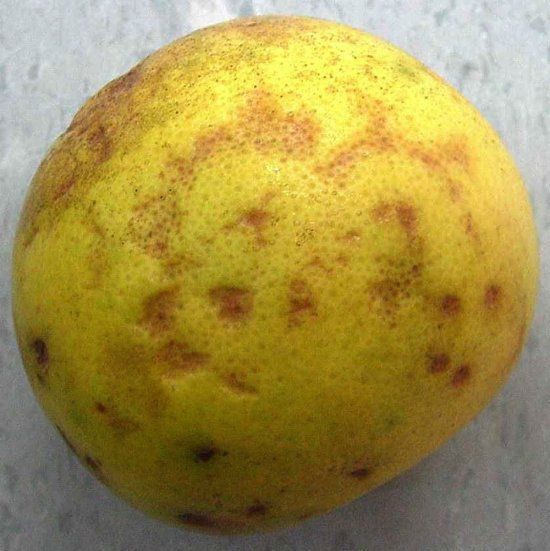
Chilling injury (CI) is a physiological disorder that is occasionally reported on fresh citrus shipments from Florida. It is most often characterized by areas of the peel that collapse and darken to form pits (Figure 1). Pitting is not targeted to the oil glands. Less severe symptoms may show up as circular or arched areas of discoloration or scalding. Symptoms of CI are typically more pronounced after fruit are warmed to room temperature following exposure to the chilling temperature. CI symptoms generally require at least 3 to 6 weeks to develop at low (e.g. 40°F) shipping and storage temperatures. Chilled fruit are also more susceptible to decay than are non-chilled fruit. CI is often confused with another physiological disorder called postharvest pitting (PP) that is caused by low-oxygen concentrations (< 9%) within waxed fruit and is visible as collapsed oil glands. PP requires only 2 to 4 days for symptom development after waxing and appears in fruit held at warm (> 50°F) temperatures.
Packers and shippers should keep in mind several factors that influence if and to what degree grapefruit develop CI.
Temperature Effects on CI
Depending on other predisposing factors, grapefruit storage and shipment below 50°F can cause severe CI. Studies show that CI is most severe when fruit are stored at temperatures from 38°F to 40°F compared with storage at higher or lower temperatures. Though holding fruit at temperatures above 50°F greatly reduces the potential for CI, it can also lead to the development of severe PP in waxed fruit. Thus, storage of waxed grapefruit at 45°F may often represent the best compromise to minimize the occurrence of both disorders. Preconditioning fruit for 7 days at 60°F can greatly reduce CI, but this may promote severe PP if fruit are preconditioned after the wax application. The conditions fruit experience during degreening can reduce grapefruit susceptibility to CI.
Time of Season
In Florida's climate, fruits are most susceptible to CI early (October–December) and late (March–May) in the season. The fruit usually become more resistant to CI during mid-season (December-March), but the specific time of year when the fruit become resistant fluctuates from season to season.
Intermittent Warming
Though intermittent warming (e.g. warming fruit to room temperature 1 day a week) has been reported to reduce CI development, it is usually not practical with large quantities of fruit under commercial conditions.
Relative Humidity
High relative humidities (e.g. > 95%) reduce the development of CI symptoms by reducing water loss from the fruit. Water loss dehydrates the cells resulting in their collapse and the development of pitting associated with CI.
Waxing and Modified Atmospheres
Storing citrus fruit in low O2 (possibly not effective for grapefruit) or high CO2 concentrations (e.g. 10%) reduces CI. Increased CO2 generated by the use of semipermeable film packages sometimes reduce CI, but the effect disappears on grapefruit harvested after the trees bloom. Waxing reduces CI, but the effect appears to depend on the gas permeability of the wax and the CO2 buildup within the fruit. Waxes that restrict gas exchange (e.g. shellac) reduce CI more than do waxes that "breathe" (e.g. carnauba). However, too little gas exchange leads to off flavors (anaerobic respiration) and increased PP. Waxing also reduces water loss, thus slowing the development of CI symptoms.
Fungicide
Fungicides such as thiabendazole (TBZ), benomyl, and imazalil reduce CI in citrus fruit. These generally have less of an effect on reducing CI development than waxing or use of modified atmospheres.
Canopy Position and Sun Exposure
Fruit from the sun-exposed, exterior canopy are more susceptible to CI than the shaded fruit from inside the canopy. Even the sun-exposed side of exterior fruit is more susceptible to CI than the shaded side of the same fruit.
Heat Treatments
Heat treatments, such as dips or sprays in hot water, have been shown to reduce CI. A range of treatments involving longer exposure to relatively cooler temperatures (e.g. 2 minutes at 127°F) or shorter exposure to higher temperatures (e.g. 15 seconds at 140°F) have been tested. However, fruit response to heat treatments (e.g. temperatures resulting in injury vs. CI resistance) has not yet been determined under Florida conditions.
What Packers Can Do to Reduce CI
- Do not hold fruit at chilling temperatures. However, when PP is a potential problem on waxed fruit, storage and shipping temperatures of 45°F should be considered as a compromise to minimize the occurrence of both CI and PP.
- Be particularly cautious of holding grapefruit at low temperatures early and late in the season when grapefruit are most sensitive to CI.
- Remember that use of more "breathable" waxes (e.g. carnauba) may reduce the CI protection commonly observed when using less gas-permeable waxes (e.g. shellac). On the other hand, use of waxes with lower gas permeability may result in the development of PP.
- Be more cautious of holding organic or "chem-free" fruit at low temperatures because potential CI protection from TBZ and/or imazalil will be absent.
- Maintain relative humidity at 85% to 90%. At relative humidities above 90%, fiberboard cartons deteriorate. If fruit are stored in plastic or wood bins, maintain relative humidity between 90% and 98%.