
There are several potato varieties available in the market today. Most of them have been bred or developed in production regions other than Florida. The University of Florida Potato Variety Evaluation Program screens new germplasm from public and private breeding programs and identifies the most promising cultivars for commercial potential considering broad adaptability to Florida climate and conditions and market purpose: processing, fresh-market and specialty-type varieties. Over the years, the UF/IFAS Potato Variety Program has become an important reference to vegetable growers, seed producers, processors, crop insurance agencies, and brokers looking for alternative potato varieties to explore different markets, improved characteristics, and yield. This UF/Potato Variety Trials Spotlight presents a summary of the field evaluation of tuber yield and quality performance of the potato variety 'Red LaSoda' cultivated in Florida.
General Comments
'Red LaSoda' is a red-skinned fresh-market potato standard for Florida. 'Red LaSoda' was first observed in 1949 as a deep red mutant of LaSoda, a progeny of Triumph and Katahdin, in the Louisiana potato breeding program. 'Red LaSoda' was released by the USDA and the Louisiana Agricultural Experiment Station in 1953 (Webb and Miller 1954). Production and quality results provided here are summarized from various fresh-market trials conducted by the UF/IFAS Hastings Agricultural Extension Center from 1998 to 2019.
General Characteristics
'Red LaSoda' plants have a spreading growth habit with high early vigor that gives them a competitive advantage over many weed species. Tubers have a red and slightly netted skin with white flesh (Figure 1) according to Florida's rating codes for potato tuber characteristics (Table 1). The tubers are uniform with round to oblong tuber shape and deep eye depth. The variety has good yield potential and is adapted to Florida growing conditions (Tables 2 and 3). The variety demonstrated similar marketable yield and good tuber characteristics compared to the commercial standard 'LaChipper' (Table 2). On average, 86% of the tubers produced in tuber size distribution classes A1 to A3.
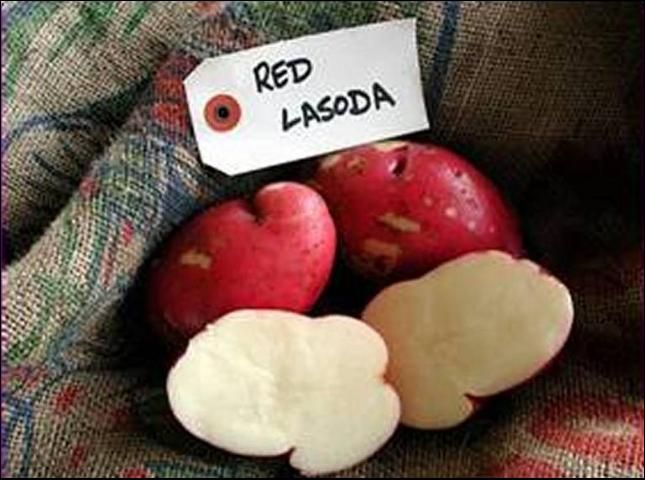
Credit: C. Hutchinson, UF/IFAS
Diseases
'Red LaSoda' is susceptible to scab, early blight (Alternaria solani), late blight (Phytophthora infestans), corky ring spot, and bacterial wilt (Ralstonia solanacearu). In all trials, the variety showed slight susceptibility of 1% to hollow heart (Table 3). The UF/IFAS Extension recommended disease and weed control program is described under Potato Production (Chapter 14 of the Vegetable Production Handbook for Florida, https://edis.ifas.ufl.edu/cv131).
Season Length and Growth
'Red LaSoda' performs as early- to midseason-maturing variety under Florida growing conditions. Season lengths range from 81 to 115 days from planting to harvesting with an average season length of 95 days, depending on growing conditions during the season. The plants should be harvested two to three weeks after vine kill to improve tuber maturation and skin set. Potatoes with proper skin set maintain better skin color, lose less weight in storage, and are more resistant to bruising and soft rot. For more information about vine killing on potatoes, see Potato Vine Killing or Desiccation (Zotarelli et al. 2016). Late in the season, tuber size should be checked regularly in order to harvest tubers with desirable marketable size. Soil moisture should be managed late in the season to avoid enlarged lenticels and delayed skin set.
Fertilization
University of Florida trial plots are normally fertilized with 200 to 230 lb/acre N. The first application of 100 lb/acre of N (granular) is typically incorporated in the bed prior to planting, followed by one or two side-dress fertilizer applications at emergence and/or at tuber initiation. Phosphorus and potassium applications follow the UF/IFAS guidelines described in Liu et al. (2020) and normally range between 45 to 100 lb/ac of P2O5 and 170 to 235 lb/ac of K2O, depending on the soil test results.
Planting
A seed piece of 2½ to 3 oz is recommended for planting. This variety should be planted with 40 inches between rows and 8 inches between plants, at 3 to 4 inches deep. Closer in-row spacing will reduce harvested tuber size. A seed rate of 2,000 to 3,000 lb/acre seed is expected.
Other Information
For additional information on cultivation and weed and disease management, see the Potato Production chapter of the Vegetable Production Handbook, available at https://edis.ifas.ufl.edu/cv131.
References
Hutchinson, C. M., J. M. White, D. M. Gergela, P. A. Solano, K. G. Haynes, R. Wenrich, and C. S. Lippi. 2003. "Performance of chip processing potato varieties in northFlorida." HortTechnology 13 (4): 706–711. https://doi.org/10.21273/HORTTECH.13.4.0706
Liu, G., E. H. Simonne, K. T. Morgan, G. J. Hochmuth, S. Agehara, and R. Mylavarapu. 2020. Chapter 2. Fertilizer Management for Vegetable Production in Florida. Vegetable Production Handbook for Florida, 2020–2021 Edition. CV296. Gainesville: University of Florida Institute of Food and Agricultural Sciences. https://edis.ifas.ufl.edu/cv296
The Potato Association of America. n.d. "Red LaSoda (Solanum tuberosum)." https://www.potatoassociation.org/varieties/red-rounds-potato-varieties/red-la-soda-solanum-tuberosum/. Accessed 24 April 2020.
Sisson, J. A., and G. A. Porter. 2002. "Performance evaluations of potato clones and varieties in the northeastern states—1999." Maine Agr. For. Expt. Sta., Misc. Publ. 751.
Webb, R. E., and J. C. Miller. 1954. "Red La Soda—A Mutation of La Soda." American Potato Journal 31 (2): 40–43. https://doi.org/10.1007/BF02859986
Zotarelli, L., P. J. Dittmar, P. D. Roberts, J. Desaeger, and B. Wells. 2020. Chapter 14. Potato Production. Vegetable Production Handbook for Florida, 2020–2021 Edition. HS733. Gainesville: University of Florida Institute of Food and Agricultural Sciences. https://edis.ifas.ufl.edu/cv131
Zotarelli, L., S. Sargent, P. Dittmar, and M. Makani. 2016. Potato Vine Killing or Desiccation. HS181. Gainesville: University of Florida Institute of Food and Agricultural Sciences. https://edis.ifas.ufl.edu/hs181
Summary of production statistics and specific gravity of 'Red LaSoda' potato variety grown at the UF/IFAS Hastings Agricultural Extension Center, Hastings, FL from 1998 to 2019.