
Numerous insects feed on sugarcane in Florida, which can decrease yield and increase production costs. Insect pest management aims to decrease insect populations to acceptable levels while maintaining the environmental and economic sustainability of sugarcane production. This approach is called integrated pest management, or IPM, and relies on the use of multiple management tactics often used in combination. These IPM tactics include the adoption of sugarcane varieties resistant or tolerant to insect feeding, the implementation of appropriate cultural practices, the release or conservation of natural enemies, and the judicious use of insecticides.
This document addresses the management of five major insect pests of sugarcane produced in southern Florida. This document also lists arthropod species that are minor sugarcane pests. The mention of insecticide trade names is for information only. Users must follow insecticide label instructions.
Wireworms
Wireworms are the larvae of click beetles, which can cause severe damage to numerous crops in Florida. The rear of the larvae is adorned with a symmetric array of ridges, bumps, or points that can be used to identify larvae to species. At least 12 species of wireworms have been found in southern Florida, but only Melanotus communis is abundant enough to cause economic losses in sugarcane (Figure 1). M. communis has traditionally been a more important pest in Florida sugarcane grown on organic (muck) soil than on mineral (sandy) soil. Wireworm densities appear to have decreased recently in organic soils, potentially because of the implementation of best management practices and organic soil subsidence, which result in higher water tables and more frequent flooding.
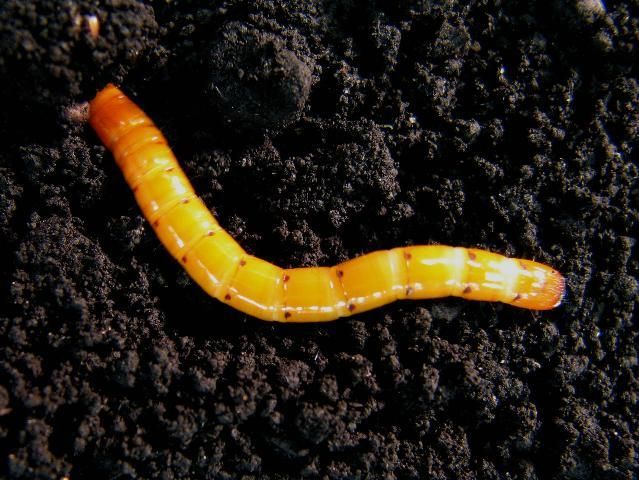
Credit: Alvin Wilson, UF/IFAS
Wireworms are a belowground pest of newly planted sugarcane and are rarely a pest in ratoon sugarcane. Wireworms feed on the buds and root primordia during germination of sugarcane seed pieces, and on shoots and roots after germination. Most of the injury to young shoots is near the point where the shoots join the seed piece or stubble. Larvae also feed along the seed pieces between buds (i.e., internodes). Wireworm injury can generally be identified as relatively large, ragged holes into seed pieces and buds or into young shoots. The death of buds or young shoots leads to stand reduction whereas root feeding can stunt young plants. Wireworm injury to seed piece internodes facilitates the entrance of pathogens, including the fungus that causes sugarcane red-rot disease, which can ultimately kill the buds and shoots connected to the injured internodes.
Flooding is a cultural practice for wireworm management that can be effective. However, it is a slow process and may not always be practical. A minimum of 6 weeks of continuous flooding is needed during the summer to obtain wireworm control whereas longer flooding durations are needed during colder months. Flooding during late spring and summer will kill the wireworms and will also prevent egg laying by the adult click beetles. Fallow-field flooding or production of flooded rice in rotation with sugarcane may eliminate the need to use a soil insecticide for wireworm control at sugarcane planting the following fall.
Soil insecticides are generally used in newly planted sugarcane for wireworm control. Some Florida sugarcane growers do not use a soil insecticide at planting knowing that previous flooding of fallow fields or rice fields reduces wireworm populations. However, these fields account for a small proportion of sugarcane fields. Insecticides are not used for wireworm control in ratoon sugarcane.
Phorate (e.g., Thimet 20G) and ethoprop (e.g., Mocap 15G) are granular insecticides registered for use on sugarcane. These insecticides are applied at planting with specialized equipment. Granules are applied in a band approximately 1 foot wide in the open furrow on the seed pieces before being covered with soil. Phorate has consistently been the most effective insecticide in UF/IFAS trials for wireworm control in sugarcane produced on organic soils. Results of UF/IFAS trials suggest that pyrethroid and neonicotinoid insecticides may also protect sugarcane from wireworm injury. However, these insecticides are not currently registered for use on sugarcane. No resistance to insecticides has been reported to occur in wireworms in Florida sugarcane.
Florida growers producing sugarcane on mineral soils sometimes do not use a soil insecticide at planting in the belief that fewer wireworms are in mineral than organic soils where most sugarcane is grown. However, a study reported that high wireworm populations occur in mineral soil although not as frequently as in organic soils. Another study concluded that registered rates for phorate may be too high for effective control. These studies have brought into question when to use soil insecticides at sugarcane planting. However, Florida sugarcane growers have not had a useful sampling method to help them in this decision. Recently, a simple sampling method has been tested that may be of use to Florida sugarcane growers to determine the necessity of soil insecticide applications at planting.
Wireworm samples are taken by digging in a transect across a field after fields have been disked and right before planting. By counting wireworms found in samples, a decision can be made to determine the necessity of a soil insecticide application to control wireworms in that field. This sampling method has been successfully applied by several Florida sugarcane growers. Details on this sampling method may be found in Cherry et al. (2013).
White Grubs
White grubs are beetle larvae that are belowground sugarcane insect pests in Florida. They have soft bodies but tough heads and legs that allow them to move through the soil to find and hold on to roots and underground stalks to feed (Figure 2). White grubs tend to curl into a "c shape" when disturbed or removed from the soil. Species that have been found in Florida sugarcane fields are in the genera Anomala, Cyclocephala, Dyscinetus, Euphoria, and Tomarus. Of these grub species, the sugarcane grub, Tomarus subtropicus, has historically been a major pest in fields on organic soils where most Florida sugarcane is grown. However, sugarcane grub population levels have drastically decreased recently, potentially due to higher water tables and more frequent flooding in shallow organic soils.
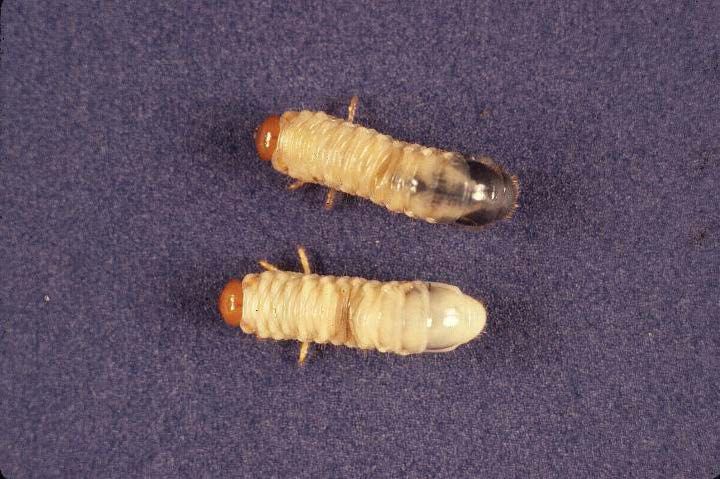
Credit: Alvin Wilson, UF/IFAS
White grubs are belowground pests that injure sugarcane by feeding on roots and underground stems. The first symptom is a yellowing (chlorosis) of the leaves. This is usually followed by stunted growth, dense browning, lodging, plant uprooting, and death in heavily infested areas. Symptoms may be seen as early as September. Freshly planted fields usually have little or no grub infestation. Injury is usually more severe in older ratoon crops and is most evident around the edges of a field.
A sugarcane grub infestation usually starts at the edge of a field and slowly spreads, in an irregular pattern, throughout the field. Infested fields may need to be replanted because ratoon regrowth and productivity can be severely reduced. Heavily infested areas may not be worth harvesting.
Disking infested fields, reducing the number of ratoon crops, and flooding are the most common methods of grub management in Florida. Disking kills many grubs and allows birds to kill many more. Although it is not always practical to flood, this control method can significantly reduce grub populations. The following points are to be considered if flooding is to be used to control sugarcane grub in sugarcane grown on organic soil.
- Positive identification of the sugarcane grub should be made and the stage found should be noted (i.e., adult, egg, larva).
- Adults are essentially impossible to kill by flooding. Eggs are also very difficult to kill using this method. These stages occur from approximately May through July.
- Larvae (grubs) and pupae, which occur mostly from August through April, are the easiest stages to kill by flooding.
- The warmer the weather, the better the flood will kill larvae and pupae. If the water temperature in the flooded field is 77°F or higher, a continuous flood for 5 days will be sufficient for grub control.
- The flood water level should be about 2 inches above the soil surface. Many grubs will come to the soil surface and survive if there is less than two inches of standing water. Water depth greater than 2 inches will increase grub mortality very little, if at all.
- Given the option, the best time to kill grubs by flooding is in August. At this time, water temperatures are warm, rainfall abundant, and feeding damage by the grubs is just starting.
Lesser Cornstalk Borer
The lesser cornstalk borer, Elasmopalpus lignosellus, is a serious pest in sugarcane produced on mineral soils and an occasional pest on organic soils. Young lesser cornstalk borer larvae are white to creamy yellow with reddish to brown patterns adorning each thoracic segment, except for the first, which is covered with a broad black shield. Older larvae develop a green to turquoise blue color between the darker patterns, particularly between the head and thoracic segments (Figure 3). Lesser cornstalk borer larvae wiggle energetically when handled. Lesser cornstalk borer adults are small, slender moths about 1/2 to 5/8 inch long (Figure 4). Adults are easily disturbed by walking through the field, but these quick fliers usually move no more than 10 feet at a time. They are most active at dawn and dusk, and females lay their shingle-like, translucent eggs on soil or detritus near young sugarcane shoots.
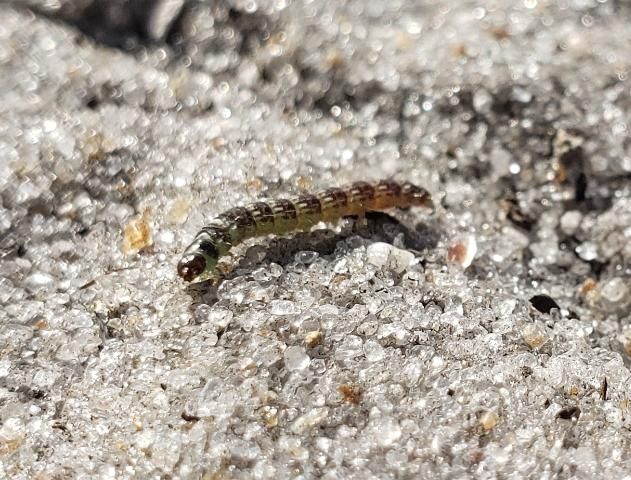
Credit: Erik Roldán, UF/IFAS
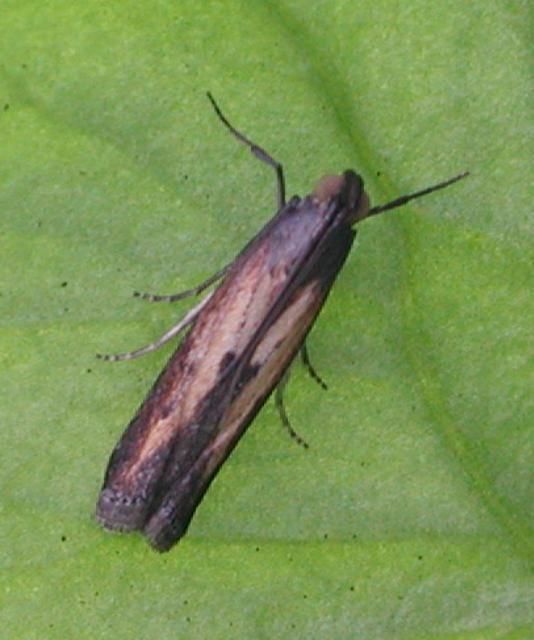
Credit: Hardev Sandhu, UF/IFAS
Larvae enter the soil to burrow into soft young plant tissue usually within 3/8 inch of the soil surface. They feed on tillers and older shoots from within tunnels lined with silk and usually bore-out tissue within 1 inch above or below the soil line. The soil-covered tunnels are often found attached to the entry wounds and serve as an important diagnostic trait to separate their damage from that of wireworms, which do not produce such tunnels. The larvae complete development in 16 to 66 days and can kill several young shoots before pupating in the soil.
Larval injury to sugarcane meristematic tissue presents itself as dead young tillers and older shoots with dead youngest leaves (i.e., deadheart). Shoots with deadhearts can produce additional tillers, and some varieties can compensate for this type of early injury (e.g., CP 78-1628). Evidence of feeding above the meristem later becomes visible as rows of holes on the two to three leaves present within the whorl when it was attacked. Frequently, the tips of these leaves break off at the row of holes. Fields with a high frequency of lesser cornstalk borer injury may appear to have been mechanically mowed. Susceptibility to injury generally decreases after the shoots reach 1 foot in height. More information on lesser cornstalk borer damage to sugarcane can be found at https://edis.ifas.ufl.edu/sc094.
As with most soil insect pests, initiating management before injury symptoms become obvious is important because injury symptoms are frequently delayed by several days to a week after larvae reach the damaging instar. Pheromone traps can be used to identify sugarcane fields with adult activity. Timely follow-up scouting should look for adults flying low over the soil and early signs of larval injury (i.e., rows of holes in emerging leaves or wilting of newest leaves due to injury to meristematic tissue).
Insecticides are best applied when adults are common, but before or immediately following first evidence of larval feeding injury to reduce potential long-term stand and yield loss. Foliar applications of insecticides containing chlorantraniliprole (e.g., Coragen) or of a premix containing chlorantraniliprole and lambda-cyhalothrin (Besiege) are registered for use on sugarcane and are effective at controlling the lesser cornstalk borer.
Rainfall, overhead irrigation, and raising water levels can be effective at reducing egg laying in the field because adults prefer dry fields and tend to avoid wet soil. Similarly, the layer of sugarcane residue left on the soil surface after green cane harvest (i.e., no preharvest burning) retains soil moisture longer than bare soil and blocks direct contact of adults with the soil surface, which lowers lesser cornstalk borer injury in ratoon crops. Field flooding is effective at controlling larvae between crops.
The lesser cornstalk borer is also an important pest of beans, corn, and pepper. This insect feeds on other grasses and is often found in association with nutsedges, which also exhibit dead tiller and deadheart symptoms. Weedy sugarcane fields and those bordered by other lesser cornstalk borer host plants may experience prolonged activity associated with adult emergence from these reservoirs.
Sugarcane Borer
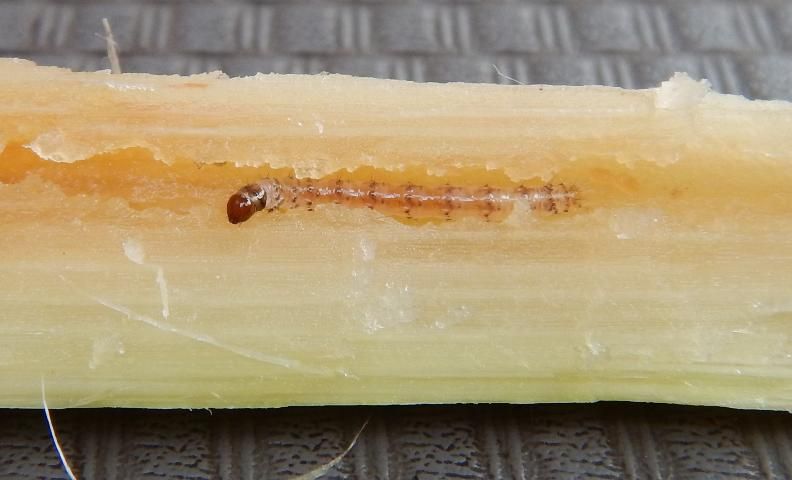
The sugarcane borer, Diatraea saccharalis, has historically been considered the most important aboveground insect pest of sugarcane in Florida. Sugarcane borer larvae have a brown head and are pale yellow-white with dark brown spots on each body segment along the dorsal side (Figure 5). They can grow to 1.2 inches long. Sugarcane borer adults are straw colored moths with delta-shaped wings. Sugarcane borer population levels in Florida sugarcane fields have declined since the 1990s, likely associated with successful biological control from natural enemies. Although this insect feeds on sugarcane, numerous other grasses have been reported as hosts in Florida, including rice and weeds.
Credit: Julien Beuzelin, UF/IFAS
Larval feeding on young sugarcane plants and boring near the shoot meristem can cause a deadheart, eventually killing the shoot. Larval tunneling into sugarcane stalks causes loss of stalk weight (tonnage/acre) and sucrose yield. If tunneling is extensive, death of the of the apical meristem will result in a "dead top." Weakened stalks are also subject to breaking and lodging. Additionally, sugarcane borer tunnels are points of entry for pathogens. Research showed that bored internodes produce 45% less sugar than uninjured internodes.
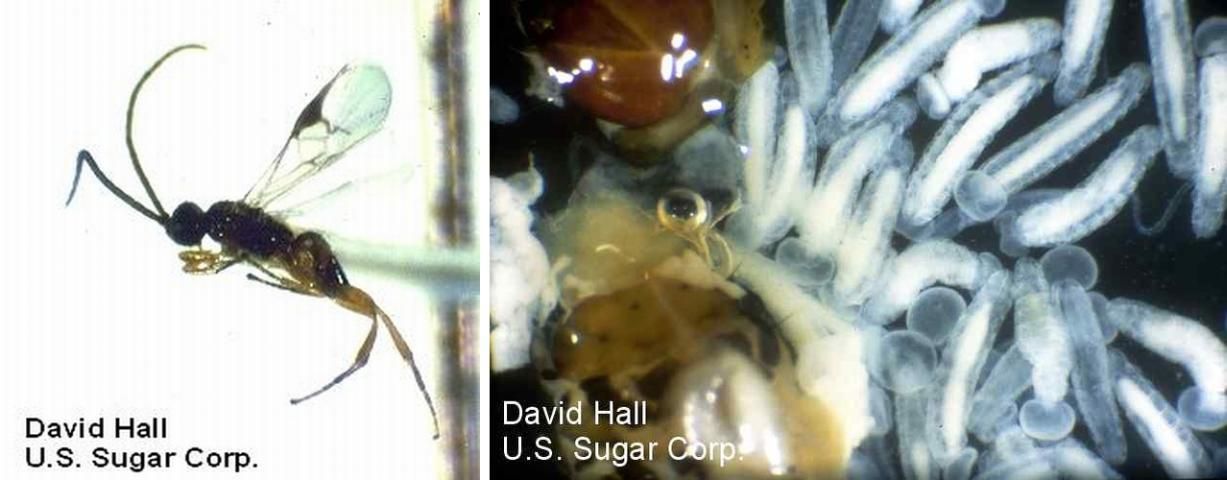
Sugarcane borer management in Florida relies primarily on biological control from natural enemies. Two braconid wasps, Alabagrus stigma and Cotesia flavipes, were introduced into Florida and have become established. These wasps lay eggs into sugarcane borer larvae, parasitizing these larvae and eventually killing them. The red imported fire ant, Solenopsis invicta, is the dominant ant species in Florida sugarcane fields on organic and mineral soils and is an effective sugarcane borer predator. Pheidole spp. are abundant ants that also prey on sugarcane borers.
Until the early 2000s, regular scouting programs were implemented to determine whether sugarcane borer and parasitic wasp population levels warranted insecticide applications to prevent economic losses. Although these scouting programs and insecticide applications have been discontinued because of low areawide sugarcane borer pest pressure, scouting for sugarcane borers may be needed if increased population levels are observed.
Fields should be scouted every 2 or 3 weeks from March through November. A scouting program developed by one Florida sugar company recommends sampling each 40-acre field in at least 4 locations. At each location, 5 stalks are randomly sampled from each of 5 stools spaced 10 feet apart (5 stalks/5 stools/location). It is desirable to detect borers before they tunnel into stalks so that, if necessary, insecticides can be applied before larvae become protected inside the stalks and further stalk injury occurs. Characteristic signs that plants are infested are window paning of leaf sheaths, holes into stalks, and frass (light-brown fibrous waste material) at these holes. Pinholes in leaves and tiny holes into midribs are also signs of infestation. However, an infestation cannot be positively identified until the sugarcane borers are actually observed. The whorl, leaves, and leaf sheaths should be examined. Stalks should be split to detect borers tunneling inside stalks (Figure 5). Detecting 2 to 3 live larvae per 100 sampled stalks is generally thought to be enough to cause concern about economic damage. When this 2-to-3% threshold is reached, sugarcane borer larvae should be dissected to determine the level of parasitism. If <50% of the borers are parasitized (Figure 6), an insecticide should be applied.
Credit: David Hall, formerly U.S. Sugar Corporation
Insecticides containing chlorantraniliprole (e.g., Coragen, Prevathon), or insect growth regulators such as tebufenozide (e.g., Confirm 2F) and novaluron (e.g., Diamond 0.83EC) are registered for use on sugarcane and are effective. Insecticides containing pyrethroids (e.g., Asana XL, Baythroid XL, Mustang Maxx, Warrior II, etc.) are also registered and may be effective. However, their use is not recommended because of potential disruption of biological control and resurgence of secondary pests such as aphids.
Yellow Sugarcane Aphid
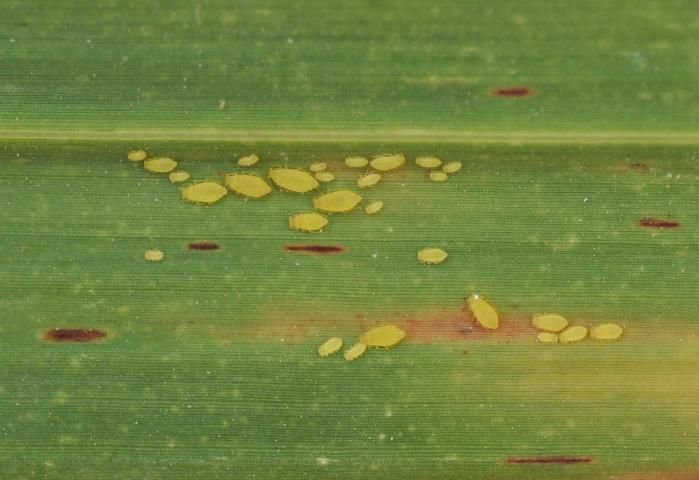
The yellow sugarcane aphid, Sipha flava, is a fairly small, bright yellow aphid with short legs and antennae. Its body is adorned with short stiff hairs and cornicles are shortened to no more than raised pores near the end of the abdomen (Figure 7). Outbreaks of this aphid are frequently limited to localized areas of the field that may go unnoticed when they are away from field margins and the use of aerial imagery can be useful. However, field-wide outbreaks can develop, particularly during the drier spring and fall months in southern Florida.
Credit: Julien Beuzelin, LSU AgCenter
Yellow sugarcane aphid feeding causes yellowing, reddening, or purpling of affected leaves, which may eventually die under severe infestations. This injury can result in reduced tillering in young sugarcane plants or in reduced growth. In addition, yellow sugarcane aphid feeding results in lighter stalks that contain less sugar. Sugarcane plants do not compensate for early-season yellow sugarcane aphid injury. Severely injured stalks that survive have narrow internodes near the soil surface that may break later in the season.
Leaf injury symptoms appear to be a good indicator of season-long effects on growth and yield. A yellow sugarcane aphid infestation associated with 4 leaves beneath the top visible dewlap leaf with >50% green tissue is still enough to reduce sugar content at harvest. This means an average of 2 to 3 leaves with >50% injury early in the season will significantly reduce yield. Significantly greater yield reductions occur with each additional pair of leaves showing >50% yellow sugarcane aphid injury.
Yellow sugarcane aphid infestation levels are influenced by sugarcane variety. Thus, the development and adoption of relatively resistant varieties is an important management tactic. In addition, natural enemies, including 10 species of lady beetles, several species of flower flies, and green and brown lacewings, can greatly reduce populations. However, this may not occur before the aphids have caused significant plant injury. Rainfall decreases infestations.
The pyrethroid lambda-cyhalothrin (e.g., Warrior II) is registered for yellow sugarcane aphid management. However, pyrethroids should only be used if it appears that natural enemies or rainfall will not soon greatly reduce populations below levels that cause unacceptable symptoms. Pyrethroids may reduce or eliminate predators and parasitoids of other arthropod pests that are currently under biological control.
Sugarcane Arthropod Pests of Minor or Undetermined Importance
The Diaprepes root weevil, Diaprepes abbreviatus, was first reported in Florida during the 1960s. The insect is damaging to citrus and ornamental plants; however, damage in Florida sugarcane by this pest was first noted in 2010. Diaprepes root weevil larvae are white and look like grubs but have no legs. Economic damage associated with infestations has been sporadic and weed control is probably the single most important factor in preventing infestations of the root weevil in sugarcane.
Sugarcane spider mites, primarily Oligonychus stickneyi, have been occasional pests in Florida sugarcane since the 1970s. These mites live and feed on the undersides of leaves. They form fine webs in which eggs are laid and young nymphs develop. Leaves infested by mites often develop a red russetting. Severe injury by spider mites can result in leaf death.
The sugarcane aphid, Melanaphis sacchari, was first discovered in Florida in 1977. This insect is a dirty white or light grey to very light tan aphid in its wingless form. The sugarcane aphid produces large amounts of honeydew associated with sooty mold development on leaves and leaf sheaths. In addition, it is a virus vector, transmitting Sugarcane yellow leaf virus, which can decrease yield.
The sugarcane delphacid, Perkinsiella saccharicida, was first discovered in Florida in 1982. Sugarcane delphacid adults are gray planthoppers with dark gray patterns on the wings. Little to no economic damage has been associated with infestations. The sugarcane delphacid is the vector of Fiji disease, which does not occur in Florida.
The sugarcane lacebug, Leptodictya tabida, was first discovered in Florida in 1990. Sugarcane lacebug adults are oblong, flat, with transparent wings exhibiting lacelike patterns. Feeding on sugarcane leaves causes brown-red russetting. The potential effects of infestations on yield have not been determined.
The sugarcane rust mite, Abacarus sacchari, was originally identified as Abacarus officinari while observed feeding on sugarcane in Florida in 1982. It was not until 2007 that the mite was observed again and correctly identified as A. sacchari. The mites are invisible to the naked eye. However, injury in some sugarcane varieties consists of orange to reddish-brown flecks on the underside of leaves. Some varieties may sustain high infestations without exhibiting injury symptoms. Yield losses associated with sugarcane rust mite infestations have been observed.
The sugarcane thrips, Fulmekiola serrata, was first discovered in Florida in 2017. Adults are black insects that feed in the folds of sugarcane whorl leaves. Sugarcane thrips feeding scars leaf surfaces and tips, which will eventually brown and desiccate. Potential yield losses associated with sugarcane thrips infestations in Florida have not been determined.
Other insects feeding on sugarcane in Florida include the West Indian canefly (Saccharosydne saccharivora), West Indian cane weevil (Metamasius hemipterus sericeus), American bird grasshopper (Schistocerca americana), and a grass leaf tier (Marasmia trapezalis).
The Mexican rice borer, Eoreuma loftini, was first detected in central Florida in 2012. However, this insect has not been observed in the main sugarcane production region in southern Florida as of 2021. The Mexican rice borer is expected to be a significant pest when it becomes established in Florida sugarcane.
More detailed information on the arthropods mentioned previously is available in the "Miscellaneous Insect Pests of Florida Sugarcane" (https://edis.ifas.ufl.edu/sc014).
Selected References
Beuzelin, J. M., M. T. VanWeelden, F. N. Soto-Adames, H. S. Sandhu, R. W. Davidson, L. Baucum, S. Swanson. 2019. Effect of sugarcane cultivar and foliar insecticide treatment on infestations of the invasive sugarcane thrips, Fulmekiola serrata (Thysanoptera: Thripidae), in Florida. Journal of Economic Entomology 112: 2703-2712.
Cherry, R. 1988. Correlation of crop age with populations of soil insect pests in Florida sugarcane. Journal of Agricultural Entomology. 5: 241-245.
Cherry, R., and G. Nuessly. 1992. Distribution and abundance of imported fire ants (Hymenoptera: Formicidae) in Florida sugarcane fields. Environmental Entomology 21: 767-770.
Cherry, R., P. Grose, and E. Barbieri. 2013. Validation of a sequential sampling plan for wireworms (Coleoptera: Elateridae) at sugarcane planting. Journal of Pest Science 86: 29-32.
Cherry, R. H., J. M. McCray, and H. S. Sandhu. 2017. Changes in the relative abundance of soil-dwelling insect pests in sugarcane grown in Florida. Journal of Entomological Science 52: 169-176.
Hall, D. 1988. Insects and mites associated with sugarcane in Florida. Florida Entomologist 71: 138-150.
Hall, D., and F. Bennett. 1994. Biological control and IPM of sugarcane pests in Florida, pp. 297-325. In D. Rosen, F. Bennett, and J. Capinera (eds.). Pest management in the subtropics: biological control - A Florida perspective. Intercept. Paris.
Hayden, J. E. 2012. Mexican rice borer, Eoreuma loftini (Dyar) (Lepidoptera: Crambidae: Crambinae) in Florida. Pest Alert Nov 13, 2012. Florida Department of Agriculture and Consumer Services, Division of Plant Industry, Gainesville, FL.
Larsen, N., G. S. Nuessly. 2009. Effectiveness of reduced rates of insecticides for the control of Melanotus communis (Coleoptera: Elateridae) in sugarcane. Florida Entomologist 92:629-634.
Larsen, N., G. Nuessly, R. Cherry, and B. Glaz. 2013. Varietal susceptibility to the corn wireworm Melanotus communis (Coleoptera: Elateridae) in sugarcane. Journal of Pest Science 86: 91-98.
Nuessly, G. S., R. H. Cherry, H. S. Sandhu, and J. M. Beuzelin. 2019. Miscellaneous insect pests of Florida sugarcane. ENY-667. Gainesville: University of Florida Institute of Food and Agricultural Sciences. https://edis.ifas.ufl.edu/sc014
Odero, D., R. Cherry, and D. Hall. 2013. Weedy host plants of the sugarcane root weevil (Coleoptera: Curculionidae) in Florida sugarcane. Journal of Entomological Science 48: 81-89.
Roldán, E. L., J. M. Beuzelin, M. T. VanWeelden, and R. H. Cherry. 2020. Abundance of the sugarcane borer (Lepidoptera: Crambidae) and foraging ants (Hymenoptera: Formicidae) in sugarcane grown on organic and mineral soils in Florida. Environmental Entomology 49: 473-481.
Roldán Salazar, E., J. Beuzelin, M. VanWeelden, R. Cherry, M. Karounos, K. Shaber, and L. Baucum. 2018. Sugarcane borer and ant abundance in sugarcane fields grown on organic and mineral soils in Florida. Journal of the American Society of Sugar Cane Technologists 38: 48 (abstract).
Sandhu, H., G. Nuessly, S. Webb, R. Cherry, and R. Gilbert. 2010. Temperature dependent development of Elasmopalpus lignosellus (Lepidoptera: Pyralidae) on sugarcane under laboratory conditions. Environmental Entomology 39: 1012-1020.
Sandhu, H. S., G. S. Nuessly, R. H. Cherry, R. A. Gilbert, and S. E. Webb. 2011. Effects of harvest residue and tillage on lesser cornstalk borer (Lepidoptera: Pyralidae) damage to sugarcane. Journal of Economic Entomology 104: 155-163.
Sandhu, H., G. Nuessly, S. Webb, R. Cherry, and R. Gilbert. 2013. Temperature-dependent reproductive and life table parameters of Elasmopalpus lignosellus (Lepidoptera: Pyralidae) on sugarcane. Florida Entomologist 96: 380-391.