
University of FloridaSolutions for Your Life

Download PDF 
Publication #ENY-213

Pantry and Stored Food Pests1

P. G. Koehler2

There are many species of stored food pests found at various times in food pantries. Most of these pests are introduced into our homes in infested food. Some invade homes through normal methods of entry.

There is hardly a food item in the kitchen or food pantry which can escape being infested by some pest if it remains unused and exposed in some dark corner or drawer long enough. All items are susceptible, including spices, hot pepper, ice cream cones, and even cereals, grits, and cake mixes. Dried flower arrangements and stuffed furniture and toys, often harbor infestations.

Stored food pests are economically important and are responsible for millions of dollars of loss every year in stored foods and other products. Most of the stored food pests under Florida conditions can reproduce quickly and have several to many generations in a year. Many species are active the year around under suitable conditions.

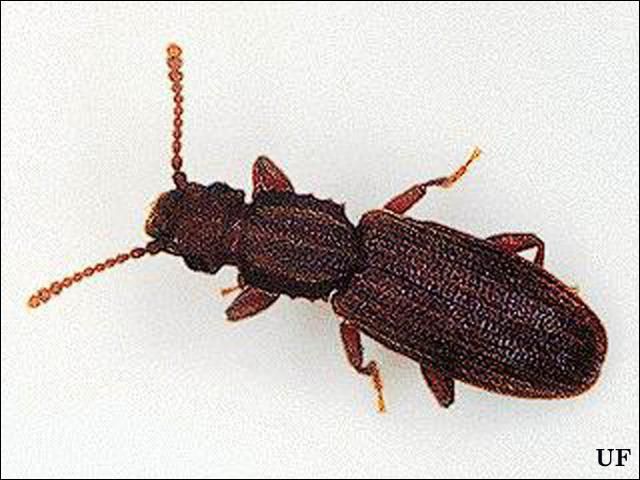
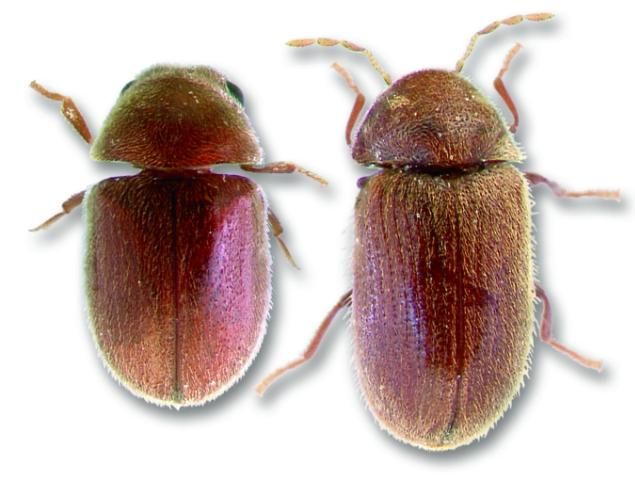
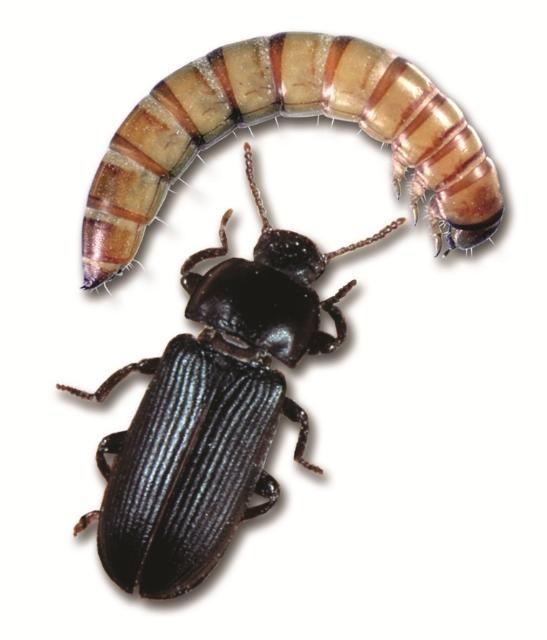
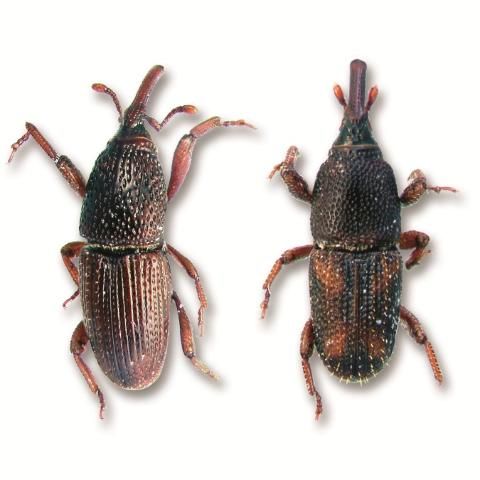
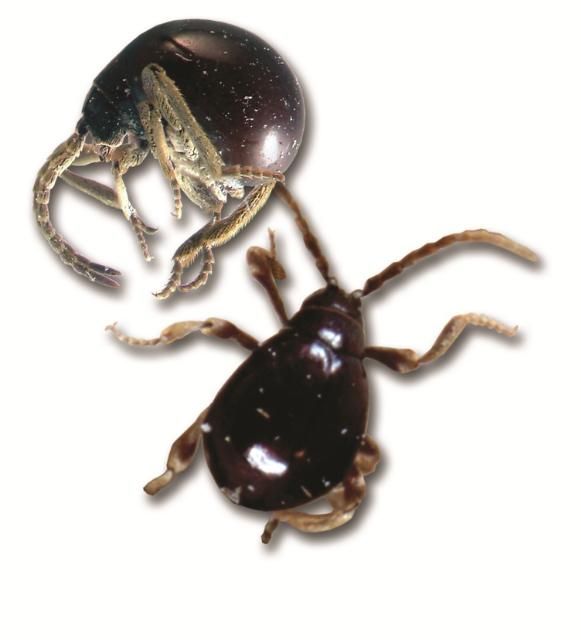
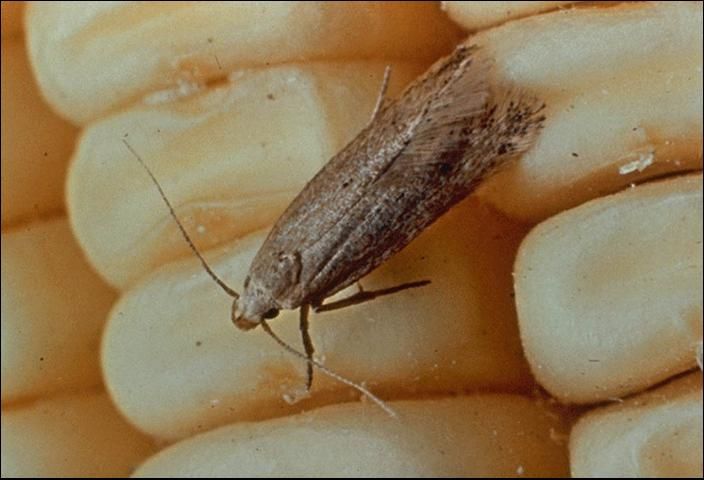
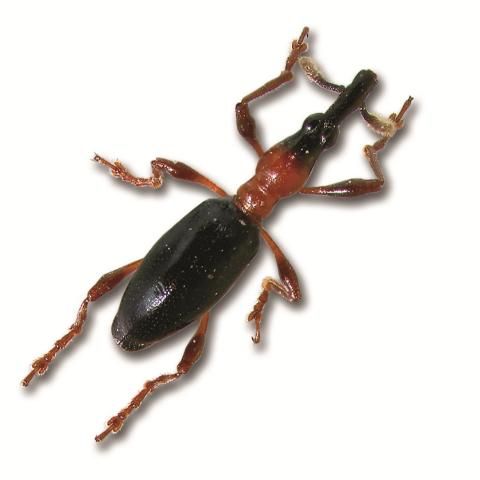
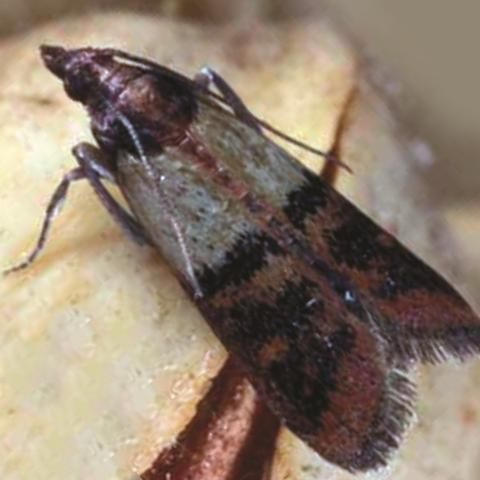
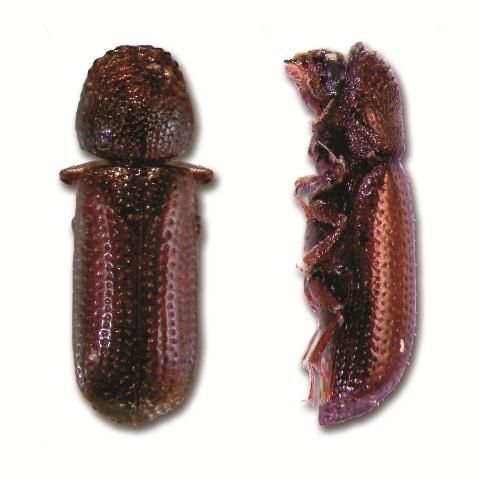
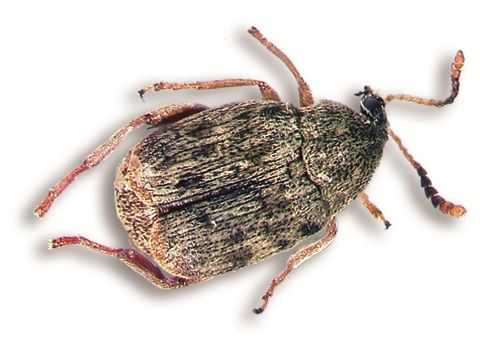
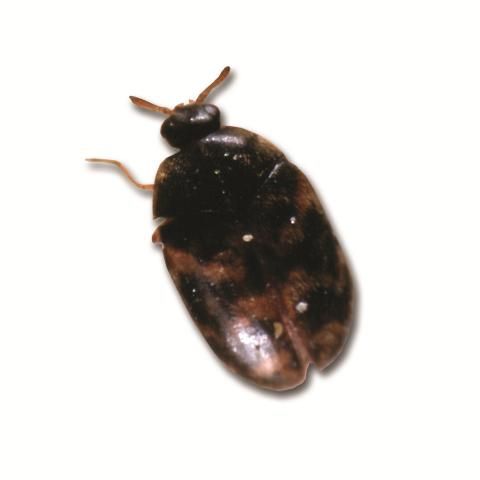
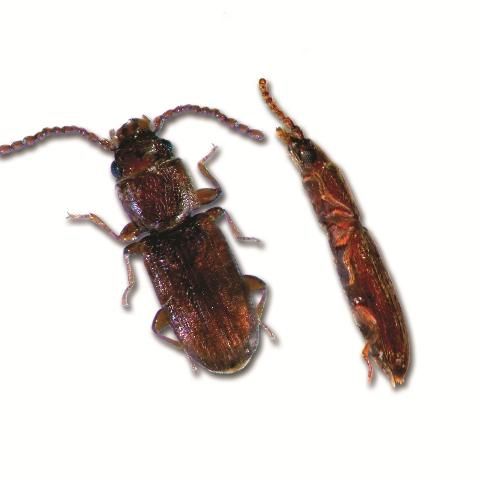
Some of the common pantry pests are flour beetles (Figure 1), saw-toothed grain beetles (Figure 2), cigarette beetles (Figure 3), drugstore beetles (Figure 4), larder beetles, granary weevils (Figure 5), rice weevils (Figure 6), spider beetles, grain moths (Figure 7), flour moths (Figure 8, Figure 9), psocids, and grain mites. Although there are many different kinds of insects that attack stored food, the damage they produce and the control procedures are similar.
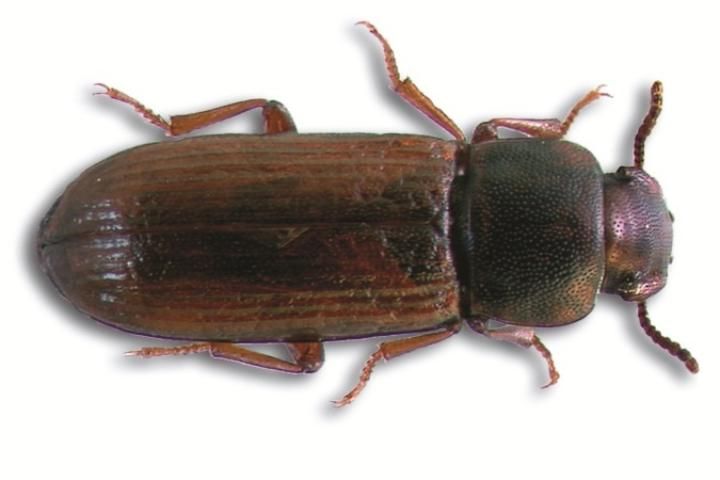
Figure 1. 

Flour beetle.

Figure 2. 

Sawtoothed grain beetle.

Figure 3. 

Cigarette beetle.

Figure 4. 

Drugstore beetle.

Large populations of these food pests may develop in unused or undisturbed foods which were infested when purchased. A food package which is not tightly sealed after use can also lead to infestation. From the infested food packages, the pests may spread to other exposed food. Often the only way that one knows of their presence is by discovery of an infested and infrequently used food item or the encounter of flying or crawling adults coming from the pantry shelves. Moths and beetles are often attracted to lights or windows and may indicate an infestation. The presence of stored food pests is not an indication of uncleanliness since infestation may be brought home in purchased food.

Figure 5. 

Granary weevil.

Figure 6. 

Rice weevil.

Figure 7. 

Angoumois grain moth.

Figure 8. 

Mediterranean flour moth.

Figure 9. 

Indian meal moth.

Control

The basic fundamentals of controlling stored food pests are exclusion, regular inspections, cleaning of shelves, and chemical treatment. Sometimes an infestation can develop on bread or cracker fragments or in some undisturbed, loose flour or meal on one corner of the shelf. Keep all containers tightly closed. Put susceptible items in tight containers or screw-top jars or other sealable containers. Do not overstock shelves with products which will not be used frequently or in a short period of time. Rotate use of stored items so oldest are used first.

The first step in controlling pantry pests is to locate the source of infestation. All susceptible foods should be thoroughly inspected, and badly infested items discarded. Insects in infested foods may be killed by heat or cold if the item is of value. Infested foods may be placed in an oven at 130°F for 30 minutes or a freezer at 0°F for 4 days to kill insects. If placed in a freezer, the commodity should be used as soon as possible since defrosting usually causes excess moisture in the item. The excess moisture could cause mold to form later. Freezing and defrosting the item in a tightly sealed plastic bag can limit condensation on the product.

To kill insects in the storage area, cabinets and shelves should be thoroughly vacuumed to pick up loose infested material and washed with warm, soapy water. Caulk cracks to limit harborage for insects. Stored food pests often hide in cracks and crevices or in corners of cabinets. These insects can be controlled using a crack and crevice insecticide application. Products labelled for crack and crevice treatment are listed in Table 1. Apply a residual spray to the cracks, corners, and surfaces of the shelves. Remove all food items from shelves which may become contaminated with spray. Allow the spray application to dry before replacing the food items. Be sure to remove and spray all drawers as well as the inside of the cabinets after cleaning.

Some moths and beetles readily fly to light and remain on exposed surfaces that should not be sprayed with residual insecticides. These exposed insects can be controlled with indoor space spray treatments listed in Table 2.

Storage of grains and grain products has resulted in considerable problems with stored grain insects in homes and institutions. Whole grain can be fumigated in storage containers with carbon dioxide. Dry ice (frozen carbon dioxide) can be placed in storage containers directly on top of grain at the rate of 1/4 lb per 5 gal container. The container lids should not be tightened for 1/2 hour. After 1/2 hour tighten lids and place the commodity in storage. At least 14 days exposure is necessary to be certain of satisfactory control.

Tables

Table 1. 

Products labeled for crack and crevice or indoor surface treatment of pantry pests.1

Common Name

Homeowner Products*

Commercial Products*

Acephate

PT Orthene Crack & Crevice Pressurized Residual (B, W)1, 2

Bifenthrin

Ortho Home Defense Perimeter & Indoor Insect Killer

(B, C, M, MW, W)1, 2

Boric Acid

PT Perma Dust Pressurized Boric Acid Dust (B, M, W)1, 2

Cyfluthrin

Bayer Advanced Home, Home Pest Control Indoor & Outdoor Insect Killer (B, C, M, MW, W)1, 2

PT Cy-Kick Crack & Crevice Pressurized Residual (B, W)1, 2

PT Cy-Kick CS Pressurized Crack & Crevice Residual

(B, C, M, MW, W)1, 2

Tempo 20 WP (B, C, M, MW, W)1, 2

Tempo SC Ultra (B, C, M, MW, W)1, 2

Deltamethrin

DeltaDust (B, C, M, MW, W)1, 2

Suspend SC Insecticide (B, M, W)1, 2

Hydroprene

Gentrol Aerosol (B, M)1, 2

Gentrol IGR Concentrate (B, M)1, 2

Lambda Cyhalothrin

PT 221L (B)1, 2

Permethrin

Dragnet SFR Termiticide/Insecticide

(B, C, M, MW, W)1, 2

Prallethrin

PT ULD SPy-300 (B, M, W)1, 2

Prallethrin, Esfenvalerate, MGK-264 synergist

Ortho Roach, Ant & Spider Killer

(B, M, W)1, 2

Propetamphos

Catalyst (B)1, 2

Pyrethrins

Kicker (B, C, MW, W)1, 2

PT Tri-Die Silica & Pyrethrum Dust

(B, C, M, , W)1, 2

PT ULD BP-300 (B, C, M, MW, W)1, 2

Pyrethrins and Others

PT 565 Plus XLO (B, M, W)1, 2

PT Microcare CS Controlled Release Pyrethrum (B, C, M, MW, W)1, 2

PT Microcare Pressurized Pyrethrum Capsule Suspension

(B, C, M, MW, W)1, 2

PT Tri-Die Pressurized Silica & Pyrethrin Dust (B, C, MW, W)1, 2

PT ULD BP-100 (B, C, M, MW, W)1, 2

Pyrethrins, PBO

PT P.I. Contact Insecticide (B, W)1, 2PT ULD BP-50 (B, C, M, MW, W)1, 2

Pyrenone 100 (B, C, M, MW, W)1, 2

Synerol Insecticide

(B, C, M, MW, W)1, 2

Pyrethrins, PBO, Silica Gel

Drione (B, C, MW, W)1, 2

Pyrethrins, PCO

Pyrenone 50 (B, C, MW, W)1, 2

Tralomethrin

Saga WP Insecticide (B, M, W)1, 2

1 Read label carefully to insure pest, site and commodity are listed prior to applying product. Some product labels are very restrictive.

2 B = Beetles, C = Cadelles, M = Moths, MW = Mealworms, W = Weevils

Table 2. 

Products labeled for indoor space treatment of pantry pests.1

Common Name

Homeowner Products*

Commercial Products*

Hydroprene

Gentrol IGR Concentrate (B, M)1, 2

TurboCide Gold with Gentrol (B, M)1, 2

Prallethrin

PT ULD SPy-300 (C, M, MW)1, 2

Pyrethrins

Kicker (B, C, M, MW, W)1, 2

PT ULD BP-300 (B, C, M, W)1, 2

Pyrethrins and Others

PT 565 Plus XLO (B, M, W)1, 2

PT Pro-Control Plus (B, W)1, 2

PT ULD BP-100 (B, C, M, MW, W)1, 2

Pyrethrins, PBO

PT P.I. Contact Insecticide (B, M)1, 2

PT ULD BP-50 (B, C, M, MW, W)1, 2

Pyrenone 100 (B, C, M, MW, W)1, 2

Synerol Insecticide

(B, C, M, MW, W)1, 2

TurboCide Gold with Pyrenone

(B, M)1, 2

Pyrethrins, PCO

Pyrenone 50 (B, M, MW, W)1, 2

Pyrethrins, permethrin

Ortho Indoor Insect Fogger

(B, M. W)1, 2

1 Read label carefully to insure pest, site and commodity are listed prior to applying product. Some product labels are very restrictive.

2 B = Beetles, M = Moths, MW = Mealworms, W = Weevils

Footnotes

1.

This document is ENY-213, one of a series of the Entomology and Nematology Department, Florida Cooperative Extension Service, Institute of Food and Agricultural Sciences, University of Florida. Revised: April 2003. Please visit the EDIS Web site at http://edis.ifas.ufl.edu.

2.

P. G. Koehler, professor/extension entomologist, Cooperative Extension Service, Institute of Food and Agricultural Sciences, University of Florida, Gainesville, 32611.

The use of trade names in this publication is solely for the purpose of providing specific information. UF/IFAS does not guarantee or warranty the products named, and references to them in this publication does not signify our approval to the exclusion of other products of suitable composition. Use pesticides safely. Read and follow directions on the manufacturer's label.


The Institute of Food and Agricultural Sciences (IFAS) is an Equal Opportunity Institution authorized to provide research, educational information and other services only to individuals and institutions that function with non-discrimination with respect to race, creed, color, religion, age, disability, sex, sexual orientation, marital status, national origin, political opinions or affiliations. For more information on obtaining other extension publications, contact your county Cooperative Extension service.

U.S. Department of Agriculture, Cooperative Extension Service, University of Florida, IFAS, Florida A. & M. University Cooperative Extension Program, and Boards of County Commissioners Cooperating. Millie Ferrer-Chancy, Interim Dean.