
University of FloridaSolutions for Your Life

Download PDF 
Publication #ENY-215

Stinging or Venomous Insects and Related Pests1

P. G. Koehler and F. M. Oi2

Millions of people in the United States are injured from venoms produced by insects and other arthropods each year. Of these injuries about 25,000 result in severe injuries and about 32 result in deaths.

Venoms

Venomous insects and other arthropods produce venoms that can be classified as:

  1. Venoms that produce blisters (vesicating toxins) (e.g., blister beetles, certain stinging caterpillars, millipedes).

  2. Venoms that attack the central nervous system (neurotoxins) (e.g., black and brown widow spiders, bark scorpions, certain ticks, Hymenoptera, wheel bugs).

  3. Venoms that destroy tissue (cytolytic and haemolytic) (e.g., Hymenoptera, fire ants, ground scorpions, mites, chiggers, wheel bugs, brown recluse spider).

  4. Toxins that prevent blood from clotting (haemorrhagic) (e.g., lice, fleas, ticks, mites, true bugs, biting flies).

Allergic Reactions

Humans differ greatly in their reaction to arthropod venoms. Allergic reactions are often more important than the toxic effects of arthropod venoms. Of individuals who die from arthropod venoms, 96% had an allergic reaction. Allergic reactions to stings or bites are when something happens to a part of the body other than the immediately affected area. Allergic reactions are classified according to the severity:

  1. Slight general reaction-inflammation, welts, itching, malaise and anxiety.

  2. General reaction-a slight general reaction, plus 2 or more of the following symptoms: swelling, wheezing, abdominal pain, nausea or vomiting.

  3. Severe general reaction-any of the above, plus 2 or more of the following: difficulty in breathing, difficulty in swallowing, hoarseness, confusion or feeling of impending disaster.

  4. Shock reaction-any of the above, plus 2 or more of the following: cyanosis, fall in blood pressure, collapse, unconsciousness or incontinence.

Insect stings result in rapid progression of toxic effects. Of 208 deaths, 80% occurred less than one hour after being stung by Hymenoptera (bees, wasps, yellow jackets, or hornets). Spider bites, however, have a longer time interval between bites and death, with 89% of 54 victims dying more than 12 hours after being bitten. Statistics also reveal that of snakebite victim deaths, 17% died 1 to 12 hours after being bitten and 64% between 12 hours and 2 days.

What to Do

Insect stings require quick, prompt action.

  1. The causative organism must be captured, saved and identified.

  2. If a general allergic reaction is suspected, or the victim has a history of hayfever, allergy or asthma, a doctor should be contacted immediately.

  3. Venom that is haemolytic, haemorrhagic or vessicating can cause marked swelling or discoloration at the sting or bite site. Keep victim warm and quiet until a physician is reached.

  4. Venom that is neurotoxic can cause little or no swelling or discoloration at the sting or bite site. Apply ice to the site or immerse the affected part of body in ice water until a physician is reached.

  5. Persons who have exhibited a severe allergic reaction in the past to arthropod venoms or have a history of asthma, hayfever or allergies should:

    • Undergo skin testing to determine hypersensitivity to arthropod venoms.

    • Carry identification or tags noting hypersensitivity.

    • Consider desensitization (immunization).

    • Carry an insect sting kit (available only with a physician's prescription).

Prevention of Stings

Several procedures can be used to minimize the danger of being stung by venomous arthropods.

  1. Avoid mowing lawns or working with flowering ornamentals when bees and wasps are collecting nectar.

  2. Don't walk barefooted in the yard.

  3. Sweet items like soft drinks, ripened fruits and watermelons attract bees and wasps. Keep these items covered outdoors. Pick fruit as it ripens and dispose of rotten fruits.

Some Common Venomous Arthropods

Pertinent information on common venomous arthropods is in Table 1.

Bees

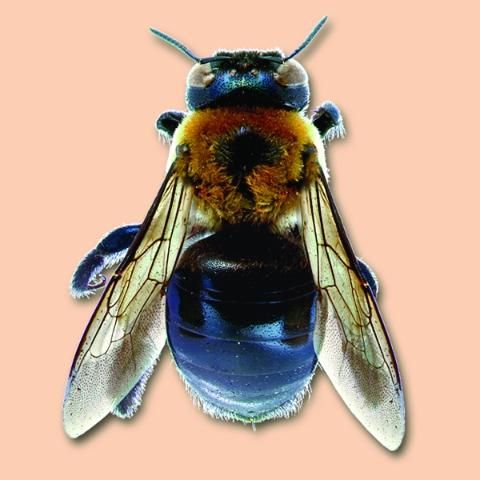
Bees are often confused with wasps. Although closely related, they differ in many ways. Bees feed pollen and nectar to their young. They are beneficial insects that pollinate fruits, vegetables and many other plants. The most common bees are the honey bee (Figure 1), bumble bee (Figure 2), and carpenter bee (Figure 3). Bees are not commonly serious problems and usually require no control.
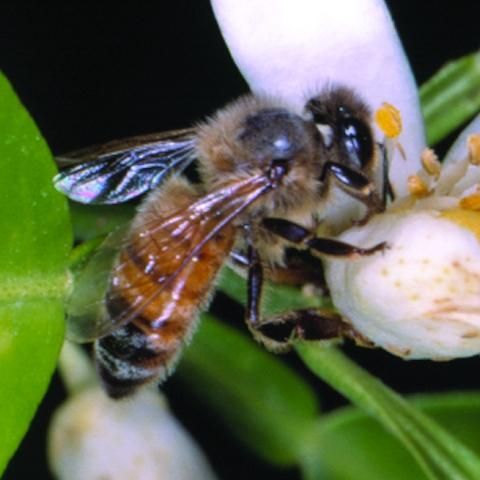
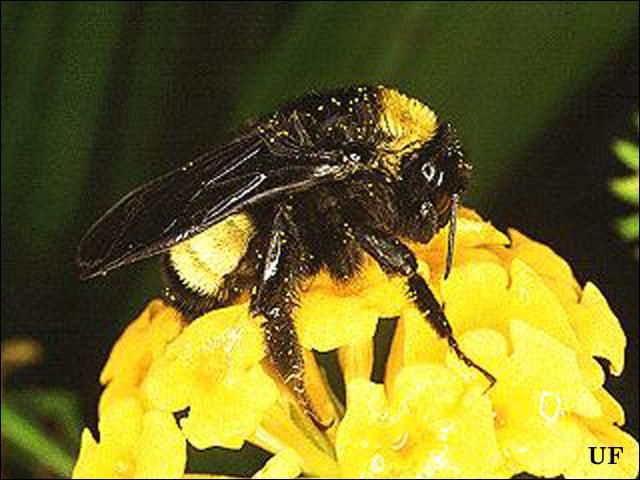
Figure 1. 

Honey bee.

Figure 2. 

Bumble bee.

Figure 3. 

Carpenter bee.

When stung by a honey bee, scrape the bee's stinger out of the wound immediately. Be careful not to pull it out. If you do, you will force poison into the wound. If the stinger is not removed, the poison gland attached to the stinger will continue to pump poison into the wound for several minutes. Wasps and other bees do not leave a stinger and are capable of stinging many times. At certain times of the year (spring and early summer), honey bee colonies divide by swarming. Swarms are not usually a problem unless they land in an inconvenient spot or enter a building. A honey bee colony in a building must be removed after it has been killed to prevent problems from odors of decaying bees, honey and other pests.

If a bee swarm is undesirable in trees (Figure 4), shrubbery or buildings, you may wish to contact a beekeeper, county agent or pest-control company to remove or kill the bees. Insecticide dusts are effective for killing bee colonies in buildings. Dusts may be applied for effective control. To control bees:

  1. Locate the colony in the wall at night by tapping and listening for the area of loudest buzzing. Bees keep the nest at 95°F so you may be able to feel the heat through the wall.

  2. At night, drill a small hole in the wall above the colony and apply dust through it or apply to honey bee entrance to colony.

  3. Seal all entrances and exits from the colony.

  4. After 2 weeks or when all sound and bee activity has stopped, open the wall and remove dead bees, comb and honey.

  5. Bury the comb or otherwise dispose of it, so valuable honey bee colonies will not be attracted to the contaminated residue and be destroyed.
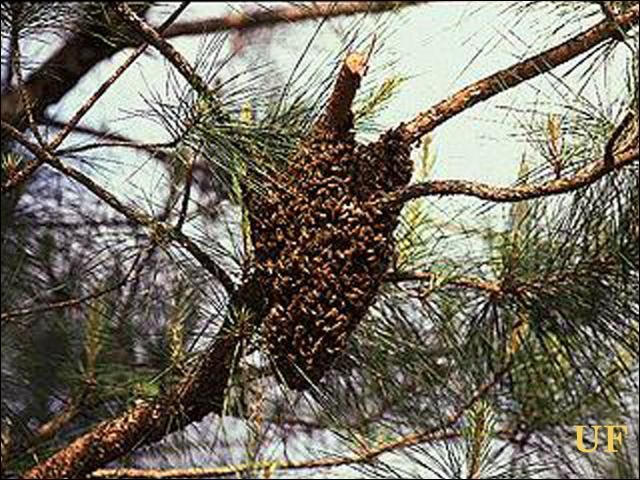
Figure 4. 

Honey bee swarm in tree.

Wasps

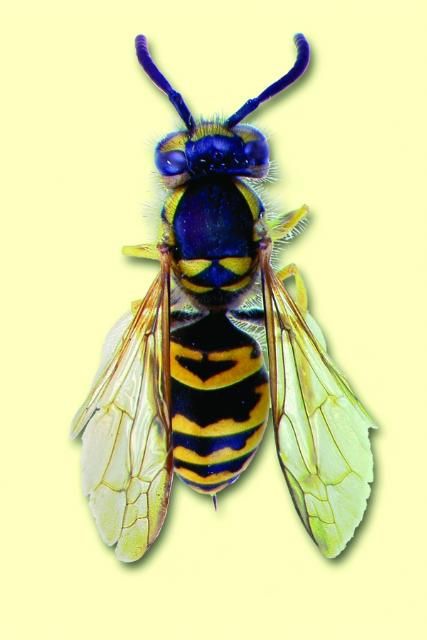
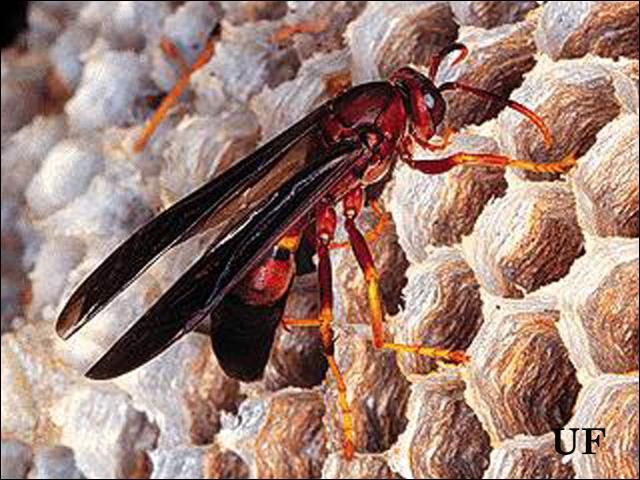
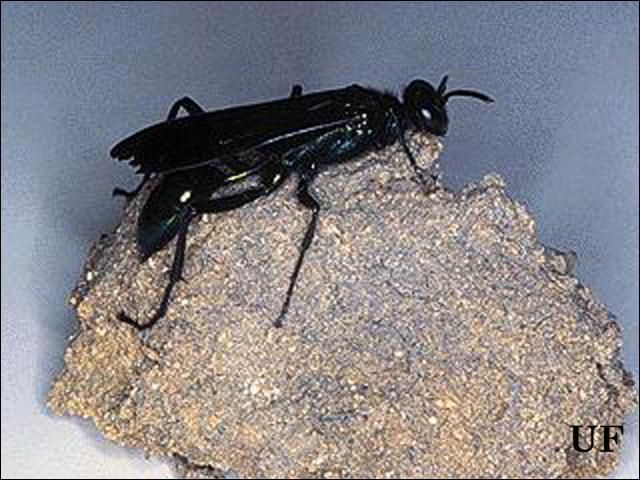
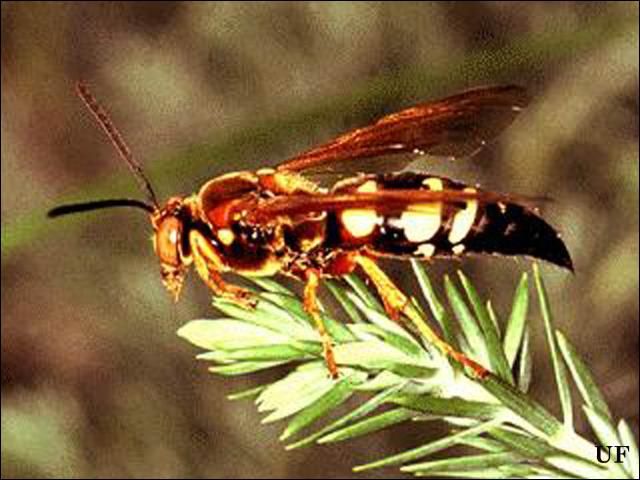
Hornets, yellow jackets (Figure 5), Polistes (Figure 6), mud daubers (Figure 7) and the cicada killers (Figure 8) are all wasps.

Figure 5. 

Yellow jacket.

Figure 6. 

Polistes, paper wasp.

Figure 7. 

Mud dauber wasp.

Figure 8. 

Cicada killer.

They are generally considered to be beneficial because they attack and destroy many harmful insects found around homes and gardens. Hornets and yellow jackets kill such pests as house flies, blow flies and various caterpillars. Polistes are predators of corn earworms, armyworms and many other garden pests. Though beneficial, wasps also attack people. If disturbed, hornets, yellow jackets and Polistes will sting. Mud daubers and cicada killers usually are not as aggressive and will not sting unless touched or accidentally caught in clothing. If wasps build nests on houses or in bushes where children play or living activities are carried on, nest destruction or chemical control is necessary. Wasps can usually be identified by their nests and their location. Hornets, Polistes and mud daubers build nests above the ground. Hornets and Polistes nest in trees, shrubbery and under eaves. Mud daubers nest under eaves, porch roofs or similar sheltered areas. Yellow jackets usually build their nests in the ground, but sometimes build them above the ground. Cicada killers nest in the ground.

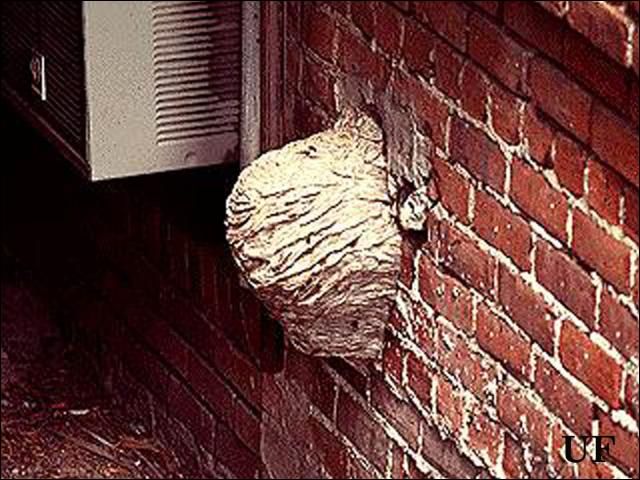
Hornets and yellow jackets build football-shaped paper-like nests (Figure 9). Polistes build paper-like nests that resemble a honeycomb (Figure 10). Mud daubers build clay or mud-cell nests. Cicada killers dig homes about one half inch across and pile the excavated soil around the opening.
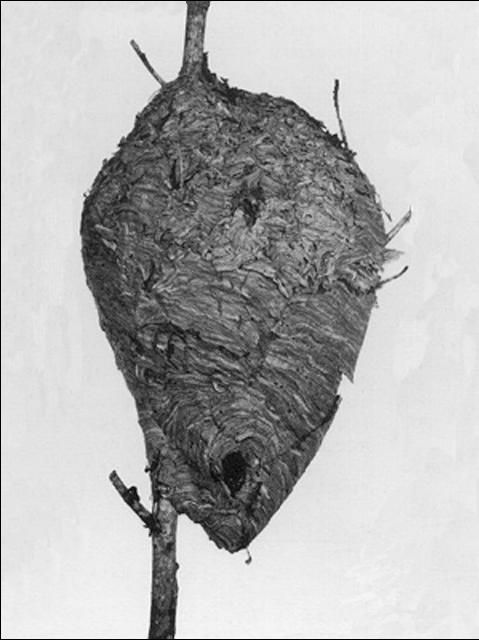
Figure 9. 

Hornet nest.

Figure 10. 

Polistes wasp nest.

Hornets, yellow jackets and Polistes are social insects and their colonies develop in a similar way. Adult females make up two castes: queen or fertile females which lay eggs; workers or sterile females which feed larvae and may lay eggs without mating if the queen dies during the season. In the fall, queens and males leave the nest and mate. The male dies and the surviving queens hibernate in cracks of rocks, under bark of trees, in buildings, or in the ground. In the spring the queen comes out of hibernation and builds a nest with a few shallow cells. An egg is laid in each cell and these hatch into worker larvae in 2 to 3 days. The queen feeds these larvae which develop in 12 to 18 days and spin cocoon caps over the cells and change into pupae. After the first brood emerges the queen resumes egg laying. The workers take charge of the nest, enlarging it and caring for the new larvae.

Mud daubers are solitary wasps. Each female constructs a clump of mud cells. There is no worker caste. In the spring, young adults come out of their nests and mate. The female then build mud-cell nests. After she completes the nest she captures about 20 spiders, paralyzing each with her sting as she catches it. Spiders are stored in the cell and she lays an egg on one of the spiders and caps the cell with clay. This is repeated until she has built one nest containing 6 to 20 cells. She may then build other nests in other locations. Once a nest is finished, she leaves it and never returns. The larvae hatch from the eggs and feed on the paralyzed spiders. Complete development takes place in the cell. One to three generations can develop in a year.

The cicada killer is also a solitary wasp. Its habits are similar to the mud dauber except it constructs its cells in the soil and provisions the cells with cicadas.

When a wasp stings it injects a venomous fluid under the skin. The venom causes a painful swelling that may last several days. In some cases a wasp sting may cause severe illness or even death.

Control

Wasps can be easily controlled by applying insecticides to the nest. However, there is usually a certain amount of risk. Nests should be treated at night to minimize the danger of being stung or protective clothing should be worn. Whatever spray is used, it should have a quick knockdown agent such as synergized pyrethrum or pyrethroids mixed with it.

Control Procedures

For below ground nests, locate nest and mark area so it is easy to find after dark. Use a flashlight covered with a red cellophane paper so wasps stay in their nest. At night, puff dusts into nest entrance and immediately throw a shovelful of moist soil over entrance. Be careful not to step into the nest.

For aerial nests, spray nests with pressurized containers with a pin-stream spray from a distance (20 ft.).

Indoor wasp nests should be controlled as honey bee colonies.

Scorpions

Scorpions (Figure 11) are flattened, crab-like animals having ten legs and a flesh tail, ending in an enlarged upturned tip which bears a stinger. They vary in size from one to four inches long. They normally live outdoors, though they will invade homes and buildings. Scorpions will sting, but usually only when provoked or disturbed. Scorpion venom is a neurotoxin, but the dose injected usually is insufficient to prove fatal to an adult human. None of the several species of scorpions which occur in Florida is capable of inflicting a lethal sting; however, the site of the sting may be sore and swollen for some time.
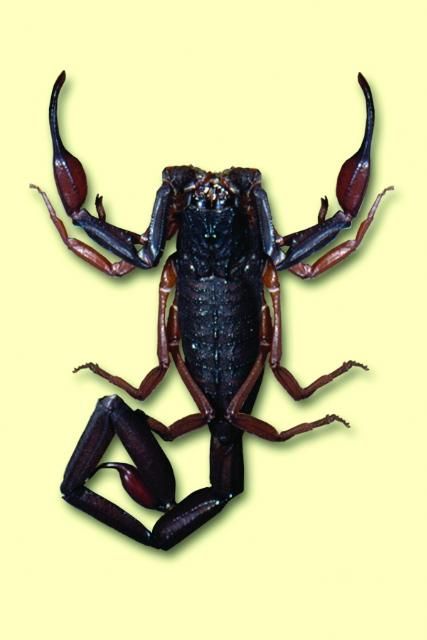
Figure 11. 

Scorpion.

Scorpions are most active at night. They hide under boards, rubbish, or similar debris which provide shelter and protection. Places commonly infested in a home are under the house or in the attic. They feed on insects, spiders, or similar small animal life.

Scorpions have a long life cycle, lasting three to five years. Males and females go through a courtship ritual prior to mating. Scorpions do not lay eggs and the young are born alive. After birth the young scorpions climb on the back of the mother and remain there until after their first molt. Scorpions are cannibalistic and will readily eat their own species. Females will often eat their own young.

Control

Mechanically destroy any scorpions found indoors by swatting or crushing. Clean out all possible hiding places. Hiding or breeding areas can be treated with sprays.

Ducks and chickens will eliminate most scorpions from around a building. During dry weather scorpions can be attracted and trapped by spreading moist burlap on the ground around infested areas.

Spiders

Almost all spiders in Florida are harmless to man. Most species do not bite unless provoked to attack. The widow spiders, primarily the brown widow (Figure 12), the southern black widow (Figure 13) and the northern black widow, are the most frequently found venomous spiders.

Figure 12. 

Brown widow spider.

Figure 13. 

Southern black widow spider.

The brown widow is established pretty much throughout the Florida peninsula. It is most common on, but not restricted to, buildings. They are also found on bridges and fences as well. The egg sac looks like an old naval mine or a sandspur seed. The spiders are extremely timid; the only bites reported have resulted from a spider being accidentally trapped against the victim's body. They reproduce rapidly, and one female can produce up to 18 egg sacs. Once encountered, a spider is indicative of a widespread population which is extremely difficult, if not impossible given available control methods, to eradicate.

The brown recluse spider (Figure 14) is not considered to be established in Florida although physicians have diagnosed its bites on patients.

Figure 14. 

Brown recluse spider.

Fire Ants

Fire ants (Figure 15) look like ordinary house ants; however, they are an aggressive ant capable of inflicting a painful sting. The colony of imported fire ants is a mound sometimes 3 feet across.

Figure 15. 

Imported fire ant.

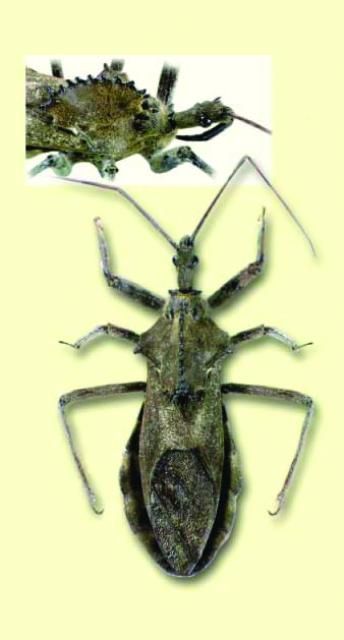
Wheel Bug

The wheel bug (Figure 16) is a predacious bug with a cog-like crest on its thorax. They feed on insects; however, humans are bitten by accidental contact. The bug penetrates the skin with its beak and injects a salivary fluid used to kill its prey. The fluid causes an immediate intense pain which lasts 3-6 hours. The best way to prevent wheel bug bites is to avoid the insect.

Figure 16. 

Wheel bug.

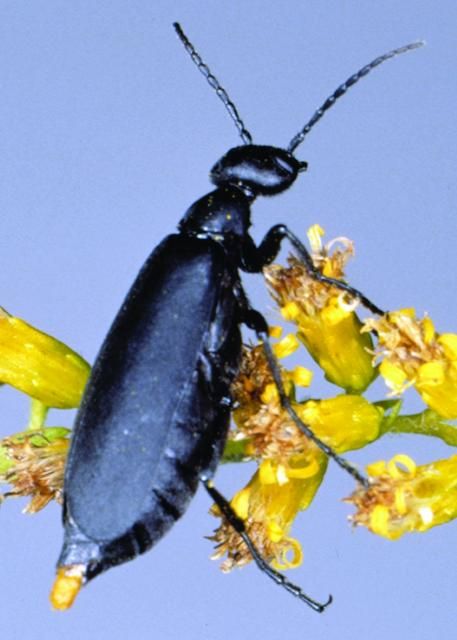
Blister Beetles

Blister beetles (Figure 17) are narrow beetles with a neck which is slenderer than the head and wings. Adult beetles can release a fluid which causes blisters on human skin. The larvae of blister beetles are harmless to man and are predaceous on other insects. The adult beetles feed on foliage, and persons often come into contact when moving through infested vegetation. The only suitable control of blister beetles is avoidance of individual beetles or chemical application to crop plants. It is necessary to check recommendations for the crop to determine the chemical to be used.

Figure 17. 

Blister beetle.

Stinging Caterpillars

Stinging caterpillars frequently found in Florida are the puss caterpillar, saddleback caterpillar, Io moth caterpillar, and the hag moth caterpillar. These caterpillars feed on vegetation and have spines which can break off in the skin. When the spines break, a toxin flows from the spines onto the skin, causing a burning sensation.

When working in an infested area, wear protective clothing.

Saddleback Caterpillar

This is a very unusual and striking insect (Figure 18). It is brown with a green back and flanks on which is a conspicuous, brown, oval-shaped central area usually bordered with white. The brown spot gives the appearance of a saddle and the green area appears to be a saddle blanket; hence, the common name. It may exceed an inch in length and is stout bodied. The primary nettling hairs are borne on the back of paired fleshy protuberances toward the front and hind ends of the body. There is also a row of smaller stinging organs on each side. The saddleback caterpillar feeds on many plants including hibiscus and palms, and appears to show little host preference.

Figure 18. 

Saddleback caterpillar.

Puss Caterpillar

It is a convex, stout bodied larva, almost 1" long when mature and completely covered with gray to brown hairs. Under the soft hairs are stiff spines that are attached to poison glands. When touched, these poisonous spines break off in the skin and cause severe pain. Puss caterpillars (Figure 19) feed on a variety of broadleaf trees and shrubs, but prefer oaks and citrus. In Florida, there appear to be two generations per year, one in spring and the other in the fall. Natural enemies keep these caterpillars at low numbers during most years; however, they periodically become numerous.

Figure 19. 

Puss caterpillar.

Hag Moth Caterpillar

This caterpillar is light to dark brown in color. It has nine pairs of variable length lateral processes that bear the stinging hairs. These processes are curved and twisted and likened by some to the disheveled hair of a hag, for which it is aptly names. The hag moth caterpillar (Figure 20) is found on various forest trees and ornamental shrubs, but is not as common as the other stinging species.

Figure 20. 

Hag moth caterpillar.

Io Moth Caterpillar

This is a pale green caterpillar (Figure 21) with yellow and red stripes. It often exceeds 2" in length and is fairly stout bodied. The nettling organs are borne on fleshy tubercles, and the spines are usually yellow with black tips. Io moth caterpillars feed on a wide range of plants; however ixora and roses are favorite hosts.

Figure 21. 

Io moth caterpillar.

Velvet Ant

Velvet ants (Figure 22) belong to a large family (Mutillidae), and look like wingless, ant-like wasps. The females are solitary with an efficient, large stinger. Most species are parasitic on solitary bees and wasp species.
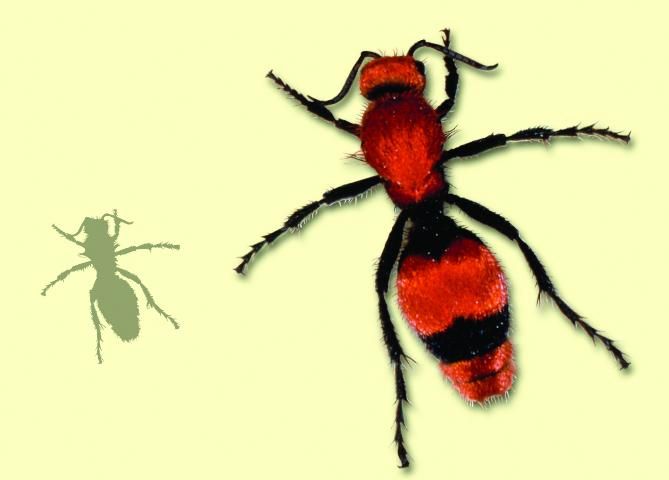
Figure 22. 

Velvet ant.

Humans are usually stung by velvet ants when the female is accidentally stepped on with bare feet or trapped against the body in clothing or bedding. Since the velvet ant is solitary and roaming, control is difficult.

Stinging/venomous Insect Control

Stinging/Venomous insects' can be managed using a variety of control methods. Baits listed in Table 2 are usually used to control ant infestations. Crack and crevice or surface treatments in Table 3 can be used to control insects located in harborages or on surfaces inside the house. Flying stinging insects can be controlled indoors by using aerosols listed in Table 4. Stinging insects nesting in wall voids or attics can be controlled with products in Table 5. Outdoor barrier treatments listed in Table 6 can be used to control insects nesting around the perimeter of houses. Broadcast treatments in Table 7 can be used for control of infestations located in areas of lawns and landscapes around homes.

Tables

Table 1. 

Summary of Important Stinging Arthropods.

Pest

Description

Nest

Biting or Stinging Ability

Honey Bee

2/3 in., yellow and black or brown, body covered with hairs. Made of wax cells, found in wall voids or under slab foundations. Yes

Bumble Bee

1 in., black and yellow body covered with hair. Made of wax cells, below ground, under slabs, in wall voids. Yes

Hornets and Yellow Jackets

3/4 in., black with yellow or white markings.

Made of papery material. Nests either aerial or below ground or both. Nests large and globular.

Yes

Polistes

3/4 - 1 in., black or brown with red and a few small yellow markings. Made of papery material. One circular comb of cells opening downward commonly under eaves or window ledges. Yes

Mud Daubers

3/4 - 1 in., black and yellow, or metallic blue, or shiny black. Made of clay or mud. Usually along eaves or in garages. Rarely sting.

Cicada Killer

1 1/2 in., black with yellow markings. Solitary, digs in soil. Females sting only when handled.

Scorpion

1 - 4 in., have 10 legs with tail which bears a stinger. Hide under boards, rubbish, and debris, solitary. Yes -- Florida species do not have a lethal sting.

Spiders

Depend on species, 8 legs, 2 body regions.

Widespread and solitary.

Brown recluse and widow spiders are the only dangerous species. Other species are not considered dangerous.

Brown Recluse

Brown with fiddle-like mark on cephalothorax, 6 eyes.

Yes

Black Widow

Black with red hourglass mark on underside of abdomen, 8 eyes. Yes

Fire Ants

1/16 - 1/4 in., yellowish to dark red with stinger on end of abdomen. Mounds 3 - 36 in. high with surrounding vegetation undisturbed. Yes

Wheel Bug

1 - 1 1/2 in., cog-like wheel on top of thorax. Solitary, occur in vegetation and debris. Bite only when handled.

Blister Beetle

1/2 - 3/4 in. beetle with thorax narrower than head or wings. Solitary. Secrete an irritating substance when disturbed.

Stinging Caterpillars Io Moth

Buck Moth

Puss Moth

Saddleback

Slug Moth

Depend on species, usually have long and short hairs. Solitary, occur in vegetation and debris. Hollow hairs with poison sac. Sharp hairs penetrate skin.
Velvet Ant 1/2 - 1 in., wingless and ant-like, covered with hair, bright red, orange, or yellow. Solitary on ground. Sting only when handled or trapped.
Table 2. 

Products labeled for bait treatment of stinging or venomous insects.1, 2

Common Name

Homeowner Trade Name1

Commercial Trade Name1

Arsenic Trioxide

Grant's Kills Ants (FA)2

Avermectin B1

Raid Ant Baits II (FA)2

Disodium Octaborate Tetrahydrate

Gourmet Ant Bait (FA)2

Gourmet Ant Bait Gel (FA)2

Uncle Albert's Super Smart Ant Bait (FA)2

Fipronil MaxForce FC Ant Bait Stations
Hydramethylnon MaxForce Ant Killer Bait Stations
Orthoboric Acid

Dr. Moss's Liquid Bait System

PT Advance Liquid Ant Bait

Sodium Tetraborate Decahydrate (Borax)

Terro Ant Killer (FA)2

Terro Liquid Ant Killer II (FA)2

Sulfluramid

MaxAttrax Ant Bait (FA)2

Raid Ant Baits Plus (FA)2

Raid Double Control Ant Baits (FA)2

FluorGuard Ant Control Baits

PT Advance Dual Choice

1 Read label carefully to insure pest, site and commodity are listed prior to applying product. Some product labels are very restrictive.

2 B = Honey Bees, FA = Fire Ants, H = Hornets, S = Scorpions, SP = Spiders, W = Wasps, and YJ = Yellow Jackets.

Table 3. 

Products labeled for indoor crack and crevice or surface treatment of stinging or venomous insects.1, 2

Common Name

Homeowner Trade Name1

Commercial Trade Name1

Abamectin

PT Advance Granular Ant Bait (FA)2

Abamectin B1

PT Advance 375A (FA)2

PT Advance Granular Carpenter Ant Bait (FA)2

PT Ascend Fire Ant Bait (FA)2

Acephate

PT Orthene Crack & Crevice Pressurized Residual (FA, SP)2

Beta-Cyfluthrin

Bayer Power Force Carpenter Ant & Termite Killer Plus (FA, S, SP)2

Bifenthrin

Ortho Home Defense Perimeter & Indoor Insect Killer (FA)2

Ortho Termite & Carpenter Ant Killer

(H, W, YJ)2

Talstar F Insecticide/Miticide

(B, FA, H, S, SP, W, YJ)2

Talstar Termiticide/Insecticide

(B, FA, H, S, SP, W, YJ)2

Boric Acid

PT Perma Dust Pressurized Boric Acid Dust (FA, S, SP)2

Chlorfenapyr

Phantom (FA)2

Cyfluthrin

Bayer Advanced Home, Home Pest Control Indoor & Outdoor Insect Killer (FA, H, SP, W, YJ)2

PT Cy-Kick Crack & Crevice Pressurized Residual (FA, S, SP)2

PT Cy-Kick CS Controlled Release Cyfluthrin (FA, SP)2

PT Cy-Kick CS Pressurized Crack & Crevice Residual (FA, SP)2

Tempo 20 WP (FA, H, SP, W, YJ)2

Tempo SC Ultra (FA, H, SP, W, YJ)2

Cypermethrin

Cynoff EC (B, FA, H, SP, W, YJ)2

Cynoff Power Spray Insecticide

(B, FA, H, SP, W, YJ)2

Cynoff WP (B, FA, SP, W, YJ)2

Cynoff WSB (B, FA, H, SP, W, YJ)2

Prevail FT Termiticide (B, FA, H, SP, W, YJ)2

Deltamethrin

DeltaDust (FA, S, SP)2

Suspend SC Insecticide (FA, S, SP)2

Disodium Octaborate Tetrahydrate

Uncle Albert's Super Smart Ant Bait

(FA)2

NiBor-D

Hydramethylnon

Eclipse (FA)2

MaxForce Fine Granule Insect Bait (FA)2

MaxForce Fire Ant Killer Granular Bait (FA)2

MaxForce Granular Insect Bait (FA)2

SiegePro Fire Ant Bait (FA)2

Imiprothrin, Deltamethrin

Raid Max Roach Killer 7 (FA, SP)2

Lambda Cyhalothrin

PT 221L (FA, S, SP)2

Orthoboric Acid

Drax Ant Kil Gel (FA)2

Drax Ant Kil--PF (FA)2

InTice Sweet Ant Gel (FA)2

Niban FG (FA)2

Niban Granular Bait (FA)2

Snuffer (FA)2

Permethrin

Ortho Ant-B-Gon Dust (FA)2

Dragnet SFR Termiticide/Insecticide

(B, FA, H, S, SP, W, YJ)2

Prallethrin

PT ULD SPy-300 (FA, SP)2

Prallethrin, Esfenvalerate, MGK-264 synergist

Ortho Roach, Ant & Spider Killer

(FA, S, SP)2

Propetamphos

Catalyst (FA, SP)2

Pyrethrins

Kicker (FA)2

PT Tri-Die Silica & Pyrethrum Dust

(FA, S, SP)2

PT ULD BP-300 (FA, H, S, SP, W, YJ)2

Pyrethrins and Others

PT 565 Plus XLO (FA, SP)2

PT Microcare CS Controlled Release Pyrethrum (FA, S, SP)2

PT Microcare Pressurized Pyrethrum Capsule Suspension (FA, SP)2

PT Tri-Die Pressurized Silica & Pyrethrin Dust (FA, S, SP)2

PT ULD BP-100 (FA, SP)2

Pyrethrins, MGK-264, Permethrin

Ortho Ant-B-Gon (FA, SP)2

Pyrethrins, PBO

PT P.I. Contact Insecticide (FA, SP)2

PT ULD BP-50 (FA, S, SP)2

Pyrenone 100 (B, FA, H, W, YJ)2

Synerol Insecticide (FA, H, W, YJ)2

Pyrethrins, PBO, Silica Gel

Drione (B, FA, H, SP, W, YJ)2

Pyrethrins, PCO

Pyrenone 50 (FA, S, SP)2

Tau-Fluvalinate

Yardex Supplemental Labelling (FA)2

Tetramethrin, Phenothrin

Ortho Flying Insect Killer 1 (FA, SP)2

Tralomethrin

Saga WP Insecticide (FA, S, SP)2

Tralomethrin, d-trans-allethrin

Spectracide Wasp and Hornet Killer (FA)2

1 Read label carefully to insure pest, site and commodity are listed prior to applying product. Some product labels are very restrictive.

2 B = Honey Bees, FA = Fire Ants, H = Hornets, S = Scorpions, SP = Spiders, W = Wasps, and YJ = Yellow Jackets.

Table 4. 

Products labeled for indoor space treatment of stinging or venomous insects.1, 2

Common Name

Homeowner Trade Name1

Commercial Trade Name1

Prallethrin

PT ULD SPy-300 (FA, H, SP, W, YJ)2

Pyrethrins

Kicker (FA)2

PT ULD BP-300 (FA, H, S, SP, W, YJ)2

Pyrethrins and Others

PT 565 Plus XLO (FA, SP)2

PT Microcare CS Controlled Release Pyrethrum (B, H, SP, W, YJ)2

PT Pro-Control (FA, H, SP, W, YJ)2

PT Pro-Control Plus (FA, H, SP, W, YJ)2

PT ULD BP-100 (FA, SP)2

Pyrethrins, PBO

PT P.I. Contact Insecticide (FA, SP)2

PT ULD BP-50 (FA, H, S, SP, W, YJ)2

Pyrenone 100 (B, FA, H, W, YJ)2

Synerol Insecticide FA, H, W, YJ)2

Turbocide Gold with Pyrenone (FA, SP)2

Pyrethrins, PCO

Pyrenone 50 (FA, H, S, W, YJ)2

Pyrethrins, Permethrin

Ortho Indoor Insect Fogger

(FA, SP, YJ)2

Tetramethrin, Phenothrin

Ortho Flying Insect Killer 1 (H, W, YJ)2

1 Read label carefully to insure pest, site and commodity are listed prior to applying product. Some product labels are very restrictive.

2 B = Honey Bees, FA = Fire Ants, H = Hornets, S = Scorpions, SP = Spiders, W = Wasps, and YJ = Yellow Jackets.

Table 5. 

Products labeled for voids and attic treatment of stinging or venomous insects.1, 2

Common Name

Homeowner Trade Name1

Commercial Trade Name1

Abamectin B1

PT Ascend Fire Ant Bait (FA)2

Acephate

PT Orthene Crack & Crevice Pressurized Residual (FA, SP)2

Boric Acid

PT Perma Dust Pressurized Boric Acid Dust (FA, , SP)2

Deltamethrin

DeltaDust (B, FA, , S, SP, W, YJ)2

Suspend SC Insecticide (FA, S, SP)2

Disodium Octaborate Tetrahydrate

NiBor-D (FA)2

Hydramethylnon

Eclipse (FA)2

MaxForce Fine Granule Insect Bait (FA)2

MaxForce Fire Ant Killer Granular Bait (FA)2

MaxForce Granular Insect Bait (FA)2

SiegePro Fire Ant Bait (FA)2

Orthoboric Acid

Niban FG (FA)2

Niban Granular Bait (FA)2

Snuffer (FA)2

Pyrethrins

PT Tri-Die Silica & Pyrethrum Dust

(B, FA, H, S, SP, W, YJ)2

Pyrethrins and Others

PT 565 Plus XLO (FA, SP)2

PT Tri-Die Pressurized Silica & Pyrethrin Dust (FA, S, SP)2

Pyrethrins, PBO

PT P.I. Contact Insecticide

(B, FA, H, SP, W, YJ)2

Pyrethrins, PBO, Silica Gel

Drione (FA, )2

1 Read label carefully to insure pest, site and commodity are listed prior to applying product. Some product labels are very restrictive.

2 B = Honey Bees, FA = Fire Ants, H = Hornets, S = Scorpions, SP = Spiders, W = Wasps, and YJ = Yellow Jackets.

Table 6. 

Products labeled for outdoor barrier treatment of stinging or venomous insects.1, 2

Common Name

Homeowner Trade Name1

Commercial Trade Name1

Abamectin PT Advance Granular Ant Bait
Abamectin B1

PT Advance 375A (FA)2

PT Advance Granular Carpenter Ant Bait (FA)2

Acephate

PT Orthene Crack & Crevice Pressurized Residual (FA, SP)2

Beta-Cyfluthrin

Bayer Power Force Carpenter Ant & Termite Killer Plus (FA, S, SP)2

Bifenthrin

Ortho Home Defense Perimeter & Indoor Insect Killer (FA, S, SP)2

Ortho Termite & Carpenter Ant Killer (FA, H, S, SP, W, YJ)2

Talstar CA Granular Insecticide (FA)2

Talstar EX Granular Insecticide (FA)2

Talstar F Insecticide/Miticide

(B, FA, H, S, SP, W, YJ)2

Talstar GC Granular Insecticide (FA)2

Talstar PL Granular Insecticide (FA)2

Talstar Termiticide/Insecticide

(B, FA, H, SP, W, YJ)2

Carbaryl

Ortho Bug-B-Gon Multipurpose Insect Killer Ready-to-Use Granules

(FA, S, SP)2

Carbaryl, Metaldehyde

Ortho Bug-Geta Plus (FA)2

Cyfluthrin

Bayer Advanced Home, Home Pest Control Indoor & Outdoor Insect Killer (B, FA, H, S, SP, W, YJ)2

Bayer Advanced Lawn & Garden Multi-Insect Killer (FA, S, SP)2

Bayer Power Force Ant Killer Ready-to-Use Granules

(FA, S, SP)2

Bayer Power Force Multi-Insect Killer Ready-to-Spray

(FA, H, SP, W, YJ)2

Bayer Power Force Multi-Insect Killer Ready-to-Spread Granules

(FA, S, SP)2

Bayer Power Force Multi-Insect Killer Ready-to-Use (FA, H, W, YJ)2

PT Cy-Kick CS Controlled Release Cyfluthrin (B, FA, H, S, SP, W, YJ)2

PT Cy-Kick Crack & Crevice Pressurized Residual (FA, S, SP)2

PT Cy-Kick CS Pressurized Crack & Crevice Residual (FA, SP)2

Tempo 20 WP (B, FA, H, S, SP, W, YJ)2

Tempo SC Ultra (FA, H, S, SP, W, YJ)2

Cypermethrin

Cynoff EC (B, FA, H, SP, W, YJ)2

Cynoff Power Spray Insecticide

(B, FA, H, SP, W, YJ)2

Cynoff WP (B, FA, H, SP, W, YJ)2

Cynoff WSB (B, FA, H, SP, W, YJ)2

Prevail FT Termiticide (B, FA, H, SP, W, YJ)2

Deltamethrin

DeltaDust (B, FA, H, S, SP, W, YJ)2

DeltaGard G (FA)2

Suspend SC Insecticide (FA)2

Esfenvalerate

Ortho Bug-B-Gon Multipurpose Insect Killer (FA, SP)2

Ortho Bug-B-Gon Multipurpose Insect Killer Ready-to-Use (FA, SP)2

Hydramethylnon

Eclipse (FA)2

Lambda Cyhalothrin

PT 221L (FA, S, SP)2

Malathion

Ortho Malathion 50 Plus Insect Spray (FA, SP)2

Orthoboric Acid

Niban FG (FA)2

Niban Granular Bait (FA)2

Permethrin

Ortho Bug-B-Gon Multipurpose Insect Killer Ready-Spray (FA, S, SP)2

Astro Insecticide (B, FA, H, S, SP, W, YJ)2

Dragnet SFR Termiticide/Insecticide

(B, FA, H, S, SP, W, YJ)2

Prallethrin, Esfenvalerate, MGK-264 synergist

Ortho Roach, Ant & Spider Killer

(FA, S, SP)2

Pyrethrins

Kicker (B, FA, H, SP, W, YJ)2

PT Tri-Die Silica & Pyrethrum Dust

(FA, S, SP)2

Pyrethrins and Others

PT Microcare CS Controlled Release Pyrethrum (B, FA, H, S, SP, W, YJ)2

PT Microcare Pressurized Pyrethrum Capsule Suspension

(B, FA, H, SP, W, YJ)2

PT Tri-Die Pressurized Silica & Pyrethrin Dust (FA, S, SP)2

Pyrethrins, MGK-264, Permethrin

Ortho Ant-B-Gon (SP)2

Pyrethrins, PBO, Silica Gel

Drione (S)2

Tau-Fluvalinate

Yardex Supplemental Labeling (FA)2

Tralomethrin

Saga WP Insecticide (FA)2

1 Read label carefully to insure pest, site and commodity are listed prior to applying product. Some product labels are very restrictive.

2 B = Honey Bees, FA = Fire Ants, H = Hornets, S = Scorpions, SP = Spiders, W = Wasps, and YJ = Yellow Jackets.

Table 7. 

Products labeled for outdoor broadcast treatment of stinging or venomous insects.1, 2

Common Name

Homeowner Trade Name1

Commercial Trade Name1

Abamectin

PT Advance Granular Ant Bait (FA)2

Abamectin B1

PT Advance 375A (FA)2

PT Advance Granular Carpenter Ant Bait (FA)2

PT Ascend Fire Ant Bait (FA)2

Beta-Cyfluthrin

Bayer Power Force Carpenter Ant & Termite Killer Plus (FA, S, SP)2

Bifenthrin

Ortho Fire Ant Killer Granules (FA)2

Ortho Fire Ant Killer Granules 2 (FA)2

Ortho Lawn Insect Killer Granules (FA, S, SP)2

Talstar CA Granular Insecticide (FA)2

Talstar EX Granular Insecticide (FA)2

Talstar F Insecticide/Miticide

(B, FA, H, S, SP, W, YJ)2

Talstar GC Granular Insecticide (FA)2

Talstar PL Granular Insecticide (FA)2

Talstar Termiticide/Insecticide

(B, FA, H, S, SP, W, YJ)2

Carbaryl, Metaldehyde

Ortho Bug-Geta Plus (FA)2

Cyfluthrin

Bayer Advanced Home, Home Pest Control Indoor & Outdoor Insect Killer (B, FA, H, S, SP, W, YJ)2

Bayer Advanced Lawn & Garden Multi-Insect Killer (FA)2

Bayer Power Force Ant Killer Ready-to-Use Granules (FA)2

Bayer Power Force Multi-Insect Killer Ready-to-Spread Granules (FA)2

Tempo 20 WP (B, FA, H, S, SP, W, YJ)2

Tempo SC Ultra (FA, H, S, SP, W. YJ)2

Deltamethrin

DeltaGard G (FA)2

Esfenvalerate

Ortho Bug-B-Gon Multipurpose Insect Killer (FA, SP)2

Fenoxycarb

Award (FA)2

Fipronil

Over 'n Out Fire Ant Killer Granules (FA)2

Firestar Fire Ant Bait (FA)2

Hydramethylnon

Amdro (FA)2

Eclipse (FA)2

MaxForce Fine Granule Insect Bait (FA)2

MaxForce Fire Ant Killer Granular Bait (FA)2

MaxForce Granular Insect Bait (FA)2

Probait (FA)2

SiegePro Fire Ant Bait (FA)20

Malathion

Ortho Malathion 50 Plus Insect Spray (FA, SP)2

Methoprene

Extinguish (FA)2

Extinguish Professional Fire Ant Bait (FA)2

Orthoboric Acid

InTice Ant Granules (FA)2

Niban Granular Bait (FA)2

Permethrin

Dragnet SFR Termiticide/Insecticide

(FA, SP)2

Pyriproxyfen

Spectracide Fire Ant Bait (FA)2

Distance Fire Ant Bait (FA)2

Spinosad

Justice Fire Ant Bait (FA)2

1 Read label carefully to insure pest, site and commodity are listed prior to applying product. Some product labels are very restrictive.

2 B = Honey Bees, FA = Fire Ants, H = Hornets, S = Scorpions, SP = Spiders, W = Wasps, and YJ = Yellow Jackets.

Footnotes

1.

This document is ENY-215 (IG099), one of a series of the Entomology and Nematology Department, Florida Cooperative Extension Service, Institute of Food and Agricultural Sciences, University of Florida. Publication date: October 1994. Revised: March 2003. Reviewed: June 2007. Please visit the EDIS Website at http://edis.ifas.ufl.edu.

2.

P. G. Koehler, professor, and F. M. Oi, assistant extension scientist, Entomology and Nematology Department, Cooperative Extension Service, Institute of Food and Agricultural Sciences, University of Florida, Gainesville, 32611.

The use of trade names in this publication is solely for the purpose of providing specific information. UF/IFAS does not guarantee or warranty the products named, and references to them in this publication does not signify our approval to the exclusion of other products of suitable composition. Use pesticides safely. Read and follow directions on the manufacturer's label.


The Institute of Food and Agricultural Sciences (IFAS) is an Equal Opportunity Institution authorized to provide research, educational information and other services only to individuals and institutions that function with non-discrimination with respect to race, creed, color, religion, age, disability, sex, sexual orientation, marital status, national origin, political opinions or affiliations. For more information on obtaining other extension publications, contact your county Cooperative Extension service.

U.S. Department of Agriculture, Cooperative Extension Service, University of Florida, IFAS, Florida A. & M. University Cooperative Extension Program, and Boards of County Commissioners Cooperating. Millie Ferrer-Chancy, Interim Dean.