Rice Weevil, Sitophilus oryzae (Coleoptera: Curculionidae) Rice Weevil, Sitophilus oryzae (Coleoptera: Curculionidae)
Rice Weevil, Sitophilus oryzae (Coleoptera: Curculionidae)1
P. G. Koehler2Appearance
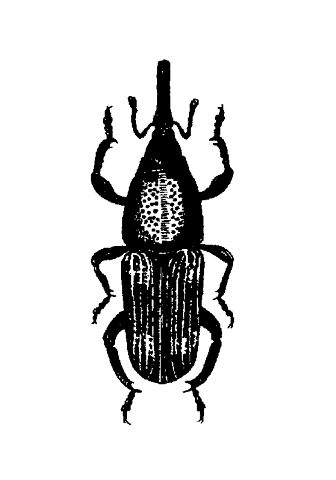
The rice weevil ( Figure 1 ) is small, 1/10 inch (2 to 3 mm) and stout in appearance. It is very similar in appearance to the granary weevil. However, the rice weevil is reddish-brown to black in color with four light yellow or reddish spots on the corners of the elytra (the hard protective forewings). The snout is long (1 mm), almost 1/3 of the total length. The head with snout is as long as the prothorax or the elytra. The prothorax (the body region behind the head) is strongly pitted and the elytra have rows of pits within longitudinal grooves. The larva is legless and stays inside the hollowed grain kernel. It is fat with a cream colored body and dark head capsule.
![]()
Figure 1. Rice weevil. Habits
The rice weevil is one of the most serious stored grain pests worldwide. This pest of whole grain originated in India and has been spread worldwide by commerce. It now has a cosmopolitan distribution. It is a serious pest in the southern United States. The rice weevil is replaced by the granary weevil north of North Carolina and Tennessee. Both the adults and larvae feed on whole grains. They attack wheat, corn, oats, rye, barley, sorghum, buckwheat, dried beans, cashew nuts, wild bird seed, and cereal products, especially macaroni. The adult rice weevil can fly and is attracted to lights. When disturbed, adults pull in their legs, fall to the ground, and feign death. The larval rice weevil must complete its development inside a seed kernel or a man-made equivalent, like macaroni products. Larval rice weevils have been known to develop in hard caked flour. The adult female eats a cavity into a seed and then deposits a single egg in the cavity, sealing in the egg with secretions from her ovipositor. The larva develops within the seed, hollowing it out while feeding. The larva then pupates within the hollow husk of the grain kernel.Biology
The adult female rice weevil lays an average of 4 eggs per day and may live for four to five months. The full life cycle may take only 26 to 32 days during hot summer months, but requires a much longer period during cooler weather. The eggs hatch in about 3 days. The larvae feed inside the grain kernel for an average of 18 days. The pupa is naked and the pupal stage lasts an average of 6 days. The new adult will remain in the seed for 3 to 4 days while it hardens and matures.Control
The most important aspect of control is location of the source of the infestation. Place sticky traps around the room to locate the infestation, if not initially or easily located. Sticky traps with a higher density of rice weevils attached are probably closest to the infestation site. Common sources of infestations include decorative "Indian corn" saved from Thanksgiving, wild bird seed, dry plant arrangements that contain wheat or other seed heads, popcorn, beanbags or toys stuffed with grain, macaroni products, and seeds for sprouting. Infested materials should be destroyed or disposed of. All life stages can be killed by extreme heat (120°F for one hour) or cold (0°F for a week). The best control measure is to store products likely to be infested in pest-proof containers of plastic, glass, or metal. Seeds and nuts can be stored long term by adding a 1 inch cube of dry ice (solid carbon dioxide) to a quart mason jar of seeds and sealing the lid. The carbon dioxide atmosphere discourages all stored product pests.Infestations in non-food areas can be treated with space sprays or crack and crevice treatments with residual insecticides having rice weevils listed on the label. Infestations in large quantities of grain are controlled by fumigation.
Tables
Table 1. Pesticides Available for Rice Weevil.
Trade Name (Formulation)
Common Name - %
Site(s)
Pest(s)
Re-Entry Time
Preharvest Time
Retreatment Interval
CB-38 Extra (Aerosol) Pyrethrins - 0.30% Hotels/motels Rice Weevils None None None Hospitals, Day Care Centers, Schools Rice Weevils None None None Spray into cracks and crevices, around cartons or containers and other areas where these insects tend to congregate. Spray 30 seconds for each 100 square feet of surface. Keep area closed for 45 minutes to 1 hour after treatment. Conquer (Emulsifiable concentrate) Esfenvalerate - 3.48% Commercial Warehouses/Industrial Buildings/Storage Buildings Rice Weevils Do not contact until dry None 14 days Infested stored products should be removed and destroyed, fumigated or treated with other products approved for this use. Use in mechanical aerosol foggers. Keep area closed for at least 1/2 hour and ventilate thoroughly before re-entry. Do not remain in treated area. Demand CS (Microcapsulated suspension) Lambda-cyhalothrin - 9.7% Hotels/Motels Rice Weevils Do not contact until dry None 3 weeks For use as a general surface spray and crack and crevice or spot treatment in, on, or around buildings and structures and their immediate surroundings. P.I. Contact Insecticide (Formula 1) (Aerosol) Pyrethrins + Piperonyl Butoxide - 0.5 + 4.0% Hospitals Rice Weevils 2 hrs after None None Patients should be removed from room. For exposed adult and larval stages only. Contact as many insects as possible. Inject into cracks and crevices. Repeat treatment as necessary. Also apply as space treatment. Patients should be removed from room prior to treatment. Room should be ventilated for at least 2 hours after spraying. Do not return patients to room until after ventilation. Nursing Homes Rice Weevils Well ventilated. None None Patients should be removed from room. For exposed adult and larval stages only. Contact as many insects as possible. Inject into cracks and crevices. Repeat treatment as necessary. Also apply as space treatment. Patients should be removed from room prior to treatment. Room should be ventialted for at least 2 hours after spraying. Do not return patients to room until after ventilation. Pestab (Wettable/soluble powder) Lambda-cyhalothrin - 10.0% Restaurants/Commercial Kitchens Rice Weevils Do not contact until dry None 3 weeks Use as a crack and crevice or spot treatment to selective surfaces. Do not apply when facility is in operation or when foods are exposed. Grocery Stores/Supermarkets, Hotels/motels Rice Weevils Do not contact until dry None 3 weeks Apply as a crack and crevice or spot treatment to selective surfaces. Do not apply when facility is in operation or food is exposed. Pro-Control Plus Total Release Aerosol Insecticide (Aerosol) Pyrethrins + Cyfluthrin + Piperonyl Butoxide - 0.5 + 0.1 + 1.0% Hospitals, Nursing Homes Rice Weevils 2 hours None None Do not apply this product in any rooms while occupied by patients, the elderly, or infirmed. Open doors, drawers, and closets. Shut off fans and air conditioning. Set fogger on stand. Immediately leave treated area. Keep area closed for at least 2 hours. Allow treated area to air for 30 minutes. Day Care Centers, Schools Rice Weevils 2 hours None None Do not apply in classroom when in use. Open doors, drawers, and closets. Shut off fans and air conditioning. Set fogger on stand. Immediately leave treated area. Keep area closed for at least 2 hours. Allow treated area to air for 30 minutes.
Footnotes
1. This document is ENY-261, one of a series of the Entomology and Nematology Department, Florida Cooperative Extension Service, Institute of Food and Agricultural Sciences, University of Florida. Publication date: March 1994. Revised: June 2005. Reviewed: June 2008. Please visit the EDIS Website at http://edis.ifas.ufl.edu.2. P. G. Koehler, professor/extension entomologist, Entomology and Nematology Department, Cooperative Extension Service, Institute of Food and Agricultural Sciences, University of Florida, Gainesville, 32611.
The Institute of Food and Agricultural Sciences (IFAS) is an Equal Opportunity Institution authorized to provide research, educational information and other services only to individuals and institutions that function with non-discrimination with respect to race, creed, color, religion, age, disability, sex, sexual orientation, marital status, national origin, political opinions or affiliations. For more information on obtaining other extension publications, contact your county Cooperative Extension service.
U.S. Department of Agriculture, Cooperative Extension Service, University of Florida, IFAS, Florida A. & M. University Cooperative Extension Program, and Boards of County Commissioners Cooperating. Larry Arrington, Dean.
Copyright Information
This document is copyrighted by the University of Florida, Institute of Food and Agricultural Sciences (UF/IFAS) for the people of the State of Florida. UF/IFAS retains all rights under all conventions, but permits free reproduction by all agents and offices of the Cooperative Extension Service and the people of the State of Florida. Permission is granted to others to use these materials in part or in full for educational purposes, provided that full credit is given to the UF/IFAS, citing the publication, its source, and date of publication.