

Credit: UF/IFAS
Springtails are minute insects without wings in the Order Collembola. They occur in large numbers in moist soil and can be found in homes with high humidity, organic debris, or mold. Homeowners sometimes discover these insects occurring in large numbers in swimming pools, potted plants, or in moist soil and mulch. They feed on fungi, fungal spores, and decaying, damp vegetation, causing organic material and other nutrients to return to the soil; these nutrients are later used by plants. Occasionally, springtails attack young seedlings and may damage the roots and stems.
Biology and Description
The Order Collembola has two suborders easily distinguished by their body shape. One appears linear (Figure 1), while the other appears globular (Figure 2). These suborders are further divided into families that contain the separate species. Only seven families include the 650 species in North America. Worldwide, 3,600 species have been discovered.
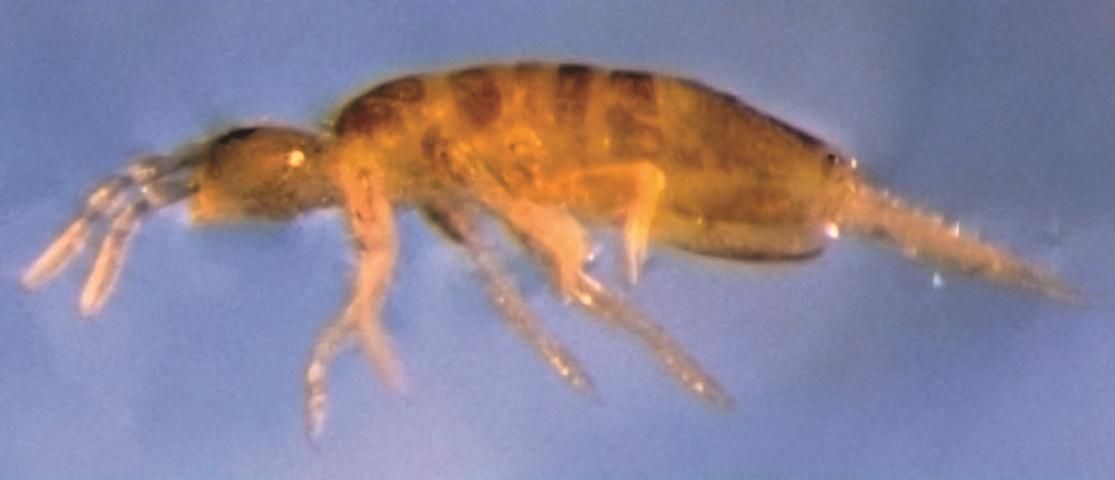
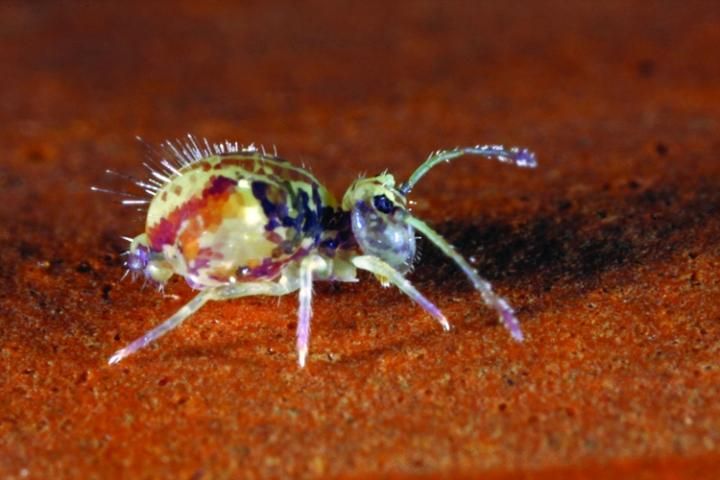
Springtails range in length from 0.25 to 6 mm, but are normally about 1 mm long. Colors range from white to yellow, gray, or blue-gray. Attached to the tip of the abdomen is a forked appendage resembling a lever and called the furcula. At rest, a clasp called the tenaculum holds the furcula to the abdomen. When disturbed or threatened, the springtail's tenaculum releases the furcula, which then strikes the ground, causing the insect to spring into the air. They are capable of springing up to 100 mm, or about 4 inches, into the air. The name "springtail" originated from this action.
Springtails range throughout the Arctic, temperate and tropical regions. Breeding can be year-round. Time from egg to adult may take five to 11 weeks. Springtails are ametabolous, meaning adults are wingless, and the only difference between them and the immature nymphs is body size. Both adults and nymphs live and feed in the same habitat.
Problems
Springtails are pests due to their large numbers. They do not bite nor transmit diseases. They can easily climb the sides of houses and are attracted to lights. They can also be brought into homes in the soil of potted plants. Overwatering encourages springtail propagation.
Homeowners may first encounter springtails inside the home. The insects invade buildings in times of dry weather or heavy rains. They may also breed indoors with high levels of humidity that occur near leaks and cracks to the exterior. Because of their attraction to lights, they may enter homes lured by light shining through cracks under doors and windows.
Springtail populations have also been found floating in swimming pools. Normally, they live in surrounding soil and mulch and accidently spring into the pool while in search of food. Leaving the pool lights on at night may also attract them to the pool.
Some species of springtails may damage plants by chewing on the roots and stems of healthy seedlings. The plants attacked normally are found in overly wet and acidic soil. The seedlings may appear wilted and, if too young, may die. Damage occurs as minute, rounded pits on young roots.
Control
Indoors
Springtails cause no problems inside the house. They are so small that they can't really be removed with a dustpan and broom. But they can be knocked down by misting the areas where they occur with some dishwashing soap in water (about 1%). Sometimes, springtails are brought into the house on potted plants. Check plants for springtail activity before bringing them into the house. If springtails are active, let the soil dry outside for several days before bringing the plant indoors. Do not overwater plants inside the house.
Sometimes, springtails enter the house through small cracks and crevices, under doors, or through windows. Seal cracks and crevices with caulk. Weather-strip around doors and windows. This will not only seal access of springtails from the outside but will also keep humidity and moisture out of the house. This all will help control springtails.
Insecticides can be applied for control of springtails. They can be applied as crack-and-crevice or spot treatments to infested areas where springtails occur in the house. Be sure to read and follow all label directions to assure that the pest and location of application are on the label. Keep children and pets off sprayed areas until dry.
Outdoors
A large indoor population of springtails may be an indication that large numbers are surrounding the structure. Removal of breeding sites will aid in control. Compost piles and decaying vegetation should be removed from areas close to the house. Mulch should be only 2- to 4-inches (5- to 10-cm) deep so it remains dry most of the time. Do not overwater mulched landscape plants, and let the soil dry between watering plants.
If springtails enter swimming pools, they will drown because they cannot tolerate chlorinated water for long. Since they live in surrounding soil, preventing the soil from becoming overly moist and reducing the acidity by liming can controls the populations. Natural enemies, such as naturally occurring predaceous mites, may also help control springtails without the application of pesticides. Soapy water (about 1% dishwashing soap in water) or insecticidal soap can be applied to soil or mulch where springtails occur. Contacted springtails will drown or suffocate in the soapy water.
It is sometimes necessary to control springtails with outdoor insecticide applications. These applications can be made as either barrier treatments to prevent springtails from entering the house or as broadcast treatments to control springtails in infested areas of the landscape. Barrier treatments are usually applied to the walls and soil immediately surrounding the house. It is typical to make barrier applications 3 feet (90 cm) up the wall and 6 feet (183 cm) out, depending on the label. Additionally, treatments should concentrate on steps and damp areas. It may also be necessary to treat mulched flowerbeds and the base of shrubbery. Proper scheduling of applications may increase the efficiency of control. Applications should be made in the afternoon or early evening because springtails will be most active then. Because of the moist conditions and high organic matter in areas of treatment, it is usually necessary to apply treatments at regular intervals to maintain control. Be sure to read and follow all directions on the label.