Wasps and bees can cause problems around structures. Most are social insects that live in colonies. They aggressively defend their nests by stinging. The sting usually involves the injection of a venom that is a nerve poison. The sting may cause death in cases of allergy or when many wasps sting the same individual.
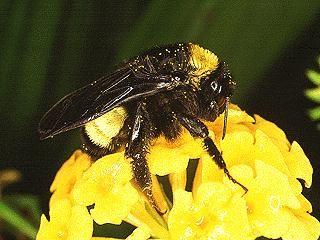
- Bumble bee, Bombus spp. (Figure 1). It nests underground in colonies of several hundred individuals. The nests are usually in abandoned rodent burrows, in mulch, or under logs or debris. The abdomen of the bumble bee is covered with hairs.
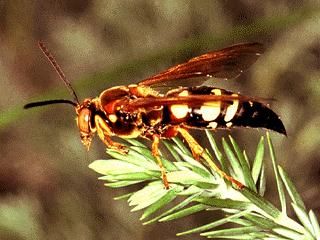
- Cicada killer, Specius speciosus (Figure 2). It is 40 mm long and black with pale-yellow markings on the last three abdominal segments. It is a solitary wasp, but colonies of wasps nest in the same location. Each female digs its own hole up to 10 inches deep. It stings and paralyzes cicadas, placing one in the hole with an egg. Closely related species attack and kill flies.
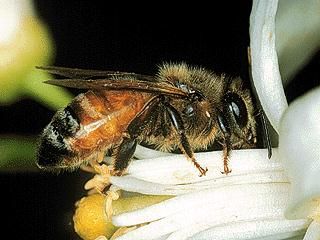
- Honey bee, Apis mellifera (Figure 3). Honey bee colonies have 20,000 to 80,000 individuals. They are raised for honey and beeswax, and are essential for pollination of crops. The stinger has barbs, so that the stinger and the poison sac remain in the skin. Unlike wasps, honey bees can sting only once.
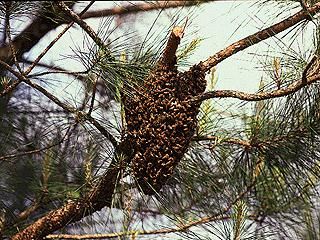
- Honey bee swarm (Figure 4). Most honey bee colonies are in hives managed by beekeepers, but some colonies swarm in large numbers and can be found outside. They may become established in house walls or eaves. The nests in walls can contain a lot of honey. If the bees are controlled or removed, the nest and honey should also be removed to prevent problems to the house.
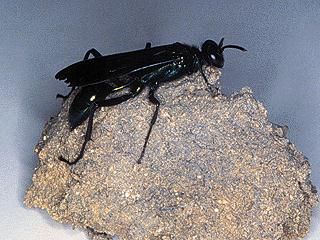
- Mud dauber wasp, Sphecidae (Figure 5). It is a black wasp with a long, thin waist, and is not a social wasp. It is not very aggressive and rarely stings people. However, it often builds its mud nests close to human activity.
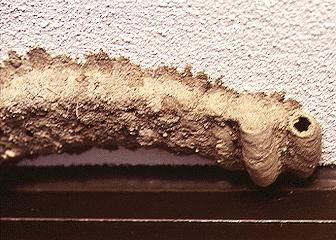
- Mud dauber brood chamber (Figure 6). The mud dauber constructs brood chambers from mud on the sides of buildings and under eaves. The wasp stings and paralyzes spiders, lays an egg on them, and seals them inside the chambers. The wasp larva hatches and feeds on the spiders. An emergence hole in the mud means the wasp has emerged from the chamber.
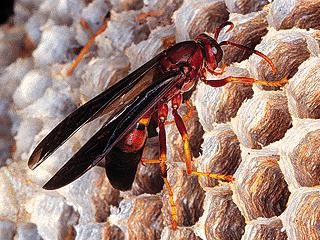
- Paper wasp, Polistes spp. (Figure 7). It is usually yellow with brown markings or black with red or yellow markings. These wasps are aggressive and they readily sting. People are usually stung while trimming shrubbery or cleaning nests from eaves of houses.
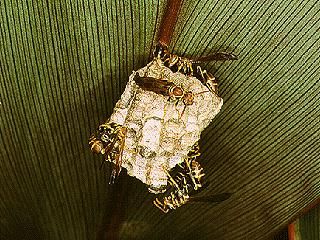
- Paper wasp nest (Figure 8). Paper wasp nests are made of a papery material that is shaped like an inverted umbrella. It usually has a single comb with up to 250 wasps. Nests are often built under eaves or on branches of shrubs. The eggs are laid in a cell. When the larvae hatch, the wasps feed them. They forage for caterpillars and other small insects to feed the larvae.
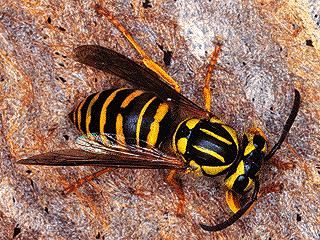
- Yellowjacket, Vespula spp. (Figure 9). It is about 12 mm long and has alternating yellow and black markings on the abdomen. The wasp is very aggressive in defending itself or the nest. The stinger is not barbed, so the wasp can sting repeatedly.
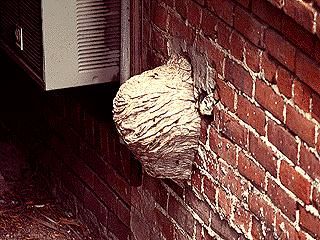
- Yellowjacket nest (Figure 10). The nest can be quite large for some colonies of yellow jackets. It is made of a papery material. Inside, the new nest has layers of combs to raise the brood. Some nests are aerial, but usually the nests are subterranean or are both aerial and subterranean. People are usually stung when they step into or disturb a nest.