
The Featured Creatures collection provides in-depth profiles of insects, nematodes, arachnids and other organisms relevant to Florida. These profiles are intended for the use of interested laypersons with some knowledge of biology as well as academic audiences.
Introduction
The household casebearer, Phereoeca uterella, is a moth in the Tineidae family of Lepidoptera. Many species in this family are casebearers and a few are indoor pests of hair fibers, woolens, silks, felt, and similar materials. Most people know this species by the name plaster bagworm. However, bagworms are moths in the family Psychidae. Perhaps for this reason, the accepted common name of Phereoeca uterella is now listed as the household casebearer, instead of plaster bagworm (Bosik et al. 1997).
The cases are constructed by the larval (caterpillar) stage and often attract attention when found in homes. However, we usually see only the empty larval or pupal cases of the household casebearer on walls of houses in south and central Florida.
Taxonomy
The first record of this species came from Lord Walsingham in 1897 (Busck, 1933). However, the specimens that he collected from the Virgin Islands were misidentified.
In 1933, August Busck proposed the name Tineola walsinghami for the Virgin Island insects of Walsingham. The same year Kea wrote about the food habits of the species present in Florida, using the name given by Walsingham (Tineola uterella). After a while, the species in the peninsula was recognized as Tineola walsinghami. In 1956, Hinton and Bradley described the new genus Phereoeca, in order to separate the true Tineola from this and other species of flat case-bearing moths.
Finally, an early synonym established by Meyrick was recognized as the most appropriate name, and the species was named Phereoeca dubitatrix (Meyrick 1932). However, another name change occurred and the current official common and scientific names for this species are the household casebearer, Phereoeca uterella Walsingham.
Distribution
The household casebearer, Phereoeca uterella, requires high humidity to complete its development, a limiting factor for its dispersion throughout the rest of the country. Hetrick (1957) observed the insect in many parts of Florida and Louisiana, as well as USDA records of the household casebearer from Mississippi and North Carolina. He also assumed that this species might be present in the coastal areas of Alabama, Georgia, South Carolina, Texas, and Virginia. However, proper identification by a specialist is advised because case-bearing species other than Phereoeca uterella might be in those states.
In South America, Phereoeca uterella Walsingham is known to be present in Brazil (state of Para) and Guyana.
In South America, Phereoeca uterella Walsingham is known to be present in Brazil (state of Para) and Guyana.
Another related species of case-bearing moths is Praececodes atomosella (tecophora) (Walker 1863). It was found in Gainesville, Florida, and has been recorded as present in the southern contiguous US, Hawaii, Mexico, Bermuda, Brazil, Peru, Venezuela, Europe, Africa, Malaya, Australia, and other localities. It is possible that records of Phereoeca uterella might be misidentified as this species or vice versa.
Due to the active international exchange of goods, other case-bearing moths may occur in Florida in the future. For example, Phereoeca allutella (Rebel) has been recorded in Hawaii, Panama, Canary Islands, Madeira, Sierra Leone, Seychelles, Sri Lanka, India, Java, and Samoa.
Description
Eggs
After mating, females lay their eggs on crevices and the junction of walls and floors, cementing them on debris. Two hundred eggs may be oviposited by a single female over a period of a week, after which she dies. Eggs are soft, pale bluish, and about 0.4 mm (< 1/32 in) in diameter.
Larva
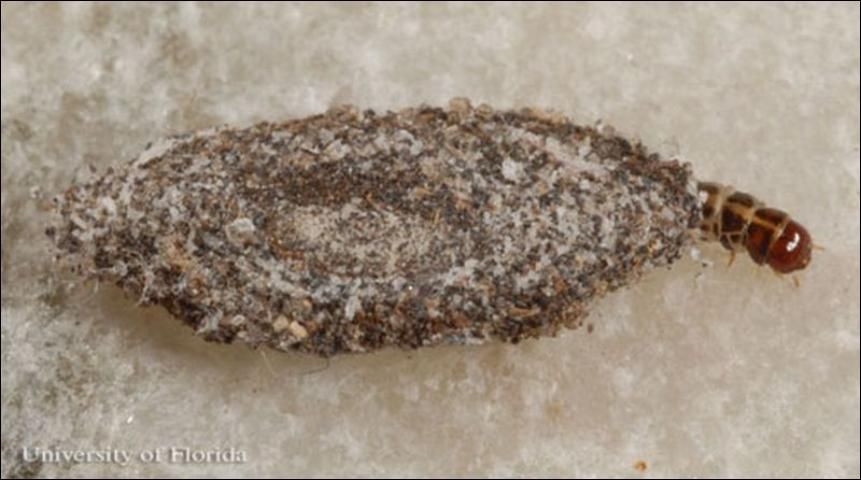
The larva is not usually seen by most people. The case that it carries around wherever it feeds is what is immediately recognized. It can be found under spiderwebs, in bathrooms, bedrooms and garages. Cases can be found on wool rugs and wool carpets, hanging on curtains, or underneath buildings, hanging from subflooring, joists, sills and foundations, on the exterior of buildings in shaded places, under farm sheds, under lawn furniture, on stored farm machinery, and on tree trunks.
Credit: Lyle J. Buss, UF/IFAS
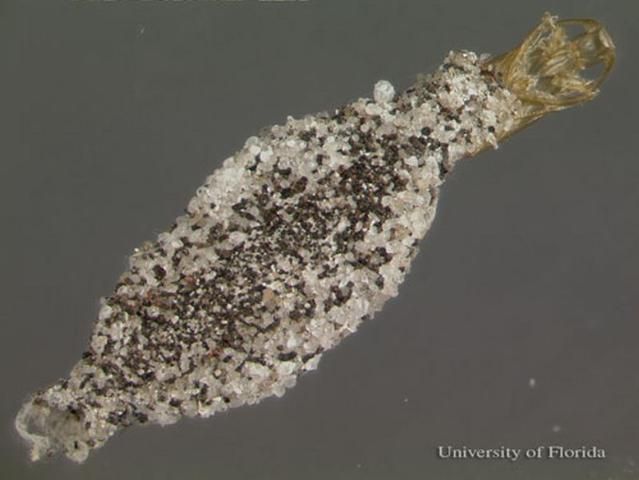
The larval case is a slender, flat, fusiform, or spindle-shaped case which resembles a cantaloupe or pumpkin seed. It is silk-lined inside and open at both ends. Most of the biology described here was taken from Aiello's (1979) description of Phereoeca allutella, a closely related case-bearing moth species from Panama. Specific information of Phereoeca uterella biology is limited.
The case is constructed by the earliest larval stage (1st instar) before it hatches and is enlarged by each successive instar. In constructing the case, the larva secretes silk to build an arch attached at both ends to the substrate. Very small particles of sand, soil, iron rust, insect droppings, arthropod remains, hairs, and other fibers are added on the outside. The inside of the arch is lined exclusively by silk, and is gradually extended to form a tunnel, while the larva stays inside. The tunnel is closed beneath by the larva to form a tube free from the substrate, and open at both ends. After the first case is completed, the larva starts moving around, pulling its case behind. With each molt, the larva enlarges its case. Later cases are flattened and widest in the middle, allowing the larva to turn around inside. A fully developed larva has a case 8 to 14 mm (1/3–½ in) long and 3 to 5 mm (~1/8–3/16 in) wide.
Credit: Lyle J. Buss, UF/IFAS
Both ends of the case are identical and are used by the larva to hide. When disturbed, it encloses itself in the case by pulling the bottom side up. This closing mechanism is very difficult to open from the outside.
The fully developed larva is about 7 mm (1/4 in) long, it has a dark brown head, and the rest of the body is white, except for the lateral and dorsal plates on the three thoracic segments close to the head, which are hardened and dark. Aiello (1979) believes the plates protect the larva from natural enemies when it reaches out of its case for locomotion.
The larva has three pair of well-developed, brown legs. The ventral prolegs are white and are located on abdominal segments 3 to 6 and 10. At the tip of each proleg there is an ellipse formed by 23 to 25 very small crochets (a small hook). The anterior crochets are bigger and broader than posterior ones by one third, which is a good detail for identification. The crochets are used to walk inside the case, and also to grab the case when the larva pulls its head and thorax out and uses its true legs to walk on the floor or walls.
Pupa
Pupation occurs inside the case. The larva walks up a vertical surface and attaches the case at both ends with silk. One end of the case is then modified. The larva cuts a short slit along both edges to make that end flatter, which acts as a valve. Before eclosion the pupa pulls itself halfway through the valve. The new moth emerges around noon, leaving the pupal case exposed on the outer case.
Adult
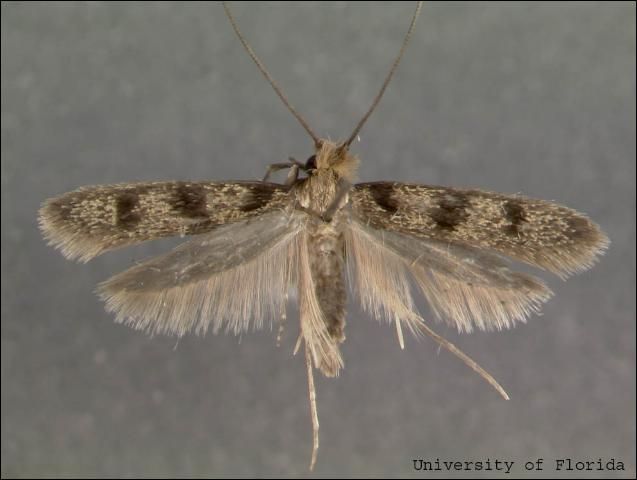
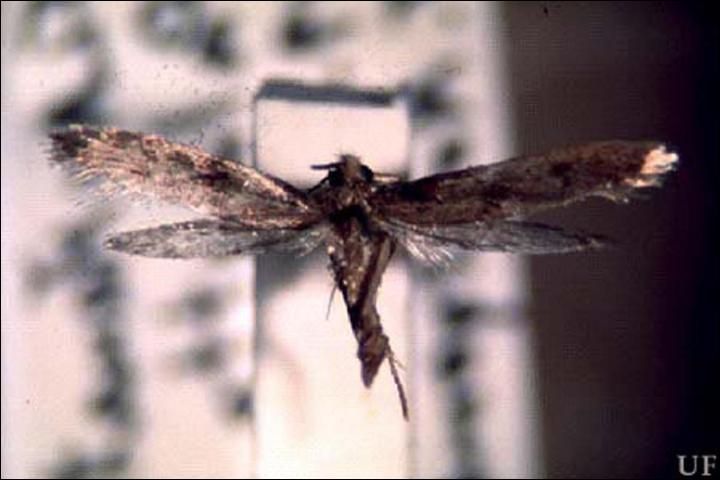
Adult females have a wing span 10 to 13 mm (3/8 – ½ in) long. They are gray with up to four spots on the fore wings, and a brush of long, lighter gray hair-like scales along the posterior margin of the hind wings. Males are smaller (wing span: 7 to 9 mm (1/4 – 3/8 in)) and thinner than the female, with a less distinctive wing pattern.
Credit: Lyle Buss, UF/IFAS
Credit: Juan A. Villanueva-Jimenez, UF/IFAS
The heads of both sexes are uniformly clothed with dense, rough hairs. There are two pairs of buccal appendages called palps. The maxillary palps are smaller than the labial palps and are folded inwards. The labial palps extend a little beyond the head vestiture (dense covering of hairs). The remaining mouth parts are reduced, and adults do not feed. The antennae are filiform (threadlike), as long as the wings, and are held back over the body. The compound eyes are prominent.
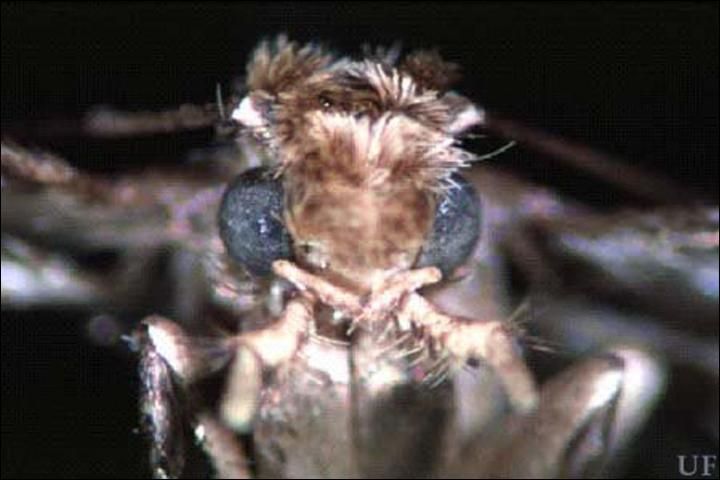
Credit: Juan A. Villanueva-Jimenez, UF/IFAS
Wing venation is very important for genera identification and was described by Hinton and Bradley in 1956. Adults at rest hold their wings tented over the body. They fly fairly well, but usually rest on walls, floor edges, or on webs of house spiders (theridiids) (Aiello 1979).
Life Cycle
At non-air-conditioned room temperature in Panama, the life cycle of Phereoeca uterella (a close relative of Phereoeca dubitatrix) was reported by Aiello (1979) as follows:
Eggs require more than 10 days to hatch. There are six to seven larval instars that require about 50 days to mature. They remain in the pupal stage an average of 15.6 days (range of 11 to 23 days). The entire cycle from egg to adult averages 74.2 days (62 to 86 days). Aiello (1979) indicates that the number of instars may vary among individuals of both sexes.
Economic Significance
Hetrick (1957) found that the most common and abundant food of the household casebearer in Florida is old spider webs, consumed in large quantities. Webs of insects such as booklice (Psocoptera) and webspinners (Embioptera) from tree trunks were also suitable food. Old cases of its own species were chewed as well. Kea (1933) could not observe this insect feeding on dried insects in the laboratory, even though small portions of dried insects were found attached to its case. Furthermore, household casebearer larvae did not eat cotton products offered by Kea. But when woolen threads and woolen cloth were offered to the larvae "they ate eagerly". Watson (1939) corroborated the preference of Pjerepeca uterella for woolen goods of all kinds. Aiello (1979) succeeded in rearing specimens of the related species Phereoeca allutella by offering them dead mosquitoes and her own hair.
Management
Due to its food habits the household casebearer is a potential household pest. However, regular cleaning practices, increased use of air conditioning in houses, and reduced number of woolen goods in this part of the country, along with pesticide application in cracks and crevices for household pest control, have decreased the incidence of the household casebearer. Manual picking or vacuuming of cases and spider web removal should be enough to keep this species under control.
Insect Management Guide for Bagworms and Clothes Moths (https://edis.ifas.ufl.edu/IG090).
A braconid wasp, Apanteles carpatus (Say), parasitizes larvae of case-bearing moths, killing the larva before pupation. In Florida, this braconid and an ichneumonid wasp, Lymeon orbum (Say), were reared from the household casebearer (Hetrick 1957).
Selected References
Aiello A. 1979. Life history and behavior of the case-bearer Phereoeca allutella (Lepidoptera: Tineidae). Psyche 86: 125–136.
Arnett Jr RH. 2000. American Insects: A Handbook of the Insects of America North of Mexico. CRC Press. Boca Raton. 1003 pp.
Borror DJ, Triplehorn CA, Johnson NF. 1989. An Introduction to the Study of Insects. Harcourt Brace Jovanovich College Publishers. New York. 875 pp.
Bosik JJ et al. 1997. Common Names of Insects & Related Organisms. Entomological Society of America. 232 pp.
Busck A. 1933. Microlepidoptera of Cuba. Entomologica Americana 13: 151–203.
Creighton JT. 1954. Household Pests. Bulletin No. 156, new series. State of Florida, Department of Agriculture, Tallahassee. pp. 39–43.
Hetrick LA. 1957. Some observations on the plaster bagworm, Tineola walsinghami Busck (Lepidoptera: Tineidae). Florida Entomologist 40: 145–146.
Hinton HE. 1956. The larvae of the species of Tineidae of economic importance. Bull. Entomol. Res. 47: 251–346.
Hinton HE, Bradley JD. 1956. Observations on species of Lepidoptera infesting stored products. XVI: Two new genera of clothes moths (Tineidae). The Entomologist 89: 42–47.
Kea JW. 1933. Food habits of Tineola uterella. Florida Entomologist 17: 66.
Watson JR. 1939. Control of four household insects. University of Florida, Agricultural Experiment Station Bulletin 536.
Watson JR. 1946. Control of three household insects. University of Florida, Agricultural Experiment Station Bulletin 619.