
Introduction
Plants have undoubtedly played an important role throughout human history. Many examples of these important plants are known to people throughout the world. Consider tobacco, cotton, and sugar and their importance in shaping several centuries of American history.
However, one important plant that played a very important part in shaping world history, the Paper Mulberry, Broussonetia papyrifera, has unfortunately now become better known as an unwelcome weed of natural areas worldwide.
Nearly 2000 years ago, the Chinese used paper mulberry bark for the production of paper. This was the first example of a true "paper" being used as opposed to parchment, hides, and papyrus, from which an earlier name for the paper mulberry (Papyrius papyriferus) was derived. Now, nearly two millennia later, the paper mulberry has become another plant, introduced intentionally throughout the world for economic and aesthetic purposes, which has gone terribly awry, disrupting natural vegetation patterns and processes.
Impacts
Broussonetia papyrifera, the paper mulberry, is an invasive plant which can quickly colonize disturbed areas throughout Florida. Furthermore, its tremendous range shows its ability to thrive in various climates throughout the world. Paper mulberry spreads by means of its 1.5–2.0 cm fruits which are transported significant distances by local wildlife. This also enables it to enter and colonize gaps deep within an undisturbed area. Once established, paper mulberry then spreads from its root system, forming dense thickets which are often thirty feet across.
This plant which is native to Eastern Asia has become an invader on several continents and in over a dozen countries. The International Union for the Consevation of Nature lists paper mulberry as one of the six worst plant invaders in Pakistan (http://www.iucn.org). Recent studies have shown that it is also one of the top invasive plants in Pampa grasslands in Argentina, (Ghersa et al 2002).
In Ghana, paper mulberry is only an occasional plant along the roadsides leading to Bobiri Forest, however, across the continent in Uganda, throughout the Mabira forest preserve, paper mulberry has become a dominant plant along many of the forest paths, roads, and edges, and has even begun to show up well into the forest (Morgan pers. obs 2004).
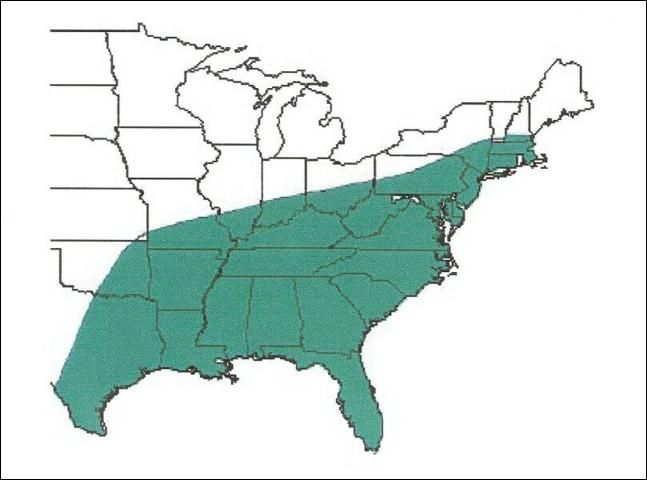
In Florida, paper mulberry is now known from Dade County in the south, to Duval in the north, and Santa Rosa in the west. With a little searching, it's not unlikely that it will be found in nearly every county in the state. Nationwide, the prognosis is just as bleak. Paper mulberry has invaded the forest parks around New York City, and has been seen as far north as Massachusetts and Vermont. To the west it has now reached Texas and Oklahoma, and even parts of Kansas. In total 29 states including Hawaii have recorded paper mulberry as escaping (Figure 1). Due to our mild winters and relatively open canopied hammock vegetation, Florida appears to be quite susceptible to further invasions by this nuisance.
UF/IFAS Assessment
Paper mulberry has been evaluated using the UF/IFAS Status Assessment of Non-Native Plants in Florida's Natural Areas (IFAS Invasive Species Working Group 2008). In all Florida zones this species is thought to cause low ecological impacts, although the assessment is incomplete because of insufficient expert opinion. In all zones, paper mulberry is thought to have a high potential for spread with evidence of range expansion in northern and southern counties. It is recommended that paper mulberry be planted with caution throughout Florida and managed to prevent escape.
Identification
Paper mulberry is generally an 8 to 10 meter high large shrub or small tree with a mounded appearance as the older, taller stems are towards the middle of the plant. Its leaf scars are in an alternate pattern although on occasion they are opposite as well. Paper mulberry is deciduous, and in winter can be identified by its conical buds, prominent stipule scars, and very hairy reddish brown twigs.
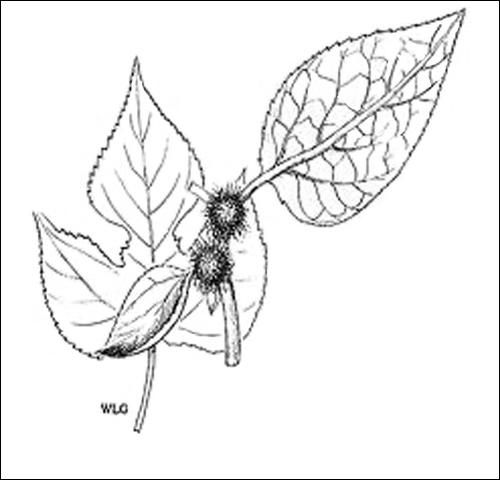
Most revealing about paper mulberry is its highly variable leaves. In size they range from 8 to 25 centimeters in length, the smallest of which are generally simple with a serrate margin. Larger leaves tend to be heart or mitten shaped, while the largest leaves are generally deeply lobed, giving the leaf three large lobes and occasionally two smaller ones near the leaf base (Figure 2). Its fruits are generally 1.5–2.0 cm in diameter and are a reddish purple in color, appearing in summer.
Credit: Holmgren (1998)
References
Ghersa, C. M., E. de la Fuente, S. Suarez, and R.J.C. Leon. 2002. Woody species in the Rolling Pampa grasslands, Argentina. Agriculture, Ecosystems and Environment. 88:271–278.
Holmgren, N.H. 1998. Illustrated companion to Gleason and Cronquist's manual: Illustrations of the vascular plants of northeastern United States and adjacent Canada. New York.
International Conservation Union Website. 2004. List of Invasive Species in Pakistan. (http://www.edu.iucnp.org/alist.htm).
University of Florida, Institute of Food and Agricultural Sciences. 2018. "Assessment of Non-native Plants in Florida's Natural Areas, Broussonetia papyrifera" (https://assessment.ifas.ufl.edu/assessments/broussonetia-papyrifera/, Accessed 1/4/2023) Gainesville, FL.