
The Featured Creatures collection provides in-depth profiles of insects, nematodes, arachnids and other organisms relevant to Florida. These profiles are intended for the use of interested laypersons with some knowledge of biology as well as academic audiences.
Introduction
Antlions are common, conspicuous insects in Florida. Florida has the richest antlion fauna in the eastern United States with 22 species in nine genera. Four species are found only in the Keys (Stange 1980a).
Wheeler (1930) called them "demons of the dust," whereas children in the southern United States coined the term "doodlebugs" to describe their antics. Although most people associate them with the funnel-shaped pitfall traps, most of the genera have other habits often reflected by their movements, which can be very fast across the surface of the sand (Brachynemurus); slow, creeping movements (Dendroleon); or fast, backward movements under the sand (Vella) (Stange 1980b).
One of the most striking antlions in Florida is Glenurus gratus (Say). It's richly dark-marked wings are distinctive in Florida, according to Stange (1980a). While most antlion larvae are found in the soil, the unusual, two-toothed mandibled larvae of Glenurus gratus live in tree holes. Adults can be seen flying in forested areas during the summer months and sometimes are attracted to lights. This species is found throughout peninsular Florida.
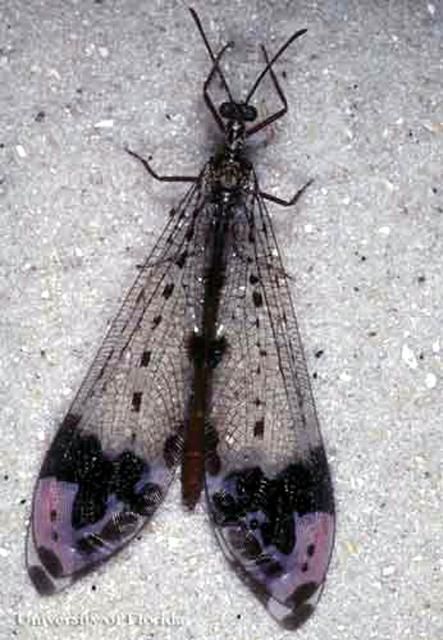
Credit: Lyle J. Buss, UF/IFAS
Distribution
In the United States, this species is known in Florida, Indiana, Kentucky, Mississippi, Missouri, New Jersey, Ohio, and Tennessee (Stange 2000).
Identification
Antlion larvae share with other Planipennian Neuroptera the singular modification of the mandibles and maxillae to form a pair of sucking tubes. The curved, toothed mandibles and fusion of the hind tibia and tarsus are diagnostic in Florida except for the related family Ascalaphidae. Ascalaphid larvae are easily distinguished by the cordate posterior margin of the head. Many of the genera can be distinguished by the mandible, which can have one (Paranthaclisis), two (Glenurus), or three (rest of the genera) teeth.
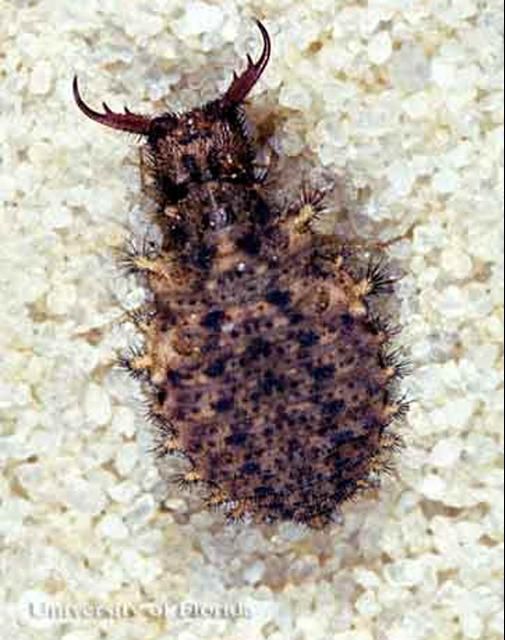
Credit: James Castner, UF/IFAS
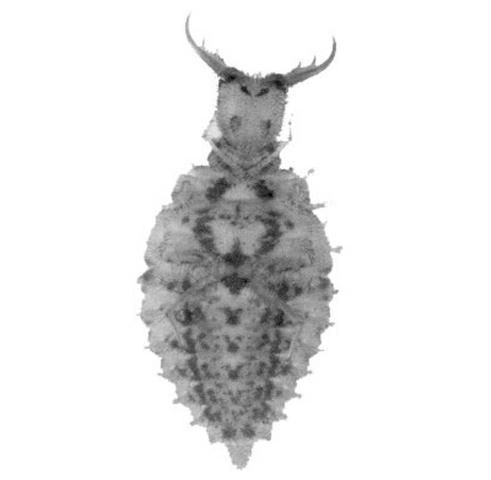
Credit: Division of Plant Industry
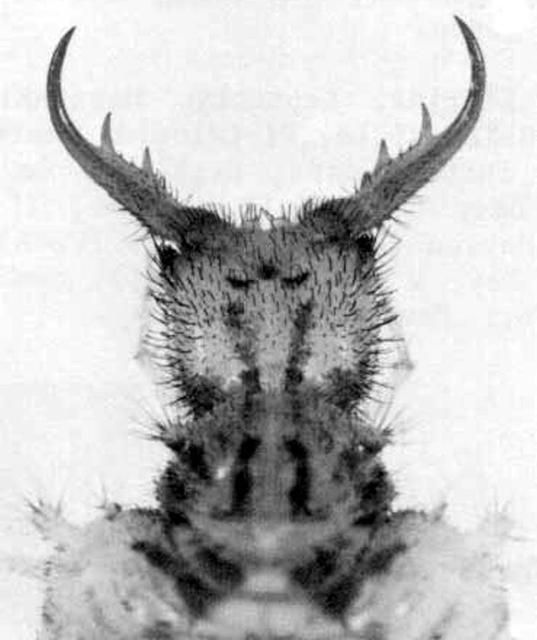
Credit: Division of Plant Industry
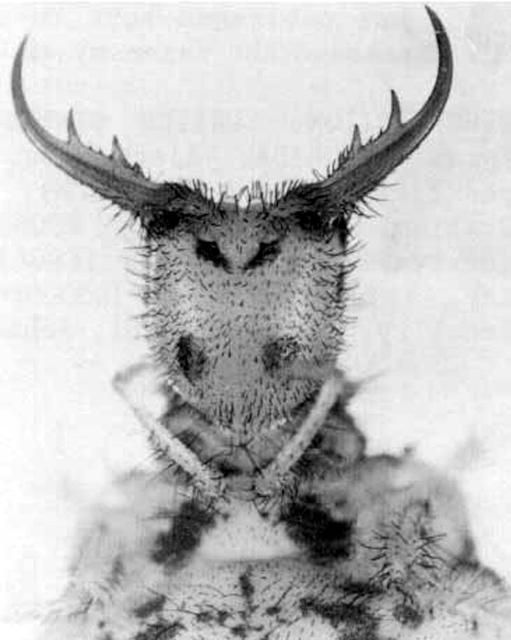
Credit: Division of Plant Industry
Biology
Oviposition and eggs are not known, but all three larval instars live in dry hollows of trees among fine wood particles, squirrel droppings, and other fecal matter and assorted debris. These hollows are large enough to allow for free movement of the larvae under the surface of the debris and are structured so that rainfall does not fully soak the contents of the hollow. The larvae may dig or run after prey, but not rapidly. At times, larvae may simply lie in wait. They feed on assorted insects found in their microhabitat such as termites, beetle larvae, and ants.
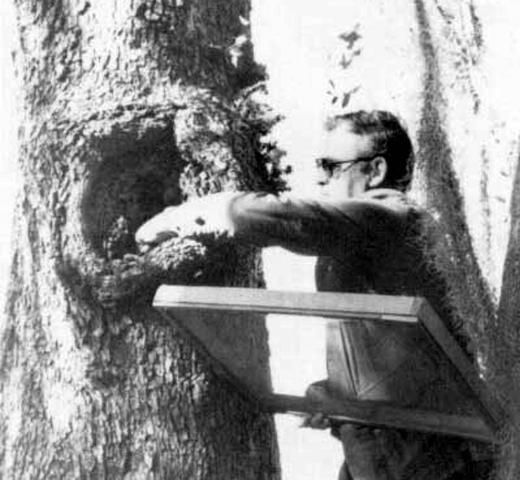
Credit: Division of Plant Industry
The authors found as many as three Glenurus larvae in one hollow, and in one instance, a larva of Dendroleon obsoletus (Say) was coinhabiting. Natural enemies and parasites are unknown. Larvae complete their life cycles in one or two years, depending on the abundance of food and the duration of warm nights during the year. Of two larvae reared by the authors, both constructed cocoons measuring 13 mm in diameter, which were completely, but shallowly, buried beneath the debris. Cocoon construction to emergence of the adult required 28 days in both instances.
Detection and Survey
Larvae can be found by sifting through dry organic material in tree holes, especially on Quercus virginiana Mill. Adults can be collected at night at lights and found in forests by beating plants.
Adult antlions are distinguished from all other insects by the four membranous, similarly-shaped wings with a long hypostigmatic cell. Males of most species have a peculiar and unique organ at the base of the hind wing (pilula axillaris). The tube-like abdomen is similar in both sexes, although normally longer in the male, with the 1st sternite reduced. Male terminalia often have a postventral lobe, whereas the female terminalia are of more variable structure probably related to oviposition sites but usually with digging setae and a finger-like process (posterior gonapophysis). Adults are commonly confused with damselflies (Odonata), but the clavate antennae of antlions easily distinguishes them (Stange 1980a).
Economic Importance
Both adults and larvae are predators and are economically beneficial. Adults commonly feed on caterpillars and aphids, whereas the larvae feed on surface dwellers such as ants and other insect larvae.
Selected References
Banks N. 1922. South American Glenurus and some other Myrmeleonidae. Canadian Entomologist 54: 58–60.
Banks N. 1928. Revision of the Nearctic Myrmeleonidae. Museum of Comparative Zoology Bulletin Harvard 68: 1–84.
Stange L. 1970. A generic revision and catalog of the Western Hemisphere Glenurini with the description of a new genus and species from Brazil. Contributions to Science, Los Angeles County Museum Natural History 186: 1–28.
Stange L. 1980a. The ant-lions of Florida. I. Genera. Florida Department of Agriculture and Consumer Services, Division of Plant Industry, Entomology Circular 215: 1–4.
Stange L. 1980b. The ant-lions of Florida. II. Genera based on larvae. Florida Department of Agriculture and Consumer Services, Division of Plant Industry, Entomology Circular 221: 1–4.
Stange L. (2000). A checklist and bibliography of the Megaloptera and Neuroptera of Florida. Florida State Collection of Arthropods. http://www.fsca-dpi.org/Neuroptera/Neuroptera_of_Florida.htm (9 November 2015).
Swanson M. (2006). The antlion pit: A doodlebug anthology http://www.antlionpit.com/. (9 November 2015).
Wheeler WM. 1930. Demons of the Dust. W.W. Horton & Co., New York, USA, 378 p.