
Proper soil preparation prior to grass planting is critical to ensure the establishment of a quality turf. Preparation is crucial in determining how quickly the lawn becomes established and its long-term maintenance requirements. Soil should be prepared whether you are planting a new lawn or replanting an existing one and whether you are seeding or propagating vegetatively. The following steps provide a general guideline for preparing to plant a lawn.
Clean and Rough Grade
Remove all construction debris, brush, large roots, rocks, weeds, and old tree stumps. If extensive grading is needed, remove the topsoil and stockpile it for replacement after the rough grade is established. The site should be sloped at 1% to 2% (e.g., 1/2- to 1-foot fall per 50 feet) away from the house. The rough grade should conform to the final grade after the topsoil is replaced. Mounds with steep slopes of more than 10% should be sodded and not seeded due to erosion problems. Steep swales should be either sodded or lined with an erosion resistant material designed to withstand flow velocities in the channel. Steep slopes and mounds should be avoided since it may be difficult to establish grass and mowing may be dangerous. Mowing on slopes steeper than 3:1 is not recommended due to risk of roll over. If an area cannot be leveled, use groundcover plants other than turfgrass. Control of perennial weeds such as Bermudagrass and torpedograss should be performed during site preparation. Several applications of a nonselective herbicide such as glyphosate (Roundup®) may be necessary for complete weed control.
Soil Analysis
You should always obtain a soil analysis before planting. A representative soil sample can be obtained by collecting the top 6 inches of soil at 10 to 15 locations around the yard using a soil probe or hand trowel. These samples should be combined and mixed thoroughly and allowed to air dry. Once dried, a subsample of soil (approximately 1 cup) can be submitted to the Florida Extension Soil Testing Laboratory for analysis. For more information on soil sampling and testing, go to http://soilslab.ifas.ufl.edu/ESTL%20Home.asp.
Soil samples can be analyzed for pH, lime requirement, and available plant nutrients (P, K, Ca, and Mg). A soil pH test will indicate whether pH adjustment is necessary. If the soil is too acidic (pH is too low), a lime requirement test will be run to determine the amount of dolomitic limestone (dolomite) that should be applied to increase the soil pH. Application should always be based on a lime requirement, because this test accounts for the soil pH and the buffering capacity of the soil (ability of the soil to resist changes in pH). Soil pH adjustments should be completed before a lawn is planted.
A soil test analysis for extractable nutrients will provide the basis for your lawn fertility program. Apply fertilizers as directed on the soil test report, paying specific attention to the rate, timing, and application method recommendations. Do not apply fertilizer prior to planting grasses because there is a greater potential for the nutrients to leach or runoff when there is no vegetation to assimilate the nutrients. Similarly, do not fertilize for the first 30-60 days after planting. This will allow the root system to grow and better assimilate the nutrients. Since sod is typically fertilized at some point prior to harvest, this will not affect the turf quality or establishment time.
Soil Compaction
Soil compaction reduces pore space within the soil matrix. It often occurs during home construction as result of vehicle traffic on the site. Compaction can extend more than 12 inches below the surface and last for years or decades. This is detrimental to establishing a healthy lawn for several reasons. First, the compacted soils can hold less water and cannot exchange air with the atmosphere as easily. Next, compaction reduces the size of pores, which slows the rate of water infiltrating into and flowing through the soil, leading to greater runoff. One of the most detrimental aspects of compaction is that plant roots may not be able to penetrate compacted soil layers. The annual cycling of roots growing and dying off can lessen compaction over time, but only as far as they can grow. So, compaction limits rooting depth and plants' ability to reverse soil compaction. Shallower roots along with less pore space means that turfgrass will be more susceptible to other stresses, both biotic and those due to site conditions. A quick test for compaction is to try to push a <1 inch diameter rod, (such as rebar, a Phillips head screw driver, or a survey flag), into moist soil. The depth that a normal adult can push a rod into the soil by hand is an indication of soil compaction. If the rod cannot be inserted at least 6 inches without significant force, then the compaction will likely affect the turfgrass.
Installation of Irrigation System
If an irrigation system is necessary, it should be designed by an irrigation specialist and installed according to design specifications prior to planting grass. An irrigation system's capacity to perform properly is limited by its design, installation, and operation. A poorly designed or improperly installed system will never operate satisfactorily. For proper irrigation of lawn areas, it is important to have an irrigation system that delivers water uniformly and in the amount needed by the turfgrass. It is advisable to turn off the automatic setting on the system and irrigate on an as-needed basis. For more information on this, see the EDIS publication LH025, "Watering Your Florida Lawn." Another option is to incorporate sensors into your irrigation control system or use a smart irrigation controller that can use weather data local weather data to estimate irrigation needed. It is also important that systems are designed to irrigate shrubbery and other plantings separately from turfgrass.
Soil Amendments
The majority of Florida's soils are sand-based, with little organic matter and low water- and nutrient-holding capacities. The condition of residential soils is typically worse than for natural or agricultural soils, due to the nature of the soil disturbance that occurs during construction. Soil amendments can be applied to soils prior to planting a lawn in order to improve soil physical, chemical, and/or biological properties.
Soil amendments can be organic or inorganic in nature. Organic amendments, such as compost, can improve soil drainage, increase water and nutrient holding capacity, and promote a healthy soil organism community. Unlike inorganic (or mineral) amendments, organic amendments will decompose over time as the organic matter is oxidized by soil microorganisms. The decomposition will release plant nutrients to the lawn.
A general guideline is to add organic soil amendments at a rate of 3 to 6 cubic yards of (roughly 15-30% by volume), per 1000 square feet of area. Do not exceed 6.5 cubic yards per 1000 square feet (approximately 35% by volume) as there may be issues with soil subsidence as the organic amendment decomposes or excessive soil moisture issues. Organic amendments should be tilled or mixed into the top 6 inches of the soil. Only well-decomposed, mature organic amendments with a C:N ratio = 30 should be incorporated into to soil, otherwise, the nitrogen present in the soil may be immobilized and unavailable to your plants. High C:N ratio materials, such as wood chips, are more suitable for use as mulching materials on the soil surface. All organic materials should be sterilized or fully composted to prevent the incorporation of weed seed. Table 1 lists the properties and suitability of several organic materials for use as soil amendments when preparing soils for planting turf.
Inorganic, or mineral, soil amendments may also be used during soil preparation to improve soil properties. In general, inorganic amendments can permanently improve soil drainage, but their effects on soil water and nutrient holding capacity will be minimal. Also, unlike organic materials, inorganic amendments will have little to no effect on soil biology and nutrient status. Inorganic amendments should be incorporated into the soil at a rate of 4.5 to 6.5 cubic yards per 1000 square feet (approximately 25-35% by volume). In general, the greater the depth of incorporation of inorganic soil amendments, the better. Table 2 lists the properties and suitability of several inorganic (mineral) materials for use as soil amendments when preparing soils for planting turf.
Tillage
Rototilling loosens compacted soil and improves the speed and depth of rooting. If soil amendments, lime, or fertilizer have been added in the preceding steps, the soil should be tilled to a depth of 6 to 8 inches. A tractor-mounted or self-propelled rotary tiller will do an adequate job of tilling the soil.
Soils with very little silt or clay (<5% combined) may not benefit from tillage alone. These soils do not have much structure and can easily return to the compacted state. In these cases an amendment, such as compost, should be incorporated with tillage to promote soil structure and resist compacting the soil again.
Final Grading
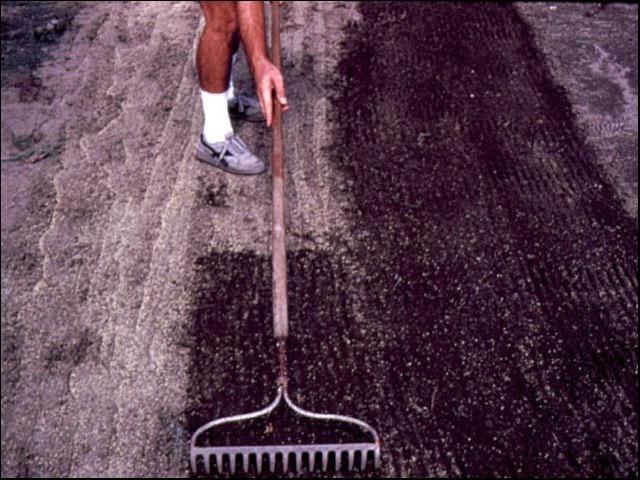
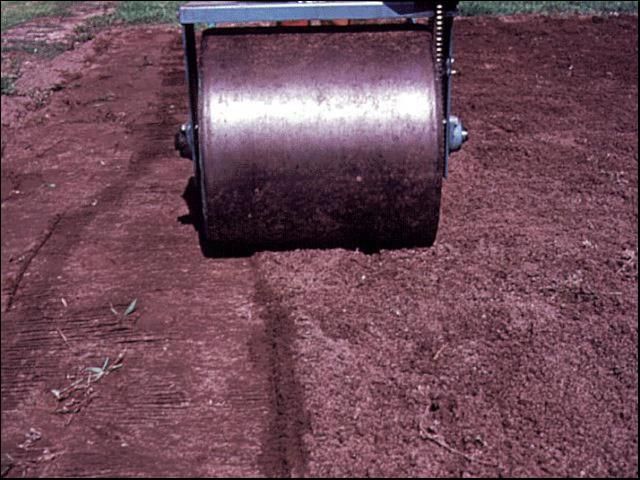
Final grading completed just prior to planting provides a smooth surface or planting bed so the turfgrass is smooth as well. The site can be hand-raked and dragged with a hand-pulled drag, such as a metal doormat or a section of chain link fence. Large areas can be smoothed by tractor-drawn equipment with a tiller rake or grading box and then hand-finished. Rocks or stones should be no larger than golf ball size, with even smaller sizes preferable. To achieve a uniformly firm planting bed and to reduce erosion, loose soil can be compressed with a water ballast roller. Care should be taken not to add too much weight and cause soil compaction. Driveways and walks should be level with, or slightly above, the final grade. If sod will be installed, then the sod thickness should be accounted for during final grading. A good job of grading will result in a more level site and a more attractive lawn that is easy to mow and maintain. Irrigation can be used to settle the soil before planting. If planting by seed to crusty surfaces, it may be necessary to moisten the soil and then hand rake the surface prior to seeding.
References
Craul, P.J. 1992. Urban Soil in Landscape Design. John Wiley and Sons, New York, NY.
Urban, J. 2008. Up by Roots. International Society of Arboriculture, Champaign, IL.