
Introduction
Turfgrass diseases are often overlooked because the biological organisms (plant pathogens) causing the problems are rarely observed and commonly mistaken for other injuries or disorders. Use of proper cultural practices (i.e., water, mowing, and fertility) will reduce the risk of grasses becoming diseased or severely damaged by turfgrass pathogens. This publication discusses turfgrass diseases, their causal agents, diagnosis, and management.
What Is a Disease?
A disease is an interaction between the plant and a pathogen that disrupts the normal growth and appearance of the plant. While turfgrasses may be affected by diseases all year, individual turf diseases are active for only a few months each year, usually because of weather patterns and resulting environmental effects. However, any stress (environmental or manmade) placed on the turf weakens it, making it more susceptible to diseases.
Turfgrass diseases in Florida are caused by fungi (yeasts, molds, and mushrooms are types of fungi). Most fungi living in lawns are completely harmless to plants. In fact, they are beneficial because they decompose the grass clippings and old roots. A very small number of fungi cause plant diseases.
The absence of turfgrass disease does not indicate that the turfgrass area is free of fungal pathogens. The pathogens are likely surviving in the environment in a state of dormancy or as a saprophyte (nonpathogenic phase), living off dead organic materials in the thatch and soil layers.
Diseases are the exception and not the rule for lawns. Spots and patches of yellow or brown turfgrass do not necessarily mean the lawn has a disease. Various injuries or disorders may cause the turf to appear diseased. Turfgrass diseases can be difficult to diagnose, so involvement of these other factors should first be ruled out. An injury to turfgrass is a destructive physical occurrence, such as pesticide damage (Figure 1), mowing the grass too short (Figure 2), or a fuel leak. A turfgrass disorder is associated with imbalances of physical or chemical requirements for turfgrass growth. Examples include nutritional deficiencies, cold temperatures, drought (Figure 3), and excessive rainfall. Again, while these problems may appear to be diseases, there are no pathogens involved. However, these injuries or disorders may weaken the turf so much that a pathogen may attack the plants and cause a disease.
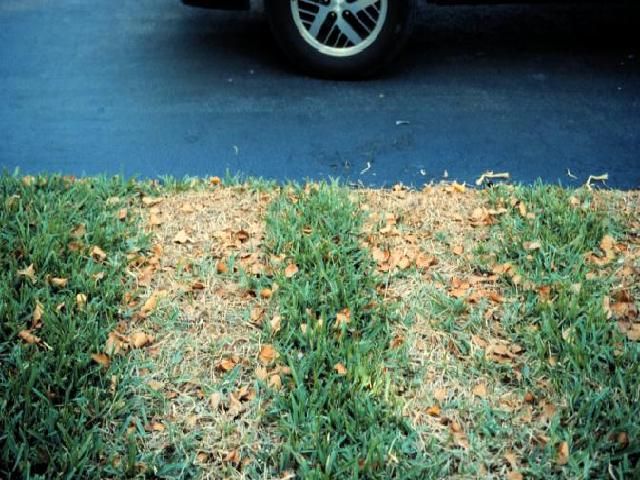
Credit: M. L. Elliott
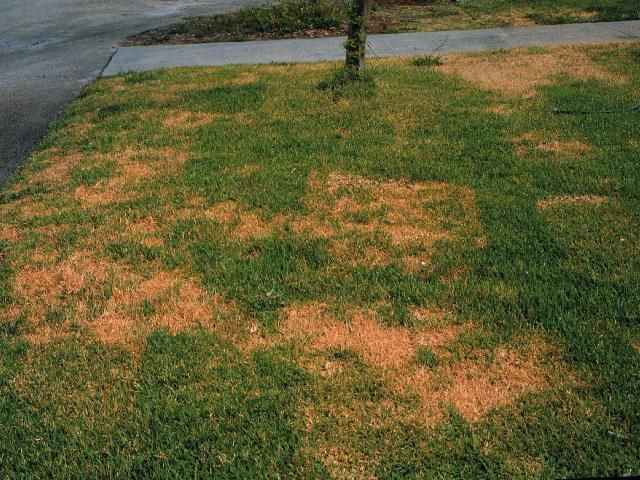
Credit: M. L. Elliott
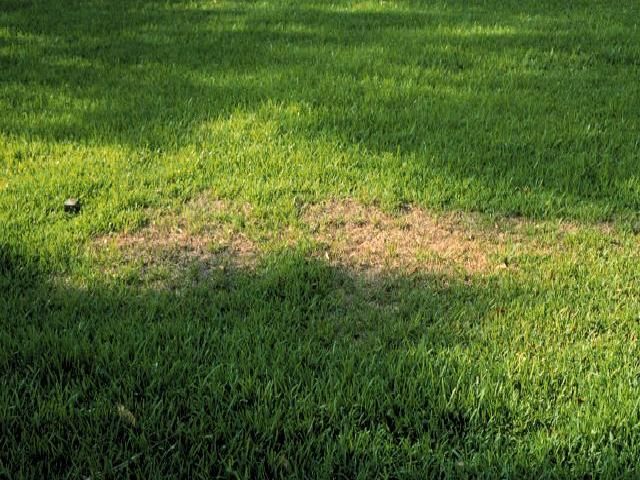
Credit: M. L. Elliott
Disease Process
There are many steps in the disease process, and all are dependent on environmental conditions. The first step is inoculation, when the pathogen comes in contact with the susceptible plant. This is always occurring with turfgrasses. The next steps determine if a disease will develop. Infection is the second step, when the pathogen actually enters the plant. Fungi can enter a plant via wounds (i.e., cut leaf blades), natural openings (i.e., stomates), or direct penetration using a number of different mechanisms. A fungus infecting a plant does not automatically imply disease. The pathogen must become established inside the host for the host to exhibit disease. It is at this point that the pathogen starts to disrupt the normal growth of the plant or affect the appearance of the plant. Depending on the pathogen, it may then reproduce (i.e., produce spores). These reproductive structures or other parts of a pathogen may then spread to other turfgrass plants. A disease epidemic means that large populations of turfgrass plants are affected by the pathogen.
Disease Symptoms
Unlike insects or weeds, it is not possible to monitor the number of turfgrass pathogens present in a given area. Instead, disease symptoms (if already present), the weather, and stress factors affecting the turfgrass are monitored. It is critical to document active disease sites, as many disease outbreaks occur in the same location each year. It is also important to determine if the active disease sites are associated with environmental characteristics, such as excessive shade, fertilizer application timing, type of fertilizer, soil type, or excessive irrigation. These records can be used to help predict disease outbreaks and to design effective management strategies.
There are two common patterns of turfgrass disease symptoms. One is a circular patch of turfgrass, either small or large, that is no longer uniformly green. The second is turf that has spots on the leaves. If disease patches are present, examine the leaves and roots in these patches for characteristic disease symptoms and signs (actual fungal structures) of the pathogen. The best time to observe fungal mycelia is in the early morning when dew is still present. Mycelia look similar to white cotton candy. Early afternoon is a good time to look for localized patches of wilt or drought symptoms that may indicate root or crown diseases. For turf with spots, note the color and shape of the spots, but always keep in mind that there are several other conditions that are not caused by disease that can produce similar symptoms.
Monitoring the weather helps with disease prediction and determining the necessity of fungicide applications. If the disease-affected areas are small and the weather is not conducive to an epidemic, then a fungicide may not be necessary, or only spot applications may be required. However, if the long-term weather forecast is conducive to development of a disease that routinely occurs in the area in specific landscapes, then a fungicide may be useful in preventing an outbreak. Again, the location in the landscape where the disease occurs is important and should be noted, especially if it occurs more than once a year or recurs each year. The disease may be occurring in areas affected by a microclimate created by man. The Florida Lawn Handbook can be found on the UF/IFAS Extension Electronic Data Information Source (EDIS) website (https://edis.ifas.ufl.edu/topic_book_disease_problems). It contains publications on specific diseases and fungicide recommendations for those diseases.
Disease Control Practices
Disease control is often not a simple process. Control recommendations are aimed at: 1) altering the environment so it is less favorable for disease development; 2) suppressing pathogen growth; and 3) decreasing stress on turfgrass. An integrated management program that includes cultural and chemical methods is the key to preventing and controlling turfgrass diseases.
There are three steps to disease management. First, it is necessary to correctly identify the disease. Next, the conditions that promote disease development should be delineated. Then management techniques can be outlined to alter or eliminate the conditions conducive to disease development. Disease samples can be sent to your local UF/IFAS Extension Plant Diagnostic Center for diagnosis (see https://edis.ifas.ufl.edu/sr007 for submission guidelines).
The primary obstacle that landscape maintenance companies and pest control companies face is lack of control over all management practices. For example, the homeowner may control the irrigation system but contract out the mowing and application of fertilizer and pesticides with multiple companies. Coordination and clear communication among all those involved with maintenance is required to ensure healthy turfgrass.
Cultural Control Practices
Proper cultural practices can create an environment that does not promote disease development. While not possible to change weather patterns (the overall environment), it is possible to change localized environments. For example, limiting water-saturated soils by reducing excessive irrigation is a way the local environmental condition can be controlled by humans to reduce disease risk. Every maintenance practice, fertilizer application, and chemical (especially herbicide) application has an impact on turfgrass health.
If turfgrass becomes diseased, cultural practices should be implemented first or at the same time that fungicides are applied. If a home lawn, recreational site, or commercial landscape has a history of developing a particular disease at a certain time of year, then it makes sense to implement cultural practices to prevent this yearly reoccurrence.
Landscape maintenance professionals can explain to the landscape owner the reasons for altering a practice. Records indicating disease outbreaks, cost of fungicide applications, and turf replacement can provide justification for changes in maintenance practices. The landscape owner may be more accepting of these changes if they understand the potential benefits of altering a maintenance practice in both economical and ecological terms.
The cultural practices discussed below are designed to alter the turfgrass environment to prevent diseases or, at least, lessen their severity. The UF/IFAS Extension EDIS website can be referenced for more specific details on each topic, in the Florida Lawn Handbook (https://edis.ifas.ufl.edu/topic_book_florida_lawn_handbook).
Turfgrass Selection
The selection of turfgrass species (e.g., St. Augustinegrass, centipedegrass, bahiagrass, etc.) and cultivars within that species (e.g., 'Floratam' vs. 'Raleigh' St. Augustinegrass) should be based on location and how the turf will be used and maintained. Selections that are not suited for a particular area are continually stressed and more susceptible to diseases and pests, requiring increased maintenance costs in terms of labor and pesticides. For example, St. Augustinegrass does not tolerate shade conditions and requires supplemental irrigation, while Centipedegrass should be grown in soils with low pH (i.e., less than 6.0). Check with your local UF/IFAS Extension office for recommendations (http://solutionsforyourlife.ufl.edu/map/).
Mowing Practices
Mowing is the most common turfgrass maintenance practice and can be the most damaging when done improperly. Mower blades must be sharp so they cut rather than tear the turf leaves. Mowing should occur as frequently as necessary so that no more than one-third of the leaf is removed at any one time. Turfgrasses that are cut below their optimum height become stressed and more susceptible to diseases, especially root rots. The actual recommended turf height depends on the turfgrass species being grown. It is especially important not to mow St. Augustinegrass too low. Wet grass should not be mowed due to the potential for spreading water-borne pathogens.
When any disease occurs, the cutting height should be raised. A low cutting height reduces the leaf tissue necessary for photosynthesis, the process by which the plant produces energy for growth. An active disease eventually reduces the leaf canopy, and photosynthesis is reduced even further. Raising the cutting height increases the green plant tissue available for photosynthesis, resulting in more energy for turfgrass growth and subsequent recovery from the disease.
Mulching mowers do not increase diseases. However, if an area of the lawn has an active leaf disease, this area should be mowed last to prevent the spread of the disease. After mowing the diseased area, the mower should be washed with water to remove diseased leaf clippings.
Water Management
Irrigation is essential to prevent drought damage during the dry season. Yet, the amount and the timing of application can either prevent or facilitate disease development. This balance exists because most fungal pathogens that cause leaf diseases require free water (e.g., rainfall, irrigation, dew) on the leaf or very high humidity to initiate the infection process.
Dew formation and the length of the dew period is dependent on temperature and humidity. The length of the dew period is a critical factor for leaf disease development. Irrigating in the evening before dew forms or in the morning after dew evaporates extends the dew period. One strategy to reduce the risk of disease development is to irrigate when dew is already present. Dew is usually present in the predawn hours, between 2 and 8 a.m. This also dilutes or removes the guttation fluid (fluid being forced out of the leaf tips by internal plant pressure) that can accumulate at the cut leaf tip and may provide a food source for some pathogens.
Turfgrass should only be irrigated when drought stress is observed (as evidenced by curled leaf blades). When irrigation is necessary, it should be applied as to only saturate the root zone of the turfgrass. Irrigating every day for a few minutes can be detrimental to the turfgrass because it does not provide enough water to the root zone, but it is beneficial for the turfgrass pathogens. The irrigation system should apply the water uniformly across the lawn.
Nutrition (Fertilizer) Management
Many diseases are also influenced by the nutritional status of the grass, especially nitrogen (N). Both excessively high and excessively low nitrogen fertility contribute to turfgrass diseases. For example, excessive nitrogen applications encourage brown patch and gray leaf spot diseases, while very low nitrogen levels are conducive for the development of dollar spot disease. The minimal amount of nitrogen required for the particular species of turfgrass in the lawn should be applied because it is easy to add nitrogen but impossible to remove it.
Potassium (K) is also an important component in the prevention of diseases, possibly because it prevents plant stress. To maintain healthy turfgrass, the amount of elemental potassium applied should be either the same or greater than the amount of nitrogen. It is beneficial to increase the amount of potassium in an area prone to disease. The use of both nitrogen and potassium from slow-release sources is highly encouraged because both are readily leached from the soil. If it is not possible to obtain slow-release potassium, apply smaller amounts of quick-release potassium more frequently. This is especially critical during the rainy season. Damaged roots have a difficult time absorbing nutrients from the soil. When turfgrass roots are damaged or not functioning properly—whether from diseases, nematodes, or water-saturated soils—it is beneficial to apply nutrients in a liquid solution sprayed on the leaf tissue. Frequent applications of small amounts of nutrients to the leaves help keep the plant alive until new roots are produced. Application frequency is dependent on the severity of the root problem but could be as often as twice a month.
Thatch Management
Thatch is the tightly bound layer of living and dead stems and roots that develops between the zone of green vegetation and the soil surface. It is a natural component of turfgrass. Bacteria, fungi, earthworms, and other organisms that naturally live in the soil decompose thatch. When excessive thatch accumulates, it means plant tissue is being produced more quickly than it is being decomposed.
Excessive thatch often causes the mower to sink because the turfgrass is "spongy." This produces a lower cutting height than desired and potential scalping of St. Augustinegrass, which results in stressed turf. Physical removal is the best way to eliminate excessive thatch. Review maintenance practices to prevent excessive thatch from occurring again. The cause could be too much nitrogen being applied or too much or too little water being used for irrigation. Correcting those practices that promoted excess thatch development should prevent it from occurring again.
Soil Physical and Chemical Status
There are several soil conditions that can lead to a weakened plant, resulting in higher disease susceptibility. Compacted soils prevent proper drainage, resulting in areas that remain excessively wet. Once they dry out completely, they are often difficult to rewet. Turfgrass in these areas may have root systems that are deprived of oxygen, creating an ideal situation for root rots to develop. High soil pH can affect nutrient uptake, while high salt concentrations also impact turfgrass health.
If areas in the lawn or landscape appear to dry out first or are the first to appear sick, a metal rod can be used to be sure that there is nothing buried at that location. It is not uncommon to find building materials buried in the landscape. If an area is waterlogged for long periods, building that area up so that it is level with the rest of the lawn could correct the problem.
Chemical Control Practices
What Is a Fungicide?
Fungicides are pesticides used to manage fungal diseases. Fungicides are effective because they can: 1) suppress or slow down fungal growth; or 2) prevent the fungus from reproducing. Most fungicides are active against a limited group of fungi. This is why it is important to know what disease you need to control.
Fungicides do not promote the growth of the turfgrass. The only way healthy turfgrass reappears is when new growth occurs. For example, a leaf spot will remain on the leaf even after a fungicide is applied. This diseased leaf area will remain until it is removed by mowing and a new leaf replaces it, or until the leaf dies and begins to decompose. Since many turfgrass diseases occur when the grass is not actively growing, complete recovery may be very slow. It may seem like the turfgrass is not responding to the fungicide application, when in fact the fungicide has been effective against the fungal target. It is simply that the turfgrass has not grown enough to replace the diseased tissue.
When to Use a Fungicide
It is acceptable to use fungicides on a preventive basis (prior to disease development) as long as it is understood which diseases/pathogens are likely to occur in a particular location at any given time of the year. For example, it is not necessary to apply a fungicide to protect against Pythium blight on St. Augustinegrass because this is an extremely rare disease. Also, a fungicide to prevent take-all root rot is unwarranted when this disease has never been observed on that particular lawn.
Fungicides should only be used when absolutely necessary. A lawn disease in one location does not mean it will occur on adjacent landscapes/properties/lawns, as management techniques or turfgrass cultivar may be different. The primary factor for turfgrass disease development in Florida is the environment—not just the overall environment, but also the microenvironment created by building placement in the landscape or by management practices. In fact, each side of a building may have its own microenvironment influenced by factors such as trees, other buildings, bodies of water, and soil type.
When using a fungicide, label directions must be read and followed. Labels are important to determine the proper rates, amount of water needed to apply the product effectively, irrigation requirements, and safety instructions for mixing, applying, and storing the product. Almost all pesticide failures are due to misapplication, including misidentification of the problem. Misuse of a product can waste money, become a safety risk, and pollute the environment.
Other maintenance practices must be considered relative to fungicide applications. Unless the clippings are returned to the turfgrass, mowing should be postponed for at least 24 hours (preferably longer). The fungicide is probably on the leaf. If the clippings are collected when the yard is mowed, the fungicide is also collected. Unless the product is supposed to be irrigated into the soil, irrigation should also be postponed for at least 24 hours after a fungicide application. Ideally, the turf area should be mowed and irrigated prior to a fungicide application to allow a maximum time interval between fungicide application and the next turfgrass maintenance operation.
Fungicide Categories
Turfgrass fungicides can be divided into four broad categories based on the location of their activity: 1) contact fungicides; 2) systemic fungicides; 3) local-penetrant fungicides; and 4) mesostemic fungicides. They can also be divided into very small groups based on chemical properties.
Contact fungicides
Contact fungicides are generally applied to the leaf and stem surfaces of turfgrasses. They are considered protective or preventive fungicides. They inhibit the fungi on the plant surface so the fungus is not able to enter/infect the plant. These fungicides remain on the plant surface and do not penetrate the plant. They remain active only as long as the fungicide remains on the plant surface in sufficient concentration to inhibit fungal growth, usually 7–14 days. Leaves that emerge after the fungicide has been applied are not protected. Any fungus already in the plant will not be affected. To obtain optimum protection, it is important that contact fungicides evenly coat the entire leaf surface and are allowed to dry completely before irrigating or mowing.
Contact fungicides are normally used to control foliar diseases and not root diseases. The exceptions are those used to control Pythium root rot (i.e., chloroneb and etridiazole). Contact fungicides have a broad spectrum of disease control activity and have been used extensively in the turf industry for a number of years. However, recent changes in labeling have occurred, so always read the label prior to fungicide use. Mancozeb can only be applied by a professional pesticide applicator. Chlorothalonil can no longer be applied to the turfgrass in residential landscapes (i.e., single-family homes, condominiums, and apartment complexes). It can be applied to the turfgrass of commercial landscapes and to the ornamentals in a residential landscape.
Systemic Fungicides
Systemic fungicides are chemicals that penetrate plant surfaces and are then translocated (moved) within the plant vascular system, usually limited to the xylem. The exception is fosetyl-Al (Aliette®), which is translocated in xylem and phloem (primarily phloem) tissue.
In general, systemic fungicides have curative and protective properties with extended residual activity. Because systemic fungicides are absorbed by the plants, they work inside the plant to 1) control pathogenic fungi that have already entered the plant and initiated a disease (curative action); and 2) inhibit fungi that enter the plant from initiating a disease (preventive action). Their residual activity is also due to the fact that the plant absorbs them. Once a systemic fungicide is inside the plant, it cannot be removed by water or degraded by sunlight. Newly emerged plant tissue may contain sufficient concentrations of the fungicide to protect it from fungal infection. Therefore, systemic fungicides do not need to be applied as often as contact fungicides; usually 21–30-day intervals are adequate.
Systemic fungicides usually have a very specific mode of action and do not have as broad a spectrum of disease control as contact fungicides. However, they control both foliar and root pathogens. When attempting to control root diseases, systemic fungicides may need to be watered into the root zone for maximum effectiveness. As indicted above, the majority of systemic fungicides are xylem limited. If the fungicides are only applied to the leaf tissue, the compounds may never reach their root target in the amount needed for control.
Local-penetrant fungicides
Local-penetrant fungicides are capable of penetrating the plant surface, but they only move very short distances within the plant. These fungicides do not enter the xylem or phloem tissue, so the majority of the fungicide remains on or near the plant surface. Included in this group of fungicides are iprodione and vinclozolin. These fungicides are considered protective/preventive fungicides. The discussion on contact fungicides applies to this group of fungicides also.
Mesostemic fungicides
Mesostemic fungicides are a new group of fungicides that includes trifloxystrobin (e.g., Compass™). This fungicide is strongly attracted to the plant surface and is absorbed by the waxy plant layers. It appears to continuously penetrate the leaf surface. However, it is not translocated in the plant vascular system (xylem or phloem), and so is not truly systemic. These fungicides redistribute on the plant surface via localized vapor movement and surface moisture. This group of fungicides work best as a preventive fungicide. Because the fungicide is not directly exposed to weathering factors, reapplication intervals are 14–21 days.
Chemical Names and Classes
Each fungicide has three different names. Each has one chemical name (a long technical name based on its chemistry) and one common name (a simpler one-word name), but the fungicide can have multiple trade or brand names (Table 1). Fungicides are also divided into chemical groups based on their chemical properties and activities. The UF/IFAS Extension EDIS website can be referenced for a homeowner's guide to turfgrass fungicides (https://edis.ifas.ufl.edu/pp154).
To prevent fungicide resistance from developing in a pathogen population, it is important to know which fungicides belong to the same chemical group. Fungicides in the same chemical group have the same mode of action. Fungicides should be periodically alternated or used in mixtures with fungicides belonging to different chemical groups to prevent fungicide resistance. For example, alternating between Bayleton® (triadimefon) and Banner® MAXX (propiconazole) is ineffective because both fungicides belong to the same chemical group, demethylation inhibitors.
Instruction Labels
It is extremely important to read and follow the instructions on the label. Almost all pesticide failures are due to either misidentification of the problem or misapplication of the pesticide. Misuse of a product can waste money, become a safety risk, and pollute the environment. These labels are considered legal documents that must be followed as required by law.
Except for chemicals used to buffer the water pH, NO additives (e.g., surfactants) should be added to a fungicide unless the label specifically states this is acceptable. The majority of fungicides already have a surfactant as part of the fungicide formulation. Fertilizer solutions should NEVER be mixed with fungicides, especially fungicides that contain metals (e.g., mancozeb, fosetyl-Al, and chlorothalonil with zinc) without determining compatibility. It has taken years of research to produce the fungicides currently on the market. Reading the label and asking questions of university and chemical company employees will allow one to take advantage of this knowledge.
Biological Control Practices
When naturally occurring microorganisms are allowed to flourish in the turfgrass ecosystem, they can help reduce disease potential or disease damage. They accomplish these tasks by: 1) competing with the pathogens for food sources; 2) producing chemicals that inhibit the growth of the pathogens; or 3) physically excluding the pathogens from the plant by occupying the space first. Therefore, it is just as critical to keep the soil microbial population healthy as it is the turfgrass. Reducing pesticide use is one way this may be accomplished. Although many products (e.g., sugars, enzymes, carbohydrates, etc.) on the market claim to increase natural microbial populations, there is no documentation that this occurs in home lawns or landscapes in Florida.
Microorganisms not naturally present in the turfgrass environment can be introduced in an attempt to control diseases. This can be done by applying organic materials that have natural microbial populations (i.e., composts) or have had microbial populations added to them (i.e., natural organic fertilizers with microbial supplements). However, there is little documentation that these products consistently prevent diseases. For both types of products, they must be applied prior to disease development because they work preventively, not curatively. Natural organic fertilizers should be used for their nutrient value (i.e., nitrogen and potassium) and not for any possible secondary effects.
There are many products composed of living organisms, primarily bacteria and fungi, on the market that claim they increase turfgrass health. However, for any material to be considered a biological fungicide or microbial biopesticide, the U.S. Environmental Protection Agency (EPA) must register it. EPA registration indicates that the safety of the product to humans, nonhumans (e.g., fish), and the environment has been determined. Materials that have not been approved by the EPA should be used with caution. Many naturally occurring bacteria and fungi are also secondary human pathogens, especially for people with weak immune systems. As part of the natural ecosystem, they cause few problems. However, caution should be exercised when concentrated formulations of these organisms are applied through a pesticide sprayer to create aerosols. Also, many of these products have not been evaluated using proper experimental protocols.
Summary
- A disease is an interaction between the plant and a pathogen that disrupts the normal growth and appearance of the plant. Diseases are the exception and not the rule for lawns.
- The three steps to disease management include correctly identifying: 1) the disease; 2) the conditions promoting disease development, and 3) the management techniques that can alter or eliminate these conducive conditions.
- Management techniques should rely on cultural practices first, with fungicides applied only when necessary.
- Cultural practices include selecting the proper turfgrass, mowing at the correct height, irrigating only as needed and at the correct time, balancing nitrogen and potassium in quantity and source, avoiding or reducing excessive thatch accumulation, and preventing or reducing compacted soils.
- Every maintenance practice, fertilizer application, and chemical (especially herbicide) application has an impact on turfgrass health.
Additional Resources
The Florida Lawn Handbook can be referenced for fact sheets about specific turfgrass diseases as well as lawn care (http://.ifas.ufl.edu/topic_book_florida_lawn_handbook).
Couch, H. B. 1995. Diseases of Turfgrasses. Melbourne, FL: Krieger.
Smiley, R. W., P. H. Dernoeden, and B. B. Clarke. 2005. Compendium of Turfgrass Diseases. 3rd ed. St. Paul, MN: APS Press.
Tani, T., and J. B. Beard. 1997. Color Atlas of Turfgrass Diseases. Hoboken, NJ: Wiley Publishers.
Vargas, J. 1994. Management of Turfgrass Diseases. Boca Raton, FL: Lewis Publishers.