
Other Names: Brown patch or Rhizoctonia blight
Pathogen: Rhizoctonia solani
Turfgrasses Affected: All warm-season turfgrasses, especially St. Augustinegrass and zoysiagrass, can be affected.
Occurrence: This disease is most likely to be observed from November through May when temperatures are below 80°F. It is normally not observed in the summer months. Infection is triggered by rainfall, excessive irrigation, or extended periods of high humidity resulting in the leaves being continuously wet for 48 hours or more.
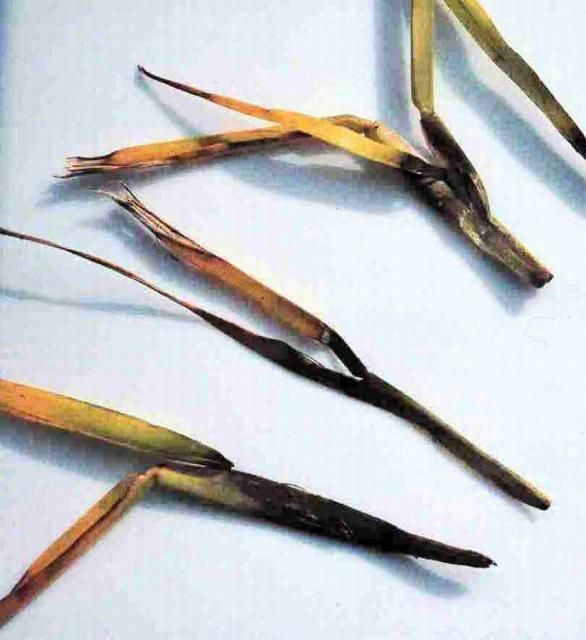
Symptoms/Signs: The fungus infects the leaf area closest to the soil, eventually killing the leaf. A soft, dark rot occurs at the base of the leaf and leaves can easily be pulled off the stem (Figure 1). The base of a pulled leaf has a rotted odor. Roots are not affected by this pathogen.
This disease usually begins as small patches (about 1 ft in diameter) that turn yellow and then reddish brown, brown, or straw colored as the leaves start to die. Patches can expand to several feet in diameter (Figure 2). It is not uncommon to see rings of yellow or brown turf with apparently healthy turf in the center. Turf at the outer margin of a patch may appear dark and wilted (Figure 3).
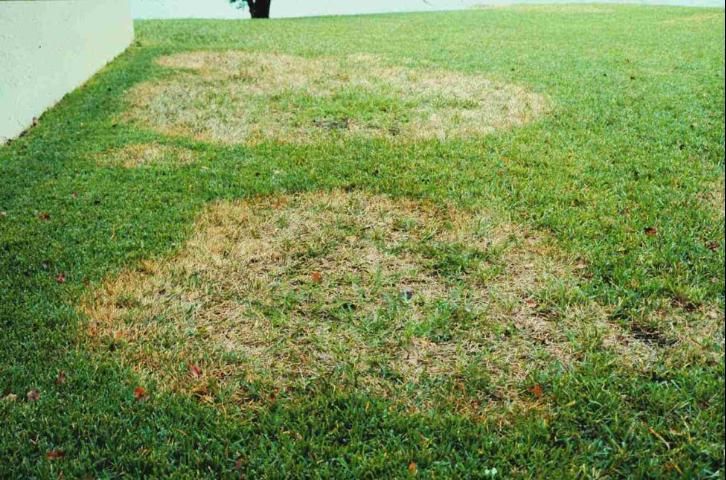
Credit: M. L. Elliott
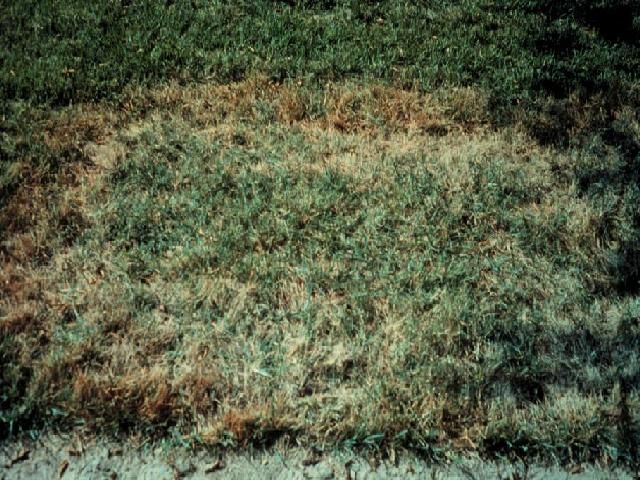
Credit: G. W. Simone
This disease is often confused with herbicide damage on St. Augustinegrass. Herbicide damage may cause the same overall symptoms of yellow or brown patches. The leaf may still pull out of the leaf sheath, but the base of the leaf is not dark and rotted (Figure 4). Instead, the leaf base is dry with a tan discoloration and there is no distinct smell of rot.
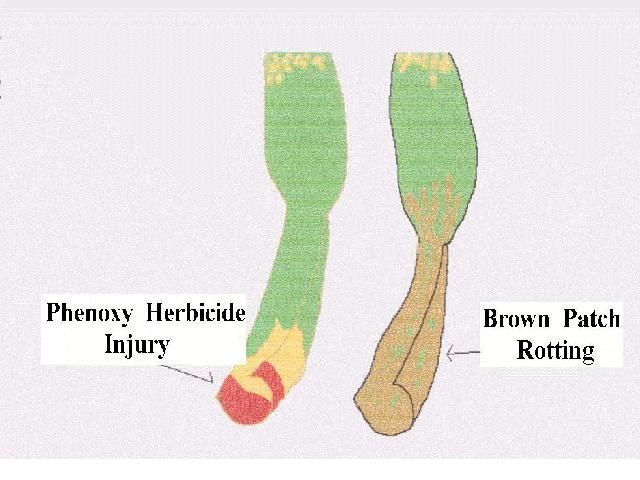
Credit: T. Johnston
Cultural Controls: Cultural practices, involving nutrient and water management, can be adjusted to control brown patch. Excessive nitrogen application during potential disease development periods should be avoided. Just prior to or during disease development periods, slow-release nitrogen sources should be used as opposed to readily available forms, such as soluble liquids or quick-release nitrogen sources. A balanced fertilizer containing equivalent amounts of potassium and nitrogen, preferably a slow-release potassium form, should be applied.
Irrigation should only occur when necessary and during in the early morning hours (between 2:00 and 8:00 a.m.) when dew is already present. Diseased areas should be mowed last since mowers can spread this disease. The mower should be washed of all turf clippings before proceeding to the next site.
Chemical Controls: Fungicide options include azoxystrobin, chlorothalonil, fludioxonil, flutolanil, iprodione, Junction®, mancozeb, metconazole, myclobutanil, polyoxin D, propiconazole, pyraclostrobin, thiophanate-methyl, thiram, triadimefon, trifloxystrobin, triticonazole, and vinclozolin.
The UF/IFAS Extension Electronic Data Information Source (EDIS) website can be referenced for a homeowner's guide to turfgrass fungicides (https://edis.ifas.ufl.edu/publication/pp154). Fungicide labels indicate site application restrictions, as some fungicides cannot be used on residential lawns. Label directions and restrictions for all pesticides should be followed as required by law. Caution should be exercised, as DMI (demethylation-inhibiting) fungicides have shown the potential to damage bermudagrass turf. The presence of a fungicide on this list does not constitute a recommendation.
Turfgrass must be actively growing in order for the diseased turfgrass to recover. Symptoms do not disappear until new leaves develop and the old leaves are removed by mowing or decomposition. Since this disease normally occurs when the turfgrass is not growing very rapidly, recovery may be very slow. The fungicides simply stop the disease from spreading— they do not promote turfgrass growth. This is why it may be beneficial to apply these fungicides prior to disease development, but only if this disease has been a routine problem in the landscape. Cultural control measures must also be incorporated into the disease management program.
Additional Information: There are two other less common Rhizoctonia species that are also pathogens of turfgrass. R. zeae and R. oryzae cause the disease Rhizoctonia leaf and sheath spot. This disease occurs during the summer when the temperatures are above 80°F. While overall symptoms may look like brown patch, the leaf symptoms are different. These pathogens do not cause a basal leaf rot, but rather cause a leaf spot that expands into a leaf blight. The entire leaf turns yellow or reddish-yellow and then brown, and it does not pull off the stem. The roots are not affected. This disease must be confirmed by a plant disease clinic prior to any control efforts as the controls are very different from large patch.
The "Turfgrass Disease Management" section of the Florida Lawn Handbook (https://edis.ifas.ufl.edu/lh040) can be referenced for explanations of cultural and chemical controls.