
Other Names: Bermudagrass decline
Pathogen: Gaeumannomyces graminis var. graminis
Turfgrasses Affected: All warm-season turfgrasses.
Occurrence: The pathogen very common on warm-season turfgrass roots. High rainfall and stressed turfgrass trigger the disease. It is observed during the summer and early fall months when Florida receives the majority of its rainfall. Prolonged periods of rainfall are most conducive to this disease. Any stress placed on the turfgrass can encourage or worsen the disease.
Symptoms/Signs: This is a root rot disease (Figure 1). Damage to the roots prevents the turfgrass from efficiently obtaining water or nutrients from the soil. The plant is also unable to store the products of photosynthesis. The fungus does not attack leaves. Symptoms observed on the leaves are the result of pathogen activity on the root system.
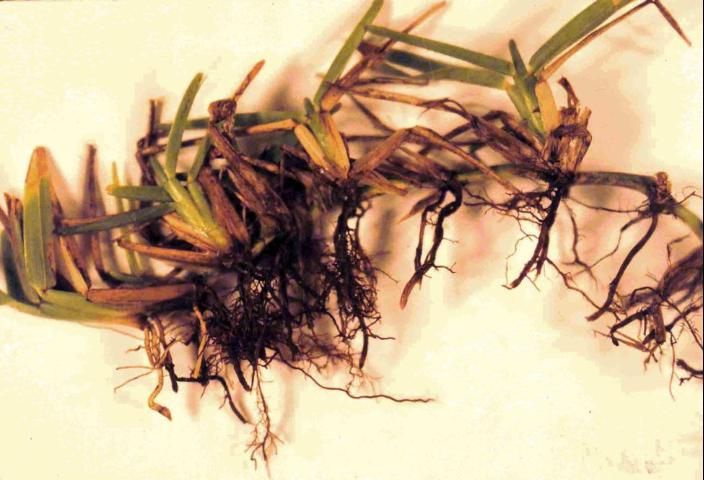
Initial activity of the fungus on the roots can only be observed by looking at the roots. If the turfgrass is not stressed, or if it is under low levels of stress, leaf symptoms may never be observed. However, under high stress conditions, symptoms can appear on the leaves. By the time the leaf symptoms appear, the pathogen has been active on the roots for at least two to three weeks—probably longer.
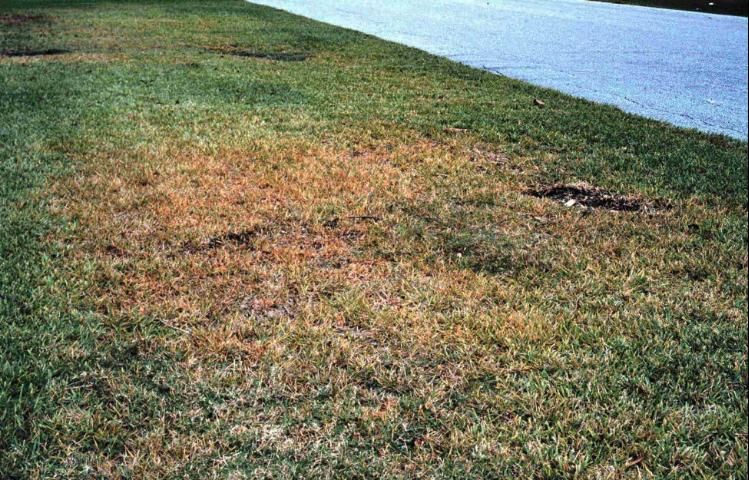
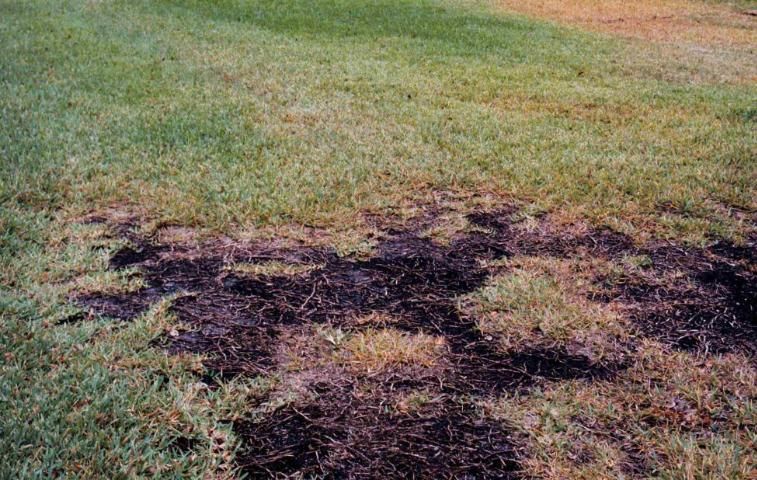
Initial symptoms aboveground are irregular, yellow (chlorotic) or light green patches ranging in diameter from a few inches to a few feet. Roots are initially thin and off-white in color with isolated black lesions. Eventually, roots become very short, black, and rotted. Stolons and rhizomes may have black lesions and, under severe disease conditions, begin to rot. Entire plants may die, resulting in irregular patches of thinning grass, and if the rot is not controlled, bare patches may develop (Figures 2). Under a microscope, black strands of fungi (runner hyphae) and special structures called hyphopodia are visible on the outside of the roots, stolons, and rhizomes (Figure 3).
Cultural Controls: This disease is very difficult to control once the aboveground symptoms are observed. Therefore, measures that prevent or alleviate stress are the best methods for controlling the disease or, at least, decreasing the potential damage. Stress on turfgrass can result from many factors and are addressed below.
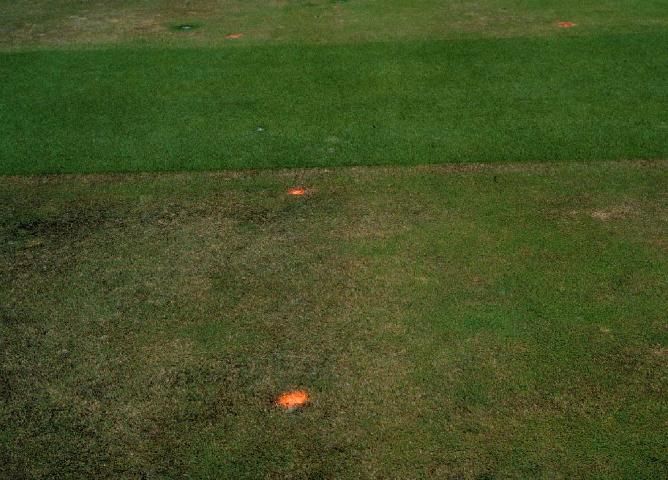
The turfgrass must be mowed at the correct height during the summer (Figure 4). Turfgrass should be mowed as frequently as necessary so that only one third of the leaf tissue is removed during any one mowing event. Removing too much of the leaf tissue in a single mowing, or scalping the grass, damages the growing point.
Nitrogen applications should be balanced with equal amounts of potassium. For every pound of nitrogen applied, an equal amount of elemental potassium should be applied. Slow-release nitrogen and slow-release potassium sources should be used. Nitrate-nitrogen products and quick-release urea products (e.g., uncoated urea) should be avoided. If slow-release potassium is not readily available, then quick-release potassium can be applied to the turfgrass between nitrogen applications. Extra potassium may be useful in late summer and early fall. Micronutrients, especially manganese, should also be applied in the sulfate form as foliar applications. When the disease is active, the roots do not function properly and are unable to obtain nutrients efficiently from the soil. In order to ensure nutrient absorption, frequent foliar (leaf) feeding of all nutrients (N, P, K, and micronutrients) in small amounts is necessary if the root system is severely damaged.
Lime should not be applied to the turfgrass. For centipedegrass, it is acceptable to apply elemental sulfur or iron sulfate to lower the soil pH to below 5.5, but this should not be done with other turfgrasses.
St. Augustinegrass is especially sensitive to herbicides. Even when herbicides are applied correctly, there is some stress placed on St. Augustinegrass. It is possible to manage turfgrass to limit weeds using cultural management techniques and minimal amounts of herbicides. Herbicides should always be applied according to the label instructions. The "Weed Management in Home Lawns" (https://edis.ifas.ufl.edu/ep141) publication provides more information on weed control and appropriate herbicide application.
Chemical Controls: Preventative fungicide options include azoxystrobin, , myclobutanil, propiconazole, pyraclostrobin, thiophanate methyl, and triadimefon. These fungicides are not as effective as the use of cultural controls once the disease symptoms are observed. These fungicides are best used preventively, meaning they must be applied prior to symptom development. Fungicides can be applied at least one month prior to the time when aboveground symptoms are normally observed. Application should continue once a month until the weather is no longer conducive to disease development. These fungicides should be lightly watered into the root zone immediately after application.
The UF/IFAS Extension Electronic Data Information Source (EDIS) website of the can be referenced for a homeowner's guide to turfgrass fungicides (https://edis.ifas.ufl.edu/pp154). Fungicide labels indicate site application restrictions, as some fungicides cannot be used on residential lawns. Caution should be exercised when applying DMI (demethylation-inhibiting) fungicides, as they have shown the potential to damage bermudagrass turf. Label directions and restrictions for all pesticides must be followed as required by law. The presence of a fungicide on this list does not constitute a recommendation.
The "Turfgrass Disease Management" section of the Florida Lawn Handbook (https://edis.ifas.ufl.edu/lh040) can be referenced for explanations of cultural and chemical controls.