
Pathogen: Cercospora fusimaculans also known as Passalora fusimaculans (G.F. Atk.) U. Braun & Crous 2003
Turfgrasses Affected: St. Augustinegrass
Occurrence: This disease is observed between the late spring and summer seasons, especially during periods of frequent rainfall. Areas of St. Augustinegrass that are under cultural or environmental stresses are more susceptible to disease development. For example, low soil fertility or suboptimal light conditions are conducive to the development of this disease.
Symptoms/Signs: Initial symptoms are narrow, dark brown leaf spots. Over time, these spots enlarge into oblong to irregularly shaped lesions with dark tan centers and dark brown to purple margins (Figure 1). Under humid conditions, the abundant sporulation of the pathogen in the lesion centers may confer a whitish sheen to the spots. Numerous spots on multiple leaves can cause extensive yellowing and withering of the canopy.
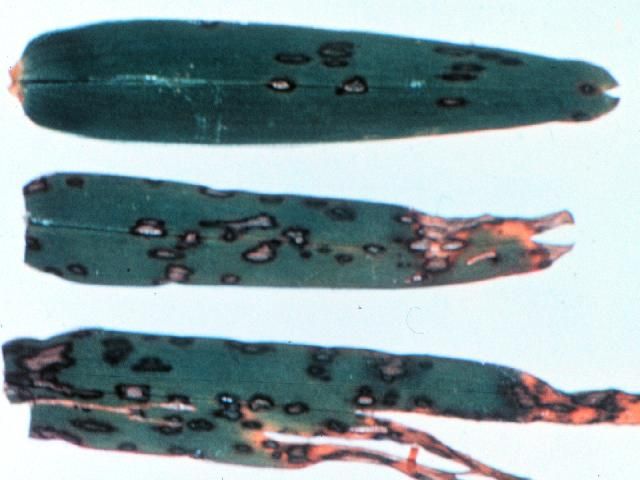
Credit: G. W. Simone
This disease is very similar in pattern on the lawn and symptoms to that of gray leaf spot, but management is very different.
Cultural Controls: Proper cultural practices can reduce the risk of Cercospora leaf spot disease. The disease can be prevented by fertilizing adequately, using slow-release nitrogen sources balanced with potassium (preferably, a slow-release potassium form). The irrigation cycle should be examined for proper timing, frequency, and amount. Irrigation should only occur in the early morning hours (between 2:00 and 8:00 a.m.) when dew is already present, so as not to extend the dew period. The turf should only be irrigated when it exhibits moisture stress. Daily, frequent irrigation cycles can promote foliar disease and should be avoided. If Cercospora leaf spot is already present, the disease can be managed with the application of quick-release nitrogen in a fertilizer blend balanced with potassium (N:K ratio of 1:1). The fertilizer can be applied at 1/2 lb N per 1000 sq ft and should be ammonium nitrate, ammonium sulfate, or quick-release urea formulation. Where Cercospora leaf spot is persistent, St. Augustinegrass cultivars derived from 'Bitterblue' types offer more resistance to this disease.
Chemical Controls: None available.
The "Turfgrass Disease Management" section of the Florida Lawn Handbook (https://edis.ifas.ufl.edu/lh040) can be referenced for explanations of cultural and chemical controls.