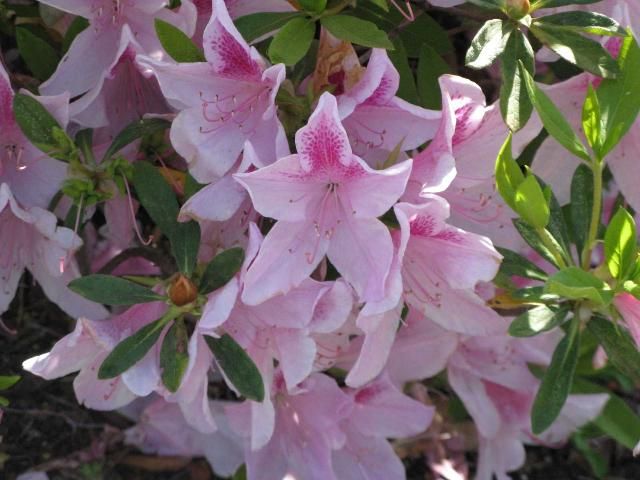
Spectacular flowers and shade tolerance - are among the reasons for the azalea's popularity in north and central Florida (USDA Hardiness Zones 8a–9b) (Figure 1). Azaleas are not successful in coastal areas where alkaline soils, salt drift, or saline irrigation water are found. They are also not adapted to the warm winters and soil conditions of most of south Florida.
Credit: Carolyn Wildes, UF/IFAS
Azaleas enhance the home landscape as foundation or mass plantings and as background or foreground plants, depending on their size. They are also sometimes pruned into single-trunked standards that serve as specimen plants. Generally, their open, relaxed growth habit is more suited to informal landscape designs, but they can be shaped more neatly with pruning.
Adapted Species and Hybrids
Azaleas adapted to Florida require 4–8 weeks of temperatures below 50°F (10°C) and generally begin to bloom between February and early April when warm temperatures follow this chilling period. Sporadic flowering is more common in central than in north Florida because of milder winter temperature fluctuation. Azaleas belong to the genus Rhododendron and most are native to eastern Asia (evergreen species) or North America (deciduous species). Many azalea types and hybrids exist. Table 1 lists some of the most reliable cultivars for Florida landscapes. Mature plant size, flower characteristics, and bloom season should be considered when selecting azaleas. North Florida is home to several native species, most of which are deciduous and have fragrant flowers. Native azaleas are listed in Table 2.
General Culture
Azaleas perform best in areas with filtered sunlight. Their shallow root system and low tolerance to drought and poor soil drainage make placement and care important.
Exposure
Dappled or partial shade provides conditions for healthy growth and optimum flowering. Most do best when protected from intense afternoon sun. On the other hand, dense shade reduces plant growth and flowering. Azaleas exposed directly to early morning sun after a hard freeze thaw too rapidly, which causes bark splitting. Death of branches with split bark may not occur until months after the injury.
Soils
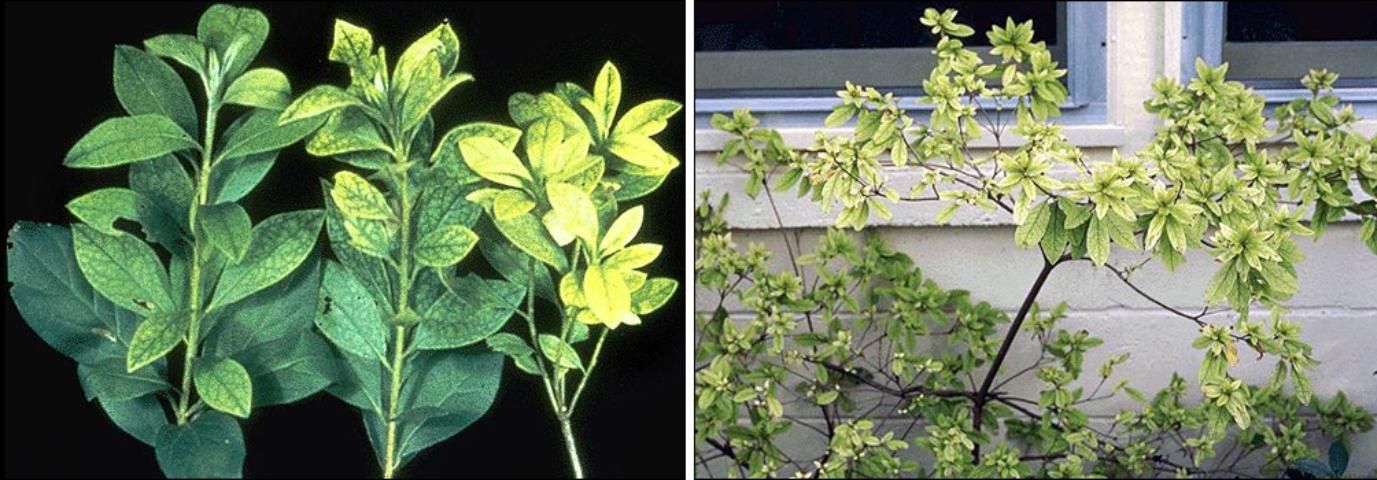
Well-drained, acidic soils with pH 4.5–6.0 are best suited for azaleas because they prefer the ample quantities of iron and other micronutrients that are readily available in acidic soils. Soil pH can be determined with a soil test. The UF/IFAS Extension Soil Testing Laboratory (https://soilslab.ifas.ufl.edu/ESTL%20Home.asp) or your local UF/IFAS Extension office (https://sfyl.ifas.ufl.edu/find-your-local-office/) can help with soil testing. Research does not indicate any benefit from adding organic matter to individual planting holes. However, when a number of azaleas are being transplanted together, the entire planting bed can be improved by adding organic matter, such as peat, compost, or pine bark. These amendments increase moisture and nutrient retention and lower soil pH. When azaleas are grown in soils with a pH higher than 6.0, they often develop a micronutrient deficiency, most typically iron, which exhibits on new growth as yellowing between the leaf veins (Figure 2). These deficiencies can be treated as needed with foliar sprays containing micronutrients. Soils can be temporarily modified (made more acidic) by applying elemental sulfur. Because excessive rates injure plant roots, no more than 1 pound of sulfur per 100 square feet of planting should be applied at one time. Apply sulfur no more than two or three times a year. Other soil amendments, such as ammonium sulfate, iron sulfate, and aluminum sulfate, can also be used to lower soil pH. These are often included in "acid-forming fertilizers." Azaleas growing in extremely acidic soils (pH 3.5–4.5) will be healthy but grow slowly.
Credit: UF/IFAS Plant Nutrient Deficiency Database
Planting/Transplanting
The planting hole for an azalea plant should be approximately 12 inches wider than the root mass. Plants should be spaced according to the cultivar's mature size, but generally they should be spaced 3–5 feet apart. Azaleas have very fibrous root systems that easily become pot bound. Before planting, gently loosen the root ball with your fingers and saturate it completely with water. Set the plant in the hole at or above the depth at which it was growing in the container, fill the hole with native soil (no amendments necessary in the planting hole), and water again.
An organic mulch should be applied and maintained at a depth of 2–3 inches to conserve water and reduce weed problems. Make sure the mulch does not cover the top of the root ball or touch the stem. November to February is the best season for transplanting; however, containerized azaleas may be planted any time if proper care is provided. Azaleas easily perish when they are not properly planted and established. When this occurs, the dead or dying azalea can be easily pulled from the soil with the root ball intact and few to no new roots.
Watering
Irrigation is necessary for successful establishment and optimum growth during extended dry periods. Plants transplanted during the dry season into sandy soils require watering two to three times a week until they are established. Generally, established plants should receive about ¾–1 inch of water every 10 days to 2 weeks during dry periods to wet the soil to a depth of 10–12 inches. The lower leaves of plants that undergo a severe wilt will yellow and drop.
Fertilization
Frequent and light fertilizer applications are often necessary in Florida's sandy soils. An acid-forming fertilizer containing iron and other micronutrients (sometimes sold as an "Azalea Special Fertilizer") should be applied as needed. Micronutrients should be applied with foliar sprays or soil-applied products when deficiencies occur. For more information about nutritional deficiencies, see the Plant Nutrient Deficiency database (https://hort.ifas.ufl.edu/database/nutdef/index.shtml).
Pruning
Pruning is necessary to obtain a full, well-branched azalea. Several light prunings just after flowering and continuing through the growing season result in a compact, denser plant with more blooms. Flower buds are initiated in late spring and early summer, long before they can be seen, so pruning should cease in midsummer (July 4 is an easy date to remember). Pruning after this date decreases the number of spring flowers.
Propagation
Evergreen azaleas are usually propagated by 3–4-inch cuttings taken after the spring growth has hardened or matured (June). They are also easy to root using different layering techniques. See Propagation of Landscape Plants (https://edis.ifas.ufl.edu/publication/mg108) and the Azalea Society of America (www.azaleas.org). Deciduous azaleas are usually propagated by seed or air layering because cuttings are difficult to root.
Pests Problems
Insects/Mites
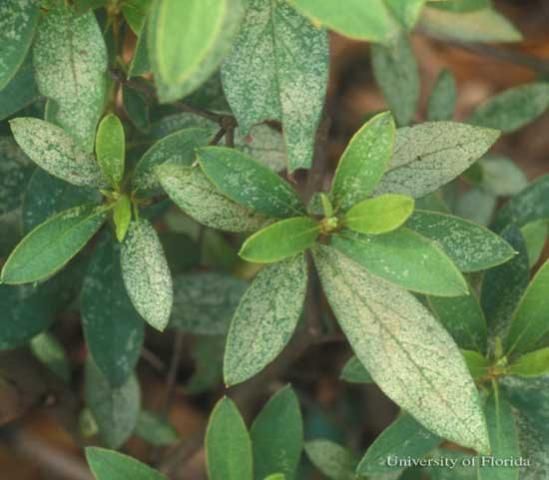
Lace bugs, spider mites, leafminers/leafrollers, and azalea caterpillars are the most common pest problems for azaleas in the Florida landscape. Lace bugs are sucking insects that feed on the undersides of leaves. The top surface of the injured leaf appears speckled or mottled (Figure 3), and tiny black spots of insect excrement can be seen on the leaf undersides. (See Azalea Lace Bug at https://edis.ifas.ufl.edu/publication/in677).
Credit: UF/IFAS
Spider mite injury appears as a bronzing or rusty coloration of green leaves. A mite infestation can be verified by placing a white piece of paper beneath the foliage and slapping the leaves with your hand. Mites can be detected on the white paper as moving, tiny red or brown specks. Two spider mites that commonly attack azaleas are the southern red mite and the twospotted mite.
The azalea leafminer injures azalea leaves in different ways during its life cycle. The young larva "mines" inside the leaves, creating small brown areas. It then migrates to the upper leaf surface, rolls the leaf over itself, and chews holes in it. It will sometimes knit together and feed on new leaves, causing an unsightly plant. When mature, the larva often rolls up in an undamaged leaf and pupates.
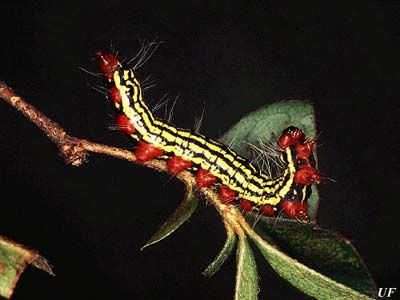
The azalea caterpillar (Figure 4) occurs in north and central Florida and can strip leaves from large portions of a plant. When mature, the caterpillar has a red head and a black body covered with rows of yellow spots and (nonstinging) white hairs. Newly hatched caterpillars feed together on new growth, and entire populations can be controlled at that stage by simply picking off infested leaves. Mature caterpillars are best managed by handpicking and destroying them.
Credit: UF/IFAS
More information about these pests can be found on the Featured Creatures website (https://entnemdept.ufl.edu/creatures/) or by consulting your local UF/IFAS Extension office (https://sfyl.ifas.ufl.edu/find-your-local-office/).
Diseases
The most common diseases reported on azaleas include petal blight, leaf and flower gall, and various azalea declines. Petal blight is most severe during cool, wet spring weather. Infection first appears as small, white spots on colored petals or rust-colored spots on white-flowered varieties. Spots enlarge rapidly into irregular blotches, causing the blossoms to "melt" into a slimy mass. Affected blossoms dry and either drop or remain on the plant. The fungus survives on dried blossoms on or in the soil. Removing mulch and dead flowers 3–4 weeks before bloom reduces disease incidence.
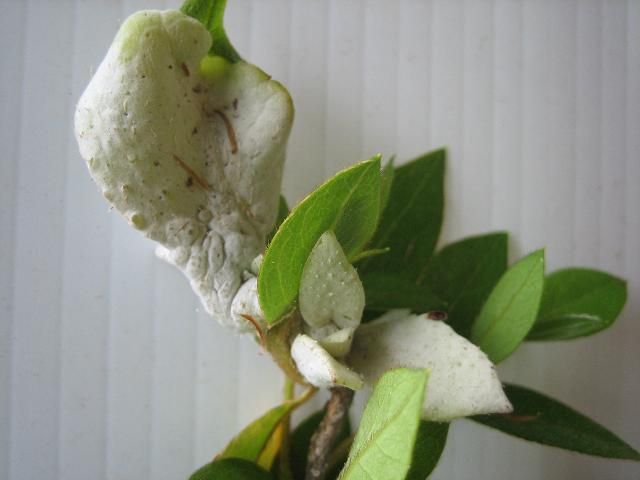
Leaf and flower galls (Figure 5) are more alarming than damaging. The fleshy galls may occur on leaves, stems, or flowers and are most severe on densely shaded plantings with poor air circulation. To prevent a reoccurrence the following year, galls should be handpicked and destroyed when they first appear. Fungicide treatments are not generally warranted in home landscapes.
Credit: Norma Samuel, UF/IFAS
The disease, mushroom root rot, is usually fatal to azaleas, especially those planted in sites with tree stumps or buried organic debris. The causal fungus is visible as a white mycelium under the bark of major roots or the plant crown.
Slow decline in plant vigor with general stunting may be due to nematode injury of the root system. Root examination will reveal galls or swellings, necrosis of fine roots, and/or general stubbiness of small roots, depending on the nematode involved. Unfortunately, at this time there are no chemical controls for nematodes on established plants.
Slow decline in plant vigor with general stunting may be due to nematode injury of the root system. Root examination will reveal galls or swellings, necrosis of fine roots, and/or general stubbiness of small roots, depending on the nematode involved. Unfortunately, at this time there are no chemical controls for nematodes on established plants.
Acknowledgements
The author acknowledges Dr. Jim Midcap and Dr. Dewayne Ingram, former University of Florida faculty who originated this publication. Thank you to former UF/IFAS Extension horticulture agent Dr. Norma Samuel of Sumter County for reviewing this revision.
Additional Resources
Dehgan, B. 1998. Landscape Plants for Subtropical Climates. Gainesville: University Press of Florida.
Galle, F. C. 1987. Azaleas. Portland, OR: Timber Press.