
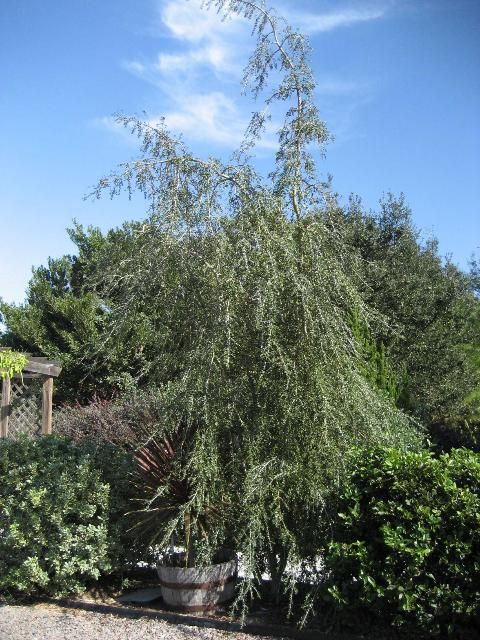
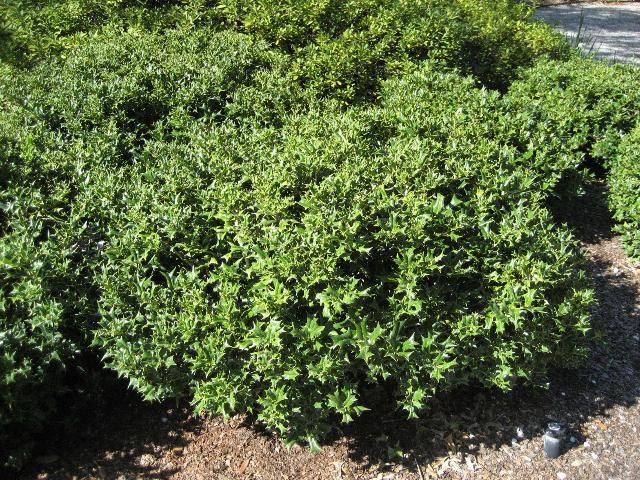
Hollies (Ilex spp.) are reliable, low-maintenance plants for Florida landscapes. Diverse sizes, forms, and textures exist, ranging from large trees to dwarf shrubs (Figures 1 and 2). Some hollies can be used as informal or formal hedges or as foundation plants, while others make beautiful accent or specimen plants. Many are valued for their colorful berries, which brighten the fall and winter seasons and provide food for birds. Several hollies are native to Florida. Table 1 lists some of the more popular hollies sold in Florida.
Credit: UF/IFAS
Credit: UF/IFAS
Description
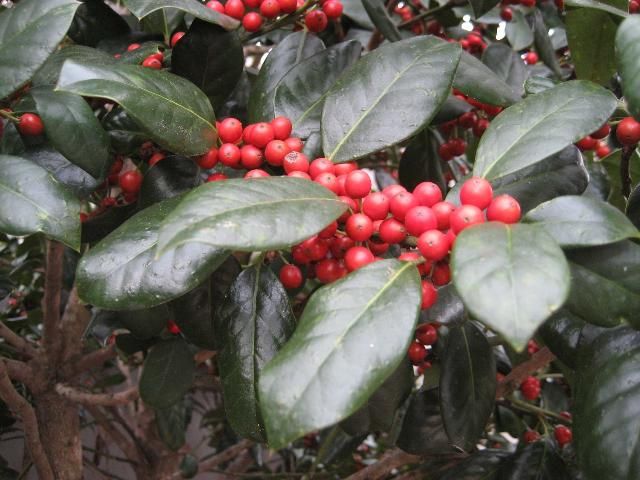
Most hollies, including all those listed in Table 1, are evergreen. A few native hollies lose their leaves in winter but are rarely commercially grown and sold in Florida. Hollies are dioecious plants, meaning male and female flowers are located on separate plants. Female plants produce berries (Figure 3); male plants do not. For this reason, nurserymen often propagate only female plants. Male and female plants produce small white blooms in spring. Bees are the primary pollinators of holly flowers and will carry pollen from male plants as far away as 1.5–2 miles, so it is not necessary to have a male holly in the immediate area.
Credit: UF/IFAS
General Culture
Hollies generally prefer partial shade, but most grow satisfactorily in full sun. Slightly acidic, well-drained soils are essential for most hollies, although a few, like Dahoon holly (Ilex cassine), are native to moist areas and can be planted on wetter sites.
Planting
Container-grown hollies can be planted at any time of the year with proper post-planting care. The planting hole should be 1 foot (30 cm) wider than the root ball and slightly shallower than the height of the root ball. Once planted the site should be watered thoroughly to settle soil around the roots. A layer of organic mulch 2-3 inches deep should be applied and maintained to moderate soil temperature, conserve moisture, and help control weeds; but do not put much over the root ball. Trees and shrubs that are regularly irrigated through the first growing season after transplanting require from 3 months (USDA Plant Hardiness Zones 9–11) to 6 months (USDA Plant Hardiness Zone 8) to become well established.
Watering and Fertilizing
Irrigation is necessary to establish newly planted hollies and to encourage optimal growth. Care should be taken not to waterlog the soil since holly roots require good aeration. Established hollies should be watered as needed during dry periods.
Fertilize newly planted and established hollies in March and September if faster growth is desired or when plants exhibit nutrient deficiencies.
Pruning
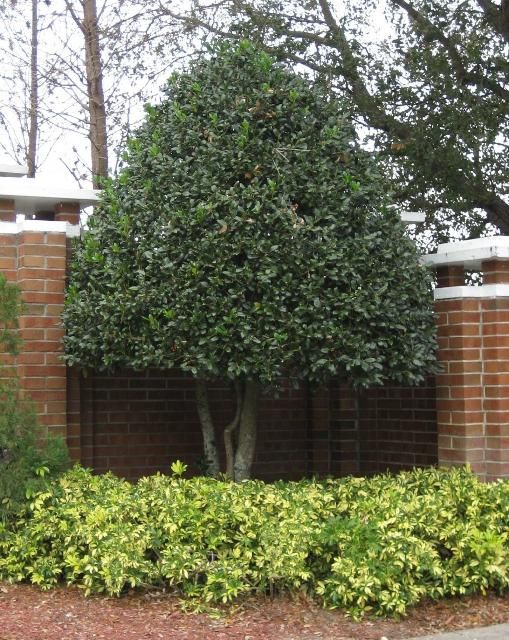
Hollies may need occasional light grooming to maintain their form. Major structural pruning may be necessary to maintain a single leader (trunk) on a specimen tree or when training plants for special purposes (Figure 4). Detailed pruning techniques are provided here: https://edis.ifas.ufl.edu/topic_tree_pruning.
Credit: UF/IFAS
Propagation
Hollies are primarily propagated from tip cuttings in order to produce plants with the same characteristics as the parent plant. Cuttings should be 3–5 inches (7–15 cm) long and treated with a rooting hormone. For optimal rooting, hollies require a humid environment to minimize water loss and tissue desiccation. Growing holly from seed takes longer to produce new plants and results in seedlings that do not have the same characteristics as the mother plant.
Pests
Insects and diseases are not a major problem when hollies are selected, planted, and cared for properly. Poor performance is usually associated with inadequate growing conditions, such as poor soil aeration, drought, improper planting, or lack of fertilization.
Infrequent pests include scale, leaf miner, and spittlebug insects, as well as mites. Many different scale insects feed on hollies by sucking plant juices from leaves and stems. A substance called honeydew is secreted by some scales, and a black, sooty mold fungus grows on the honeydew. Although sooty mold does not harm plants, it is unattractive. Leaf miner larvae feed inside the leaf between the upper and lower surfaces. Blotch or serpentine mines appear on the upper surface of infested leaves. New leaves infested with leaf miners are often stunted and deformed. This pest is seldom severe enough to threaten the health of a holly. Spittlebugs are ¼ inch long, black-brown in color, and oval shaped with two orange bands across their wings. They are most common in north and northwest Florida on Ilex cassine and I. opaca plants. They feed on young leaves and stems by sucking plant juices. Leaves often are killed and dropped from the plant. Spider mites can be found on the underside of holly leaves, especially during hot, dry weather. Infested leaves turn gray or brown and fall from the plant. More information on pest management is available from your local UF/IFAS Extension office Find Your Local Office - UF/IFAS Extension (ufl.edu).
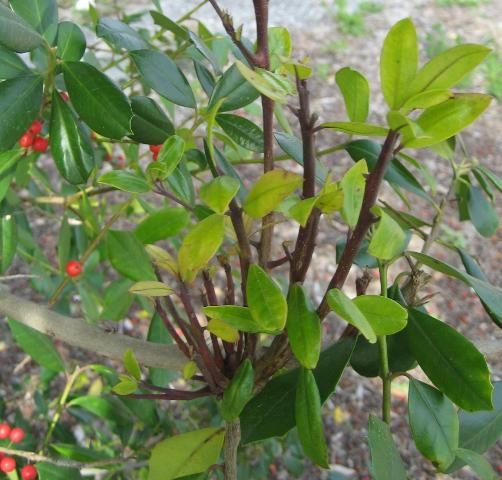
Diseases known to attack hollies include stem gall, twig dieback, and root rot. Stem gall, or witches' broom (Sphaeropsis tumefaciens), is a usually fatal disease of Florida hollies. Stem galls form on twigs and branches, causing the stems to enlarge and initiate an abnormal number of shoots, producing a broom effect (Figure 5). The disease is spread by infected pruning tools, as well as by wind and rain.
Credit: UF/IFAS
Numerous fungi can cause twig dieback, which starts at twig tips and gradually progresses toward the base. Leaves often wilt and drop from the plant. Root rots are usually associated with over-irrigation or hollies planted in poorly drained, wet soils. Poor soil aeration weakens holly roots, allowing fungi to invade and cause considerable damage. Hollies with diseased roots appear weak, and branches, sections, or the whole plant can die. A particular root rot disease known as mushroom root rot can be diagnosed by scraping the bark of large roots or lower trunk tissue. If the area between the bark and the wood shows a white layer of fungal growth, mushroom root rot is involved. Mushroom fruiting bodies may appear in advanced stages of infection. Dead or dying plants affected by mushroom root rot should be removed with as much of the root system as possible, and the soil should be replaced before replanting anything. Fungicides cannot control stem gall, twig dieback, or root rot once these diseases have become established.
For more information on pests of holly, see: https://edis.ifas.ufl.edu/pdf%5CEP%5CEP56600.pdf
Acknowledgements
The author wishes to thank Joe Sewards, UF/IFAS Extension Volusia County horticulture agent, for reviewing the original version of this publication and Mary Derrick, UF/IFAS Extension Santa Rosa County horticulture agent, for her help in developing it.