University of FloridaSolutions for Your Life

Download PDF 
Publication #CIR627

Espaliers1

Sydney Park Brown, Thomas H. Yeager, and Robert J. Black2
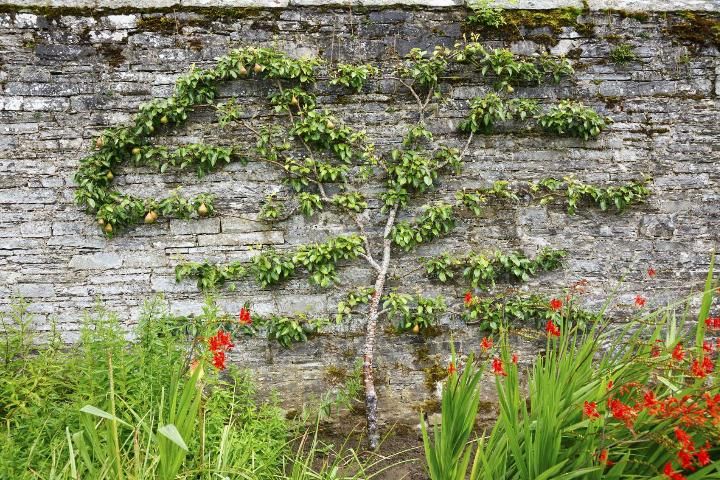
An "espalier," (pronounced "es-PAL-yer") is any plant trained to grow in a flat plane against a wall, fence, or trellis. The word espalier also may be used to describe the technique of training a plant to this flat plane. A French word, espalier is derived from the Italian spalliera, which means “something to rest the shoulder (spalla) against.” The Romans originated the technique, but later generations of Europeans refined it into an exacting but rewarding art.
Espalier has considerable merit in today's garden. The practice originally was used in the old world to conserve space. The English located espaliered fruit trees against a wall with a southern exposure for cold protection. Today, espaliers are used mostly for decorative accents in the landscape.
An espalier is a living sculpture in the garden and is especially effective against a blank wall to relieve the monotony of a row of shrubs. An espalier is also a good choice for a narrow area where spreading shrubs or trees cannot be easily maintained. With landscape spaces becoming smaller around single family dwellings, an espaliered plant may have considerable appeal. More than one espalier design is seldom used in a given landscape.

From Ornamentals to Espaliers

Almost any plant can be espaliered by continually directing growth along a flat plane and removing growth in undesired directions. Some plants are particularly suitable as espaliers. Plants that produce many flexible lateral branches and attractive flowers, fruit, and foliage and/or bark are excellent choices for espaliers. The plants listed in Tables 1-3 are only suggestions and are not intended to be inclusive. Other plants are worth trying, and may prove to be equal to, if not better than, those listed.

Table 1. Suggested trees for espaliers

Table 2. Suggested shrubs for espaliers

Table 3. Suggested vines for espaliers

Selecting an Espalier Pattern

The choice of a pattern for an espalier greatly influences plant selection and maintenance. Many plant species are suited for informal or free-form patterns, but only a few are suited to formal, symmetrical shapes. Before purchasing a plant, make a sketch of your espalier pattern and ask a knowledgeable nursery a horticulturist or your county Extension office for help in selecting a plant that can be trained to this pattern. http://solutionsforyourlife.ufl.edu/map/.
Espaliers can be difficult to train and require many hours of maintenance. Pre-trained espaliers are available in the nursery trade and make it easier and faster for the average gardener to have an elaborate espalier.
The formal patterns illustrated below are for those people who like to clip and prune.

Formal Patterns
Cordon

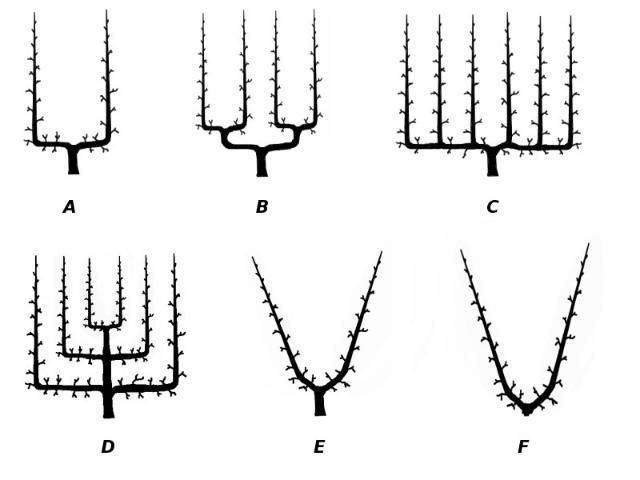
A cordon is a tree trained to grow as a single stem. There are several cordon patterns (Figure 1).

Figure 1. 

Types of cordons.

The single vertical cordon is the simplest and consists of a straight stem with severely shortened branches. This pattern can be used on a chimney or wall where strong vertical lines are desired. Cordons trained from 30° to 60° from the vertical are called oblique cordons and are usually part of a more complex pattern such as the Belgian fence.
The single horizontal cordon has one vertical trunk terminating in two lateral branches that grow horizontally in opposite directions. A double horizontal cordon can be formed by allowing the center shoot to continue upward about 18 inches (0.5m), where it is pinched to encourage the formation of two shoots, which are trained horizontally in opposite directions from each other and parallel to the two lower horizontal branches.
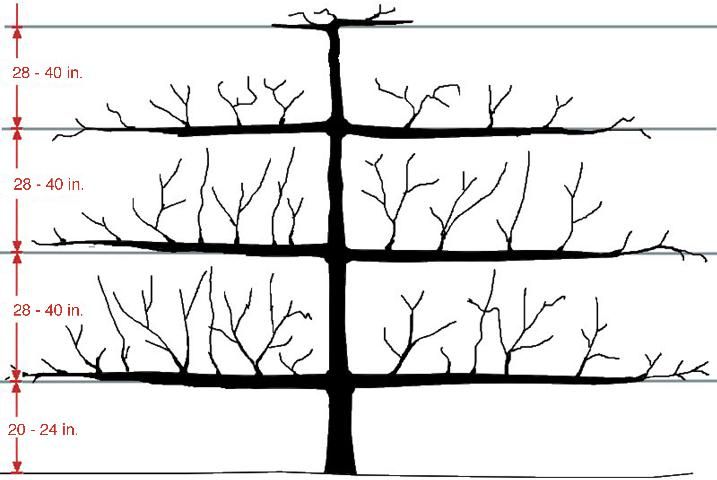
The most popular cordon pattern is a multiple, horizontal cordon called tiered cordon or horizontal T. It is formed in the same manner as the double horizontal cordon but has three or more sets of lateral branches. The braided horizontal T, a variation of the horizontal T, is formed by planting two whips (plants with un-branched trunks) close together and bending their trunks in opposite directions to form the first horizontal lines. Two side shoots are allowed to develop and braided upward, forming horizontal branches at appropriate levels.

U-Shapes

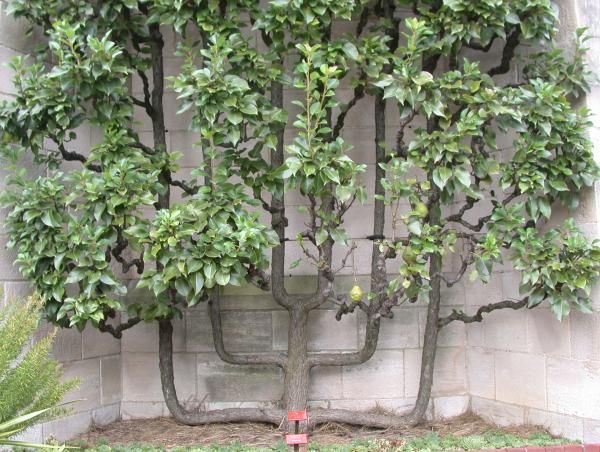
The U-shapes (Figure 2 ) are similar to the double cordon except that the lateral branches are trained to grow vertically. The triple U, sometimes called candelabra, is difficult to form and requires a lot of pruning to maintain.

Figure 2. 

U-shaped espaliers.

Palmette

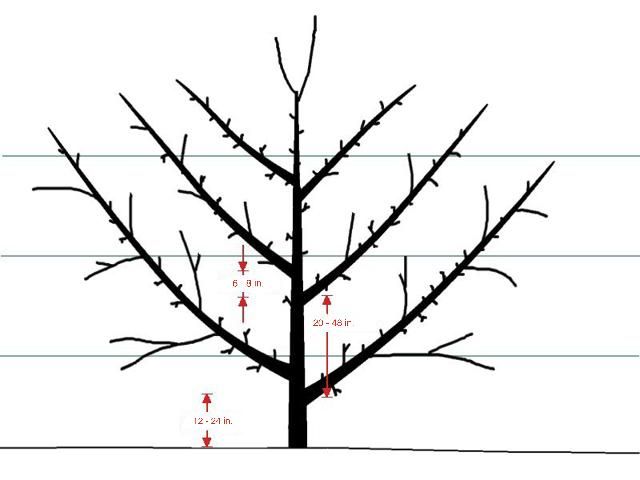
Two distinct variations of the palmette pattern exist (Figure 3). The palmette verrier is the most popular formal espalier pattern and is attained by training the branches of a tiered cordon upward into a candelabra shape. When lateral branches are one foot (0.3m) in length, they are gradually bent upward in 5° to 10° increments. The lateral branches are spaced 12 inches (0.3m) apart and this spacing is kept between the branches as they are bent upward. The oblique palmette is also formed like the tiered cordon with the lateral branches trained at the same angle. The size of the angle will depend on available space, but is always less than 90°.

Figure 3. 

Palmettes.

Fence Patterns

The Belgian fence (Figure 4 ) is a complex lattice pattern formed by combining at least three single horizontal cordons with their branches trained in opposite 45° angles forming a broad V. Two single vertical cordons at the ends are necessary to complete the pattern edges. The losange pattern (Figure 4 ), a variation of the Belgian fence, permits side branches to develop at spaced intervals to achieve increased density. This pattern is a good choice where an espalier is to be used as a solar or visual screen.

Figure 4. 

Fence patterns.

Another type of espalier fence is achieved by the arcure method (Figure 4). Whips of a suitable tree or shrub planted at a slight angle and spaced 3 feet (0.9m) apart are curved over to the right to form half-circles. A shoot is allowed to develop at top center of the curve on the whips and these are bent to the left. This procedure is repeated until the desired height is attained.

Informal Patterns

There are no strict guidelines when developing an informal pattern. Plants can be allowed to grow into their natural shapes or they can be trained into free-form designs limited only by imagination and pruning skills. Informal espaliers usually do not require the kind of supporting framework given to formal patterns; however, most need some means of support, at least until they are established.
Supporting Espaliers

Formal espaliers usually need a trellis or some other framework for support. The framework also provides a guide for training branches and serves to create the illusion of a complete espalier long before a plant is trained to a particular pattern. Wooden trellises should be constructed of rot-resistant woods such as cypress, cedar, redwood, or pressure-treated lumber. The support framework should be placed next to a wall or fence before installing the plant to be espaliered. When an espalier serves as a screen, construct a free-standing support framework consisting of sturdy terminal posts with wires stretched taut between them.
Most informal and some formal espaliers are grown against walls without a supporting framework. In these instances it is advisable to keep the plant 6 to 8 inches (15.2 to 20.3 cm) from a wall. This is particularly important on wooden walls where good air circulation helps prevent mildew, staining and decaying of wooden siding. The space also facilitates training (tying, pruning, etc.), spraying for pests, and maintenance of the building (painting). Finally, leaving space creates interesting shadow patterns that add depth and interest to the espalier. Eye bolts may be used to attach a plant 6 to 8 inches (15.2 to 20.3 cm) from a wall.
Attach plants directly to masonry walls with anchoring devices such as masonry staples or concrete nails. Zinc or plastic anchors may be placed in mortared joints between concrete blocks or bricks and eye screws inserted. You may also glue vine ties (small discs with a short wire embedded) to masonry or wooden walls. These discs are easy to install but are suitable only for small specimens and are not as permanent as devices anchored in a wall. If vine ties are used, the ties should be loosened periodically to prevent the wire from girdling a branch.

Planting and Training Espaliers

Once you have selected a plant, pattern and support framework, the next step is plant installation. Plants to be espaliered should be planted 6 to 8 inches (15.2 to 20.3 cm) from the wall or support framework in well-drained soil. Often, the soil at the base of a wall contains building debris such as concrete or stucco which should be removed and replaced with a better soil containing organic matter such as compost or manure.
Dig a hole one foot (30.4 cm) wider than the root ball of the plant. Backfill the hole with enough soil so that the plant sits in the hole with top of the root ball level with the top of the hole. Firm the soil in the bottom of the hole to prevent settling. Gently place the plant straight in the hole and fill around the roots with soil. Water thoroughly while planting to remove air pockets. Apply a 2- to 3-inch organic mulch to conserve moisture and help to control weeds.
The training technique used will depend on the pattern selected and the number of laterals on the plant. If you are following a design, carefully bend the branches into the desired positions and tie them into place. Remove all unwanted laterals or branches. If a design with a dominant main shoot is used, do not cut the top of the main shoot until the desired height is reached. A design with pronounced lateral growth, such as one of the cordon or U-shaped patterns requires that the terminal be cut at the level of the first cordon, usually 15 to 18 inches (0.4 to 0.5 m) from the ground. If no special design is desired, the branches may be tied in their natural positions as long as no branches cross.

General Care

Pruning

To maintain an espalier, prune and tie new shoots to conform to the pattern. Prune all stray branches that grow outward at right angles to the flat surface and those that grow beyond the boundaries of the desired pattern. Be careful to prune flowering shrubs and trees during the proper season.

Fertilization

In addition to regular pruning and tying, fertilization is an important aspect of espalier culture. During the early stages of an espalier, rapid growth may be encouraged with applications of 12-4-8 or 16-4-8 or similar fertilizer at 1 pound (454g) per 100 square feet (10m2) every 3 months. After an espalier has grown into a desired pattern, fertilization should be reduced to applications in the spring and fall. This fertilization schedule will maintain healthy foliage without encouraging excessive growth and maintenance.

Diseases and Insects

Espaliered plants may be prone to disease and insect problems due to the lack of air circulation around them. Carefully monitor plants for early signs of problems. Diagnostic information and management recommendations are available from your county Extension office: http://solutionsforyourlife.ufl.edu/map/

Trimming Tips for Lateral Growth

Figure 5. 

(a) Cut main leader at or near buds where you want the first set of branches, usually 15 to 18 inches from the ground. Leave at least 3 buds or branches below cut.

Figure 6. 

(b) During the first year, let buds or branches develop into long shoots.

Figure 7. 

(c) Train two shoots horizontally and one vertically. Remove all other shoots.

Figure 8. 

(d) Cut the main leader at or near the spot where you want the second set of branches.

Figure 9. 

(e) Let buds develop into shoots.

Figure 10. 

(f) Train two shoot horizontally and one vertically. Repeat process of training new shoots until the plant reaches the desired height.

Tables

Table 1. 

Suggested Trees for Espaliers

Botanical name

Common Name

Section of State1

Leaf Persistence

Light Requirements

Basic Pattern

Cercis canadensis

Red bud

N-C

Deciduous Full sun / partial shade Informal

Comment: Rose flowers in early spring.

Citrus spp.

Citrus

C-S Evergreen Full sun Informal

Comment: White, fragrant flowers in spring and colorful fruit in fall or winter.

Coccoloba uvifera

Sea grape

S Evergreen Full sun / partial shade

Formal / informal

Comment: Large evergreen leaves and small purple fruit.

Eriobotrya japonica

Loquat

N-C-S

Evergreen Full sun

Formal / informal

Comment: White, fragrant flowers in winter and yellow fruit in spring.

Lagerstroemia indica

Crape myrtle

N-C-S

Deciduous Full sun Informal

Comment: White, pink, red or purple flowers in late spring and early summer; attractive, sculptured branches and mottled bark.

Ilex spp.

Hollies

N-C-S

Evergreen

Full sun

Formal

Comment: Many species are suitable depending on the size desired. Red berries in the fall/winter on female plants.

Magnolia grandiflora

N-C

Evergreen

Full sun

Formal/informal

Comment: Leaves are large, glossy dark green with brown pubescence underneath.

Malus spp.

Apple, southern crabapple

N Deciduous Full sun

Formal / informal

Comment: Pink, fragrant flowers borne in profusion in early spring.

Prunus spp.

Peach, nectarine, plum

N Deciduous Full sun

Formal / informal

Comment: Flowers in spring and fruit in summer.

1N = north Florida (Pensacola to Jacksonville and south to Ocala); C = central Florida (Leesburg south to Punta Gorda and Fort Pierce); S = south Florida (Stuart to Ft. Myers and south to Homestead); N-C-S = entire state

Table 2. 

Suggested Shrubs for Espaliers

Botanical name

Common Name

Section of State1

Leaf Persistence

Light Requirements

Basic Pattern

Camellia japonica and C. sasanqua

Camellias

N-C

Evergreen

Partial shade Formal / informal

Comment: Wide variety of flower forms and colors; C. sasanqua and early varieties C. japonica bloom in the fall; Mid-and late-season varieties of C. japonica bloom in the winter and spring.

Carissa grandiflora

Natal plum

C-S

Evergreen

Full sun / partial shade Informal

Comment: White flowers in spring and attractive, scarlet fruit in summer.

Gardenia jasminoides

Gardenia

N-C-S

Evergreen

Full sun / partial shade

Informal

Comment: White, fragrant flowers in spring; white flies and sooty mold are major problems; should be grafted on G. thunbergia rootstock in central and south Florida for resistance to nematodes.

Juniperus spp.

Juniper

N-C-S

Evergreen

Full sun

Formal or informal

Comment: Hundreds of cultivars are available in many shades of green, blue, and gray. Need well-drained soils; very heat and drought tolerant

Ligustrum japonicum

Ligustrum

N-C-S

Evergreen

Full sun / partial shade Informal

Comment: White, small, odorous flowers in spring.

Photinia glabra

Redtip photinia

N-C

Evergreen

Full sun Informal

Comment: Photinia x fraseri is an excellent hybrid. Leaf spots are often an unsightly problem.

Podocarpus spp.

N-C-S

Evergreen

Full sun

Formal / informal

Comment: Both the weeping podocarpus (P. gracilior) and P. macrophyllus are suitable for espaliers. P. gracilior is cold tender and can only be grown in south Florida and protected locations in central Florida.

Pyracantha coccinea

Pyracantha

N-C-S

Evergreen

Full sun Formal / informal

Comment: White flowers in spring followed by orange-red berries in fall and winter.

1N = north Florida (Pensacola to Jacksonville and south to Ocala); C = central Florida (Leesburg south to Punta Gorda and Fort Pierce); S = south Florida (Stuart to Ft. Myers and south to Homestead); N-C-S = entire state

Table 3. 

A Few Suggested Vines for Espaliers. For others, see EDIS publication CIR860, "Flowering Vines for Florida."

Botanical name

Common Name1

Section of State2

Leaf Persistence

Light Requirements

Basic Pattern

Allamanda cathartica

Allamanda

C-S

Evergreen

Full sun

Informal

Comment: Large, yellow, trumpet-shaped flowers throughout most of the year in south Florida.

Ficus pumila

Climbing or creeping fig

N-C-S

Evergreen

Full sun / partial shade

Informal

Comment: Clings by aerial rootlets; should be used only on masonry walls.

Trachelospermum jasminoides

Confederate jasmine

N-C-S

Evergreen

Full sun / partial shade

Informal

Comment: White, fragrant, star-shaped flowers in bloom from April to May.

1For others, see EDIS publication CIR860, "Flowering Vines for Florida"

2N = north Florida (Pensacola to Jacksonville and south to Ocala); C = central Florida (Leesburg south to Punta Gorda and Fort Pierce); S = south Florida (Stuart to Ft. Myers and south to Homestead); N-C-S = entire state

Footnotes

1.

This document is Circular 627, Department of Environmental Horticulture, Florida Cooperative Extension Service, Institute of Food and Agricultural Sciences, University of Florida. First published: May 1985. Reviewed and revised May 1993, June 2004, Sept. 2007. Please visit the EDIS website at http://edis.ifas.ufl.edu.

2.

Sydney Park Brown, associate professor and Consumer Horticulture Specialist ; Thomas H. Yeager, professor, woody ornamental specialist; and Robert J. Black, professor emeritus. Cooperative extension service, Institute of Food and Agricultural Sciences, University of Florida, Gainesville FL 32611.


The Institute of Food and Agricultural Sciences (IFAS) is an Equal Opportunity Institution authorized to provide research, educational information and other services only to individuals and institutions that function with non-discrimination with respect to race, creed, color, religion, age, disability, sex, sexual orientation, marital status, national origin, political opinions or affiliations. For more information on obtaining other extension publications, contact your county Cooperative Extension service.

U.S. Department of Agriculture, Cooperative Extension Service, University of Florida, IFAS, Florida A. & M. University Cooperative Extension Program, and Boards of County Commissioners Cooperating. Millie Ferrer-Chancy, Interim Dean.