
Summary
- The most common bud rot pathogen in Florida is Phytophthora palmivora. Thielaviopsis paradoxa may cause this disease also.
- The first symptom is discoloration and wilting of the spear leaf and wilting/discoloration of the next youngest leaf. If severe, the spear leaf easily pulls from the bud.
- In palms with a canopy above eye level, this first symptom is often missed. Instead, a lack of new leaves and an open-topped crown are often the first symptoms to be observed. Because the bud is dead, no new leaves emerge. Older leaves remain healthy for months after the bud dies.
- In a nursery, water management and sanitation are critical for bud rot management.
- Preventive fungicide applications are useful in a nursery situation for bud rot, but less so in a landscape with mature palms (palms with trunks).
- Bud rot is also observed in association with cold damage. Cold damage allows entry of secondary pathogens, both fungi and bacteria. Refer to Cold Damage on Palms (https://edis.ifas.ufl.edu/mg318).
Introduction
To understand bud rots, an explanation of palm anatomy is necessary. The apical meristem is the growing point of the palm and is often called the bud or heart. All leaves originate from the apical meristem. The youngest, unopened leaf (spear leaf) and the recently expanded leaves come from and are attached to the bud. All forthcoming new leaves are formed in the bud as the palm grows. Unlike broadleaf trees (e.g., oak, citrus) that have multiple apical meristems, each palm stem has only one apical meristem. Thus, when the bud (apical meristem) is damaged or diseased, the palm usually dies because growth ceases in the bud.
The location of the bud relative to the soil line depends on the size of the palm. If the palm is still a juvenile, then the bud is at or near ground level since a juvenile palm has no stem (trunk). Initially, the stem consists of little more than overlapping leaf bases protecting the apical meristem (bud). If the palm has a stem (trunk), then the bud is aboveground, protected by the oldest leaf bases.
Pathogens and Hosts
There are two pathogens that may cause palm bud rots in Florida—Phytophthora palmivora and Thielaviopsis paradoxa. In small, juvenile palms, other common soilborne pathogens may cause bud rot. The initial symptoms are similar no matter which pathogen causes the disease. Thus, a laboratory diagnosis is required to determine the exact cause of the symptoms observed. However, the pathogens can be very difficult to isolate.
Phytophthora
Phytophthora palmivora is the fungus most commonly associated with palm bud rots in Florida. This fungus is found worldwide in tropical, subtropical, and warm temperate climates. It causes disease on numerous plants besides palms. Its host range within the palm family appears to be broad also. Phytophthora bud rot is observed in container nurseries, field nurseries, and in the landscape in all stages of palm development.
The fungus produces three types of spores—sporangia that can be moved by wind or water, zoospores that are motile in water, and chlamydospores that are very long lived in the soil. Free water is very important for the life cycle of this fungus and a critical factor in disease development.
Thielaviopsis
Thielaviopsis paradoxa is a fungus that can also be found worldwide and appears to have a broad host range within the palm family. Its asexual stage name has changed from Thielaviopsis to Chalara and, more recently, back to Thielaviopsis. It is this stage that is most often encountered. The fungus produces two different types of asexual spores, endoconidia and chlamydospores. The latter survive for very long periods in the soil.
Symptoms
Phytophthora Bud Rot
The first symptom of Phytophthora bud rot is the discoloration and possibly the wilting of the spear leaf (youngest, unopened leaf). The next youngest leaves may also appear discolored and wilted. The leaves will be a lighter green color than normal, or they will be chlorotic (yellow). Eventually, these leaves become desiccated, turn brown, and collapse. A close examination of the leaves, especially the spear leaf, often reveals blighted areas on the blade. The leaf base often has distinct brown or necrotic (dead) areas. As the disease progresses, the spear leaf can be easily pulled from the bud, and the leaf base rots and has a foul odor. These symptoms occur because the pathogen has infected the youngest leaves and then progressed down the leaves to the bud (Figures 1 and 2).
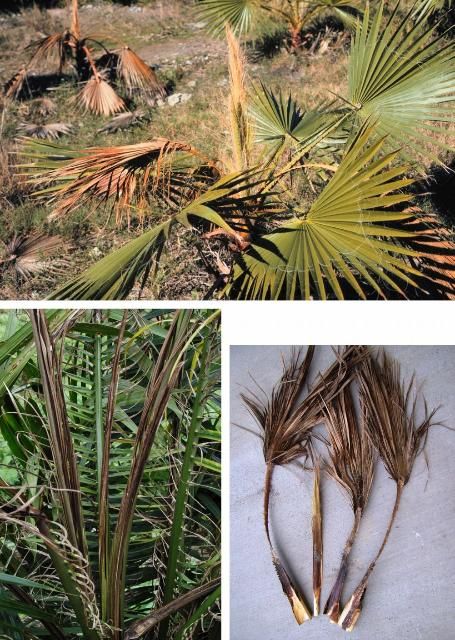
Credit: T. K. Broschat and M. L. Elliott, UF/IFAS
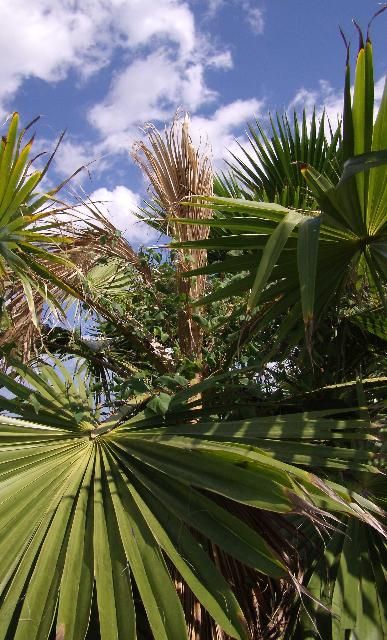
Credit: M. L. Elliott, UF/IFAS
If the diseased palm is still in a container or small enough in the field or landscape that the top of the canopy is still at eye level or below, the wilting and discoloration of the youngest leaves are the first symptoms observed. However, if the palm is so large that the canopy is above eye level, then the first symptoms observed is usually the lack of new leaves, especially the spear leaf, and an open-topped crown (Figure 3). The diseased palm did go through the discoloration and wilting of the youngest leaves, but that symptom might not have been observed.
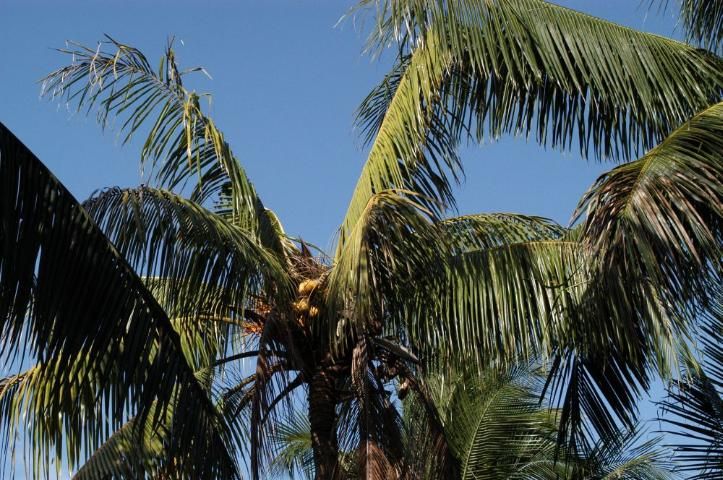
Credit: M. L. Elliott, UF/IFAS
No new leaves emerge from the bud because the bud is already dead. However, the leaves that were present prior to infection of the bud by the pathogen remain green, appear healthy, and remain attached to the trunk for many months. Eventually, these leaves become various shades of green, yellow, and brown as they naturally senesce.
In the landscape, bud rot caused by Phytophthora is more likely to occur during the rainy season and appears to occur with greater frequency after a tropical storm or hurricane (Figure 4). In container nurseries or field production of juvenile palms, however, bud rots can occur at any time, especially if the palms are watered via overhead irrigation.
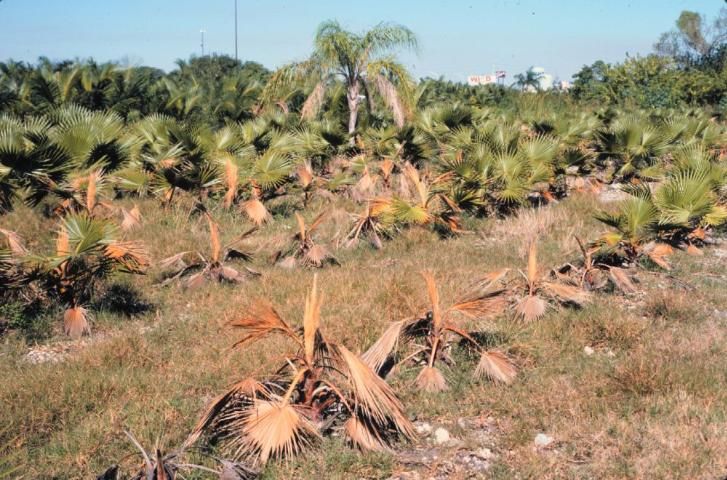
Credit: T. K. Broschat, UF/IFAS
Thielaviopsis Bud Rot
It is presumed that the symptoms associated with Thielaviopsis bud rot are similar to those observed for Phytophthora bud rot, but this is not well documented. The likely difference between these two diseases is that Thielaviopsis probably moves beyond the bud tissue and into the trunk tissue because Thielaviopsis degrades woody tissue, but Phytophthora does not.
Diagnosis
Since both pathogens cause similar symptoms, a laboratory diagnosis is required to determine the cause. This is especially critical if fungicides are used as part of a management program, as each pathogen requires a different group of active ingredients. The UF/IFAS Plant Diagnostic Center in Gainesville (PDC-GNV) can provide this service (http://plantpath.ifas.ufl.edu/extension/plant-diagnostic-center/). Contact your local UF/IFAS Extension office (http://solutionsforyourlife.com/map) or PDC-GNV for details about sample submission and cost of a laboratory diagnosis. In general, the best sample is one with both healthy and diseased tissue. A sample of a completely rotted tissue makes the diagnosis more difficult, if not impossible, as secondary organisms are likely present. Be sure to provide pertinent information regarding environmental conditions that occurred prior to symptom development.
Disease Management
Phytophthora or Thielaviopsis Bud Rot
Cultural Control
In container nurseries and for juvenile palms in a field nursery, sanitation and water management are critical for disease control. Water is required for spore germination and infection. Rain and irrigation can splash spores from one plant to another. A flooded field also allows spores to move. Increasing distance between plants, increasing air movement, and irrigating in the early morning hours to reduce leaf wetness at night are critical water management components. When possible, eliminate overhead irrigation or grow palms under rain shelters.
Spores can also be moved by insects, snails, and rodents; with infested potting mix and soil; or possibly by pruning tools. Pruning tools should be disinfected and palms trimmed carefully so as not to damage the bud or young leaves.
In general, severely diseased plants should be removed and destroyed immediately to limit pathogen spread. Potting mix from diseased container palms should be removed from the nursery. For mature palms, the diseased palm should be removed and the canopy region (including the bud) destroyed. The lower trunk should be pathogen free, so it would be acceptable to chip it and recycle it in the landscape.
While the cultural controls described above are applicable for bud rots caused by both fungal pathogens, a laboratory diagnosis is required before fungicides can be applied. This is because the fungicides used for Phytophthora are not effective against Thielaviopsis, and vice versa.
Fungicides for Juvenile Palms
For juvenile palms, bud drenches are appropriate since the bud is readily accessible. For bud rot caused by Phytophthora, products containing the active ingredients fosetyl-Al, phosphite, mefenoxam, or propamocarb are recommended. Propamocarb is for use in container nurseries only. For bud rot caused by Thielaviopsis, products containing the active ingredient thiophanate-methyl are recommended. If it is not clear from the laboratory diagnosis which pathogen is causing the disease, then mixtures of these products that conform to the label could be used. A product that is already a mixture of fungicides effective against both pathogens, for use on nursery crops only, is Banrot® (active ingredients etridiazole and thiophanate-methyl). As with the other fungicides, it should be applied as a bud drench. Etridiazole is a contact fungicide, whereas all the other fungicides listed are systemic fungicides. All fungicides must be used according to the label.
Unless bud rot is caught very early in a juvenile palm, the palm usually dies. The primary reason for applying a fungicide in a nursery situation is to prevent disease development on remaining palms. Nursery stock should be monitored closely at all times for bud rots, but especially after a tropical storm or prolonged periods of rainy weather. Preventive fungicide applications may be warranted in these environmental situations.
Fungicides for Mature Palms
Disease management of mature palms is more difficult. This is especially true of palms in the landscape or field nursery when the palms have trunks that are too tall to allow for an easy view of the bud and emerging leaves. Again, unless the bud rot is caught very early, the palm usually dies. If the spear leaf is missing and no new leaves are emerging, or if it is possible to pull the spear from the bud, the palm should be removed immediately. It is only acting as a source of fungal spores for infecting the surrounding palms. Since the bud is already dead on these palms, no fungicides are recommended.
While no research has been conducted on mature palms in the U.S., fungicides may be useful as a preventive measure on palms in close proximity to a palm that has died from bud rot. For Phytophthora bud rot, a bud drench with products containing the active ingredient mefenoxam or fosetyl-Al may be effective. Phosphite trunk injections may also be effective.
Selected References
Atilano, R. A. 1982. "Phytophthora Bud Rot of Washingtonia Palm." Plant Disease 66 (6): 517–519.
Guest, D., K.G. Pegg, and A.W. Whiley. 1995. "Control of Phytophthora diseases of tree crops using trunk-injected phosphonates." Horticultural Reviews 17:299-330
Simone, G. W. 2004. "Thielaviopsis Diseases." In Compendium of Ornamental Palm Diseases and Disorders, edited by M. L. Elliott, T. K. Broschat, J. Y. Uchida, and G. W. Simone, 37–38. St. Paul, MN: American Phytopathological Society.
Uchida, J. Y. 2004. "Phytophthora Diseases." In Compendium of Ornamental Palm Diseases and Disorders, edited by M. L. Elliott, T. K. Broschat, J. Y. Uchida, and G. W. Simone, 29–32. St. Paul, MN: American Phytopathological Society.