Homeowners are generally discouraged from using fungicide products to manage diseases of the lawn and landscape for the following reasons:
- Fungicide products have been developed to help manage specific plant diseases. There is no one product suitable for every situation.
- Correct diagnosis of the disease being treated is necessary to select the appropriate fungicide products. Diagnosing the disease is difficult to do based on visual appearance alone
- Timing (i.e., when and how much) applications to effectively control a disease is a complex task. In many cases, there is a narrow window of time when best performance is likely. It takes experience to recognize that window through close observation of the plant and environment. Reapplication is necessary at intervals that depend on how long the fungicide persists and remains effective. In addition, there is no available curative treatment once symptoms of some diseases have developed. Fungicide applications will help only with preventing spread to other areas in these situations.
- There are specialized skills, equipment, and a certain attention to detail that is required to effectively and safely measure, dilute, and apply fungicide products.
That being said, many fungicides are packaged for and marketed to homeowners. These products can help manage some lawn and landscape diseases when used appropriately.
What is a disease?
Plants die for many reasons, not all of which are diseases. Many environmental stresses can mimic diseases. A variety of injuries (e.g., mowing the grass too short) or disorders (e.g., nutritional deficiencies, drought) can result in plant death, yet not involve a pathogen. Disease occurs when a pathogen infects a plant and disrupts growth and appearance. This could eventually kill that plant over time. The most common plant pathogens include fungi, bacteria, and viruses.
Disease Triangle
Environmental factors influence disease development in the landscape. When the environment favors the host plant, disease is unlikely to occur. When environmental factors favor growth of the pathogen and infection of the host, disease is more likely to occur. All three sides of the disease triangle (Figure 1) must be present for disease to occur: a susceptible host, a pathogen that can cause disease, and an environment favorable for infection and disease development.
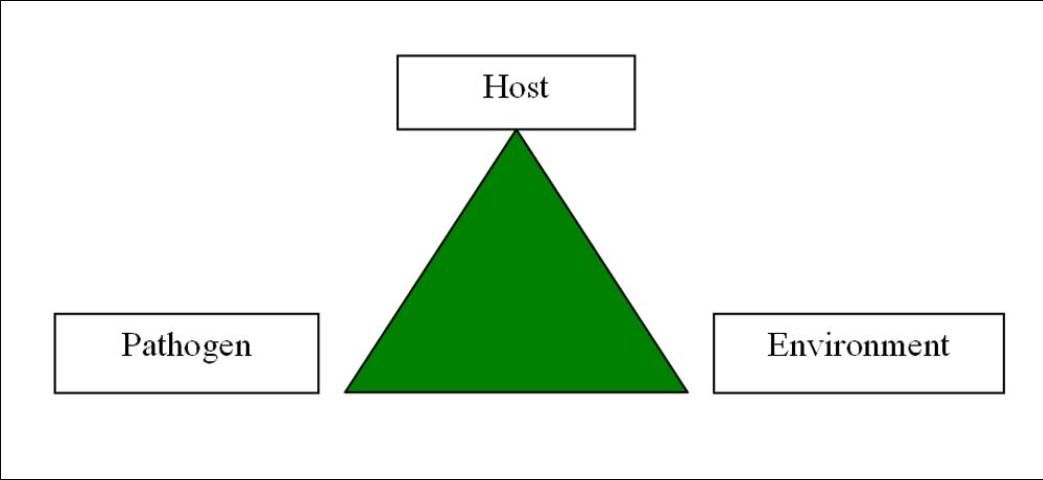
Environmental factors affecting disease development include (but are not limited to) the following:
- Temperature—Fungal diseases occur over a wide range of temperatures.
- Moisture—High relative humidity favors fungal pathogen growth.
- Wind—Wind increases the spread of plant pathogens and the number of wounds on host plants.
- Wounds—Pruning and hedge trimming can create wounds that allow pathogens to enter a plant.
- Host—All plants are not susceptible to all pathogens; each pathogen has a host range.
- Soil Type—Sandy soil can stress plants because of its low moisture-holding capacity, while a high clay level can cause stress because of its excessive water-holding capacity.
- Fertility—Low fertility causes stress, while excessive fertilizers can provide a flush of growth that is more susceptible to disease.
- Light—Insufficient light can favor certain diseases.
- Herbicides—Herbicides can increase the severity of certain diseases.
- Air Pollutants—Air pollutants can cause direct symptoms on the host and affect the pathogen.
Disease Diagnosis
Because of the wide range of problems that occurs on the many plants in a landscape, determining which disease is affecting the plant or turfgrass is often difficult. Correctly diagnosing disease problems is critical because treatment recommendations are vastly different for different disease problems. To diagnose a plant disease problem, homeowners can
- consult a lawn and landscape professional,
- consult a Master Gardener or other knowledgeable plant person,
- contact their local UF/IFAS Extension agent for help (https://sfyl.ifas.ufl.edu/find-your-local-office/), or
- submit a sample to the UF/IFAS Extension Plant Diagnosis Center (https://edis.ifas.ufl.edu/SR007).
Once the cause of the problem is known, homeowners can determine how to manage it and prevent the problem from occurring again.
Disease Prevention
A proper irrigation schedule, good fertilization regime, and planting the right plant for the right place reduce the chance of some diseases becoming a problem. Maintaining healthy and stress-free plants helps reduce the chance that a landscape will become diseased. Just like humans, plants are more capable of thriving and surviving an infection if they are healthy and not already plagued by stress. When introducing new plants into the landscape, homeowners should take care to choose a strong and healthy plant that is not already infected with a pathogen. To do this, homeowners should look for signs (e.g., fungus spores and structures) and symptoms (e.g., wilts, spots, stunting, and cankers) of plant disease on the plant and root system. It is a good idea to only purchase plants from reputable and licensed nurseries. "Bargain" plants should be inspected carefully.
Even with the best cultural management regime, not all disease problems can be prevented. Fungicides can be very effective tools for disease management when the right product for the job is applied correctly and early enough in the development of the disease. Plant diseases can spread to other susceptible plants in a landscape. Fungicides are most effective when used to prevent disease spread to healthy plants.
Fungicide Facts
Fungicides are chemicals that inhibit the growth of fungi. There are many different chemical active ingredients that work as fungicides. Some active ingredients are sold in several different products and formulations. After a homeowner has diagnosed the disease problem and has received a fungicide management recommendation, it is important to carefully consider pesticide safety and selection.
Fungicides can be classified by how they work on the fungus and how they work on the plant. Products that work in a similar way on fungi have the same mode of action (also referred to as chemical family or class). Contact fungicides are sprayed onto plants and act as a protective barrier from pathogen infection. They prevent infections from occurring when applied before symptoms are visible, but infections that have already occurred will continue to develop. Systemic fungicides move into the plant, but movement inside the plant is limited. The vast majority of fungicides only move upward in the plant vasculature, but not down to the roots. Some fungicides only move locally into the plant part treated. Some systemic products exhibit curative action, which means the disease is stopped during its development. A description of the types of systemic fungicides and additional information can be found in "Turfgrass Disease and Management" (https://edis.ifas.ufl.edu/lh040).
All pesticides sold in the United States are required by law to have a label. The label contains a wealth of information about the product, including instructions for: 1) use, application, and storage; 2) the plants to which the product can be legally applied; and 3) the diseases against which the product may be effective. Any use of a pesticide that is not in accordance with its label is illegal.
Some fungicide products are labeled for bedding plants, shrubs, trees, and other ornamental plant uses in the landscape, but not turfgrass, and vice versa. As older active ingredients are re-examined by the EPA, uses that include residential turfgrass often are scrutinized and removed from product labels. Existing stock is usually allowed to be sold for a few years after label adjustment. During these transitions, both old and new products (with different sites on the labels) could be available in the marketplace. Situations like this are confusing and reinforce the need for users to carefully read and follow product labels each time they use a pesticide.
Fungicides available at local garden center retailers are available to the general public and are marketed toward the homeowner or private pesticide applicator. Lawn and landscape care companies that offer fungicide services do so under the supervision of licensed pesticide applicators. Some professional products are illegal for homeowners to apply. Other products are packaged and marketed such that they are not available to the general public because of package price and availability. Not all products are safe to apply to all plants. Homeowners should check product labels to determine which plants can safely tolerate the product.
Employing a lawn and landscape service for fungicide applications is the best choice for all homeowners. Those determined to make their own applications should exercise extreme caution and make informed decisions. Table 1 lists fungicides that have been marketed to homeowners by companies or under brands listed in the second column. Product names will vary and the active ingredient or actual fungicide that is in the product may change as well. If the brands below are purchased, the active ingredient on the bottle should be checked. Fungicides marketed toward professionals for residential lawn and landscape use are listed in Table 2. Residential lawn and landscape uses for products continue to change. Homeowners should always check the label on the container they plan to buy before purchasing.