
Introduction
Downy mildew of basil, caused by an oomycete, Peronospora belbahrii, is a new destructive disease that has spread to at least 42 states in the United States since its first detection in south Florida in 2007 (Roberts et al. 2009; Wyenandt et al. 2015). Downy mildew has also been reported in many other countries, such as Switzerland, Italy, France, Belgium, Israel, South Africa, Cameroon, Canada, Cuba, and in greenhouse-grown basil in Argentina (Belbahri et al. 2005; Cohen et al. 2013b; Garibaldi et al. 2004b, 2005; Martinez-de la Parte et al. 2010; McLeod et al. 2006; Nagy and Horvath 2011; Kanetis et al. 2014; Khateri et al. 2007; Petrzelova et al. 2014; Ronco et al. 2009; Safrankova and Holkova 2014; Saude et al. 2013). Farmers in Europe experienced the impact of the downy mildew disease earlier (2001), but reports of the disease have continued as recently as 2010 from Hungary. This implies the possibility that the disease may already exist in other countries but has neither been detected nor reported. Prior to these recent outbreaks, downy mildew had only been reported on basil in Uganda in 1933 (Hansford 1933).
Downy mildew was also observed on ornamental plants related to basil, particularly coleus (Solenostemon spp.) and salvia (Salvia spp.), which belong to the Lamiaceae family that includes basils (Ocimum spp.), mints (Menta spp.), sages (Salvia spp.) and other aromatics (Ito et al. 2015; Thines et al. 2009). Recently, in Japan, the oomycete pathogen that causes downy mildew on coleus has been identified as Peronospora belbahrii (Ito et al. 2015). However, there are many basil-related ornamentals that are also hosts to the downy mildew pathogen, affecting basil grown for use as an herb. Although sporangiophores and sporangia of the basil downy mildew pathogen (P. belbahrii) are capable of dispersing long distances, it is likely that P. belbahrii is able to move between geographically separated areas via contaminated seed rather than via spores. The pathogen found in Florida has been shown to be genetically the same as that in Switzerland (Roberts et al. 2009).
Symptoms
Symptoms of downy mildew initially appear as the yellowing of basil leaves (Figure 1). Upon close observation of individual leaves, an irregular-shaped chlorosis or typical vein-bounded symptoms are clearly discernible when contrasted to the green foliage of healthy leaves (Figure 2). Growers generally do not realize their basil plants are infected with downy mildew disease because the most noticeable symptom on affected basil is leaf yellowing (Figure 1), which is phenotypically similar to the result of nutrition deficiency. The discolored area may cover most of the leaf surface. On the underside of leaves, a gray, fuzzy growth may be apparent upon visual inspection (Figure 3). Under high humidity, the chlorotic areas on the leaf rapidly turn from dark brown to black. Sporangia, the reproductive structures of the pathogen, are easily detected under magnification and are a diagnostic characteristic of this disease (Figure 5). Sporulation on the abaxial (bottom) leaf surface and chlorosis of the adaxial (upper) leaf surface make basil leaves unacceptable for the marketplace.
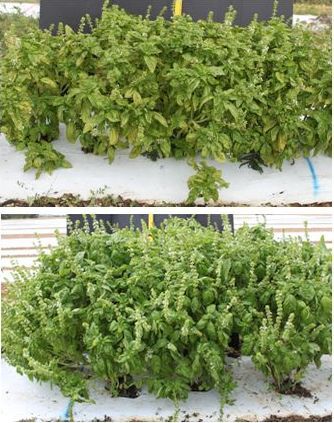
Credit: Zelalem Mersha, UF/IFAS
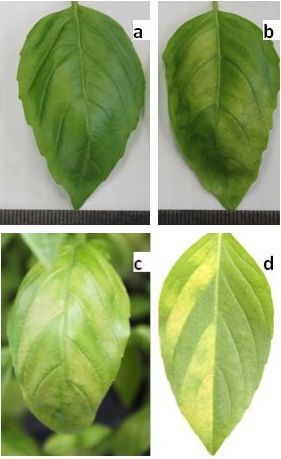
Credit: Zelalem Mersha, UF/IFAS
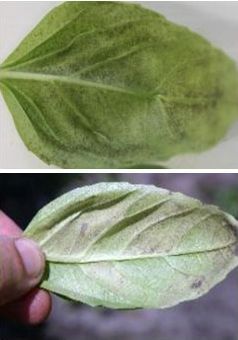
Credit: Zelalem Mersha, UF/IFAS
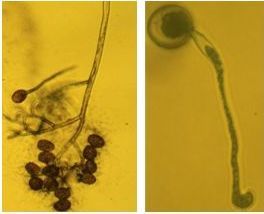
Credit: Zelalem Mersha, UF/IFAS
Control
A few fungicides are currently labeled for downy mildew control on basil. Some phosphorous acid fungicides are effective against downy mildew under herbs on the current label. These fungicides were effective in fungicide efficacy experiments with applications started before or after initial symptoms were found. Actinovate AG is an OMRI-listed fungicide that is labeled for use on herbs and for suppressing foliar diseases, including downy mildew. Other fungicides are expected to be labeled for this use in the future.
Besides those fungicides that are specifically labeled for this disease, some fungicides that are labeled for basil may also be useful in management of downy mildew in basil. Revus and Ranman are among other fungicides that effectively control downy mildew of basil. Applying labelled fungicides before appearance of downy mildew as a preventative measure is important for successful control of downy mildew of basil. Young basil plants are more susceptible than old basil plants (Patel et al. 2014), and therefore plants should be protected starting from their emergence from the ground. Reducing the period of leaf wetness by avoiding overhead watering may be helpful. The sporulation of basil downy mildew pathogen can also be suppressed if basil plants are illuminated during the night (Cohen et al. 2013a). Heavily infected plants should be discarded. If possible, isolate new plantings to reduce inoculum spread from older plantings. Consult the University of Florida IFAS Plant Disease Management Guide and current labels for specific and current fungicide recommendations.
References
Belbahri, L., G. Calmin, J. Pawlowski, and F. Lefort. 2005. "Phylogenetic analysis and real time PCR detection of a presumably undescribed Peronospora species on sweet basil and sage." Mycol. Res. 109(11):1276-1287.
Cohen, Y., M. Vaknin, Y. Ben-Naim, and A.E. Rubin. 2013a. "Light suppresses sporulation and epidemics of Peronospora belbahrii." PLoS ONE 8:e81282.
Cohen, Y., M. Vaknin, Y. Ben-Naim, A.E. Rubin, M. Galperin, D. Silverman, S. Bitton, and U. Adler. 2013b. "First Report of the Occurrence and Resistance to Mefenoxam of Peronospora belbahrii, Causal Agent of Downy Mildew of Basil (Ocimum basilicum) in Israel." Plant Dis. 97(5):692.
Garibaldi, A., A. Minuto, and M.L. Gullino. 2005. "First report of downy mildew caused by Peronospora sp. on basil (Ocimum basilicum) in France." Plant Dis. 89(6):683.
Garibaldi, A., G. Minuto, and M.L. Gullino. 2004. "First report of downy mildew on basil (Ocimum basilicum) in Italy." Plant Dis. 88(3):312.
Hansford, C. G. 1933. "Annual report of the mycologist." Rev. Appl. Mycol. 12:421-422
Ito, Y., T. Takeuchi, Y. Matsushita, Y. Chikuo, and M. Satou. 2015. "Downy mildew of coleus caused by Peronospora belbahrii in Japan." J. Gen Plant Pathol. 81:328-830.
Kanetis, L., A. Vasiliou, G. Neophytou, S. Samouel, and D. Tsaltas. 2014. "First report of downy mildew caused by Peronospora belbahrii on sweet basil (Ocimum basilicum) in Cyprus." Plant Dis. 98(2):283.
Khateri, H., G. Calmin, N. Moarrefzadeh, L. Belbahri, and F. Lefort. 2007. "First report of downy mildew caused by Peronospora sp. on basil in northern Iran." J. Plant Pathol. 89:S70.
Martinez-de la Parte, E., L. Perez-Vicente, B. Bernal, and D. Garcia. 2010. "First report of Peronospora sp. on sweet basil (Ocimum basilicum) in Cuba." Plant Pathol. 59:800.
McLeod, A., S. Coertze, and L. Mostert. 2006. "First report of a Peronospora species on sweet basil in South Africa." Plant Dis. 90(8):1115.
Nagy, G., and A. Horvath. 2011. "Occurrence of downy mildew caused by Peronospora belbahrii on sweet basil in Hungary." Plant Dis. 95(8):1034.
Patel, J. S., S. Zhang, and M.I. Costa de Novaes. 2014. "Effect of Plant Age and Acibenzolar-S-methyl on Development of Downy Mildew of Basil." HortScience 49(11)1392-1396.
Petrzelova, I., M. Kitner, I. Dolezalova, V. Ondrej, and A. Lebeda. 2014. "First report of basil downy mildew caused by Peronospora belbahrii in the Czech Republic." Plant Dis. 99(3):418.
Roberts, P.D., R.N. Raid, P.F. Harmon, S.A. Jordan, A.J. Palmateer. 2009. "First report of downy mildew caused by a Peronospora sp. on basil in Florida and the United States." Plant Dis. 93, 199.
Ronco, L., C. Rollán, Y.J. Choi, and D.H. Shin. 2009. "Downy mildew of sweet basil (Ocimum basilicum) caused by Peronospora sp. in Argentina." Plant Pathol. 58(2):395.
Safrankova, I. and L. Holkova. 2014. "The first report of downy mildew caused by Peronospora belbahrii on sweet basil in greenhouses in the Czech Republic." Plant Dis. 98(11):1579.
Saude, C., S. Westerveld, and M. Filotas. 2013. "First report of downy mildew caused by Peronospora belbahrii on basil (Ocimum spp.) in Ontario." Plant Dis. 97:1248.
Thines, M., S. Telle, S. Ploch, and F. Rung. 2009. "Identity of the downy mildew pathogens of basil, coleus, and sage with implications for quarantine measures." Mycol. Res. 113(5):532-540.