
Eyespot has been reported in many sugarcane-growing areas of the world. Eyespot is a minor disease because almost all varieties are resistant, even without any selection or screening program for resistance (Comstock 2000). A rare susceptible variety may have severe economic losses if environmental conditions are favorable. In one case, a 33% loss in cane tonnage was documented in Mexico when yields of diseased plots were compared with disease-free plots. Eyespot was observed in a few growers' fields in 2004, but it is not a problem for Florida growers at this time, thus only the most important features of the disease will be described.
Symptoms
The first observable symptoms are minute water-soaked spots that usually occur on young leaves (Comstock and Steiner 1989). Typical mature eyespot symptoms are characterized by a reddish-brown elliptical lesion (0.5–4.0 mm long, 0.5–2.0 mm wide) with yellowish-brown margins (Figure 1). Reddish-brown to yellowish-brown streaks, sometimes called "runners," extend upward from individual lesions toward the leaf tip. These streaks are 3–6 mm wide and 30–90 cm long. Multiple lesions can be extensive. The runners occur only in cooler temperatures and are not present in hotter temperatures (Figure 2). The runners are the results of tissue damage caused by a toxin produced by the pathogen (Larkin and Scowcroft 1981).
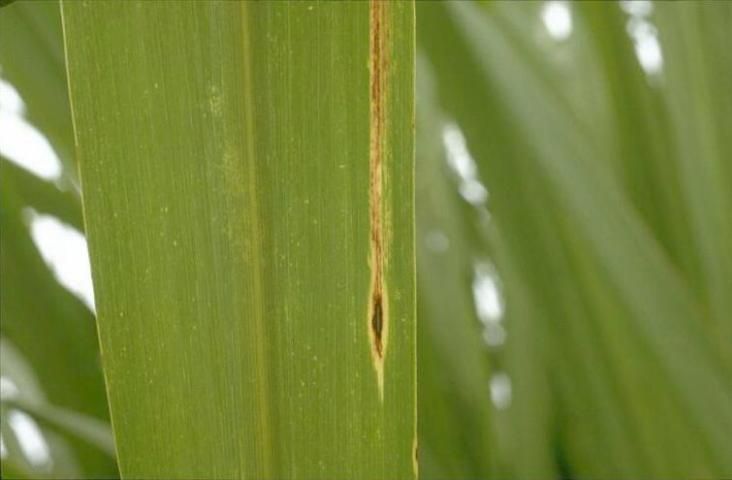
Credit: Philippe Rott, UF/IFAS
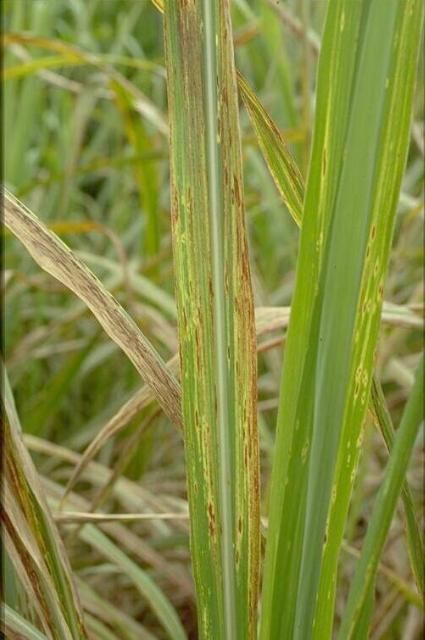
Credit: Philippe Rott, UF/IFAS
Causal Agent
Eyespot disease is caused by the fungus Bipolaris sacchari. No information is available regarding variation in pathogenicity of the pathogen.
Spread of the Disease
Eyespot is transmitted by spores (conidia), which are produced abundantly on leaf lesions and are dispersed by wind and rain. Fungal spore germination is favored by high humidity and dew formation. Colonization is more rapid in younger leaves than older leaves. Transmission by seed piece does not occur. Mechanical transmission by equipment and by human activity is not an issue.
Prevention and Control
The only practical and efficient method for controlling eyespot disease is the use of resistant sugarcane clones. Resistant clones can be grown without losses, even in environments that favor eyespot disease. Chemical control using foliar fungicides is not practical.
References
Comstock, J. C. 2000. "Eye spot." In A Guide to Sugarcane Diseases, edited by Philippe Rott, Roger A. Bailey, Jack C. Comstock, Barry J. Croft, and A. Salem Saumtally, 100–103. Montpellier: CIRAD/ISSCT, La Librairie du Cirad.
Comstock, J. C., and G. W. Steiner. 1989. "Eye spot." In Diseases of sugarcane: Major diseases, edited by C. Ricaud, B.T. Egan, A.G. Gillaspie Jr, and C.G. Hughes, 123–133. Amsterdam: Elsevier Science Publishers B.V.
Larkin, P. J., and W. R. Scowcroft. 1981. "Eyespot disease of sugarcane. Induction of host-specific toxin and its interaction with leaf cells." Plant Physiology 67: 408–414.