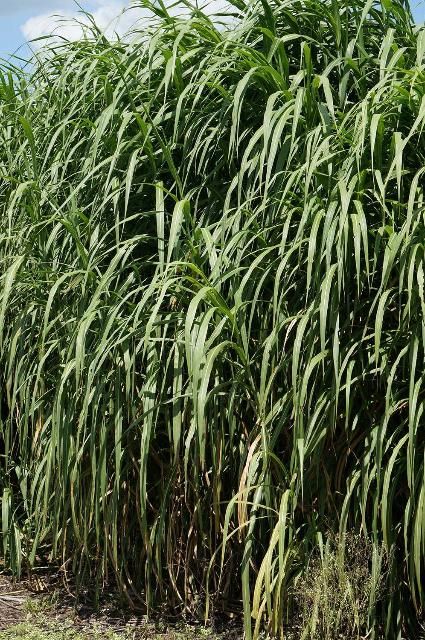
Napiergrass (Pennisetum purpureum Schumacher) is an enormous, weedy, cane-like grass (Figure 1) commonly seen growing along canals and roadsides in the sugarcane production area of south Florida. Napiergrass, also known as elephantgrass, has been documented in almost 30 counties throughout Florida. It is of African origin but has been introduced to all tropical areas of the world because of its ability to quickly produce large amounts of biomass. Currently, napiergrass is widely used in Central America, South America, and Africa as a forage crop. Napiergrass was introduced to south Florida and Texas for use as a forage crop, but it is no longer widely used for this purpose and has become a major weed problem. Napiergrass is now established throughout southern Florida, especially along canal and ditch banks and in disturbed or cultivated areas. Because of the weedy characteristics of napiergrass, it is considered to be one of the world's worst weeds and has been listed as an invasive species by the Florida Exotic Pest Plant Council. Although it can be found in central and northern Florida, it is less common due to cooler temperatures.
Credit: D. C. Odero UF/IFAS
Biology and Identification
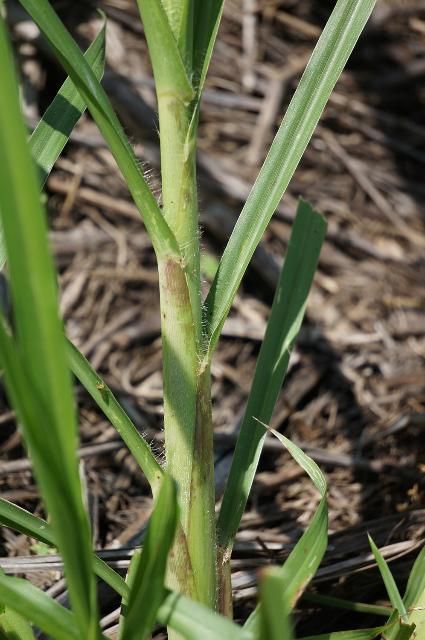
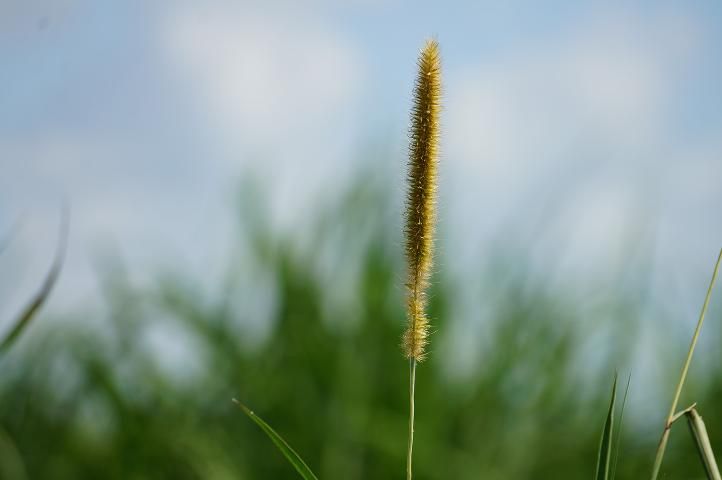
Napiergrass is a large, clumping perennial with erect cane-like stems that can be up to 15 feet tall. Leaf blades are typically ¾ to 1¼ inch wide and 12 to 29 inches long. Leaf surfaces are flat and abrasive with long stiff hairs on the upper surface and can be either smooth or abrasive on the bottom side. Leaf sheaths are extremely hairy near the bottom of the stem (Figure 2), but smooth towards the top of the stem. Napiergrass can reproduce both vegetatively and by seed. Vegetative reproduction occurs through root crown divisions or rhizome and stem fragments. Seed heads are bristly with a bottle-brush shape and can be 4 to 13 inches long (Figure 3).
Credit: D. C. Odero UF/IFAS
Credit: D. C. Odero UF/IFAS
Control
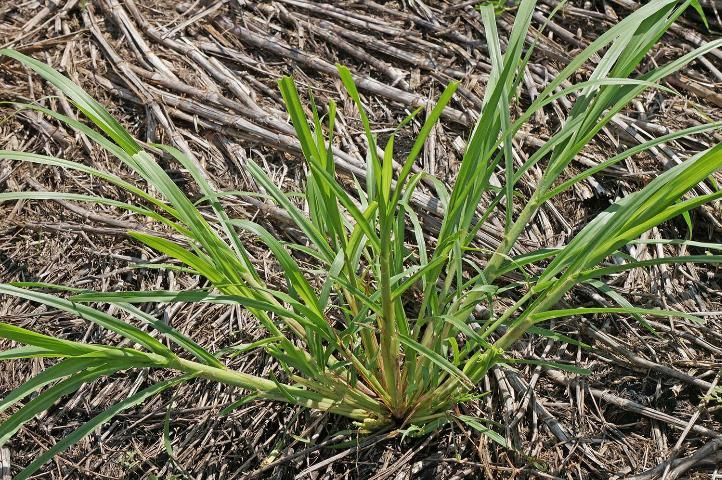
Control of napiergrass tends to be a difficult and time-consuming process. Napiergrass can grow very quickly; consequently, it is important to control napiergrass before it can outgrow and overwhelm an emerging sugarcane crop (Figure 4).
Credit: D. C. Odero UF/IFAS
Chemical
Currently, no herbicides are labeled for selective control of napiergrass in sugarcane. Once napiergrass populations become established in sugarcane fields, spot treatment with non-selective herbicides is the best option. When controlling seedling napiergrass plants, a 2% solution of glyphosate is highly effective. For more mature and established plants, glyphosate at 2% for spot treatments or broadcast applications of glyphosate at 3 to 5 pounds active ingredient will provide effective control if applied to napiergrass during the early heading stage. Napiergrass control with glyphosate is typically improved by the addition of a surfactant and ammonium sulfate to the spray solution depending on the formulation used.
Cultural
Napiergrass tends to be more common in successively planted sugarcane fields, because fallow periods or rotational crops offer a good opportunity for control. Cultural measures that prevent the introduction of napiergrass into new fields are considerably less expensive and easier than trying to control established napiergrass populations. Consequently, it is critical to control napiergrass along field borders, canals, and irrigation ditches to prevent movement of new seed or vegetative propagules into adjacent fields. Because napiergrass can easily become established from vegetative cuttings, seed cane should only be taken from fields that do not contain napiergrass. Planting vegetative pieces of napiergrass in the field along with sugarcane can quickly result in dense stands of napiergrass.
Mechanical
Cultivation can be used to effectively control seedling napiergrass plants. However, because of the ability of napiergrass to spread from vegetative cuttings and rhizomes, tillage should not be used to control mature plants. Cultivation can actually cause larger infestations of napiergrass by breaking mature plants into pieces and distributing them throughout the field. Additionally, cultivation equipment should be cleaned thoroughly when moving into clean fields from fields with napiergrass.
Although napiergrass is an invasive species with many weedy characteristics, it can be effectively managed with an integrated weed control program. Cultural practices to prevent the development of new napiergrass populations combined with timely glyphosate applications can help keep napiergrass at a manageable level. However, it will likely require several years or more to effectively remove napiergrass from fields with severe infestations.