
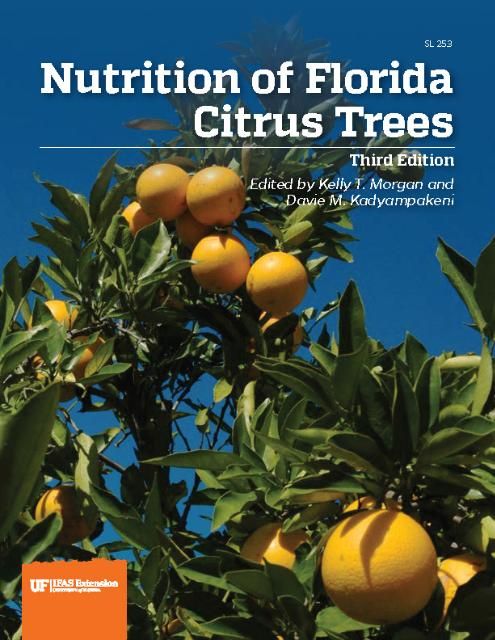
Nutrition of Florida Citrus Trees, 3rd Edition is an update of UF/IFAS Bulletin SP169, which provided guidelines for Florida citrus fertilization since 1995. The objective of the original edition was to provide background information and recommendations to develop a sound citrus nutrition program that optimizes financial returns while sustaining yields and maintaining soil and water quality. The second edition maintained that objective as it incorporated the findings of numerous citrus nutrition research projects conducted since the mid-1990s.
The information provided in the 2nd edition is still sound for healthy citrus trees under Florida production conditions. Much of the information provided in this document on nutrients, application methods, leaf and soil sampling, and irrigation scheduling are also effective for uanglongbing (HLB) affected citrus trees caused by Candidatus Liberibacter asiaticus (CLas). However, research conducted since HLB was detected in Florida in 2005 has established changes in many production practices including nutrient rates, irrigation scheduling, soil pH management, and use of Citrus Undercover Protective Screens (CUPS). On the PDF version, changes to the 2nd edition of SL253 will appear in colored boxes at the beginning of chapters 2, 6, 8, 9, and 11.
Supplemental information on subjects related to citrus nutrition appear in extensive appendices. Color plates depicting nutrient deficiencies and toxicities and a key to mineral deficiency symptoms in citrus are included to aid in visual analysis of tree nutritional status.
A copy of Nutrition of Florida Citrus Trees, 3rd Edition can be accessed by clicking on this link or the PDF icon on the top right corner of the page. The topic page for this book features links to the individual chapters available on EDIS.
Dedication
The first edition of this publication was dedicated to emeritus citrus research scientists Drs. Robert C. J. Koo, Ivan Stewart, and Herman Reitz, UF/IFAS Citrus Research and Education Center, Lake Alfred and Paul Smith, USDA-Agricultural Research Service, Orlando. Their research contributions laid the foundation for citrus nutrition programs in Florida. The editors of the second edition dedicate it to an additional group of emeritus citrus research scientists, extension specialists, and educators: Drs. David P. H. Tucker, Larry K. Jackson, and T. Adair Wheaton, CREC-Lake Alfred; Dr. David V. Calvert, Indian River Research and Education Center, Ft. Pierce; and Dr. Heinz Wutscher, USDA-ARS, Orlando. The second edition was edited by Drs. Thomas Obreza (professor, Department of Soil and Water Sciences in Gainesville, then and now Senior Associate Dean of Extension) and Kelly Morgan (assistant professor, UF/IFAS Department of Soil and Water Sciences, Southwest Florida Research and Education Center-Immokalee then, and now center director and professor). Their many years of devoted service furthered our knowledge of nutrient management as the Florida citrus industry entered the era of Best Management Practices and started contending with emerging threats including citrus greening, or huanglongbing.
Contributing Authors
L. Gene Albrigo University of Florida, UF/IFAS Citrus Research and Education Center
Fernando Alferez University of Florida, UF/IFAS Southwest Florida Research and Education Center
Brian J. Boman University of Florida, UF/IFAS Indian River Research and Education Center
Mary E. Collins University of Florida, UF/IFAS Department of Soil and Water Sciences
James J. Ferguson, UF/IFAS Horticultural Sciences Department
Rhuanito Ferrarezi, UF/IFAS Indian River Research and Education Center
Stephen H. Futch, UF/IFAS Extension Multi-County Citrus
Jim Graham University of Florida, Professor Emeritus
Said Hamido, UF/IFAS Southwest Florida Research and Education Center
Edward A. Hanlon, UF/IFAS Southwest Florida Research and Education Center
Evan Johnson, UF/IFAS Citrus Research and Education Center
Davie M. Kadyampakeni, UF/IFAS Citrus Research and Education Center
Kelly T. Morgan, UF/IFAS Southwest Florida Research and Education Center
Thomas A. Obreza, UF/IFAS Department of Soil and Water Sciences
Lawrence R. Parsons, UF/IFAS Citrus Research and Education Center
Arnold W. Schumann, UF/IFAS Citrus Research and Education Center
Tripti Vashisth, UF/IFAS Citrus Research and Education Center
Mongi Zekri, UF/IFAS Extension Multi-County Citrus
With Additional Contributions by
Ashok K. Alva US Department of Agriculture—Agricultural Research Service
David V. Calvert, UF/IFAS Indian River Research and Education Center (retired)
Frederick S. Davies, UF/IFAS Horticultural Sciences Department (retired)
Larry K. Jackson, UF/IFAS Horticultural Sciences Department (retired)
David P. H. Tucker, UF/IFAS Citrus Research and Education Center (retired)
T. Adair Wheaton, UF/IFAS Citrus Research and Education Center (retired)
Heinz Wutscher US Department of Agriculture – Agricultural Research Service (retired)
Acknowledgements
The editors gratefully acknowledge the reviewers of the second edition of publication (Mark Colbert, Fred Davies, Hugh English, John Jackson, Chris Oswalt, Mark Ritenour, Steve Smith, Jerry Southwell, Jack Zorn, and all contributing authors) for their time, effort, and suggestions for improvement. The editors are also grateful to the contributions of the reviewers of the third edition, including Dr. Tripti Vashisth, Ms. Laurie Hurner, and Mr. Chris Oswalt.
The printing of this guide was made possible through funding provided by the State Legislative Funding for the UF/IFAS Citrus Initiative.