
The earliest written account of bird feeding in the United States dates back to 1845, when Henry David Thoreau reported feeding birds at Walden Pond. The first commercially-made bird feeder was designed for hummingbirds and went on the market in 1926. Today, more than 50 million Americans put out a billion pounds of bird food each year.
In most cases, native plants are best-suited to provide food for birds and require little maintenance. One of the most effective ways to attract birds to your backyard is to use native plantings to provide the natural habitats that have supported them for thousands of years. However, bird feeders can be used to supplement the food provided by native plantings. They also provide a way to observe birds at close range.
Before placing bird feeders in your backyard, consider the bird species you would like to attract. Different birds are attracted to different bird feeders and foods. The following suggestions are useful guidelines, but it is best to experiment. Try a variety of feeders and foods located in different spots around your yard.
Types of Feeders
A wide range of different bird feeders is available. Some are non-selective and used by a variety of birds; others are more selective, attracting only one or two specific species (Table 1). If you are interested in attracting a wide diversity of birds to your yard, consider installing at least two of the different types of feeders discussed below.
- Tube feeders—These hanging feeders can be filled with a variety of different seeds. A tube feeder is a hollow cylinder, usually made of clear plastic or glass so that the seed is clearly visible, with multiple feeding ports and perches. Tube feeders with perches and feeding ports made of metal are more expensive but preferable because they are less easily damaged by squirrels. The feeding perches of most tube feeders are located below the feeding ports. Because these perches are generally fairly short, usually only small birds such as chickadees, titmice, wrens, and finches can eat from tube feeders. Some tube feeders have perches above the feeding ports. These are only suitable for small birds that can feed hanging upside down, such as goldfinches and chickadees.
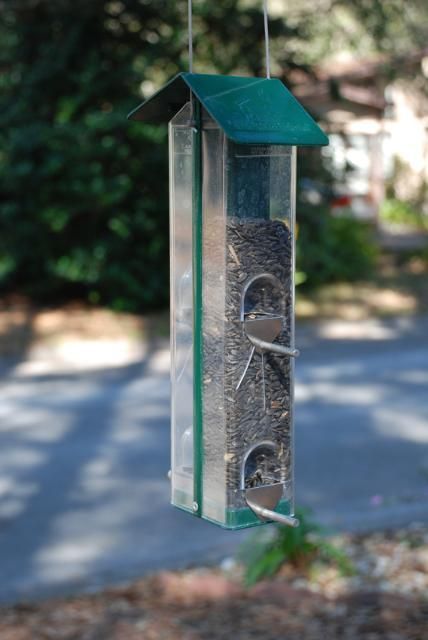
Credit: E. Willcox, UF/IFAS
- Hopper feeders—These large feeders, as with tube feeders, are primarily used to provide seed. They come in many whimsical designs, but the most common resembles a small barn with clear plastic sides positioned in a V shape. These sides funnel the seed downward and out as it is eaten. Hopper feeders typically hold a lot more seed than other feeders and require filling less often. The quantity of seed they hold can attract squirrels, however. Hopper feeders attract all the same species as tube feeders, along with larger birds like blue jays, cardinals, grosbeaks, and woodpeckers.
- Platform feeders—These tray feeders are comprised of a flat, raised surface on which seeds, fruits and other foods are spread. Some have roofs, which help keep seeds dry. Although it is important to keep all feeders clean, extra care must be taken with platform feeders. This feeder type has been cited in studies as having a higher rate of disease transmission among birds because their droppings collect on the platform and mingle with the food. To reduce the risk of disease transmission, use a platform feeder with a wire mesh bottom to allow droppings to be washed away during rain. Platform feeders located close to the ground can be used to attract a slightly different bird audience that includes ground feeding doves, juncos, blackbirds, towhees and sparrows. Platform feeders located higher above ground will attract many of the birds that visit tube and hopper feeders.

Credit: E. Willcox, UF/IFAS

Credit: E. Willcox, UF/IFAS
- Suet feeders—Woodpeckers, bluebirds, cardinals, chickadees, jays, nuthatches, titmice, and wrens are all regular visitors to this type of feeder, which is usually a simple wire cage sized to hold a suet cake. The birds that visit the feeder cling to the wires and peck at the suet inside. Look out for bottom suet feeders that are specially made for clinging birds like woodpeckers and nuthatches that can hang upside down and feed.

Credit: E. Willcox, UF/IFAS
Credit: B. Edmonds, UF/IFAS
Credit: S. Harmon, UF/IFAS
Credit: T. Sohl, http://sdakotabirds.com
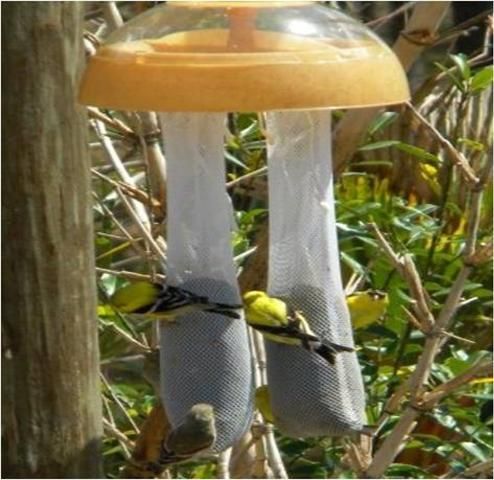
- Nyjer feeders—These feeders are filled with nyjer (also called niger or thistle), a small seed very popular with American goldfinches, purple finches and pine siskins. However, most other birds will not feed from them. There are two general types of nyjer feeder. The first looks similar to a tube feeder, the only difference being that the feeding ports are much smaller. The second, often referred to as a "thistle sock," consists of a fine mesh bag. Feeding birds cling to this bag to extract the seed. More robust "thistle socks" are made from metal mesh. The birds that visit nyjer feeders are only present in Florida during the winter. Therefore, you only need to put them out in your yard between October and March.
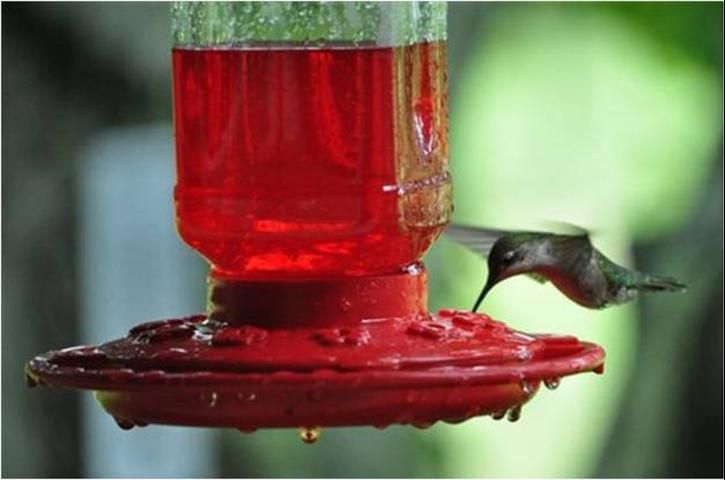
- Nectar feeders—Nectar feeders are primarily used by hummingbirds. They are designed to mimic the flowers from which these birds get their nectar and are usually filled with sugar water. They come in a variety of shapes and sizes, but most feature plenty of red, since this is a very attractive color to the tiny birds. Orioles, cardinals and woodpeckers will also use nectar feeders with larger feeding ports. Nectar feeders must be frequently cleaned because the sugar water they contain rapidly ferments and poses a serious threat to feeding birds. See cleaning section below for cleaning instructions.
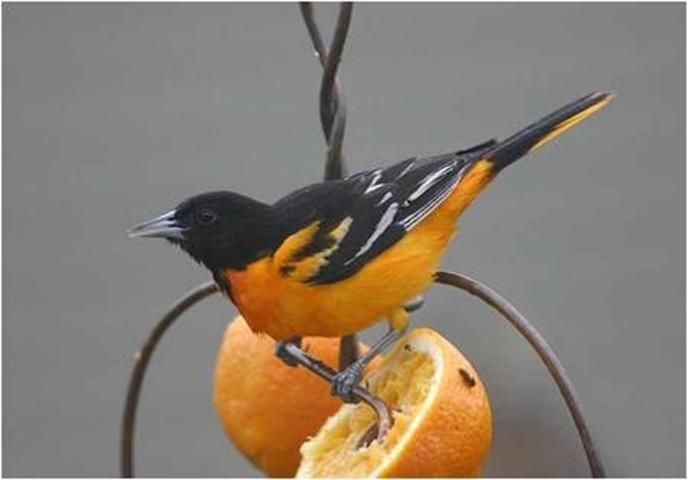
- Fruit feeders—These hanging feeders come in a mix of styles. All are designed to hold large fruit pieces consumed by bluebirds, orioles, house finches, woodpeckers, and a range of other species.
Food
The type of food you stock in your feeder determines which birds you will attract. Some birds like seeds, fruit, or insects, others suet, and a small number nectar. A vast number of companies produce bird seed mixes that vary in content, cost, and quality. Although common, bird seed mixes are not usually the best choice. Seed mixes frequently contain more unwanted food, such as milo, oats, and red proso millet, than desirable food, such as sunflower. When these mixes are used, birds will empty your feeder quickly eating only the seeds they like and scattering the rest on the ground. Usually a single seed or making your own seed mix is preferable. When purchasing seed for birds, do not buy any coated with a red or pink dye. Seeds intended for planting are often treated with a fungicide called capstan and are marked with the red dye as a warning. Capstan is extremely toxic to birds.
- Sunflower—Black-oil sunflower is the preferred seed of many birds and is generally the best all-around attractant. Its kernels are high in energy. In addition, its small size and thin shell make it easy for small birds to handle and crack. Striped sunflower seeds are larger and have a thicker shell making them difficult for small birds to consume.
- Safflower—The shell of safflower is thicker than black-oil sunflower, making it harder for some birds to crack open. However, it is a favorite of cardinals and grosbeaks, and nuthatches, finches, and titmice enjoy it, too. Cardinals and grosbeaks both like to feed from hopper and platform feeders. This makes these feeders a good choice for offering safflower.
- Millet—Many of the small-beaked ground feeding birds such as quail, doves, juncos, towhee, and sparrows enjoy white proso millet. However, cowbirds, house sparrows, European starlings, and a number of other, unwelcome bird species enjoy millet, too. These species can congregate in large numbers and become a nuisance at feeders. Red proso millet is typically an unwanted food, and birds will frequently discard it in preference of other seeds.
- Cracked corn—Corn is a less desirable feed because corn kernels rapidly soak up water, leaving them vulnerable to rot and contamination by afltoxins, which are extremely toxic to birds even at low levels. Therefore, corn must be stored with care in situations where it is to be used as bird food and should not be used in feeders in wet or damp weather. Medium cracked corn is as popular as white proso millet with ground-feeding birds such as quail, doves, jays, juncos, towhees, and native sparrows. It is also enjoyed by larger birds including crows, turkey, ducks, and cranes. It can be fed in small amounts, mixed with white proso millet, on platform feeders and in hopper feeders. Be aware that, as with millet, it can attract unwelcome species such as cowbirds, house sparrows, and European starlings.
- Nyjer (niger or thistle)—Goldfinches, house and purple finches, and siskins are extremely fond of nyjer and will select it in preference to most other foods. However, it is expensive compared to other seeds, costing around $1.50 a pound, leading to its nickname "black gold." Nyjer seeds are very small compared to other seeds. Their small size, along with their cost, makes it important to provide them in specially designed feeders made of mesh or with small feeding ports. A good nyjer feeder will allow many birds to feed at once, while not allowing excess seed to be wasted. Commercial nyjer seed is grown in Africa, India, and other areas of Southeast Asia and exported around the world. As nyjer is an exotic species, and the seed can be contaminated with noxious weeds, it is sterilized using intense heat prior to being imported into the United States. This prevents the nyjer and other contaminating seeds from germinating.
- Milo, wheat and oats—Low-priced bird seed blends frequently contain milo, wheat, and oats. However, most birds prefer to eat other foods and will discard these on the ground where they accumulate and attract rodents. The only birds that really consume these seed types are quail and doves.
- Suet—Suet is rendered animal fat. It provides a high-energy food source popular with woodpeckers, chickadees, jays, nuthatches, and titmice, particularly in winter. Suet cakes are available commercially and can be purchased from many retailers. These pre-made cakes often contain nuts and berries enjoyed by many different birds. Alternatively, you can make suet cakes yourself by melting down beef fat. Numerous suet cake recipes are available online. Regular suet should be avoided in very hot weather when it can turn rancid or coat and damage birds' feathers. Many stores sell no-melt suet for hot summer conditions. If this is not available, an alternative high-energy food capable of surviving the summer heat is peanut butter pudding, for which there are, again, many recipes online.
- Peanuts—Whole or crushed peanuts are popular with woodpeckers, chickadees, titmice, nuthatches, wrens, kinglets, northern mockingbirds, brown thrashers, starlings, jays, and certain warblers. Like corn, peanuts have a high chance of harboring aflatoxins and must be kept dry. They can be provided in feeders similar to those used to feed thistle but with a larger mesh, as well as tube, hopper and platform feeders.
- Sugar water—Sugar water is used as a substitute for the nectar consumed by hummingbirds. Orioles, cardinals, and woodpeckers will also feed on sugar water. It can be made by mixing and boiling four parts water and one part sugar. Do not use honey to make sugar water as it can spread a fungal disease lethal to the tiny birds. Alternatively, convenient, ready to mix nectar packets and bottles of concentrate can be bought from many stores. Nectar containing red coloring should be avoided. The coloring can be toxic and is not necessary to attract hummingbirds, providing the feeder has some red colored parts.
There are a range of other bird foods you can try. Bluebirds and orioles like mealworms. These birds, along with house finches and woodpeckers, also like fruits such as apples, oranges, peaches, berries, and bananas. Be creative, try a variety of foods, and see what birds you can coax into visiting your yard.
Feeder Location
When deciding where to locate your feeders, there are a number of things you will need to consider. You will, of course, want to make sure you have a good view of the feeder from where you intend to watch visiting birds. You should think about the different birds that will visit the feeders and their feeding styles. Some birds feed on the ground and others at shrub and tree height. To minimize crowding and attract the greatest diversity of species, provide low platform feeders for ground feeding birds, and hopper, tube, niger, suet, and raised platform feeders at different heights for shrub and treetop feeders.
If you have a small garden, where it is not possible to locate feeders away from your house, birds may frequently strike your windows. In such situations, research suggests it is preferable to locate feeders closer rather than farther away from windows, within 3m of a window is considered best. Most birds collide with windows as they leave a feeder. Placing feeders close to your windows will prevent visiting birds from building up enough momentum to cause serious injury if they strike the window when they try to fly away. Mobiles, decals and other decorations hanging outside windows also help to prevent bird strikes.
Many birds using feeders like to have shrubs and trees nearby where they can perch or escape from aerial predators such as hawks. However, placing your feeders among or too close to shrubs and trees puts feathered visitors at increased risk from ground predators, particularly domestic cats. Locate feeders 10–15 feet from bushes to provide perching spots and a place to escape from aerial predators without giving domestic cats hiding places close enough for them to pounce on unsuspecting birds.
If you have the space, consider placing several feeding stations throughout your yard. This is effective for two reasons. First, some birds like to feed near vegetation and others out in the open. By placing a number of feeders in different places, you will draw a greater diversity of birds. Secondly, it will help prevent overly aggressive individuals that chase other birds from controlling access to all feeders.
Cleaning
It is essential to maintain a clean bird feeding environment in order to discourage disease. You should clean your feeders at least once every two to three weeks to ensure they do not accumulate moldy and decomposing seeds, bird droppings or other contaminants that can make birds sick. The heat and humidity of Florida are perfect conditions for mold growth. Therefore, during periods of warm or wet weather, it may be necessary to clean them more regularly. To clean glass, ceramic and plastic bird feeders (except hummingbird feeders) use a 10% bleach solution (1 part bleach to 10 parts hot water), taking care to ensure they are completely dry before refilling. To clean wooden bird feeders use hot soapy water and a bristled brush.
You should change the sugar water in hummingbird feeders at least every 3 to 5 days to prevent deadly fermentation and mold growth. In hot weather or direct sunlight, the fermentation process speeds up. Under these conditions it may be necessary to change the sugar water more often. Hanging feeders in the shade can help slow the fermentation process. To clean hummingbird feeders, use hot water and a bottle brush. Unlike other feeders, hummingbird feeders should not be cleaned with bleach, soap, or any type of detergent to prevent contamination of the nectar when they are re-filled.
Clean the ground below your feeders regularly to prevent a build-up of hulls, uneaten seeds, and other waste. Moldy or spoiled food is unhealthy both for birds and outside pets, and bird food scattered on the ground can attract unwanted rodents.
Squirrels
Squirrels are a nuisance at many bird feeders. They become a real problem when they take over a feeder, scaring away birds and tossing seed around. Squirrels are extremely agile and any bird feeder hanging from a tree is likely to become a squirrel feeder. They also have strong teeth and can chew easily through plastic and wooden feeders to get at their contents. When selecting a feeder, look for one that has squirrel-proof features such as metal feeding ports and perching posts or that has a domed overhang to prevent squirrels from gaining access. You can also install your feeders on a pole with a baffle that prevents squirrels climbing up from the ground to access food. The pole, with attached feeders, should be located 10–15 feet away from tree trunks and overhanging limbs as squirrels are capable of jumping up to 10 feet. If you store your supply of bird food outside, it is best to keep it in a securely closed metal container. Squirrels can chew through containers made even from heavy plastic.
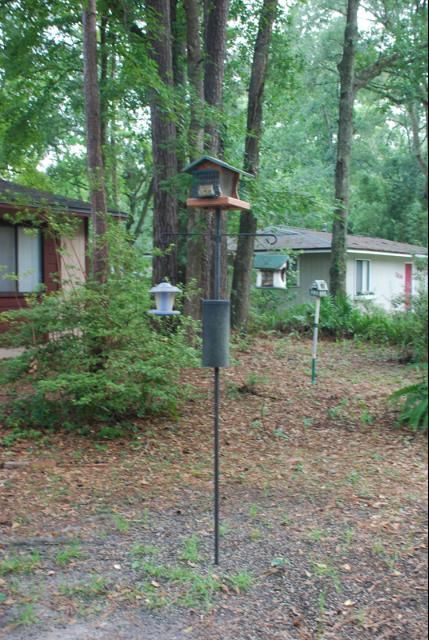
Credit: E. Willcox, UF/IFAS
Cats
House cats kill hundreds of millions of birds annually in the United States. To help keep visiting birds safe, locate feeders away from areas of ambush cover, such as shrubs and brush, where cats can lie in wait to attack. A cat's instinct to hunt is not related to hunger. Even a well-fed cat will hunt. Generally, putting a bell on your cat's collar will not prevent it from capturing birds. If you are keen to convert your yard into a haven for feathered visitors, keep your cat indoors where it cannot hunt wildlife, preferably all the time, but at a minimum between sunrise and three hours after sunrise, when birds feed most heavily and congregate around bird feeders. Try providing inside cats with a sunny window seat so that they can bask and watch birds safely without harming them or coming to grief themselves from traffic, disease, and fights with other animals.
No birds visiting feeders?
Be patient: when you first place feeders in your yard, it may take some time for birds to find the new food source and start using the feeders. If no birds visit your feeder within 1–2 weeks of setting it up, try sprinkling some seeds on the ground to help them find it. If the birds still do not come, it may be that they are uncomfortable with the feeder location. In these situations, moving feeders to a new place can help. Including more bird-friendly native plants in your landscaping and garden can also draw birds, which will then use your feeders. Contact your local UF/IFAS Extension office for advice on native plants favored by birds.
Additional Information
Cats Indoors! Campaign. American Bird Conservancy. https://abcbirds.org/program/cats-indoors/
Schaefer, J., and C.N. Huegel. (2001). Florida's Hummingbirds. UW059. Gainesville: University of Florida Institute of Food and Agricultural Sciences. https://edis.ifas.ufl.edu/uw059
Table 1. Common backyard birds and the types of bird feeders they prefer.