
"Water birds" are birds that live in or near aquatic environments such as the ocean, lakes, marshes, swamps, and rivers. This includes pelicans, ducks, geese, herons, egrets, gulls, terns, cormorants, etc. The purpose of this publication is to help reduce the frequency of people feeding birds that occur near water in Florida, by explaining the negative impacts of these actions. This publication is intended for a general audience.
What types of problems can occur from feeding water birds?
Feeding water birds leads to problems such as:
- behavioral problems in the birds—they lose their fear of humans and become aggressive;
- malnutrition from eating foods with low or no nutritional value;
- injuries from swallowing hooks (Figure 1) and nonfood items;
- entanglement in fishing line—which can lead to starvation, loss of a wing or foot, and death;
- injuries from swallowing large fish bones which they cannot digest—large fish bones can puncture a bird's pouch, get caught in the throat, and even puncture a bird's stomach;
- becoming tame, losing fear of humans;
- increased spread of disease;
- degradation of water quality (from concentrations of bird feces);
- parent birds who are dependent on humans for food and therefore cannot teach their own young proper foraging techniques to feed themselves.
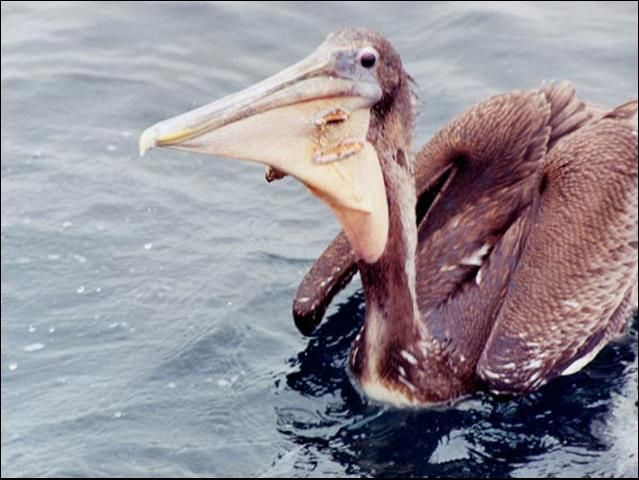
Credit: Wildlife on Wheels junglerat8@yahoo.com
Feeding wild birds at fishing piers is harmful to the birds' health. Birds that attempt to swallow too large a fish may choke or suffer internal injuries. Birds that learn to associate fishermen with food may try to eat fish off the hook and become severely injured or die from swallowing hooks (Figure 1) or getting entangled in fishing line monofilaments. Studies show that more than 700 pelicans die each year by getting caught in monofilament fishing line.
Feeding birds also concentrates birds in one location. This leads to an increased chance of disease being transmitted from bird to bird. Avian pox may be transmitted through the increased physical contact between birds that comes with crowding and intense competition for food. Diseases such as avian botulism are transmitted between birds through their droppings. With large amounts of bird droppings comes the increased transmission of these diseases. Large amounts of bird droppings can also lead to increased bacterial counts, including E. coli, in nearby bodies of water. Plus, the increased amount of nutrients from bird droppings leads to growth of algae and may affect water quality.
Bread and other processed foods are not part of a bird's natural diet and may lead to malnutrition from eating foods with little or no nutritional value. The balance of fiber, fats, micronutrients, carbohydrates and protein in a bird's natural diet is radically different from a scavenged diet consisting mostly of human food. Also, birds can choke on large pieces of bread. Further, the leftover bread is attractive to other wildlife such as rats and raccoons, which are predators of eggs and chicks.
Wild birds that are fed frequently become habituated to it. This repetitive behavior of going after food thrown to them can result in the birds swallowing anything that is thrown to them, including garbage. Birds that are taught to be dependent on humans for food cannot teach their own young traditional foraging behaviors; the young may starve as a result.
Tame birds also become vulnerable to hostile human behavior. They get chased by children and dogs, and harassed by those who think the birds are a nuisance. Feeding causes birds to be unafraid of dangerous hazards like cars. Additionally, some species, such as the ducks, geese and swans, may alter their normal migration patterns if food is provided year-round.
Sometimes people attempt to feed birds up close, which causes undue stress to birds. This is especially harmful during the breeding season. Approaching nests to feed birds may lead to birds altering their nest placement, abandoning their nests, or to nest failures. It may cause the nest to be noticed or found by predators such as crows and jays.
Feeding wild birds can lead to property damage or aggression from the birds. During breeding season, sandhill cranes that seem tame have been known to attack pets and damage property. Gulls, terns, and pelicans may swoop, dive or chase after you to obtain food. Geese and ducks can damage lawns by tearing grass up and eating it. They also deposit large amounts of fecal material on yards.
Feeding is bad for most wildlife, and especially for water birds.
What can you do to protect birds around coastal and inland water systems?
- Don't feed wild birds.
- Enjoy watching them from a distance, especially during breeding season. For closer looks, use binoculars.
- Help educate others about the consequences of feeding water birds.
- When fishing:
- Stay with your fishing poles, don't leave them unattended;
- Dispose of monofilament fishing line in a trashcan, or if provided, use the monofilament recycling box;
- Dispose of carcasses of larger fish in covered trashcans.
Additional Sources of Information
Ducks Unlimited. Online: http://www.ducks.org/
Knight, R.L. and K.J. Gutzwiller. 1995. Wildlife and Recreationalists: Coexistence Through Management and Research. Washington, DC: Island Press, 369 pp.
Kushlan, J.A., and H. Hafner., eds. 2000. Heron Conservation. London: Academic Press, 480 pp.
Lincer, J.L., D. Kricit, and J.E. Shaw. 1979. "People and 'pan-handling' pelicans." Fla. Field Nat. 7:13–18.
Mays, A. 1997. Welcoming geese can be a mistake. All Outdoors. http://mdc.mo.gov/news/out/1997/out0314.html#2
Schaefer, J. 1999. Domestic Duck Problems in Urban Areas. Gainesville: University of Florida Institute of Food and Agricultural Sciences.
Schreiber, R.W. 1980. "The Brown Pelican: An Endangered Species?" BioScience vol. 30(11) pages 742–747.
Sprott, P., and F.J. Mazzotti. 1991. Bird Attacks. SS-WIS-47. Gainesville: University of Florida Institute of Food and Agricultural Sciences.
Stys, B. 1997. Ecology of the Florida Sandhill Crane. Florida Fish and Wildlife Conservation Commission. Nongame Wildlife Technical Report No. 15. Tallahassee, Fl, 20 pp.