Florida's Organo-Auxin Herbicide Rule - 2007 Florida's Organo-Auxin Herbicide Rule - 2007
Florida's Organo-Auxin Herbicide Rule - 20071
F.M. Fishel, J.A. Ferrell, G. E. MacDonald, and B. J. Brecke2Organo-auxin (phenoxy) herbicides were first developed during the 1940s and have been used extensively in the United States since then. This group of chemicals has found a place in weed control schemes for peanut, corn, small grains, sugarcane, turf, pasture and forage crops and many other areas. On a worldwide basis more phenoxy herbicides are used than any other class of herbicides presently manufactured. The phenoxy herbicide group's unique ability to remove broadleaf weeds from grass crops has been exploited for successful weed control in many areas.
Organo-auxin herbicides have been formulated in a number of ways with each formulation possessing certain characteristics. Amine and ester formulations have been the most popular although other forms of phenoxys do exist. As a general rule ester formulations are more active than amines. This difference in control activity has made ester formulations very popular due to the fact that about one half the rate of the amine formulation could be used and achieve the same weed control level. Therefore, growers could buy less total herbicide in the ester form to do the same job as a larger amount of a phenoxy in the amine form.
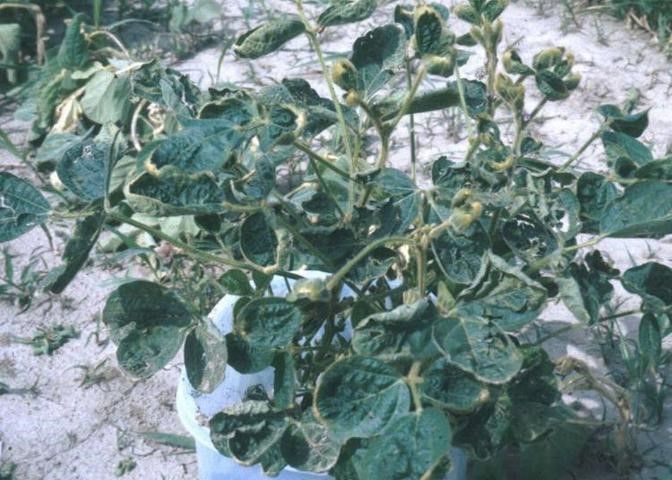
Although ester formulations are more active herbicidally than amine formulations, they do have serious drawbacks associated with their use. Specifically, ester formulations are typically very volatile and possess the ability to move away from the target site up to several days after the initial herbicide application has been made. Volatilization problems have led to the complete destruction of nearby sensitive crops if weather conditions were favorable for volatilization to occur. Due to volatilization problems, many states have totally banned the use of high-volatile ester formulations and discouraged use of lower volatile esters in sensitive areas. Florida is one such state with these regulations. Due largely to phenoxy herbicide applications in south Florida on sugarcane and drift or volatilization to nearby tomato crops and their subsequent destruction, the Florida Department of Agriculture and Consumer Services enacted the Organo-Auxin Herbicide Rule (Table 1 ). This rule applies to the application of organo-auxin herbicides anywhere within the state. It is the intent of this publication to clarify and disseminate the Florida Organo-Auxin Herbicide Rule to interested growers and applicators.
The Florida Organo-Auxin Herbicide rule 5E-2.033 appears in the Florida Pesticide Law and Rules. All inquiries should be addressed to:
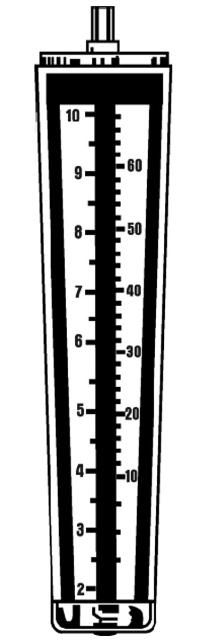
Dale W. DubberlyPossible sources to obtain wind meters ( Figure 1 ) are listed in Table 2.
Chief
Bureau of Compliance Monitoring
Division Of Agricultural Environmental Services
Florida Department of Agriculture and Consumer Services
3125 Conner Boulevard
Building 8, L-29
Tallahassee,FL 32399-1650
Phone: 850-488-8731
Fax: 850-488-8498
E-Mail: dubberd@doacs.state.fl.us
![]()
Figure 1. Wind meter
Tables
Table 1. FLORIDA ORGANO-AUXIN HERBICIDE RULE NO. SE-2.033 ORGANO-AUXIN HERBICIDES
Restrictions and Prohibitions
1.
Synthetic organo-auxin herbicides: The Synthetic organo-auxin herbicides are defined as herbicides which produce hormonal auxin type effects on plants similar to the effects of 2,4-D. These herbicides include:
2,4-D
2,4-Dichlorophenoxyacetic acid, in all forms;
MCPA
4-chloro-2-methylphenoxyacetic acid, in all forms;
2,4-DP 2-(2,4-Dichlorophenoxy)propionic acid, in all forms;
MCPP 2-(2-methyl-4-chlorophenoxy)propionic acid, in all forms;
MCPB 4-(2-methyl-4-chlorophenoxy)butyric acid, in all forms;
Dicamba 2-Methoxy-3, 6-dichlorobenzoic acid, in all forms;
Triclopyr
(3,5,6,-Trichloro-2-pyridinyl)oxyacetic acid, in all forms;
2.
Sale and use of highly volatile forms of organo-auxin herbicides in the state is prohibited except for those products labeled for use as a plant growth regulator on citrus. Highly volatile organo-auxin herbicides include he methyl, ethyl, propyl, isopropyl, and butyl esters of 2,4-D, etc.
3.
Based upon the wind speed and direction at the time of application, the distance which must separate the closest edge of the area to be sprayed from susceptible crops is listed below. Susceptible crops are defined as commercially produced plants or crops that may be damaged when exposed to low concentrations of organo-auxin herbicides. Users of organo-auxin products on citrus as plant growth regulators are exempt from the wind speed restrictions below provided they adhere to the restrictions appearing on the product label.
Wind Speed
Aerial Equipment
Ground Equipment
1 - 3 mph
½ mile downwind
1/8 mile downwind
½ mile crosswind 1/8 mile crosswind
50 feet upwind 20 feet upwind
3 - 6 mph
1 mile downwind 1/4 mile downwind
½ mile crosswind
1/8 mile crosswind
50 feet upwind
5 feet upwind
6 - 8 mph
2 miles downwind
mile downwind
½ mile crosswind 1/4 mile crosswind
50 feet upwind
5 feet upwind
Above 10 mph
Prohibited
Prohibited
Note: "Crosswind" means wind from a direction 90 degrees (+/-10 degrees) to a line drawn between the proposed treatment site and a susceptible commercial crop site.
4.
Wind speed will be measured at the crop site or up to two miles away. Wind speed measurements will be taken at spray boom height for ground application and at least six feet above the ground for aerial application. The measurement site will be located so that structures, plants, or terrain features do not interfere with the accuracy of the reading. Wind direction will be estimated as accurately as possible by the person taking the wind speed readings. THE APPLICATOR OR HIS REPRESENTATIVE SHALL TAKE AND RECORD WIND SPEED AND DIRECTION READINGS BEFORE SPRAYING STARTS AND ONCE EVERY HOUR OF THE SPRAYING OPERATION. A reading shall consist of an average of three measurements taken within a five-minute interval. These measurements shall be taken by rotating and positioning the anemometer into the wind in such a manner as to obtain the maximum wind velocity measurements which will be used to calculate the average reading. An anemometer accurate to within +/-10% shall be used to take the wind speed measurements. Possible sources to obtain wind meters listed in Table 2.
5.
Applicators should minimize the production of droplets with mean volume diameter less than 200 microns in diameter regardless of spray equipment utilized. When utilizing boom application equipment on the ground, flat fan nozzles or their equivalent should be used and application pressures shall not exceed 35 pounds per square inch. Applications of organo-auxin herbicides on citrus as a plant growth regulator utilizing air blast sprayers are exempt from the requirements of this section.
6.
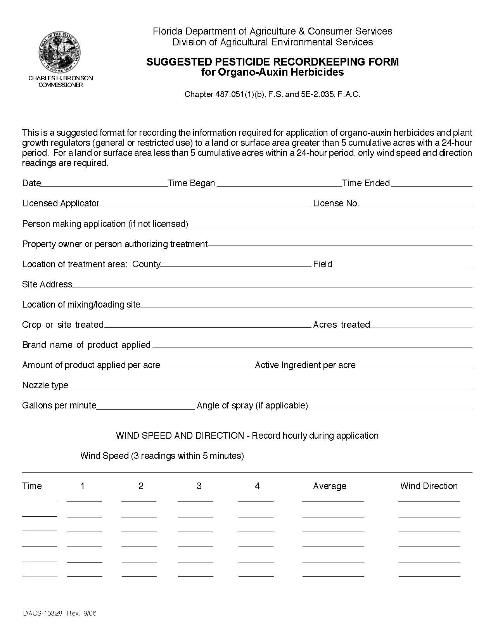
Persons making spray applications of organo-auxin herbicides to cumulative land or water surface areas exceeding 5 acres per 24 hour period, shall maintain the following records for two years:
a.
Name and address of the person(s) in control of the land (owner, lessee or tenant), and the applicator.
b.
Location of the site to be treated, location of the herbicide mixing and loading area and description of application equipment used.
c.
Date and time of application.
d.
Trade name, manufacturer, formulation, total amount of product to be applied per acre and the amount of active ingredient of the product applied per acre. e.
Total acreage and crop or site treated.
f.
Average hourly wind speed and direction.
g.
Nozzle type including gallons per minute rating at specified pressure (usually 40 psi) and angle of spray emission if applicable.
7.
AERIAL APPLICATION OF ORGANO-AUXIN HERBICIDES BY FIXED WING AIRCRAFT FROM JANUARY 1 UNTIL MAY 1 OF EACH YEAR IN HENDRY, PALM BEACH, GLADES OR MARTIN COUNTIES IS PROHIBITED. The use of rotary wing aircraft using Microfoil spray booms or their equivalent for right-of-way and aquatic spray applications is allowed provided the terms of subsections 2, 3, 4, 5 and 6 are met.
8.
Applicators who apply organo-auxin herbicides to ditches, canals, or the banks of similar waterways will assure that they are not treating water that will be directly used for irrigation of sensitive crops.
SPECIFIC AUTHORITY: 487.051(4); 487.154, 570.07(23) F.S. LAW IMPLEMENTED: 487.031(8); 487.051(2)(d), (4) F.S.
HISTORY: New 2/4/86; Amended 7/10/89.
Table 2. Possible sources to obtain wind meters.*
1. Dwyer Instruments, Inc. P. O. Box 373
102 Hwy 212
Michigan City, IN 46361
Phone: 800-872-9141
2. Forestry Suppliers, Inc. P.O. Box 8397
Jackson, Mississippi 39284-8397
Phone: 800-647-5668
3. Ben Meadows Company 190 Etowah Industrial Court
Canton, GA 30114
Phone: 800-241-6401
4. TSI Supply Company P.O. Box 151
Flanders, New Jersey 07836
Phone: 201-584-3417
5.
General Supply Corporation P.O. Box 9347
Jackson, Mississippi 39286-9347
Phone: 800-647-6450
* Suitable wind meters range in price (3/20/03) from $16.00 to $25.00.
Footnotes
1. This document is SS-AGR-12, one of a series of the Agronomy Department, Florida Cooperative Extension Service, Institute of Food and Agricultural Sciences, University of Florida. Original publication date January 2000. Revised June 2007. Visit the EDIS Web Site at http://edis.ifas.ufl.edu.2. Fred Fishel, associate professor, Agronomy Department, and director, Pesticide Information Office; J.A. Ferrell, assistant professor, Agronomy Department; G. E. MacDonald, assistant professor, Agronomy Department; and B. J. Brecke, professor, Agronomy Department, West Florida REC-Milton, FL; Florida Cooperative Extension Service, Institute of Food and Agricultural Sciences, University of Florida, Gainesville, 32611.
The use of trade names in this publication is solely for the purpose of providing specific information. UF/IFAS does not guarantee or warranty the products named, and references to them in this publication does not signify our approval to the exclusion of other products of suitable composition.
The Institute of Food and Agricultural Sciences (IFAS) is an Equal Opportunity Institution authorized to provide research, educational information and other services only to individuals and institutions that function with non-discrimination with respect to race, creed, color, religion, age, disability, sex, sexual orientation, marital status, national origin, political opinions or affiliations. For more information on obtaining other extension publications, contact your county Cooperative Extension service.
U.S. Department of Agriculture, Cooperative Extension Service, University of Florida, IFAS, Florida A. & M. University Cooperative Extension Program, and Boards of County Commissioners Cooperating. Larry Arrington, Dean.
Copyright Information
This document is copyrighted by the University of Florida, Institute of Food and Agricultural Sciences (UF/IFAS) for the people of the State of Florida. UF/IFAS retains all rights under all conventions, but permits free reproduction by all agents and offices of the Cooperative Extension Service and the people of the State of Florida. Permission is granted to others to use these materials in part or in full for educational purposes, provided that full credit is given to the UF/IFAS, citing the publication, its source, and date of publication.