Jianjun Chen and Dennis B. McConnell2
Calathea is a member of the family Marantaceae and native to tropical regions of the Americas. The total number of species in the Calathea genus has dramatically increased during the past 50 years, and taxonomists now list about 300 species. Calatheas are perennial rhizomatous or tuberous herbs and have undivided long elliptic to ovate leaves. Some species have only basal leaves while other species have their leaves on short stems. The leaves may be smooth and shiny or covered with small fine hairs, depending on the species. Inflorescences of most species are borne terminally but hidden in their long petioled leaves. Only a few species, such as C. crocata and C. loeseneri, have inflorescences that project above the foliage canopy.
Among the cultivated species, C. allouia is produced for its small gritty tubers, which are eaten like potatoes in the West Indies and northern South America. Some large-leaved species, such as C. lutea, are potential sources of commercial wax, resembling carnauba wax, which is obtained from the undersurface of leaves. Most other Calathea species are grown for their stunning attractive foliage. Their brilliant patterns of leaf color, texture, and elegance attracted wide attention as early as 1861. However, production of calatheas as ornamentals was limited to just a few species until recently new species introduction. In 1975, only three species (C. insignis, C. makoyana, and C. roseopicta) were commonly grown in the USA; but now at least 15 species and about 35 cultivars are commonly produced. New cultivars continue to be released by tissue culture laboratories, primarily from somaclonal variants.
This article is intended to describe common cultivars grown in the foliage plant industry, provide guidelines for their culture and interior use, and list physiological problems that may be encountered during production and interiorscape use.
See Table 1.
Calathea species can be propagated by division. The rhizome is divided so each piece has at least one leaf, and then is planted in appropriately sized pots. Only a few species, such as C. micans, can be propagated by seed. Currently, almost all commercial production uses liners from tissue culture.
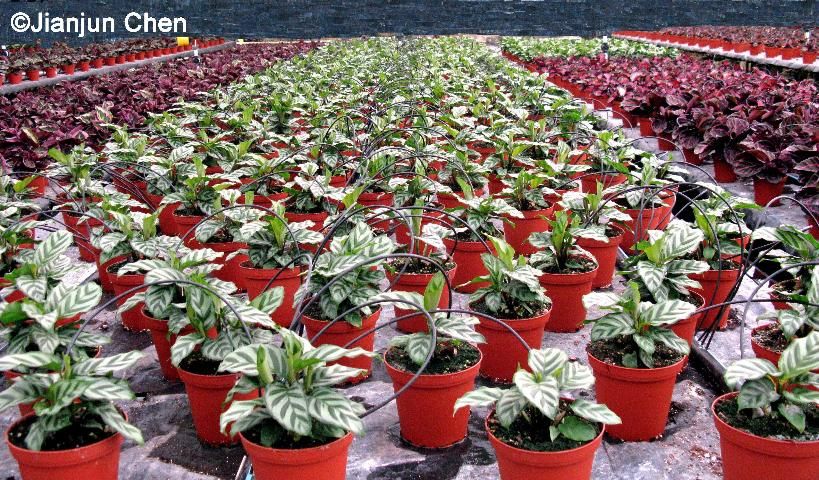
Liners are transplanted in either 6- or 8-inch pots and grown in shadehouses or shaded greenhouses. Soilless media formulated with peat, pine bark, vermiculate, and/or perlite with a pH around 6.0 and soluble salts of 1 to 2 dS/m are suitable for Calathea production. Plants should be grown under at least 80% shade (1000 to 2000 foot candles), with relative humidities between 50 to 100% and temperatures between 70 and 90o F.
If plants are fertigated via drip or ebb-and-flow irrigation, a nutrient solution with N at 150 ppm can be used. This solution can be made using a water-soluble fertilizer with N-P2O5-K2O at a 3-1-2 ratio, such as a 24-8-16 or 18-6-12 with micronutrients. If a controlled-release fertilizer with the N-P2O5-K2O ratio of 3-1-2 is used, apply it at rate of 3 lb N per 1,000 square feet on a monthly basis.
Potting media should be kept moist but not over-watered when controlled-release fertilizers are used. Growers are strongly recommended to monitor pH and the nutrient status of potting media by checking soluble salts levels at least monthly using pH and electrical conductivity (EC) meters. Media solution can easily be extracted by the pour-through method. If EC readings fall below 1.0 dS/m, additional fertilization is needed, whereas if EC readings are above 3.0 dS/m, growers should reduce either the frequency or amount of applied fertilizer.
Nutrient concentrations in leaves considered low, medium, and high for Calathea growth.
Nutrient |
Low |
Medium |
High |
Nitrogen (%) |
<3.0 |
3.0-4.0 |
>4.0 |
Phosphorus (%) |
<0.5 |
0.5-0.8 |
>0.8 |
Potassium (%) |
<2.0 |
2.0-4.0 |
>4.0 |
Calcium (%) |
<0.5 | 0.5-1.0 |
>1.0 |
Magnesium (%) |
<0.25 |
0.25-1.0 |
>1.0 |
Sulfur (%) |
<0.2 |
0.2-0.4 |
>0.4 |
Iron (ppm) |
<40 |
40-200 |
>200 |
Manganese (ppm) |
<30 |
30-150 |
>150 |
Zinc (ppm) |
<20 |
20-200 |
>200 |
Copper (ppm) |
<10 |
10-50 |
>50 |
Boron (ppm) |
<20 |
20-50 |
>50 |
It is recommended that fertilizer applications be reduced or eliminated one month before plants are shipped. Leaf nutrient concentrations listed in Table 2 provide a general guide for determining if Calathea is appropriately fertilized.
Shipping sleeves are needed for transporting finished Calathea. Recommended temperature range for shipping is 60 to 65° F as exposure to a temperature below 55° F may cause chilling injury. Irrigate the media thoroughly the day before shipping to reduce stress during transportation.
Calatheas tolerate an interior light level as low as 75 foot candles; but optimal light levels range from 150 to 200 foot candles. Plants maintain their aesthetic appearance better if relative humidity is kept between 40 and 60%. Allow the surface of potting media to dry slightly before watering. Temperatures should be kept between 65 and 80° F indoors.
See Table 3.
A listing of common cultivars of Calathea in Florida as of 2005.
Species |
Cultivar |
Characteristics |
C. fasciata |
Fasciata |
Large round leaves, green with wide dark stripes on the upper leaf surface and a purple lower leaf surface. |
C. insgnis |
Insgnis |
Oblong leaves with wavy margins; yellow-green upper leaf surface having alternating large and small dark green spots; a purple lower leaf surface. |
C. kennedeae |
Helen |
Thick leaf with dark green margin, and "paint brush strokes" of the same color on a silver interior. |
C. loeseneri |
Kopper Krome |
A sport of C. loeseneri with dark coloration under the leaf, giving the plant a darker, hardier look. The showy part of the inflorescence is a much darker pink than the species. |
Loeseneri |
Green leaves with a lighter green mid rib. The lavender inflorescence is borne above the foliage. |
|
C. majestica |
Majestica |
Light green leaves and pinkish-white stripes covering the upper leaf, purple lower leaf surface. |
C. makoyana |
Makoyana |
Oval leaves that are cream or pale green with dark green oblong blotches along lateral veins. |
C. orbifolia |
Orbifolia |
Bold, striped, luxurious foliage |
C. ornata |
Ornata |
Oblong shaped dark green leaves with pink stripes going from the mid rib to the margin. The deep magenta underside makes this one of the most popular Calathea. |
C. spp. |
Concinna |
Smaller green leaves with dark green variegation. |
C. roseapicta |
Corona |
Silver colored leaves bordered by dark green margins. |
Cynthia |
Dark green center with a 1-inch silver margin around the entire leaves and purple underside. |
|
Eclipse |
Dark green leaves surrounded by a silver irregular shaped pattern turning back to a dark green margin. |
|
Maria |
A sport of C. roseapicta. Bright silver leaves with dark green margins. |
|
Medallion |
Similar to Picta Royale but faster growing and more prominent silver color in the mid-rib. |
|
Roseapicta |
Round leaves with a solid magenta underside with two-tone green top. |
|
Silhouette |
A sport of 'Medallion' that has the same large, round leaves but a much brighter appearance. |
|
Picta Royale |
Dark purple foliage with a faint pattern of silver from mid rib to the end of the round to oblong shaped leaves. |
|
C. rotundifolia |
Rotundifolia |
Dark green leaves with whitish bands between main lateral veins and paler beneath. |
C. rufibarba |
Rufibarba |
Long slender leaves on a very upright plant. Dark green upper side with purple underside covered with tiny hairs. |
C. tigrinum |
Tigrinum |
Large velvet-looking leaves striped with bold, alternating, light and dark green bands. |
C. variegata |
Variegata |
Green with a median band of dark green above and paler with deeper green bands beneath. |
C. vittata |
Vittata |
Lanceolate light green leaves with heavy white stripes from the mid rib to the leaf margin. |
C. zebrina |
Zebrina |
Oblong light green leaves with wide dark stripes from mid rib to the leaf margin. |
Causes and effects of various physiological problems of Calathea.
Symptoms |
Probable Cause |
Treatment |
Dead spots near leaf margins |
Fluoride toxicity |
Avoid using water and fertilizer containing fluoride. |
Leaf marginal or tip necrosis |
Low pH, excess fertilizer, particularly high Mn |
Keep pH close to 6 and soluble salts between 1-2.5 dS/m in production and 1.0-1.5 in interiorscape. Recent studies showed that leaf Mn concentrations higher than 200 ppm was a cause of the problem. |
Leaf chlorosis |
Low fertilizer, over-watering, or high light levels |
Increase fertilizer, particularly nitrogen and iron; reduce watering frequency, reduce light levels. |
Leaf spotting and reduced foliage color |
Plants take up too much potassium |
Use fertilizer with an N-P2O5-K2O ratio of 3:1:2. |
Wilted leaves |
Drought stress or root pathogens |
Keep the potting medium uniformly moist but not wet. Check root systems to determine if they are infected by pathogens or nematodes. |
This document is ENH1030, one of a series of the Environmental Horticulture Department, Florida Cooperative Extension Service, Institute of Food and Agricultural Sciences, University of Florida. Original publication date December 2005. Revised March 2010. Reviewed January 2013. Visit the EDIS website at http://edis.ifas.ufl.edu.
Jianjun Chen, associate professor, Mid-Florida Research and Education Center and Environmental Horticultural Department, and Dennis B. McConnell, professor, Environmental Horticultural Department at the Institute of Food and Agricultural Sciences, University of Florida, Gainesville, FL 32611.
The Institute of Food and Agricultural Sciences (IFAS) is an Equal
Opportunity Institution authorized to provide research, educational
information and other services only to individuals and institutions
that function with non-discrimination with respect to race, creed,
color, religion, age, disability, sex, sexual orientation, marital
status, national origin, political opinions or affiliations.
For more information on obtaining other extension publications,
contact your county Cooperative Extension service.
U.S. Department of Agriculture, Cooperative Extension Service,
University of Florida, IFAS, Florida A. & M. University Cooperative
Extension Program, and Boards of County Commissioners Cooperating. Nick T. Place,
Dean.