
Introduction
The purpose of this article is to instruct ornamental aquaculture producers on how to safely prepare their ornamental fish for shipment. Handling of ornamental fish from the time they are harvested through shipment affects their overall quality. Quality of marketable fish is directly related to their health, which is affected by the amount of stress and trauma they experience during harvest, holding, and transport (see UF/IFAS Fact Sheets FA-117, FA-118, and FA-119). Stress weakens the immune system of the fish, resulting in increased susceptibility to disease (see UF/IFAS Circular 919). There is no substitute for careful handling and good water quality when trying to optimize the health of the fish. As with all steps within the production cycle of fish, proper care and planning when preparing ornamental fish for shipping leads to a healthier and more marketable product.
Holding Fish Prior to Shipping
In a typical Florida production setting, harvested ornamental fish are brought in from ponds and placed into a holding facility, where they are often held for several days prior to shipping (see UF/IFAS Fact Sheet FA-117). During this time, the fish are allowed to clear out their digestive tracts, which reduces the amount of waste released into transport bags and helps maintain acceptable water quality during shipping.
Fish should be examined for appearance (e.g., ragged fins, ulcers, fungal patches) and behavior upon arrival at the holding facility (see UF/IFAS Fact Sheet FA-118). If possible, fish should also be checked for microscopic parasites by analyzing biopsied tissues from gill, skin, and fins, especially if there are external signs of disease such as white spots, excess mucus, visible scale loss, or abnormal behavior. Consult a fish health specialist for assistance.
Prophylactic Treatments
There are very few chemicals that are approved by the Food and Drug Administration (FDA) for use in aquaculture. The FDA allows the legal use of a number of potentially useful substances for aquaculture under the heading of Low Regulatory Priority (e.g., salt). Some other chemicals on the Index of Legally Marketed Drugs for Minor Species may be used legally (e.g., metomidate hydrochloride, trade name Aquacalm®) for sedation and anesthesia of ornamental fish. See the FDA-CVM Aquaculture website for additional information.
FDA-approved formalin products that control external protozoa (e.g., Chilodonella, Ichthyobodo, Epistylis, Trichodina, Ichthyophthirius, monogeneans) of finfish and/or fungi (i.e., family Saprolegniaceae) on finfish eggs include Formacide-B, Parasite-S, and Formalin-F.
Salt (NaCl) is unapproved but is of low regulatory priority. Low regulatory priority is not considered an approval or affirmation of safety or effectiveness, but if used as a 0.5%-1.0% solution as an osmoregulatory aid or a 3% solution for 10-30 minutes as a parasiticide, the FDA is unlikely to object to its use.
Potassium permanganate is currently unapproved, but is in a special category—regulatory action is deferred pending further study. Acriflavine neutral, methylene blue, and nitrofurazone are not approved and are of high enforcement priority if used illegally in foodfish, and use is subject to regulatory action on a case-by-case basis. Malachite green used in Quick Cure is also a high enforcement priority chemical if used illegally in foodfish.
The use of other approved animal and human drugs is allowed under supervision of a veterinarian, provided that all requirements of the drugs' regulation are met and the drug is not administered through feed. However, nontherapeutic use of a drug is not permitted. Additional information regarding FDA drug approval can be found at the FDA-CVM Aquaculture website and in UF/IFAS Circular 84.
If fish are generally healthy with no history of problems, use of a prophylactic treatment (Figure 1) may be an unnecessary cost. Furthermore, unnecessary prophylactic chemical treatments can do more harm than good. Excessive or incorrect use of a prophylactic treatment can increase resistance to the chemical and decrease its effectiveness. However, in some instances, prior to shipping, prophylactic treatment with a chemical bath or dip may help reduce external parasites and bacterial loads. The use of a prophylactic or preventative treatment may decrease the outbreaks of disease while fish are recovering from harvesting and handling and increase their survival during shipment.
Some chemicals (e.g., potassium permanganate, formalin) may damage fish gills or skin and should be used carefully and only when absolutely necessary. Chemicals may also adversely affect water quality. For example, formalin decreases dissolved oxygen concentrations in water. Ideally, the producer should be familiar with common health problems, actively work to identify and treat them as they become apparent and seek assistance from a fish health professional when needed.
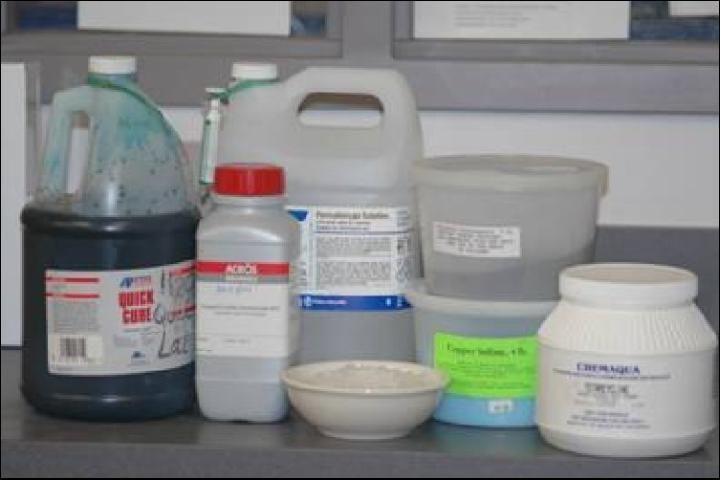
Credit: Tina Crosby (2004)
Experiments evaluating eight common chemicals used for prophylaxis on fish prior to shipment were conducted at the University of Florida Tropical Aquaculture Laboratory. The chemicals tested were oxytetracycline, formalin, salt (3 ppt sodium chloride, NaCl), potassium permanganate (KMnO4), acriflavine neutral, methylene blue, nitrofurazone, and Quick Cure (a 99.2% formalin and 0.75% malachite green mix) (Table 1). Fish were trapped in a pond, graded, and placed into holding tanks with flow-through aerated well water. Each chemical was applied according to the industry standard to separate tanks as 11.5-hour baths, except for potassium permanganate, which was administered as a 4-hour bath.
Following treatment, fish were observed for one week. Fish were evaluated for loss of scales, torn fins, coloration, deformities, pop eye, parasites, and hemorrhaging. Fish behavior was also evaluated for abnormal signs including spinning, flashing, clamping, hanging, piping, and gasping, as well as activity level. Appearance and behavior for each tank of fish were rated on a scale of 1–5, with 1 being overall unfit for sale (problems with >50% of fish) to 5 being superior quality. The use of tetracycline, potassium permanganate, nitrofurazone, Quick Cure, or formalin significantly improved the overall appearance and behavior of fish over time compared to no treatment. In contrast, fish treated with acriflavine neutral were inferior to fish not treated with any chemical in both appearance and behavior. Methylene blue and salt did not have any effect on the appearance or behavior of the fish when used as a prophylactic bath.
Oxytetracycline is an antibiotic, used to treat bacterial infections. The positive results seen with the use of oxytetracycline in our experiments may have been due to the presence of susceptible bacteria. Oxytetracycline may not be as effective under other conditions. However, in general, a single dose treatment of oxytetracycline is not recommended. Additionally, overuse or misuse of oxytetracycline or any other antibiotic may lead to bacterial resistance, making the drug ineffective. Before using any antibiotic, confirmation of a bacterial infection should be established and proper regimes should be followed (see UF/IFAS Circular 84 Use of Antibiotics in Ornamental Fish Aquaculture). Note that oxytetracycline binds to calcium ions in the water, resulting in the need for a higher dosage of oxytetracycline in hard water [Total Hardness (TH) > 120 ppm]. Also keep in mind the legal issues for use of any chemical.
Shipping to a Buyer
Once the fish have had time (1-3 days) to evacuate the wastes in their digestive tracts and have been properly evaluated and treated for any parasites or disease, they are ready to be shipped to a buyer. Fish should be placed into plastic bags containing oxygenated water and put into a polystyrene shipping box. The polystyrene boxes are placed into a cardboard box for shipping. It is important to use shipping water that has water quality appropriate for the fish being shipped (e.g., pH, temperature, TAN, NO2, DO) (see IFAS Fact Sheet FA-119 On-Farm Transport of Ornamental Fish). Water quality in the bag will become degraded due to accumulation of carbon dioxide, ammonia, and other waste products during shipment.
Temperature
Temperature is an important consideration when transporting fish. Different species of fish thrive at different temperatures: tropical fish do better at temperatures 26°C–30°C (> 78.8°F–86°F), warm water fish thrive at temperatures 21°C–28°C (69.8°F–82.4°F), and cool water fish do best at temperatures 7°C–15°C (44.6°F–59°F) (Noga 2000, Avault 1996, Wedemeyer 1996). During the summer and winter months, or when transport times are long, ice gel packs or heat packs can be placed into shipping boxes to help maintain an appropriate water temperature. The ideal temperature for the shipping water is dependent on the species of fish being transported.
Shipping Additives
Chemical additives are often used in transport water to sedate the fish or reduce pathogen (any agent that causes disease) loads in the water (Figure 2).
![Shipping additives [tricaine methanesulfonate, sodium thiosulfate, salt (NaCl)] and supplies.](/image/FA120/D3dvqijcov/Iaim4iqnax/Iaim4iqnax-2048.webp "Figure 2")
Credit: Tina Crosby (2004)
Experiments at the University of Florida Tropical Aquaculture Laboratory were run to test various shipping chemical additives for their effects on appearance and behavior of fish post shipping. The chemicals tested were tricaine methanesulfonate (MS-222), salt (3 ppt NaCl), methylene blue, acriflavine neutral, quinaldine, eugenol, an experimental commercial product in the form of a feed, and a water additive.
The commercial product contained arachidonic acid (ArA), a fungus extract from Mortierella sp., claimed by the manufacturer to be used to regulate immune systems; and an ethanol extract from the genus Opuntia, a cactus species, claimed by the manufacturer to be used to stimulate the production of heat shock proteins (HSPs) that work to counteract stress responses.
Tricaine methanesulfonate is approved for use in finfish as a sedative and anesthetic. Quinaldine and eugenol are not approved for use in aquaculture. A description of approval for the other chemicals tested in this experiment were described in the "Prophylactic Treatments" section of this publication.
Velvet swordtail fish were trapped from a pond and placed into holding tanks with flow-through aerated well water for four days. The fish receiving the commercial test feed were fed for three days prior to shipping. The day of transportation, fish were transported with one of the additives added to the shipping water (1.5 L) (Table 2). The fish were transported by van for two hours in 1/4 square-bottom shipping bags.
Fish appearance and behavior were evaluated after harvest, immediately prior to transport, and one week after transport. Immediately following transport, fish treated with methylene blue, salt, MS-222, quinaldine, eugenol, the experimental water additive, and control fish all had better appearance than those treated with acriflavine neutral. Fish treated with methylene blue or salt had the best appearance.
After one week of holding, fish from all treatment groups appeared the same. Fish treated with methylene blue or salt had a better appearance than control fish post transport. Fish treated with salt or MS-222 had better behavior following the one-week post transportation holding period. Acriflavine neutral had a detrimental effect upon the appearance and behavior of fish.
Another set of experiments investigated the efficacy of acriflavine (8 mg/L), methylene blue (2 mg/L), nitrofurazone (4 mg/L), and two commercial products (Blue Holdex (125 mg/L), Jungle Laboratories; and Furazone Green (26mg/L), First Choice™) as transport additives for control of Aeromonas hydrophila and other culturable aquatic bacteria in shipping bags of ornamental tropical fish. The dosage rates tested were industry standards.
Experiment 1 consisted of simulated shipping field trials using swordtails Xiphophorus hellerii. One of the five shipping compounds was added to test effects on bacterial loads as a whole during transport compared to untreated controls. Experiment 2 was run to determine the effects of these shipping chemicals against one particular clinical strain of Aeromonas hydrophila. Aeromonas hydrophila was added to sterilized well water in shipping bags containing no fish. Next, one of the five shipping additives was added to the shipping bags to examine its effect on that species and strain of bacteria. In both trials, the water containing the bacteria was sampled every eight hours to determine how effective each of the shipping additives was in killing aquatic bacteria over time.
Data on the mean number of bacteria obtained at time 0, 8, 16, and 24 hr were assessed for each of the five separate shipping additives as well as the control. In experiment 1, overall bacterial populations increased over the 24 hours of the experiment in each of the water samples obtained at time 8, 16, 24 hr. There was less of an increase at 8 hours for acriflavine, but by 24 hours, there was no significant difference between any of the treatments and the control. This suggests that none of the treatments had greater efficacy over the others by the end of the 24 hours for total culturable bacteria populations. Results from experiment 2, testing only one clinical strain of the bacteria Aeromonas hydrophila showed there was no obvious pattern of increase in bacteria populations over the 24 hours during the experiment. At different time points, some treatments had increases in bacterial numbers, while others had decreases. However, overall, acriflavine did depress Aeromonas numbers at times 8, 16, and 24 hr significantly, relative to control and all other treatments.
While acriflavine kept Aeromonas bacteria numbers lower than other treatments in the experiment with no fish and only bacteria, in experiment 2, with fish in transport, acriflavine did not appear to provide any long-term bactericidal properties. Because of these results evaluating the appearance and behavior of fish transported in acriflavine and the lack of long-term bactericidal effects, acriflavine is not recommended for use.
Shipping Bags and Boxes
Square-bottom bags are ideal for shipping fish because they sit upright in shipping boxes and do not have “folds” where fish can concentrate and become trapped (Figure 3 and Figure 4). Another benefit of the square-bottom bag is that it allows for a larger surface area between the oxygen and the water, maximizing oxygen diffusion into the water and reducing localized zones of oxygen depletion. The size of the bag that is used depends on the number, size, and species of the fish being shipped. Table 3 lists dimensions of bags commonly used to ship ornamental fish for prolonged periods of time (up to 36 hours). Table 4 lists common species, sizes, and numbers of fish shipped from Florida in square-bottom bags with the standard two gallons of high-quality transport water (table is located at the end of this publication). In 1/4 and 1/2 square-bottom shipping bags, the oxygen gas volume to water volume ratio is generally 60% oxygen to 40% water.
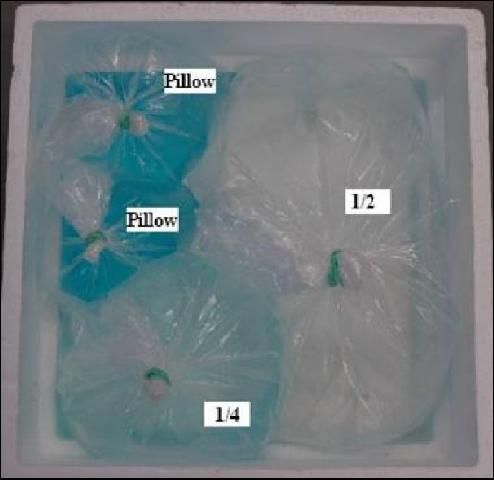
Credit: Tina Crosby (2004)
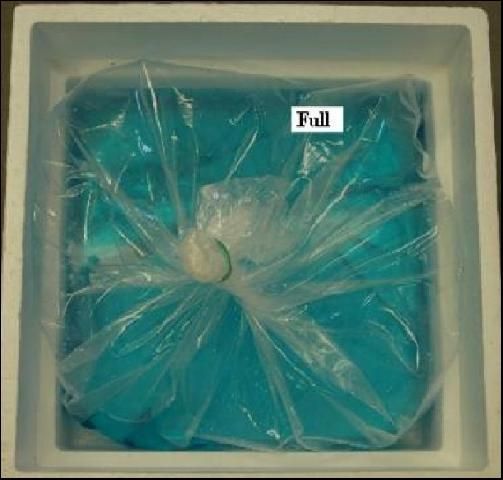
Credit: Tina Crosby (2004)
Pillow bags do not have square bottoms, so they lie on their sides. They are less expansive than square-bottom bags and come in a variety of sizes.
If a shipping additive is to be used, it is placed into the bag water prior to the addition of fish. Once the fish are placed into the appropriate bag, the ambient air is removed (squeezed out) and replaced with pure oxygen from an oxygen bottle. The bag is then sealed with a rubber band or other sealing device. During transport, oxygen levels decrease, and carbon dioxide levels increase as fish respire. The addition of pure oxygen to the shipping bag allows the producer to ship a greater number of fish in each bag for a longer period of time. If the sealed bag contains only ambient air, the fish quickly consume all of the available oxygen resulting in high mortalities (see UF/IFAS Fact Sheet FA-119 On-Farm Transport of Ornamental Fish).
There are a variety of shipping box sizes available, such as the standard "double" box that holds two full bags of fish. The size of box is determined by the number of fish being shipped. Once prepared, bags destined for local transport are put into the Florida standard ornamental "single" polystyrene boxes (17-inch x 17-inch) with lids. If fish are going further than a local buyer, the polystyrene boxes are sealed with packing tape and placed into tight-fitting cardboard outer boxes (17¼-inch x 17¼-inch) that provide added protection during shipment. Boxes are usually pre-labeled with a “live fish” stamp and are suitable for shipping via airplane or truck (Figure 5).
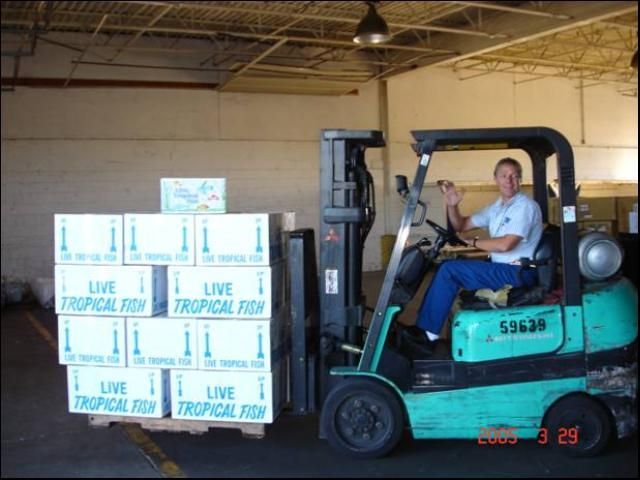
Credit: Jon Kao (2004)
Permits and Health Certificates
Permit requirements and health certificates vary by state and region. Check with your local state agency and/or the importing country's regulations to determine requirements for shipping ornamental fish domestically and internationally.
Summary
The quality and overall health of ornamental fish are affected by stressors that occur during harvest, holding, and transport to the buyer. Experienced ornamental fish farmers minimize the effects of these stressors. Overall fish health is improved by screening fish showing signs of disease. If harvested fish show signs of external parasites, the prophylactic use of potassium permanganate, Quick Cure, or formalin may provide protection from mortality. The use of salt (3 ppt) or methylene blue in shipping water may be beneficial to the overall behavior and appearance of fish post-transportation. Acriflavine neutral is not recommended for use because it has a negative effect on the appearance and behavior of fish. Optimal dissolved oxygen and temperature levels should be maintained during shipping. Prior to shipment, determine the best packaging methods (e.g., bag size, amount of water per bag, amount of fish per bag, addition of ice or heat pack). These factors, along with good water quality, help facilitate the production and sale of high quality marketable fish.
Recommended Reading
UF/IFAS Circular 84 Use of Antibiotics in Ornamental Fish Aquaculture. https://edis.ifas.ufl.edu/FA084
UF/IFAS Circular 120 Fish Health Management Considerations in Recirculating Aquaculture Systems - Part 1: Introduction and General Principles. https://edis.ifas.ufl.edu/FA099
UF/IFAS Circular 121 Fish Health Management Considerations in Recirculating Aquaculture Systems - Part 2: Pathogens. https://edis.ifas.ufl.edu/FA100
UF/IFAS Circular 122 Fish Health Management Considerations in Recirculating Aquaculture systems - Part 3: General Recommendations and Problem-Solving Approaches. https://edis.ifas.ufl.edu/FA101
UF/IFAS Fact Sheets FA-107 to FA-115 Common Freshwater Fish Parasites Pictorial Guides. https://edis.ifas.ufl.edu/topic_series_common_freshwater_fish_parasites
UF/IFAS Circular 919 Stress - Its Role in Fish Disease. https://edis.ifas.ufl.edu/FA005
UF/IFAS Fact Sheet FA-7 Fish Fingerlings: Purchasing, Transporting, and Stocking. https://edis.ifas.ufl.edu/FA013
UF/IFAS Fact Sheet FA-13 Use of Copper in Freshwater Aquaculture and Farm Ponds. https://edis.ifas.ufl.edu/FA008
UF/IFAS Fact Sheet FA-16 Ammonia in Aquatic Systems. https://edis.ifas.ufl.edu/FA031
UF/IFAS Fact Sheet FA-117 Harvesting Ornamental Fish From Ponds. https://edis.ifas.ufl.edu/FA117
UF/IFAS Fact Sheet FA-118 Grading Ornamental Fish. https://edis.ifas.ufl.edu/FA118
UF/IFAS Fact Sheet FA-119 On Farm Transport of Ornamental Fish. https://edis.ifas.ufl.edu/FA119
UF/IFAS Fact Sheet VM-77 Use of Formalin to Control Fish Parasites. https://edis.ifas.ufl.edu/VM061
SRAC Publication No. 410 Calculating Treatments for Ponds and Tanks. https://srac.tamu.edu/categories/view/20
SRAC Publication No. 462 Nitrite in Fish Ponds. https://srac.tamu.edu/categories/view/25
SRAC Publication No. 463 Ammonia in Fish Ponds. https://srac.tamu.edu/categories/view/25
SRAC Publication No. 464 Interactions of pH, Carbon Dioxide, Alkalinity, and Hardness in Fish Pond. https://srac.tamu.edu/categories/view/25
SRAC Publication No. 468 Carbon Dioxide in Fish Ponds. https://srac.tamu.edu/categories/view/25
SRAC Publication No. 474 The Role of Stress in Fish Disease. https://srac.tamu.edu/categories/view/26
SRAC Publication No. 3900 Anesthetics in Aquaculture. https://srac.tamu.edu/categories/view/18
SRAC Publication No. 4601 Measuring Dissolved Oxygen Concentration in Aquaculture. https://srac.tamu.edu/categories/view/25
References and Further Reading
Avault, J.W. 1996. Fundamentals of Aquaculture. Baton Rouge, LA: AVA Publishing Company Inc.
Noga, E.J. 2000. Fish Disease: Diagnosis and Treatment. Ames, IA: Iowa State University Press.
Wedemeyer, G.A. 1996. Physiology of Fish in Intensive Culture Systems. New York, NY: Chapman and Hall.
Table 1. Prophylactic treatments tested.
Table 2. Shipping additives tested.
Table 3. Dimensions for bags commonly used to ship ornamental fish from Florida.
Table 4. Various-size common ornamental fish shipped in a full square-bottomed bag with 2 gallons of water.