
Introduction
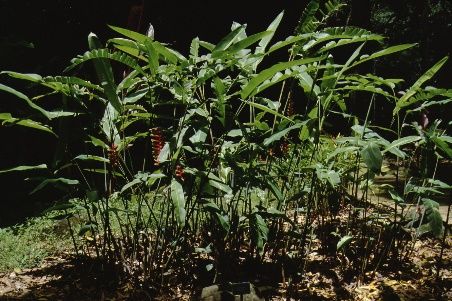
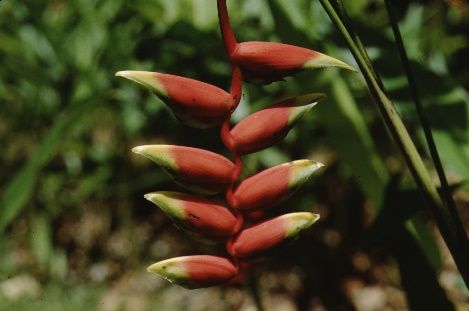
Lobster claw is an herbaceous perennial with leathery, dark green leaves which are borne on long petioles arising directly from the ground. It has 3 to 5feettall stems terminated by a drooping inflorescence. The flowers hang in showy clusters that emerge from second year stalks. They are enclosed by scarlet- and yellow-colored bracts that are 6 to 8 inches long. This unique plant is used as a specimen for tropical gardens. The inflorescence may be cut for indoor decoration where they last for several weeks.
Credit: Edward F. Gilman, UF/IFAS
Credit: Edward F. Gilman, UF/IFAS
General Information
Scientific name: Heliconia rostrata
Pronunciation: hel-lick-KOE-nee-uh ros-STRAY-tuh
Common name(s): lobster claw, false bird of paradise
Family: Heliconiaceae
Plant type: herbaceous
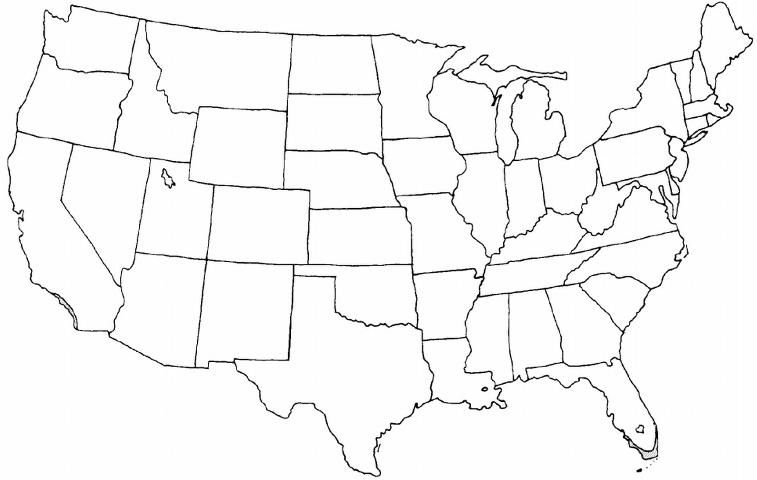
USDA hardiness zones: 10B through 11 (Figure 3)
Planting month for zone 10 and 11: year round
Origin: not native to North America
Invasive potential: not known to be invasive
Uses: cut flowers; suitable for growing indoors
Availability: somewhat available, may have to go out of the region to find the plant
Credit:
Description
Height: 5 to 6 feet
Spread: 3 to 6 feet
Plant habit: upright
Plant density: open
Growth rate: fast
Texture: coarse
Foliage
Leaf arrangement: alternate
Leaf type: simple
Leaf margin: entire
Leaf shape: ovate
Leaf venation: pinnate
Leaf type and persistence: evergreen
Leaf blade length: more than 36 inches
Leaf color: green
Fall color: no fall color change
Fall characteristic: not showy
Flower
Flower color: yellow
Flower characteristic: spring flowering; summer flowering
Fruit
Fruit shape: unknown
Fruit length: unknown
Fruit cover: unknown
Fruit color: blue
Fruit characteristic: inconspicuous and not showy
Trunk and Branches
Trunk/bark/branches: typically multi-trunked or clumping stems
Current year stem/twig color: green
Current year stem/twig thickness: thick
Culture
Light requirement: plant grows in part shade/part sun
Soil tolerances: acidic; alkaline; sand; loam; clay
Drought tolerance: moderate
Soil salt tolerances: moderate
Plant spacing: 36 to 60 inches
Other
Roots: not applicable
Winter interest: no special winter interest
Outstanding plant: plant has outstanding ornamental features and could be planted more
Pest resistance: very sensitive to one or more pests or diseases which can affect plant health or aesthetics
Use and Management
Lobster claw will prosper in locations that receive full or partial sun. It grows and flowers best in fertile, moist soil. Fertilize this plant regularly during the growing season.
Propagation is by division of the matted clumps.
Pests and Diseases
None are usually serious. This plant may be bothered by Cercospora and Helminthosporum leaf spots. Scales and nematodes may also cause problems.