
Introduction
The scarlet rosemallow is a narrow, upright, herbaceous perennial that can reach a height of 4 to 8 feet. The 5- to 6-inch-long leaves of this plant are palmately lobed into 3, 5, or 7 parts. These finger-like lobes are slender and have jagged teeth along their margins. Deep red flowers that are 5 to 6 inches wide appear in mid to late summer. These flowers are funnel form and occur on long axillary peduncles. There are 10 or more involucral bracts present on the flower. They are curved upward and are much shorter than the calyx lobes.
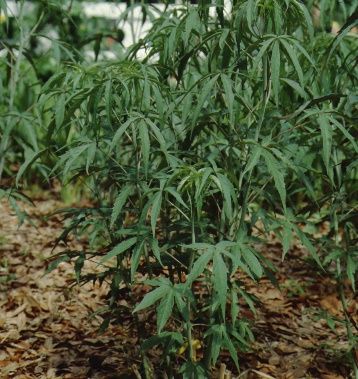
Credit: Edward F. Gilman, UF/IFAS
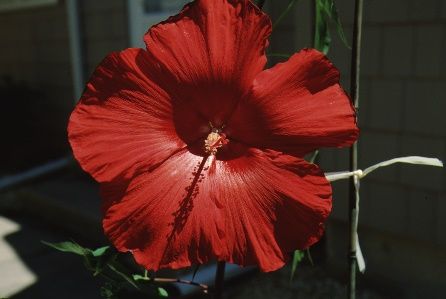
Credit: Edward F. Gilman, UF/IFAS
General Information
Scientific name: Hibiscus coccineus
Pronunciation: hye-BISS-kus kock-SIN-ee-us
Common name(s): scarlet rosemallow, Texas star hibiscus, swamp hibiscus
Family: Malvaceae
Plant type: perennial; herbaceous
USDA hardiness zones: 8 through 10 (Figure 3)
Planting month for zone 8: year-round
Planting month for zone 9: year-round
Planting month for zone 10 and 11: year-round
Origin: native to Florida
Invasive potential: not known to be invasive
Uses: accent; border; mass planting; attracts butterflies; attracts hummingbirds
Availability: somewhat available, may have to go out of the region to find the plant
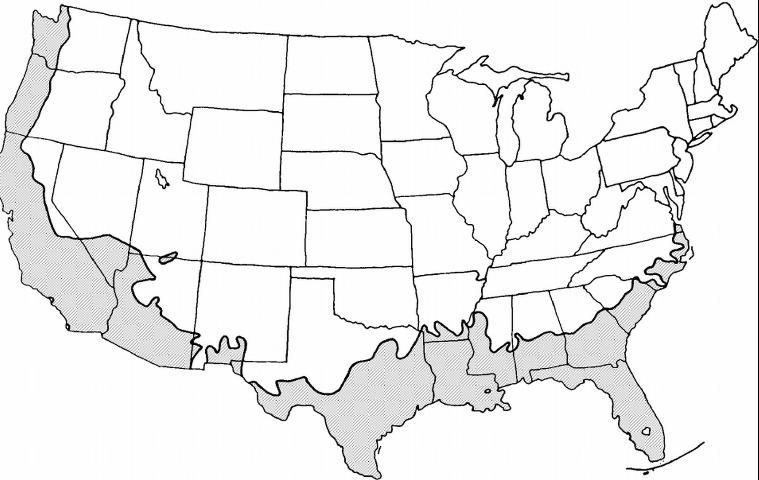
Credit:
Description
Height: 4 to 8 feet
Spread: 3 to 4 feet
Plant habit: upright
Plant density: open
Growth rate: fast
Texture: fine
Foliage
Leaf arrangement: alternate
Leaf type: simple
Leaf margin: lobed; serrate
Leaf shape: star-shaped
Leaf venation: palmate
Leaf type and persistence: deciduous
Leaf blade length: 4 to 8 inches
Leaf color: green
Fall color: no fall color change
Fall characteristic: not showy
Flower
Flower color: red
Flower characteristic: summer flowering
Fruit
Fruit shape: elongated
Fruit length: 1/2 to 1 inch
Fruit cover: dry or hard
Fruit color: unknown
Fruit characteristic: inconspicuous and not showy
Trunk and Branches
Trunk/bark/branches: typically, multi-trunked or clumping stems
Current year stem/twig color: reddish
Current year stem/twig thickness: very thick
Culture
Light requirement: plant grows in part shade/part sun
Soil tolerances: extended flooding; acidic; sand; loam; clay
Drought tolerance: moderate
Soil salt tolerances: poor
Plant spacing: 24 to 36 inches
Other
Roots: not applicable
Winter interest: no special winter interest
Outstanding plant: plant has outstanding ornamental features and could be planted more
Pest resistance: very sensitive to one or more pests or diseases which can affect plant health or aesthetics
Use and Management
The scarlet rosemallow is frequently used as a specimen and can be placed in a border. It may also be utilized around the edge of a pond or along a stream since this type of site is similar to their native Georgia and Florida habitat.
Although the scarlet rosemallow is native to wetland areas it is tolerant of somewhat drier soils. This plant requires a full sun or partial shade location in the landscape. Flowering and growth in the shade are poor.
Cultivars include: 'Lord Baltimore', deep red flowers.
Hibiscus coccineus can be propagated by seed or division.
Pest and Diseases
The scarlet rosemallow may be occasionally bothered by a stalk borer. Grasshoppers also enjoy chewing the foliage and flower buds. This can spoil the flower display. Be prepared to provide control for this pest. I usually squash them between my hands in the evening as a means of mechanical control.