
Introduction
Thin green leaves and attractive, violet-blue flowers give this plant its charm, although flowers are not as showy as those of Liriope muscari. It forms a dense, uniform cover, unlike Liriope muscari, which forms clumps until well established several years after planting. Creeping lilyturf is a 6- to 10-inch-tall evergreen perennial that is useful in the landscape as a ground cover. This plant spreads quickly by rhizomes and can invade adjacent turf areas or other ground cover beds. Therefore, this liriope may be best suited for planting in a bed surrounded by hardscape or confined with an edging (root barrier) that is 18 inches deep. The small, purple flowers occur in terminal racemes that nest in with the foliage. These flowers appear in the summer and are followed by blue-black berrylike fruits. Fruits are not produced in abundance.
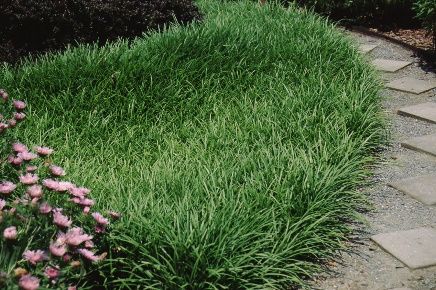
Credit: Edward F. Gilman, UF/IFAS
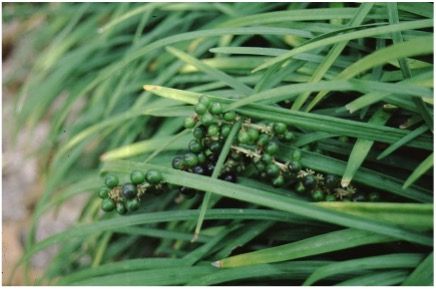
Credit: Edward F. Gilman, UF/IFAS
General Information
Scientific name: Liriope spicata
Pronunciation: luh-RYE-oh-pee spy-KAY-tuh
Common name(s): creeping lilyturf, Border-grass, creeping liriope, liriope, monkey-grass
Family: Liliaceae
Plant type: perennial; herbaceous; ornamental grass
USDA hardiness zones: 6 through 10 (Figure 3)
Planting month for zone 7: year-round
Planting month for zone 8: year-round
Planting month for zone 9: year-round
Planting month for zone 10: year-round
Origin: native to temperate and tropical Asia
Invasive potential: invasive and not recommended by UF/IFAS faculty (reassess in 10 years)
Uses: mass planting; edging; naturalizing
Availability: generally available in many areas within its hardiness range
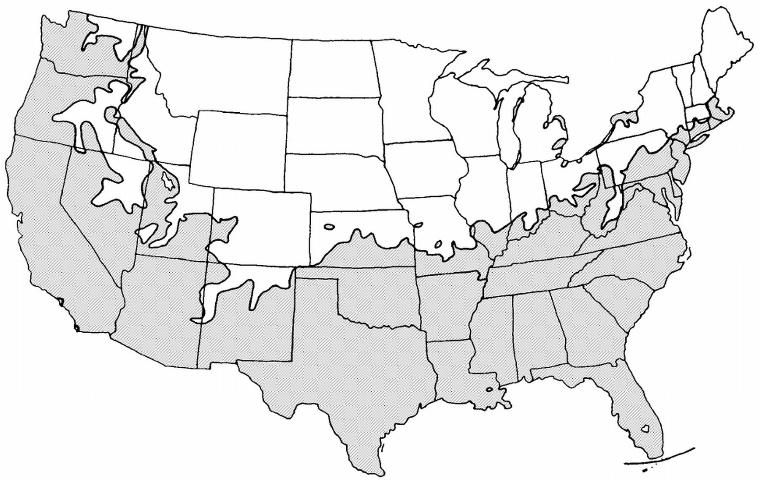
Credit:
Description
Height: 0.5 to 1 feet
Spread: 1 to 2 feet
Plant habit: upright
Plant density: moderate
Growth rate: moderate
Texture: fine
Foliage
Leaf arrangement: most emerge from the soil, usually without a stem
Leaf type: simple
Leaf margin: entire
Leaf shape: linear
Leaf venation: parallel
Leaf type and persistence: evergreen
Leaf blade length: 12 to 18 inches
Leaf color: variegated
Fall color: no fall color change
Fall characteristic: not showy
Flower
Flower color: violet-blue
Flower characteristic: summer flowering
Fruit
Fruit shape: round
Fruit length: less than 0.5 inch
Fruit cover: fleshy
Fruit color: black
Fruit characteristic: showy
Trunk and Branches
Trunk/bark/branches: not applicable
Current year stem/twig color: not applicable
Current year stem/twig thickness: not applicable
Culture
Light requirement: plant grows in part shade/part sun; plant grows in the shade
Soil tolerances: alkaline; clay; sand; acidic; loam
Drought tolerance: moderate
Soil salt tolerances: unknown
Plant spacing: 6 to 12 inches
Other
Roots: not applicable
Winter interest: no special winter interest
Outstanding plant: not particularly outstanding
Pest resistance: no serious pests are normally seen on the plant
Use and Management
Creeping lilyturf is not a good plant for bordering a sidewalk or for use as an edging because it spreads too quickly. Use Liriope muscari instead. But it will grow well underneath trees or around shrubs. However, like other liriope, it will not tolerate regular foot traffic.
Liriope can grow in a sunny location but prefers one that has partial shade or full shade. It prefers well-drained soils and is moderately tolerant of drought and salt spray. Wet soil produces many suckers. This plant does have a negative reaction to high temperatures and can turn yellow and melt out in warm weather in the full sun. Liriope beds can be mowed each spring before the new growth begins to eliminate last year's unsightly foliage. This produces a clean-looking bed and improves appearance. If you wait to cut after new growth begins, you will cut off the tops of the new leaves.
Lilyturf is most often propagated by division of the clumps or tubers. It will also grow from seed if the pulp is removed.
Pests and Diseases
No pests or diseases are of major concern. Grasshoppers may occasionally damage the foliage.