
Introduction
This evergreen shrub is grown primarily for its smooth green foliage. Myrsine is a dense, vertically growing shrub that can reach a height of 15 to 20 feet. Older plants become spreading and woody with numerous trunks. The attractive leaves of this plant are oval and a medium- to dark-green color. Young, vigorous plants in the nursery have well-spaced leaves along the green twigs, but those on older shrubs tend to cluster toward the ends of the stem. Small, inconspicuous greenish-yellow flowers occur in clusters that are found along the branches. Flowers are succeeded by decorative, shiny, black berries; plants of both sexes must be grown close by to obtain fruiting.
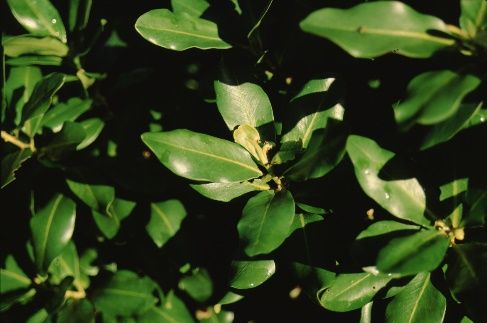
Credit: Edward F. Gilman, UF/IFAS
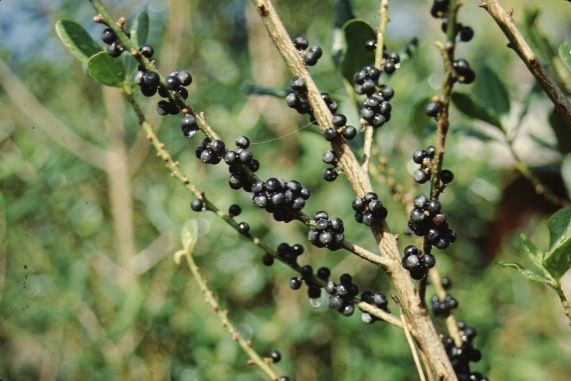
Credit: Edward F. Gilman, UF/IFAS
General Information
Scientific name: Myrsine guianensis
Pronunciation: mer-SIGH-nee gee-uh-NEN-sis
Common name(s): rapanea, myrsine
Family: Myrcinaceae
Plant type: tree
USDA hardiness zones: 10 through 11 (Figure 3)
Planting month for zone 10 and 11: year-round
Origin: native to Florida
Invasive potential: not known to be invasive
Uses: reclamation plant; trained as a standard; hedge; near a deck or patio; specimen; screen; border; attracts butterflies; small parking lot islands (< 100 square feet); medium-sized parking lot islands (100-200 square feet); large parking lot islands (> 200 square feet)
Availability: generally available in many areas within its hardiness range
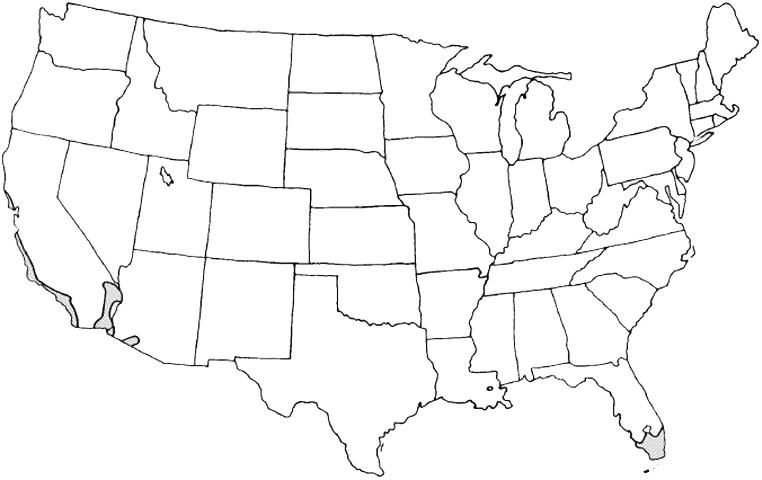
Credit:
Description
Height: 15 to 20 feet
Spread: 8 to 12 feet
Plant habit: upright
Plant density: symmetrical habit with a regular (or smooth) outline and individuals having more or less identical forms
Growth rate: moderate
Texture: medium
Foliage
Leaf arrangement: alternate
Leaf type: simple
Leaf margin: revolute
Leaf shape: obovate
Leaf venation: none, or difficult to see
Leaf type and persistence: evergreen
Leaf blade length: 2 to 4 inches
Leaf color: green
Fall color: no fall color change
Fall characteristic: not showy
Flower
Flower color: greenish-yellow
Flower characteristic: year-round flowering
Fruit
Fruit shape: round
Fruit length: less than 0.5 inch
Fruit cover: fleshy
Fruit color: black
Fruit characteristic: attracts birds
Trunk and Branches
Trunk/bark/branches: can be trained to grow with a short, single trunk; no thorns; not particularly showy
Current year stem/twig color: brown
Current year stem/twig thickness: medium
Culture
Light requirement: plant grows in the shade
Soil tolerances: occasionally wet; acidic; alkaline; sand; loam; clay
Drought tolerance: high
Soil salt tolerances: good
Plant spacing: 36 to 60 inches
Other
Roots: usually not a problem
Winter interest: no special winter interest
Outstanding plant: not particularly outstanding
Pest resistance: no serious pests are normally seen on the plant
Use and Management
Myrsine can be used in the landscape as an accent plant in a shaded or partially sunny landscape. It is excellent when used in shrub groupings. It is a good background plant in a shrub border, forming a fairly dense screen. Plant about 6 to 8 feet apart for a quick-forming screen. It is also useful as an understory plant and lends itself well to dune conditions.
Myrsine guianensis will adapt to variable soil conditions including poor drainage. This makes it especially useful near foundations or water retention basins, since water often sits here after a rainfall. Regular clipping will be required if it is used as a foundation planting because of the plant's tendency to grow 20 feet tall. This shrub grows best in a partial to full shade location in the landscape, and it has a good salt spray tolerance. Native habitat includes the lee side of coastal upland plant communities where soil is sandy with shell fragments. Soil pH is neutral to slightly alkaline and may be poorly drained. It can also be found in baldcypress swamps among other wet-site-tolerant plants.
This plant is commonly propagated by seed. Young plants may also be transplanted from a field nursery with relative ease.
Pests and Diseases
No pests or diseases are of major concern.