
Introduction
This native, eastern American aquatic plant is well adapted to Florida habitat. It can be found in the wild from Nova Scotia through the entire state of Florida in shallow wetland areas around the edges of ponds and lakes. It grows in water no more than about 12 inches deep. Foliage emerges each spring from below the water surface and stands several feet above the water surface. Beautiful purple-blue flower spikes follow several weeks later and are held slightly above the foliage.
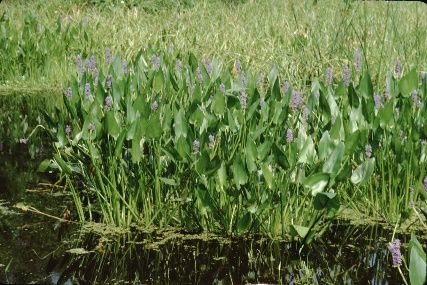
Credit: Edward F. Gilman, UF/IFAS
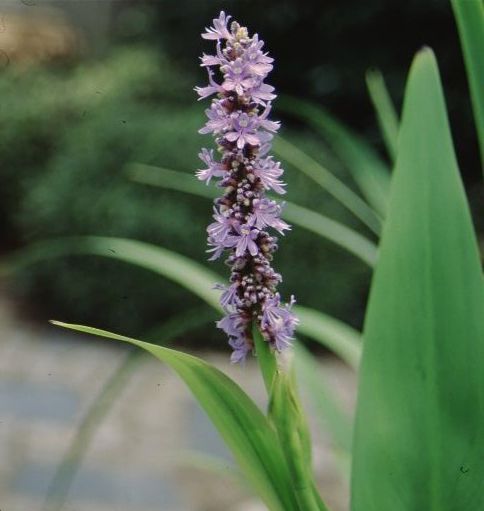
Credit: Edward F. Gilman, UF/IFAS
General Information
Scientific name: Pontederia cordata
Pronunciation: pon-tee-DEER-ree-uh kor-DAY-tuh
Common name(s): pickerel weed
Family: Pontederiaceae
Plant type: aquatic plant
USDA hardiness zones: 3B through 10 (Figure 3)
Planting month for zone 7: year-round
Planting month for zone 8: year-round
Planting month for zone 9: year-round
Planting month for zone 10: year-round
Origin: native to Florida
Invasive potential: aggressive, spreading plant
Uses: water garden; attracts butterflies
Availability: somewhat available, may have to go out of the region to find the plant
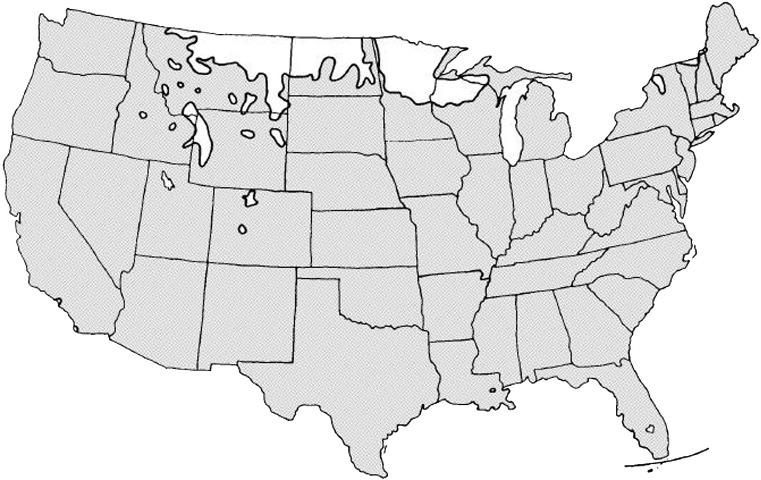
Credit:
Description
Height: 3 to 5 feet
Spread: depends upon supporting structure
Plant habit: upright
Plant density: open
Growth rate: fast
Texture: coarse
Foliage
Leaf arrangement: alternate
Leaf type: simple
Leaf margin: entire
Leaf shape: saggitate (arrow)
Leaf venation: bowed
Leaf type and persistence: deciduous
Leaf blade length: 12 to 18 inches
Leaf color: green
Fall color: no fall color change
Fall characteristic: not showy
Flower
Flower color: purple-blue
Flower characteristic: spring flowering; summer flowering; fall flowering
Fruit
Fruit shape: unknown
Fruit length: unknown
Fruit cover: unknown
Fruit color: unknown
Fruit characteristic: inconspicuous and not showy
Trunk and Branches
Trunk/bark/branches: typically multi-trunked or clumping stems
Current year stem/twig color: not applicable
Current year stem/twig thickness: thick
Culture
Light requirement: plant grows in full sun
Soil tolerances: acidic; grows submerged in water
Soil salt tolerances: poor
Plant spacing: 36 to 60 inches
Other
Roots: not applicable
Winter interest: no special winter interest
Outstanding plant: plant has outstanding ornamental features and could be planted more
Pest resistance: long-term health usually not affected by pests
Use and Management
Plants are propagated from divisions of the root system, or more efficiently in tissue culture. They can be purchased containerized in media. Plant them in about 12 inches of water at the edge of a standing body of water. Deeper water will kill them. To prevent the plant from spreading and invading the entire pond or lake, keep plants in a container without drainage holes. Plants can be placed about 4 feet apart to form a nice stand several years later.
Pickerel weed grows best in a sunny location. Its aggressive habit can help stabilize a pond bank, and it is nicely suited for planting in a water retention pond. It can complement the waterlilies in a water garden by adding height, texture, and blue flower color.
Pests and Diseases
Few important problems trouble this marginal plant.