
Introduction
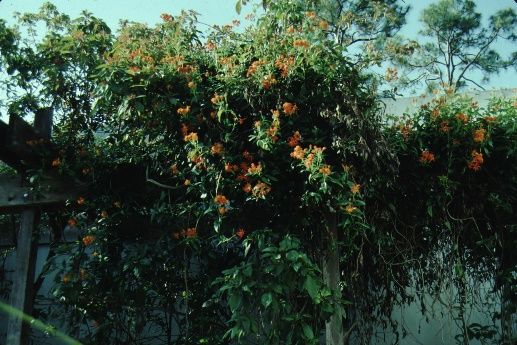
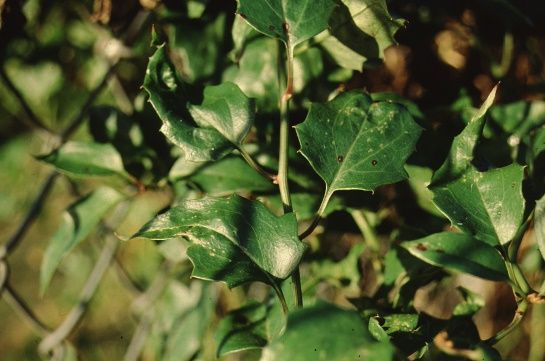
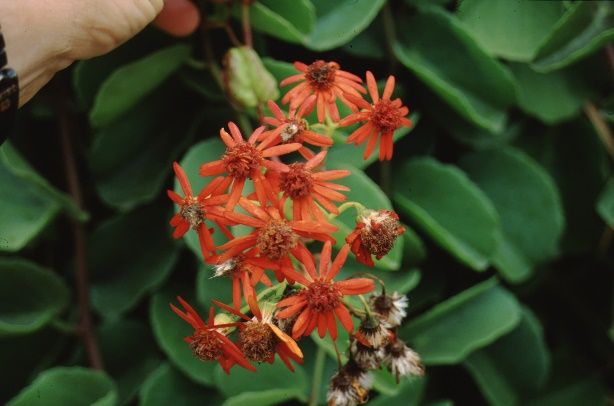
This twining, evergreen sprawling vine has 4 inch long, coarsely toothed, dark green leaves and terminal clusters of orange-red, one-inch, daisy-like flowers with golden centers. Although it appears throughout the year, peak periods of bloom are spring and summer. The quick growth of Mexican flame vine is ideal to add interest to palm trunks, to soften fences, or to veil a trellis. Occasional heading helps some foliage and flowers at the bottom of a fence or other structure supporting Mexican flame vine. Left unpruned, foliage and flowers accumulate at the top.
Credit: Edward F. Gilman, UF/IFAS
Credit: Edward F. Gilman, UF/IFAS
Credit: Edward F. Gilman, UF/IFAS
General Information
Scientific name: Senecio confusus
Pronunciation: sen-NEESH-shee-oh kun-FEW-sus
Common name(s): Mexican flame vine
Family: Asteraceae
Plant type: ground cover
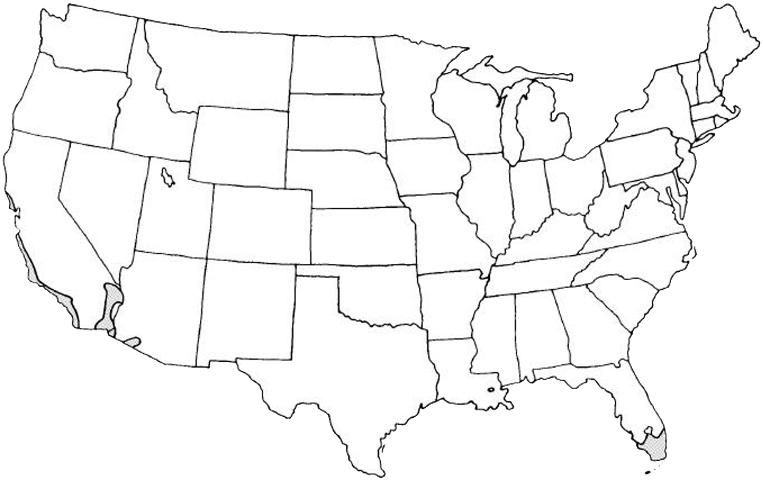
USDA hardiness zones: 10 through 11 (Figure 4)
Planting month for zone 10 and 11: year-round
Origin: native to North America
Invasive potential: aggressive, spreading plant
Uses: ground cover; cascading down a wall
Availability: somewhat available, may have to go out of the region to find the plant
Credit:
Description
Height: depends upon supporting structure
Spread: depends upon supporting structure
Plant habit: spreading
Plant density: moderate
Growth rate: fast
Texture: medium
Foliage
Leaf arrangement: alternate
Leaf type: simple
Leaf margin: dentate
Leaf shape: ovate
Leaf venation: pinnate
Leaf type and persistence: evergreen
Leaf blade length: 2 to 4 inches
Leaf color: green
Fall color: no fall color change
Fall characteristic: not showy
Flower
Flower color: orange-red
Flower characteristic: summer flowering
Fruit
Fruit shape: oval
Fruit length: less than 0.5 inch
Fruit cover: dry or hard
Fruit color: brown
Fruit characteristic: inconspicuous and not showy
Trunk and Branches
Trunk/bark/branches: not applicable
Current year stem/twig color: green
Current year stem/twig thickness: medium
Culture
Light requirement: plant grows in part shade/part sun
Soil tolerances: occasionally wet; slightly alkaline; clay; sand; acidic; loam
Drought tolerance: moderate
Soil salt tolerances: poor
Plant spacing: 36 to 60 inches
Other
Roots: not applicable
Winter interest: no special winter interest
Outstanding plant: not particularly outstanding
Pest resistance: long-term health usually not affected by pests
Use and Management
Easily grown in full sun or partial shade, Mexican flame vine thrives in any soil with little care. Although knocked down by frost, it will quickly recover in USDA hardiness zones 8b and 9. Growth rate is so rapid, it can be used as an annual vine, planting yearly in areas subjected to freezing winter temperatures.
The cultivar 'Sao Paulo' has deeper orange, almost brick red flowers.
Propagation is by seed or stem cuttings. The green, fleshy stems will root at the nodes when in contact with soil.
Pests and Diseases
Nematodes, mites, scales, and caterpillars all bother Mexican flame vine.
No diseases are of major concern.