
Introduction
Spanish dagger makes a dramatic landscape statement, its blue-grey to green, drooping leaves projecting from thick, soft, green stems and spikes of slightly reddish-tinged, white, fragrant blossoms appearing in late spring or early summer. With the sharp needled tips removed with shears, Spanish dagger makes a wonderful accent at entryways or in a shrub border, and plants eventually form attractive clumps. High salt tolerance makes Spanish dagger ideal for seaside plantings.
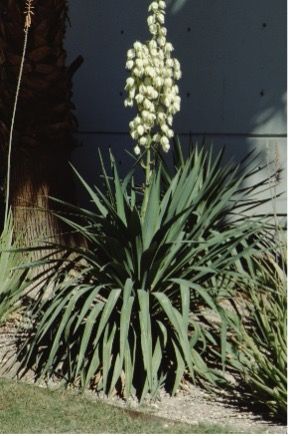
Credit: Edward F. Gilman, UF/IFAS
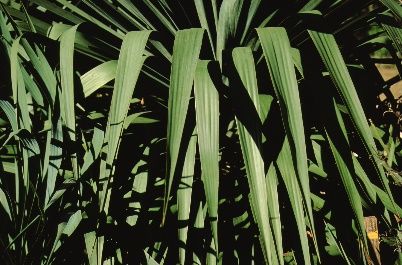
Credit: Edward F. Gilman, UF/IFAS
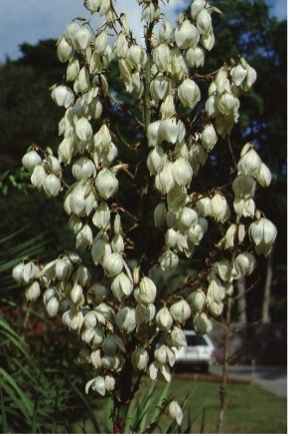
Credit: Edward F. Gilman, UF/IFAS
General Information
Scientific name: Yucca gloriosa
Pronunciation: YUCK-kuh glor-ree-OH-suh
Common name(s): Spanish dagger, moundlily yucca
Family: Agavaceae
Plant type: shrub
USDA hardiness zones: 6 through 11 (Figure 4)
Planting month for zone 7: year-round
Planting month for zone 8: year-round
Planting month for zone 9: year-round
Planting month for zone 10 and 11: year-round
Origin: native to Florida
Invasive potential: not known to be invasive
Uses: specimen; naturalizing; border; accent; attracts butterflies; screen
Availability: grown in small quantities by a small number of nurseries
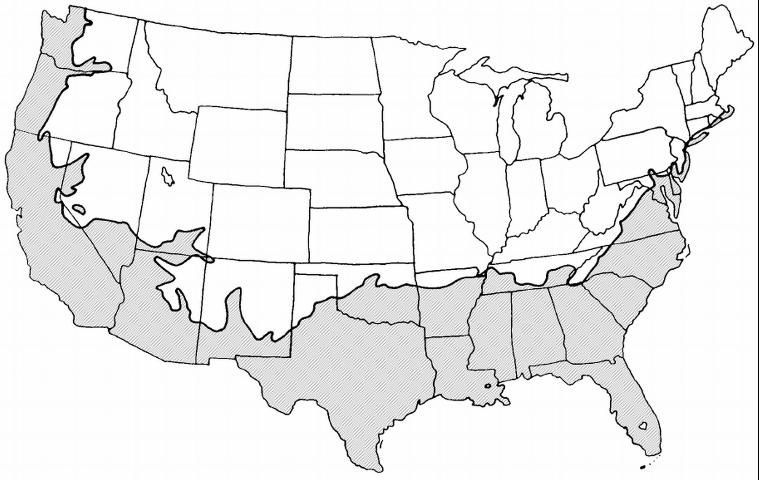
Credit:
Description
Height: 6 to 8 feet
Spread: 4 to 8 feet
Plant habit: upright
Plant density: moderate
Growth rate: slow
Texture: coarse
Foliage
Leaf arrangement: alternate
Leaf type: simple
Leaf margin: entire
Leaf shape: linear
Leaf venation: parallel
Leaf type and persistence: evergreen
Leaf blade length: 18 to 36 inches
Leaf color: green
Fall color: no fall color change
Fall characteristic: not showy
Flower
Flower color: white
Flower characteristic: summer flowering; spring flowering; pleasant fragrance
Fruit
Fruit shape: oval
Fruit length: 1 to 3 inches
Fruit cover: dry or hard
Fruit color: brown
Fruit characteristic: suited for human consumption
Trunk and Branches
Trunk/bark/branches: typically multi-trunked or clumping stems; can be trained to grow with a short, single trunk; not particularly showy
Current year stem/twig color: green
Current year stem/twig thickness: very thick
Culture
Light requirement: plant grows in part shade/part sun
Soil tolerances: alkaline; sand; acidic; loam
Drought tolerance: high
Soil salt tolerances: good
Plant spacing: 36 to 60 inches
Other
Roots: sprouts from roots or lower trunk
Winter interest: no special winter interest
Outstanding plant: plant has outstanding ornamental features and could be planted more
Pest resistance: no serious pests are normally seen on the plant
Use and Management
Spanish dagger is often confused with Spanish bayonet. Leaf margins on Spanish dagger (Yucca gloriosa) are smooth, whereas those on Spanish bayonet (Yucca aloifolia) are rough. The outer halves of the leaves on Spanish dagger also bend toward the ground, whereas those on Spanish bayonet do not.
Growing in full sun or partial shade, Spanish dagger does well on any well-drained soil and should be watered sparingly, if at all.
The cultivar 'Nobilis' is an improved form with dark green leaves.
Propagation is by division of the suckers or by cuttings of any size at any season. Occasionally plants are grown from seed.
Pests and Diseases
Pest problems include scale and yucca moth larvae, which may bore through and weaken the terminal shoot.
Leaf spot can be a problem in areas with poor air circulation.