
Introduction
This native of Florida is also known erroneously as Zamia pumila. The feather-like, light green, leathery foliage of coontie emerges from a large underground storage root in the early years before a trunk develops. Providing a tropical landscape effect, coontie's unique growth habit is ideally suited for use as a specimen or container planting. It looks particularly attractive when plants of differing sizes are planted together to form a clumping, specimen-like effect. Planted on 3- to-5-foot centers for a massing effect, it forms a 3-foot tall, medium-green ground cover. Coontie are rarely used in this manner because of the high cost of plants, but it is well worth the effort. This plant should be used more in the landscape.
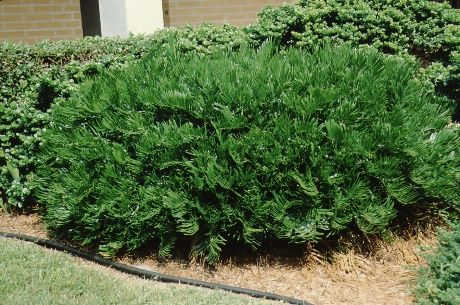
Credit: Edward F. Gilman, UF/IFAS
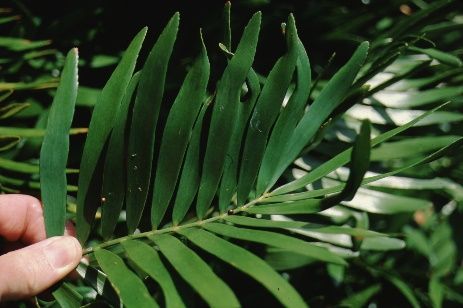
Credit: Edward F. Gilman, UF/IFAS
General Information
Scientific name: Zamia floridana
Pronunciation: ZAY-mee-uh flor-rid-DAY-nuh
Common name(s): coontie
Family: Zamiaceae
Plant type: shrub
USDA hardiness zones: 8B through 11 (Figure 3)
Planting month for zone 8: year-round
Planting month for zone 9: year-round
Planting month for zone 10 and 11: year-round
Origin: native to Florida
Invasive potential: not known to be invasive
Uses: border; mass planting; accent; attracts butterflies; suitable for growing indoors
Availability: somewhat available, may have to go out of the region to find the plant
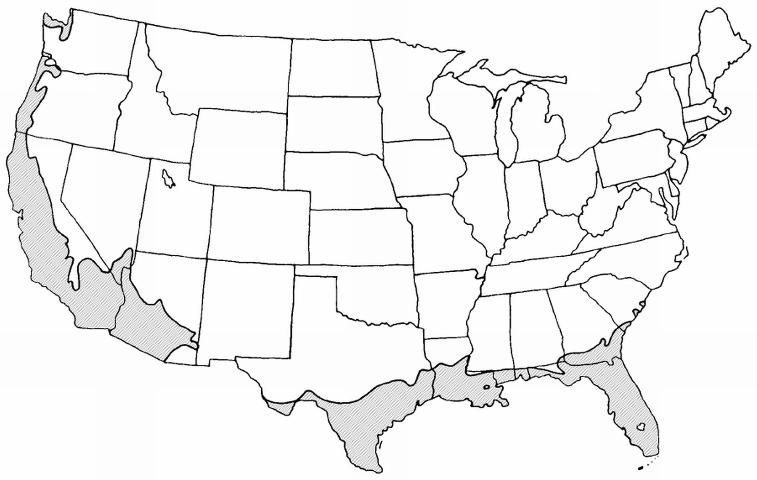
Credit:
Description
Height: 2 to 4 feet
Spread: 3 to 5 feet
Plant habit: round
Plant density: moderate
Growth rate: slow
Texture: fine
Foliage
Leaf arrangement: spiral
Leaf type: even-pinnately compound
Leaf margin: revolute; serrate
Leaf shape: linear
Leaf venation: parallel
Leaf type and persistence: evergreen
Leaf blade length: 4 to 8 inches
Leaf color: green
Fall color: no fall color change
Fall characteristic: not showy
Flower
Flower color: no flowers
Flower characteristic: no flowers
Fruit
Fruit shape: elongated
Fruit length: 3 to 6 inches
Fruit cover: dry or hard
Fruit color: red
Fruit characteristic: showy
Trunk and Branches
Trunk/bark/branches: not particularly showy; usually with one stem/trunk
Current year stem/twig color: not applicable
Current year stem/twig thickness: not applicable
Culture
Light requirement: plant grows in part shade/part sun
Soil tolerances: alkaline; sand; acidic; loam
Drought tolerance: high
Soil salt tolerances: good
Plant spacing: 36 to 60 inches
Other
Roots: usually not a problem
Winter interest: no special winter interest
Outstanding plant: plant has outstanding ornamental features and could be planted more
Pest resistance: no serious pests are normally seen on the plant
Use and Management
Growing best with some shade, coontie can tolerate full sun and grows on a variety of soils as long as it is well-drained. Watering should be done with moderation, if at all, once established. But like any plant, plenty of water is needed following transplanting.
Propagation is usually difficult by seed, and growth is very slow.
Pest and Diseases
Pest problems include sooty mold, mealy bugs, and scale. Florida red scale must be controlled by regular spraying because it can be fatal to coontie. The Alata caterpillar feeds only on the coontie. It devours foliage at a rapid rate for about two weeks and then disappears. Plants look fine after new foliage appears.
No diseases are of major concern.