
Introduction
Hurricane-force winds can be extremely damaging to communities and urban forests. Without question, trees can become hazardous and pose risks to personal safety and property. As destructive as these storms are, it is important not to forget that trees provide many environmental benefits, such as providing shade and energy conservation, reducing the well known "heat island" effect in cities caused by concrete and pavement, and increasing property values. Also, there are opportunities to better prepare for the next hurricane season by rebuilding a healthy urban forest. Valuable lessons can be learned from knowing more about how, when, and why trees fail in storms. A key issue facing communities is how to manage the urban forest from an ecological standpoint so urban forests are healthier and more wind-resistant.
A healthy urban forest is composed of trees that maximize ecosystem benefits while being able to withstand natural and anthropogenic stresses and disturbances, such as wind from hurricanes and tropical storms, flooding, pollution, etc.
This fact sheet reports on the lessons learned from research conducted after 10 hurricanes by scientists at the University of Florida/Institute of Food and Agricultural Sciences (UF/IFAS). It also includes valuable field observations from professionals, such as urban foresters, scientists, and arborists.
Our goal is to promote a healthy and more wind-resistant urban forest. This publication is aimed at citizens and communities who seek to rebuild and set better urban forest management practices so that future storms are less devastating.
The Study
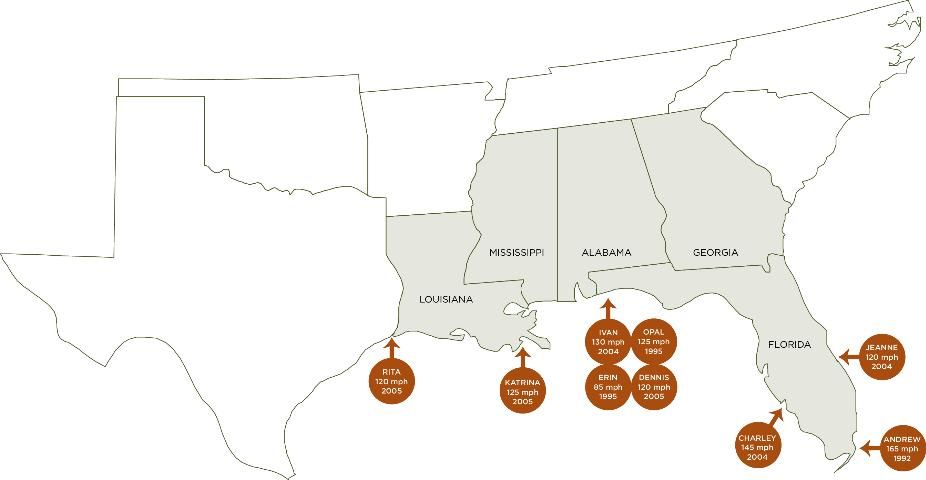
Since 1992, when Hurricane Andrew struck south Florida, researchers at UF/IFAS have been studying the impacts of hurricanes on the urban forest (Duryea et al. 1996). Hurricane wind damage to urban neighborhoods was measured again in 1995 when two hurricanes struck the Pensacola, FL area (Duryea 1997) and once more in 1998 when Hurricane Georges crossed over the entire island of Puerto Rico. In 2004, four hurricanes (Charley, Jeanne, Francis, and Ivan) struck Florida with maximum sustained winds ranging from 105 to 145 mph. In 2005, Hurricanes Dennis, Katrina, and Rita struck the Gulf Coast of the US (Figure 1).
The impacts of these hurricanes gave us the opportunity to study over 150 urban tree species and their comparable responses to hurricanes (Duryea et al. 2007).
Our goal was to answer the question, what makes a tree more wind resistant? Our main objective was to determine what biological, site, and cultural factors make trees more or less wind resistant. By evaluating these factors, we can understand the difference between species (i.e., whether they defoliate quickly in wind) and between certain practices (such as planting trees in groups compared to individual tree planting). This fact sheet describes the lessons and recommendations about the urban forest, trees (i.e. species and structure), and soil and rooting conditions.
I. Lessons about the Urban Forest
Lesson 1
The higher the wind speed of the hurricane, the more likely trees will fail
In the 10 hurricanes we studied, we measured standing, leaning, or fallen trees in yards. Standing trees were considered survivors of the wind. Trees were considered not surviving if they had fallen or were leaning at less than a 45 degree angle.
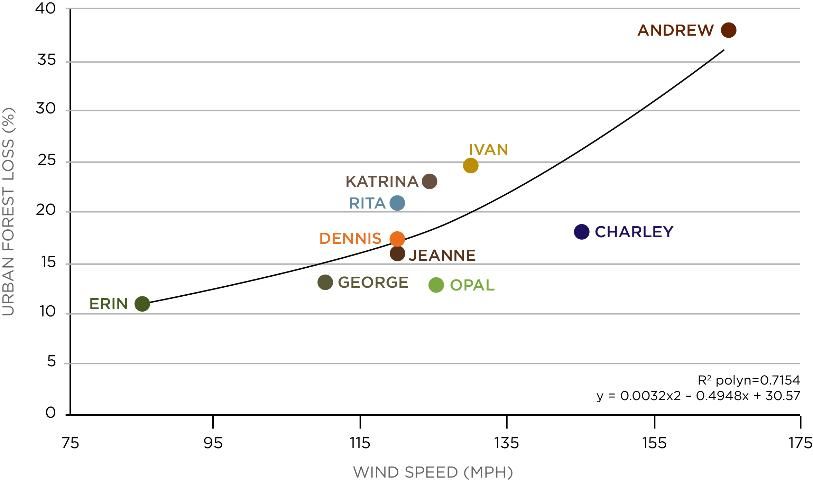
From these numbers we calculated the percent of urban forest lost in each hurricane, which ranged from 11% in Hurricane Erin to 21% in Hurricane Rita to 23% in Hurricane Katrina to 38% in Hurricane Andrew (Figure 2). As wind speed increases, trees are more likely to suffer damage (i.e. uproot, break, or lean), resulting in greater urban forest loss, as the graph shows.
However, it is important to point out that in addition to wind intensity and speed, other factors influence urban forest damage during hurricanes:
-
Conditions accompanying the hurricane, such as precipitation and the time it takes to move through an area
-
Tree species, age, health, and structure
-
Site characteristics, such as soil conditions (e.g., soil depth, water table, soil compaction) and soil composition
-
Urban forest conditions, such as overall tree canopy density and composition
These factors together will determine whether a tree will fail during winds. Biological factors such as tree species, age, health and condition are related to the urban forest composition and structure. For example, Pensacola, FL has a denser tree canopy composed of older trees and these trees suffered considerably more damage during hurricanes when compared to Miami, FL, with less canopy cover and younger tree species.
Conditions accompanying the hurricane also influence tree fall. For instance, a slower-moving storm with a lot of precipitation will mean more water accumulating in the soil and less friction between roots and soil to hold trees up.
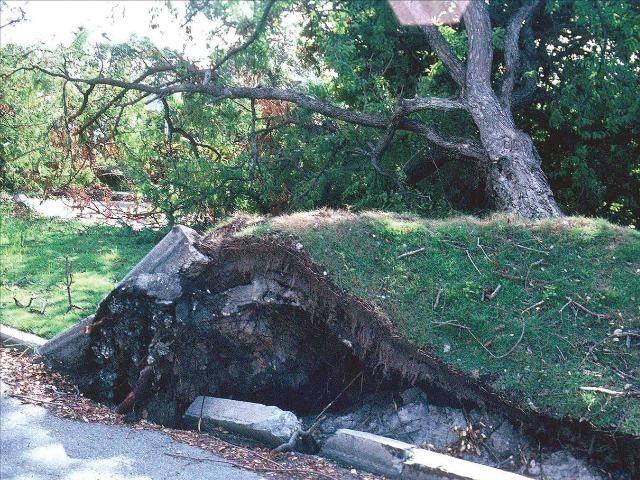
Trees growing in shallow soils, such as in Miami-Dade County with soils no more than 1 foot deep, will also behave differently from those planted in deeper soils. Trees in shallow soils are more prone to blow over than trees rooted more deeply.
Recommendation
Establish and manage a healthy urban forest to improve wind resistance by:
-
Having a comprehensive tree management plan for your community.
-
Beginning a structural pruning program for young and mature trees.
-
Choosing more wind-resistant species.
-
Selecting the right species and designing the right place.
-
Planting high-quality trees with central leaders and good structure.
Lesson 2
Trees in groups survive winds better than trees growing individually
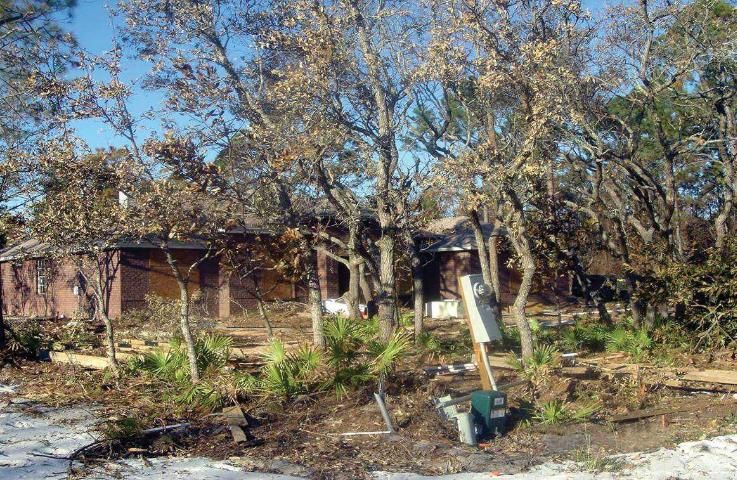
In Hurricanes Ivan and Jeanne, our research showed that trees growing in groups survived the winds better than individual trees (80% versus 70% in Hurricane Ivan, and 88% versus 78% in Hurricane Jeanne.) A group was defined as 5 or more trees, each growing within 10 feet of another tree, but not in a row, as shown in (Figure 3).
Our research has also shown that the more rooting space trees have, the less likely they are to fail (see section Lessons Learned about Soil and Rooting Conditions for more details). Only if they have adequate soil space can trees develop a strong supporting root system.
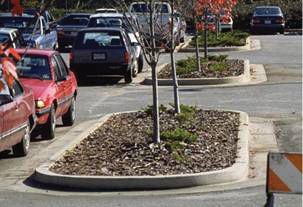
Recommendation 1
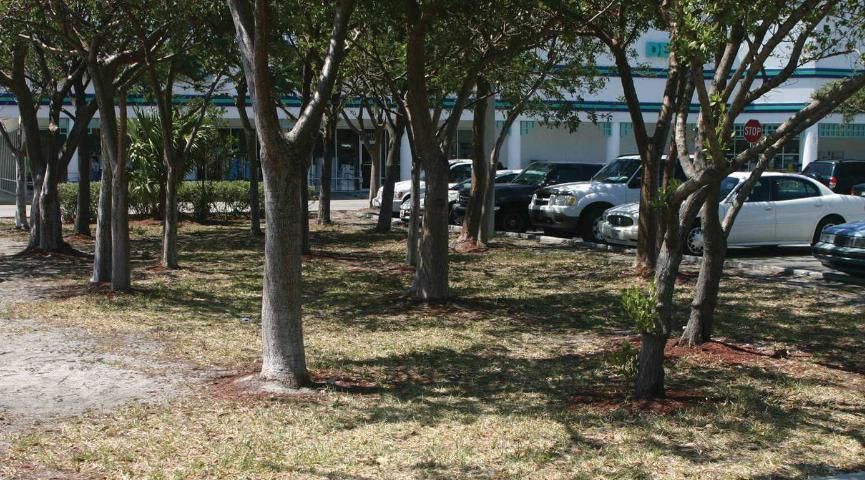
Plant trees in groups of at least 5 trees (Figure 4) as opposed to individually (Figure 5).
Recommendation 2
Plant a variety of species, ages, and layers of trees and shrubs to maintain diversity in your community (Figure 6).
II. Lessons about Trees
Lesson 1
Some species resist wind better than others
others.
In our measurements of trees after 10 hurricanes, we have seen that some tree species are more resistant to wind than others. Wind resistance is defined as the ability or capacity of a tree to survive (remain standing and living) hurricane-force winds, which means that they do not easily uproot or break in the winds.
One of the main objectives of this study was to develop lists of wind-resistant tree species. To complement our findings, we conducted a survey of arborists, scientists and urban foresters who ranked wind resistance of urban tree species they observed after hurricanes. We used these ratings along with our research results and the available scientific literature to classify broad-leaved, conifer, palm, and fruit tree species into highest, medium-high, medium-low and lowest wind resistance. The recommended tree species are divided into the Southeastern Coastal Plain region (including USDA hardiness zones 8 and 9) and Tropical and Subtropical regions (USDA hardiness zones 10 and 11).
Recommendation 1
Plant tree species that have been shown to be more wind resistant.
Recommendation 2
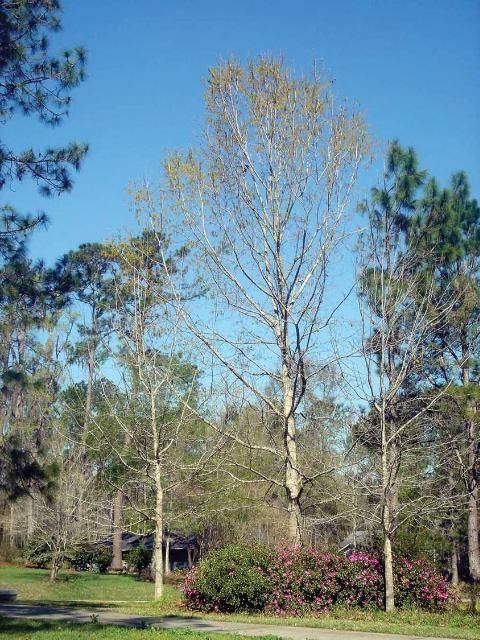
Consider removing over-mature and hazardous tree species that have demonstrated poor survival in hurricanes. This is especially true if trees are over-mature, endangering lives and property, and belong to the lowest wind resistance list. Some of these species can be seen below and include sand pine, pecan, laurel oak, and water oak in north Florida and queen palm, Australian pine, melaleuca, weeping banyan, and Washington palm in South Florida. For borderline species, consult a professional urban forester or a certified arborist.
Recommendation 3
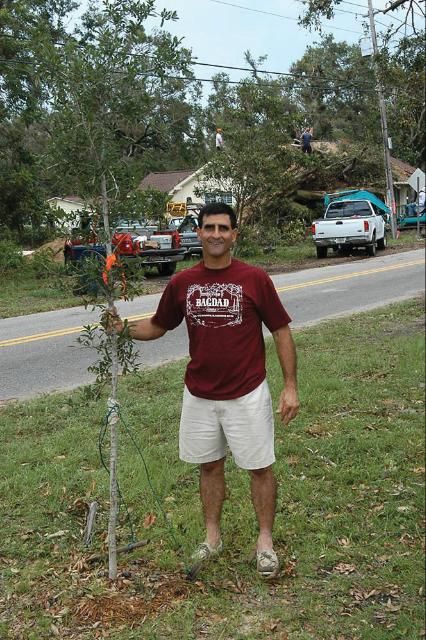
When a tree fails, plant a new tree in its place. In the streets of Bagdad, Florida, laurel oaks such as the one on the house in the background are being replaced with more wind-resistant, longer-living street tree species, such as live oaks (Figure 7). The healthy urban forest this will create, with its mixture of young and mature trees, will provide benefits such as good canopy cover, diversity, and mitigation of high winds. When possible, remember to replace individual trees with groups of trees. Doing so can improve wind resistance.
Another Finding: Oaks
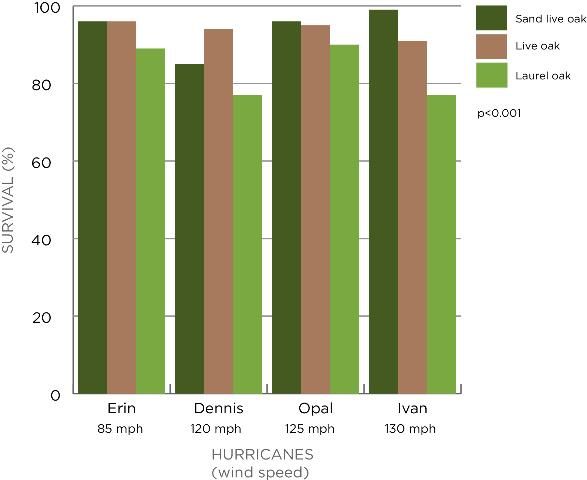
When comparing survival of sand live oak, live oak, and laurel oak in 4 panhandle Florida hurricanes (Erin, Dennis, Opal, and Ivan), laurel oak had poorer overall survival than both live oak and sand live oak (Duryea et al. 2007) (Figure 8). However, in 2 south Florida hurricanes (Jeanne and Charley), both survival and branch loss for these oaks were similar. Speculations about the reasons for this lack of difference include: (1) Laurel oak in south Florida may be a different cultivar or variety than those in north Florida and (2) Sandier soils in south Florida and their accompanying lower site quality may result in laurel oaks with shorter heights or lower height-to-diameter ratio (as occurs between the north Florida and south Florida varieties of slash pine (Pinus elliottii var. elliottii and var. densa). Still, many authors point to live oak as a tree with strong wood and little failure in hurricanes (Touliatos and Roth 1971; Swain 1979; Hook et al. 1991; Barry et al. 1993).
Recommendation
Become familiar with the recommended tree species and how they perform in natural and urban ecosystems in your community. The same species in different locations may behave differently due to soils, climate, local disease problems, and other factors.
Lesson 2
As a group, palm species survive hurricanes better than broad-leaved and conifer trees
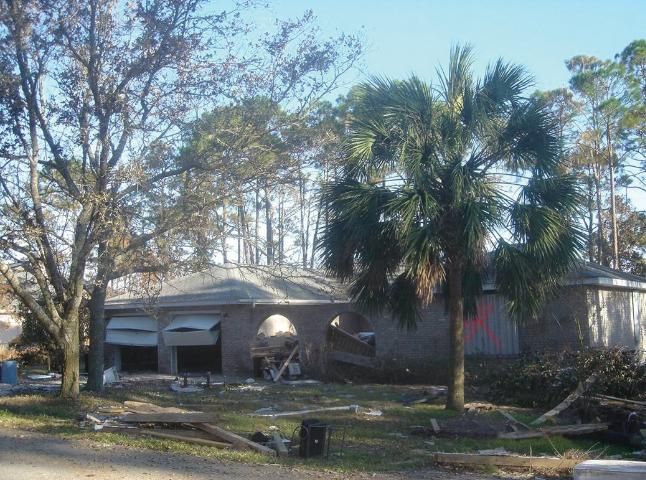
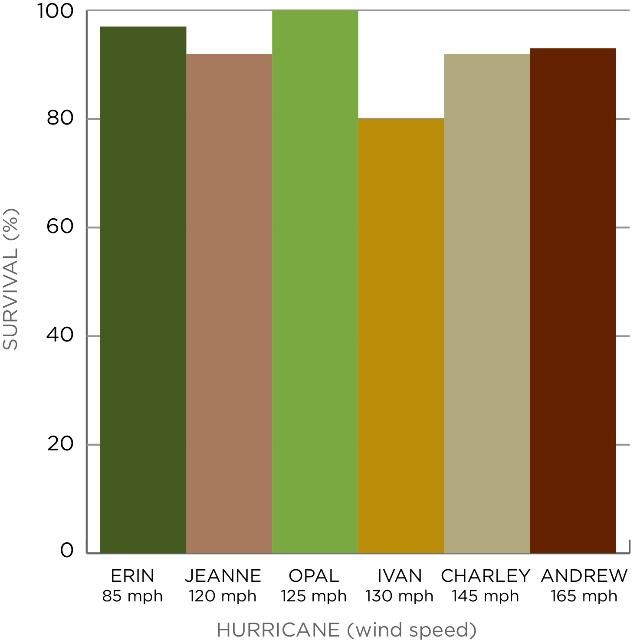
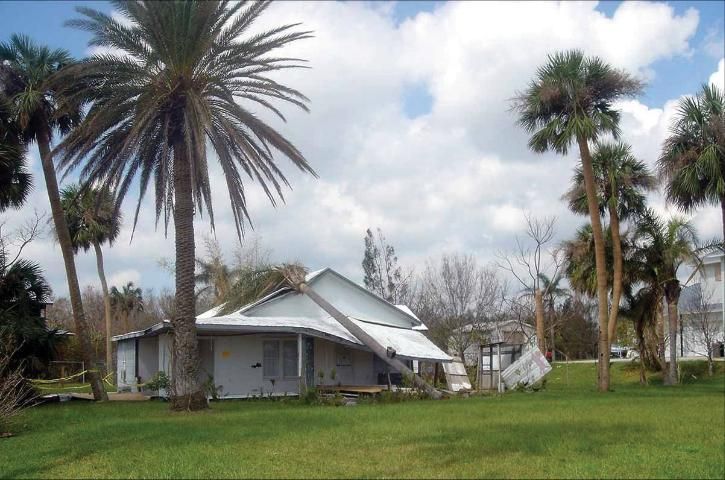
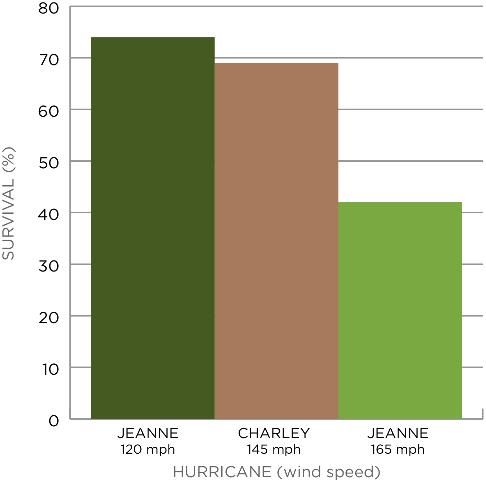
When compared to broad-leaved and other conifer trees (such as pines), palms have often been observed to be more resistant to winds. Palms grow differently than other trees because they have one terminal bud. If that bud is not damaged, palms may lose all their fronds (leaves) and still survive. Our research shows that palms in the coastal plain and tropical and subtropical regions are often more resistant to winds (Figure 9). However, individual palm species do vary in their responses to wind. Examples would be queen and Washington palms which have exhibited poor survival in south Florida during hurricanes (Figure 10).
Recommendation 1
Consider planting wind-resistant palm species. Examples include sabal palm, Canary Island date palm, and manila palm.
Recommendation 2
Monitor palms carefully after storms. Bud damage may not show up immediately after the storm. Allow at least 6 months for palms to put out new fronds. Palms should also be checked for hidden root, stem, or bud damage.
Lesson 3
Pines may show no immediate visible damage after hurricanes, but may decline over time
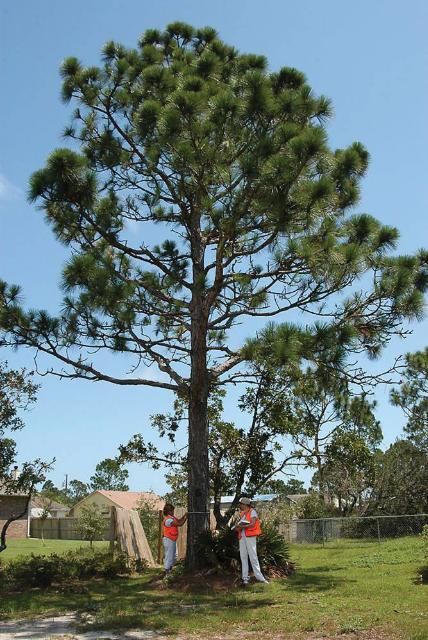
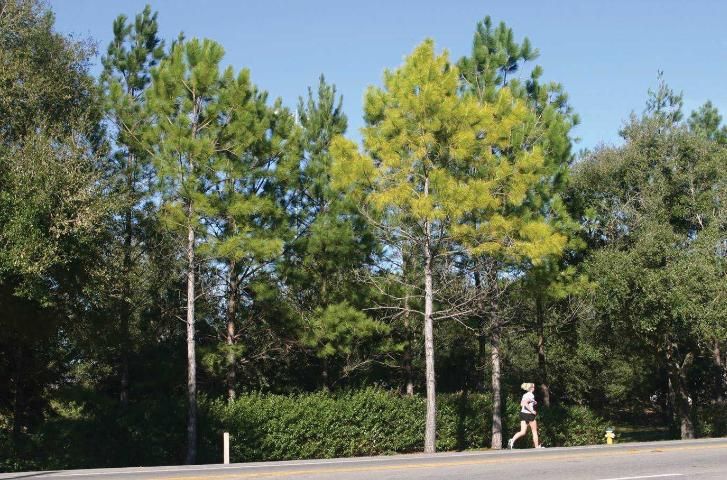
In our study, we measured pines right after hurricanes, when they looked green and healthy (Figure 11). However, we went back 3 months after Hurricane Charley and found that 27% of the standing south Florida slash pines and 48% of the standing longleaf pines had died. Pines have been observed to be very sensitive to wind damage. They may show no immediate visible damage after high winds but may die sometime later. They can die slowly over a period of 6 months to 2 years after wind storms. Some may remain green for a year or more, and then suddenly turn yellow (Figure 12) and quickly progress to brown needles in a very short period. The causes of yellowing of the needles and pine death are not completely understood. It is likely due to hidden damage produced by bending and twisting during hurricane-force winds. Prolonged winds may also rupture smaller roots without breaking the larger support roots. The injured stems and roots are unable then to supply the water and nutrients needed in the crown, resulting in pine decline and death.
Recommendation
Monitor pines carefully. Sometimes there is hidden damage and the tree declines over time. Look for signs of stress or poor health. Check closely for insects. Weakened pines may be more susceptible to beetles and diseases.
Lesson 4
Trees that lose all or some of their leaves in hurricanes are not necessarily dead
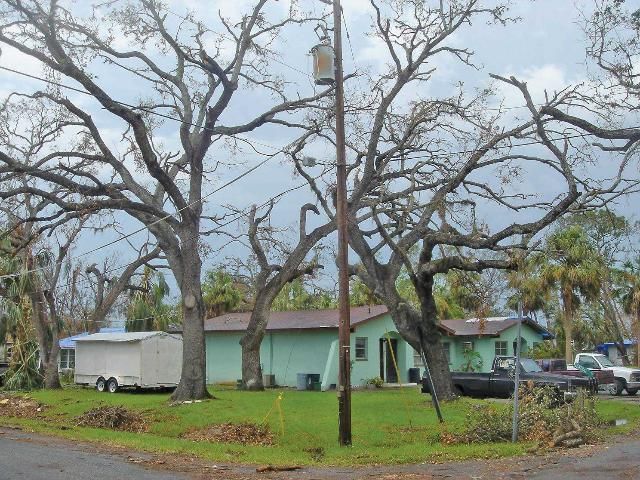
The greater the wind speed, the more leaves trees lose during hurricanes, and leaf loss may help trees to survive. Trees can lose all or some of their leaves in most hurricanes. However, leaf loss does not mean the tree is dead; rather it means the tree is temporarily unable to photosynthesize (produce food) and store energy. With time, the tree will produce new leaves which are a sign of recovery, since they restore the tree's ability to photosynthesize and bring the tree back to health. Some species defoliate (lose leaves) easily during winds. Losing leaves may be a good strategy, helping the tree to better resist winds. Our research in Hurricane Ivan found that trees that lost their leaves survived the winds better. Live oak (in north Florida) (Figure 13) and gumbo limbo (in south Florida) are examples of trees which readily lose leaves and small branches and stand up well to winds.
Recommendation
Wait, watch for leaves, and monitor the tree's health. Most trees will leaf out again in a few months or in the spring of the following year. If the tree does not grow new leaves by the spring or early summer following the hurricane, it is not likely to recover. Note that some species, such as pines, may not recover if defoliated.
Lesson 5
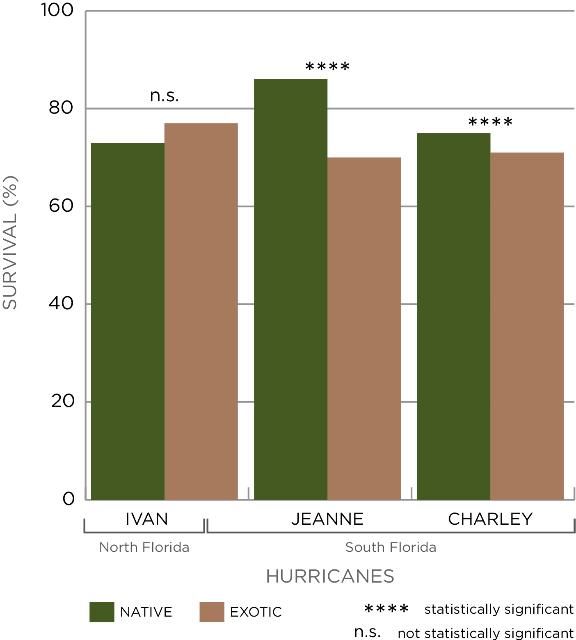
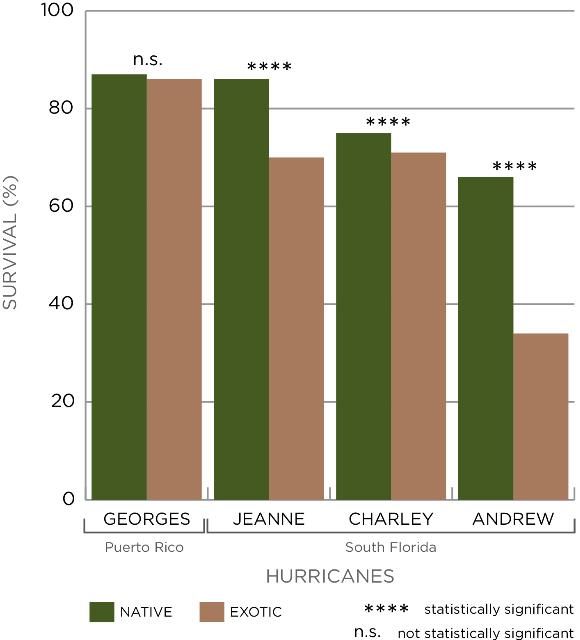
Native tree species survived better in South Florida hurricanes (Jeanne, Andrew, and Charley)
In our research, native trees survived better in south Florida hurricanes but not in north Florida (Hurricane Ivan) (Figure 14). Native species also lost fewer branches than exotic species in Jeanne (36% versus 21%) and Charley (39% versus 36%) in south Florida. Some of the exotic species with low survival in south Florida were melaleuca, Australian pine, and queen palm as compared to native species with high survival, such as live oak, gumbo limbo, and sabal palm. In tropical and subtropical areas, exotics represent a large proportion of the urban forest (for Hurricane Jeanne, exotics made up 38% of the trees in the urban forest, for Hurricane Charley, 42%, and for Hurricane Andrew, 64% were exotics). In the southeast coastal plains (Hurricane Ivan), exotic tree species make up 9% of the trees in the urban forest. The major exotic species were crape myrtle, Chinese tallow (a prohibited invasive species), camphor tree, (an invasive species), Bradford pear, and palms such as pindo and Washington. These differences in the composition of the urban forest may explain why, with fewer exotics in their population, natives did not survive better in the coastal plain during Hurricane Ivan. Native trees also survived winds better in south Florida hurricanes when compared to Puerto Rico (Hurricane Georges) (Figure 15). Out of the 35 tree species measured in Puerto Rico, only 4 were native to the island. The lighter winds and conditions of Hurricane Georges showed no differences between native and exotic species.
Recommendation
Consider native tree species when selecting trees for planting. Native trees should receive strong consideration when selecting trees for the urban forest. Additional benefits of using native species include their values for wildlife and native ecosystem conservation.
Lesson 6
Older trees are more likely to fail in hurricanes
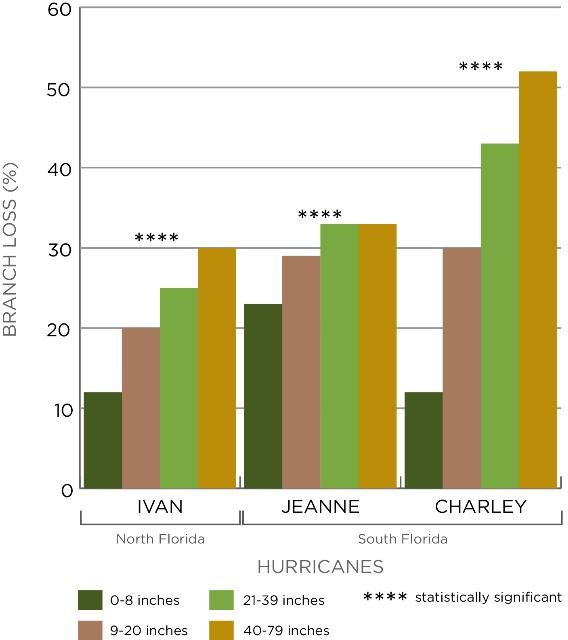
As trees grow and age, they become more susceptible to insects and diseases, branches and parts of the tree begin to die, they become less flexible, and they may be more vulnerable to winds. Our research shows that larger and older trees lose more branches in hurricanes. Larger trees (40 to 79 inches in diameter) lost a greater percentage of their branches compared to small trees (less than 8 inches in diameter) (Figure 16). Every tree species has an inherent life span. Some tree species live longer than others (Table 1). It is important to keep in mind that risk of failure in wind increases with age. For example, the life span of laurel oak is 50 years; it begins to decay and show signs of diseases as it reaches 40 years. The older a tree gets, the greater the likelihood of diseases and pathogens, breakage during winds, and the greater the risk of it causing damage when it fails.
Recommendation 1
Consider life span when managing urban forests for wind resistance (Table 1).
Recommendation 2
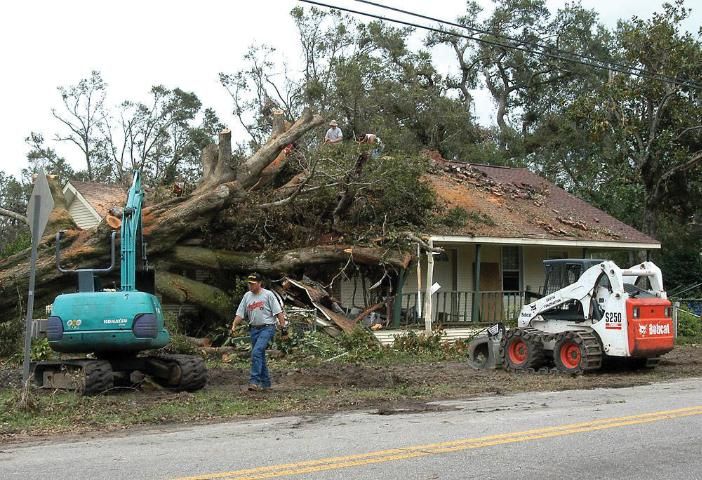
Over-mature trees that present a hazard to people and property should be removed and replaced by new trees (Figure 17). These trees should be monitored regularly for structural defects. Consult with a certified arborist or urban forester.
Lesson 7
Unhealthy trees are predisposed to damage
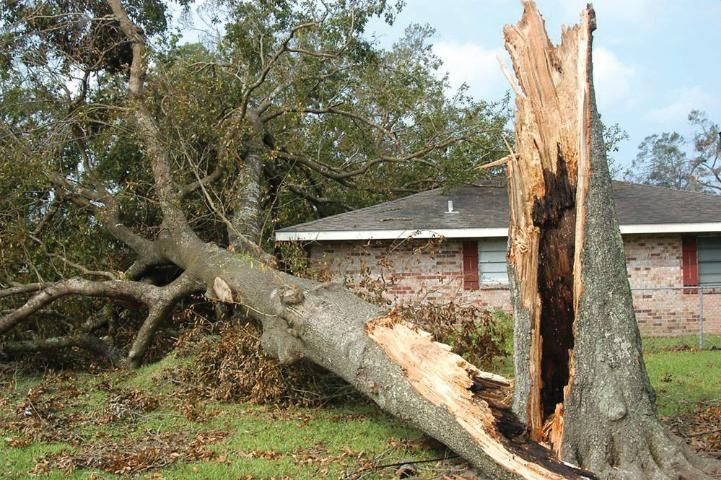
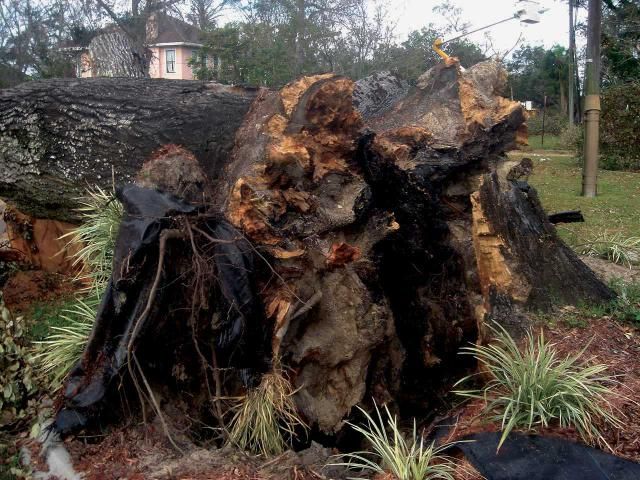
Old trees with decayed root systems, stem decay, or large dead branches are vulnerable to hurricanes. Decay, a major cause of tree failure, is caused by fungi that weaken wood (Figure 18). Cracks, seams, butt swell, dead branch stubs and large, older wounds suggest internal decay. They can be weak points on a trunk and increase the likelihood of tree failure. Mushrooms at the base of the tree trunk might also indicate root problems. They can be the sign of Armillaria or other fungi than can decay roots, creating unstable trees (Figure 19). Root rot can be diagnosed with careful, regular inspections by qualified arborists.
Recommendation
Remove hazard trees before the wind does. Have a certified arborist inspect your trees for signs of disease and decay. They are trained to advise you on tree health.
Lesson 8
Trees with poor structure or included bark are more vulnerable in the wind
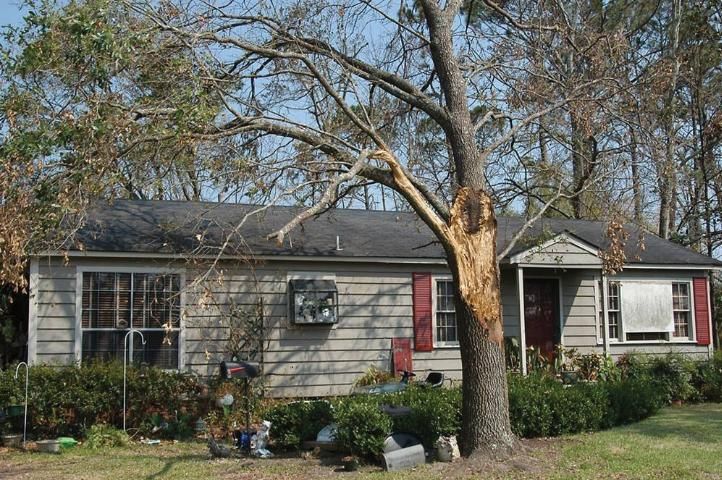
A tree with two or more trunks or stems of equal size originating from the same point on the tree is said to have co-dominant stems. Co-dominant stems may develop bark inclusions, which are weak unions between branches, and are very susceptible to breakage (Figure 20). To develop strong structure, trees need to be managed with structural pruning.
Recommendation 1
For a more wind-resistant, sustainable landscape, plant high-quality trees with central leaders and good form.
Recommendation 2
Follow with a preventive structural pruning program of young and mature trees.
Lesson 9
Well-pruned trees survive hurricanes better than poorly pruned or unpruned trees
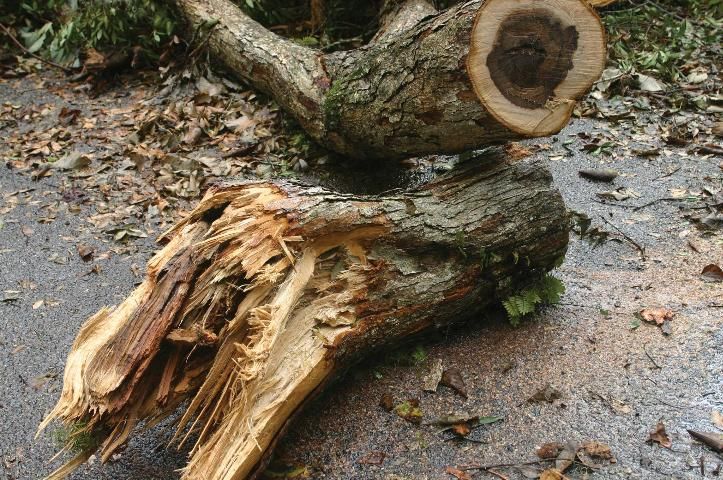
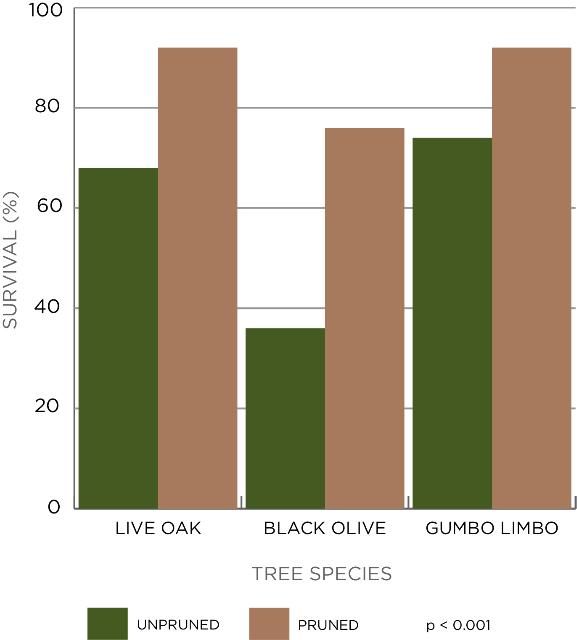
Poor pruning practices, such as topping or removing large branches, make trees more susceptible to wind failure. Old, large pruning cuts can become an entry point for fungi that begin the decay process (Figure 21). In our study of Master Gardeners after Hurricane Andrew in 1992 (Duryea et al. 1996), we found that trees that had been pruned properly (not topped and with more open and well-distributed crowns) survived high winds better than unpruned trees (Figure 22). We re-analyzed this data using more broad-leaved tree species—black olive, gumbo limbo, bottlebrush, royal Poinciana, live oak, West Indian mahogany, and white cedar. Survival for pruned trees was 73% compared to 47% for unpruned trees, showing that overall, pruned trees are less likely to fail in hurricanes.
Recommendation 1
Begin a preventive pruning program for both young and mature trees. The main goal of preventive pruning is to reduce the length of branches competing with the main trunk.
Recommendation 2
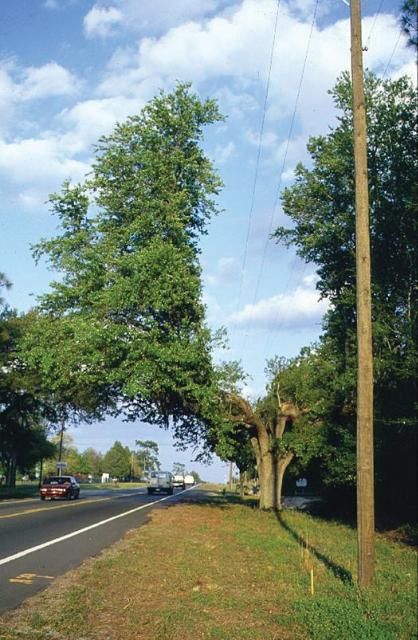
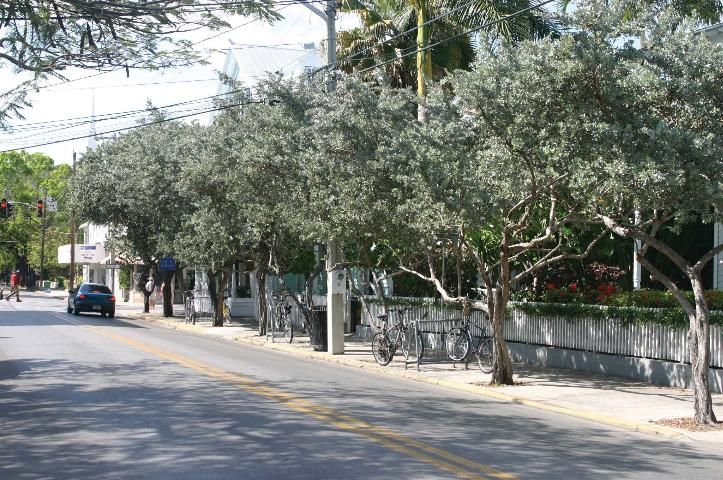
Select the right tree for the right location to avoid poor pruning practices. To allow healthy crown development, plant considering the aerial space needed for a mature-sized tree (Figure 23). Under power lines, the preferred option is to plant smaller trees that will better fit the space (Figure 24).
III. Lessons about Soil and Rooting Conditions
Lesson 1
Trees with more rooting space survive better
The most important factor in designing a healthy urban landscape is also probably the one most often overlooked —that is providing enough soil space for tree roots to grow. In Hurricane Georges (Puerto Rico), we measured rooting space for trees and found that with more rooting space, tree survival during winds was higher (Table 2).
Soil should provide plenty of open space to allow growth of the trunk and development of the main flare roots. To provide anchorage for the tree, roots need to spread beyond the edge of the canopy and grow deep into the soil. Sidewalks, curbs, buildings, parking lots, driveways, and other urban structures restrict root development. A strong supporting root system with adequate rooting space is the most critical factor to the ability of trees to withstand hurricane-force winds in urban landscapes.
Recommendation
Give trees enough rooting space based on their mature size:
• Small trees need at least 10 feet by 10 feet .
• Medium trees need 20 feet by 20 feet.
• Large trees need at least 30 feet by 30 feet.
Lesson 2
Good soil properties, such as adequate soil depth, a deep water table, and no compaction, help wind resistance
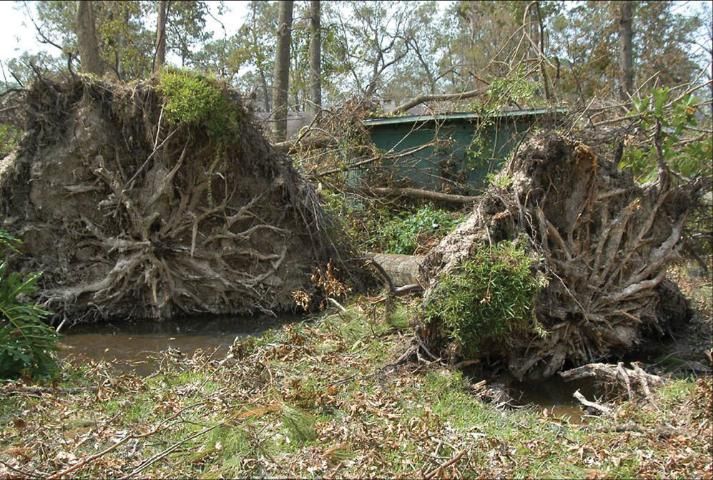
Trees without deep roots can become unstable and fall over in strong winds. Trees in shallow soils are more likely to blow over than trees rooted more deeply (Figure 25). Trees planted in compacted soil grow very poorly and are weak and unhealthy. This is especially true when the soil is poorly drained or the water table is high (Figure 26).
Recommendation 1
Make sure that planting sites have 3 feet of soil depth with a deep water table to allow healthy root system development.
Recommendation 2
Keep soil compaction to a minimum.
Lesson 3
Damaged root systems make trees vulnerable in the wind
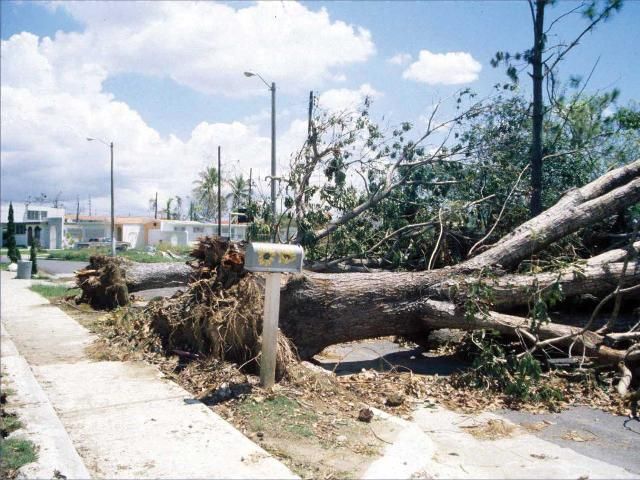
Roots anchor the tree. It is important that roots under the canopy are not cut because many roots are located just below the surface of the soil. Tree roots need to extend out from a tree in all directions in order to stabilize it against wind throw. When roots under the canopy are cut, trees are more predisposed to falling over (Figure 27).
Recommendation
Do not damage or cut main support roots during construction. Never cut roots closer than the distance of 5 times the trunk diameter. Be aware that when tree roots are cut, the anchoring system of the tree may be harmed and compromised.
IV. Final Considerations
A healthy and more wind-resistant urban forest depends on managing existing trees well, and, at the same time, establishing new trees properly. Follow these recommendations when managing older trees or planting new trees.
Older Tree Management
• Consider life span when managing urban forests for wind resistance. Over-mature trees should be removed and replaced by new trees.
• Remove hazard trees before the wind does. Have a certified arborist inspect your trees for signs of disease and decay in trees.
• Consider removing tree species that have demonstrated poor survival in hurricanes, especially if they are over-mature and endangering lives and property.
• Be careful not to damage or cut main support roots during construction. Be aware that when the tree roots are cut, the anchoring system of the tree may be harmed and compromised.
• Establish a preventive structural pruning program of both young and mature trees.
Planting
• When a tree fails, plant a new tree in its place.
• Plant tree species that have been shown to be more wind resistant.
• To reduce your risk, maintain diversity in your yard and community by planting a mixture of species, ages and layers of trees and shrubs.
• Plant trees in groups as opposed to individually.
• Give trees enough rooting space based on their mature size: small trees need at least 10 feet by 10 feet, medium trees 20 feet by 20 feet, and large trees 30 feet by 30 feet.
• To allow healthy root system development, make sure that planting sites have 3 feet of soil depth with a deep water table. Keep soil compaction to a minimum.
• To allow healthy crown development (instead of misshapen pruning) under power lines, plant small trees such as buttonwood, dogwood, crape myrtle, and wax myrtle.
• For a more wind-resistant, sustainable landscape, plant high-quality trees with central leaders and good form. Begin a structural pruning program for young trees.
References
Barry, P.J., C. Doggett, R.L. Anderson, and K.M. Swain, Sr. 1993. "How to evaluate and manage storm-damaged forest areas". Management Bulletin R8-MB 63 of the USDA Forest Service, Southern Region. Atlanta, GA. 11 pp.
Duryea, M.L., G.M. Blakeslee, W.G. Hubbard, and R.A. Vasquez. 1996. "Wind and trees: A survey of homeowners after Hurricane Andrew". J. Arboric. 22(1):44–50.
Duryea, M.L. 1997. Wind and trees: Surveys of tree damage in the Florida Panhandle after Hurricanes Erin and Opal. Circular 1183 of the University of Florida Cooperative Extension Service (http://edis. ifas.ufl.edu/). Gainesville, FL. 7 pp.
Duryea, M.L., E. Kampf, and R.C. Littell. 2007. "Hurricanes and the Urban Forest: I. Effects on Southeastern U.S. Coastal Plain Tree Species". Arboric. & Urban Forestry 33(2):83–97.
Duryea, M.L., E. Kampf, R.C. Littell and Carlos D. Rodríguez-Pedraza. 2007. "Hurricanes and the Urban Forest: II. Effects on Tropical and Subtropical Tree Species". Arboric. & Urban Forestry 33(2):98–112.
Gilman, E. 2005. "Tree selection for landscapes". Website with 680 Tree Fact Sheets: http://hort.ifas.ufl.edu/ woody/planting/TreeSelectionIntroduction.htm of the University of Florida Cooperative Extension Service. Gainesville, FL.
Hook, D.D., M.A. Buford, and T.M. Williams. 1991."Impact of Hurricane Hugo on the South Carolina coastal plain forest". J. Coastal Res. (Special issue) 8:291–300.
Swain, K.M. 1979. "Minimizing timber damage from hurricanes". S. Lumberman 239:107–109.
Touliatos, P. and E. Roth. 1971. "Hurricanes and trees: Ten lessons from Camille". J. For. 285–289.