
Family
Arecaceae, palm family.
Genus
The history behind the genus name Dypsis is unknown.
Species
The species name decaryi is in honor of Raymond Decary, the person who first collected the palm.
Common Name
Triangle Palm
The common name of this palm comes from the triangular shape at the top of the trunk that is formed by three distinct points where fronds emerge.
Description
This palm is endemic to the southeasternmost part of Madagascar, and it thrives in poor, dry soils. In the United States, triangle palm is found in southern Florida, southern Texas, and the Hawaiian Islands. It can reach heights of 25 to 35 feet with a crown spread of 15 feet, and it grows best in full sun but can tolerate partial shade. The pinnately compound leaves or fronds can grow to 10 feet long, with the upper half of the leaf hanging or drooping. The bottom portion of the frond, known as the leaf petiole, is only 1 foot long and forms a cupped, triangular shape. Fronds grow from the top portion of the trunk in three distinct rows, creating the shape of a triangle as petioles stack on top of one another. Leaflets are bluish-green, about 2 feet long, have entire or smooth margins, and form a "V" shape as they sit opposite to one another on the rachis. The trunk is dark gray, stocky, and, though generally smooth, it has obvious leaf scars. Flowers are small and light yellow. The inflorescence emerges near the base of the lower leaves in the springtime and can grow to be up to 5 feet long. Each fruit is 1 inch long, egg shaped, and green when immature and yellowish-white when ripe.
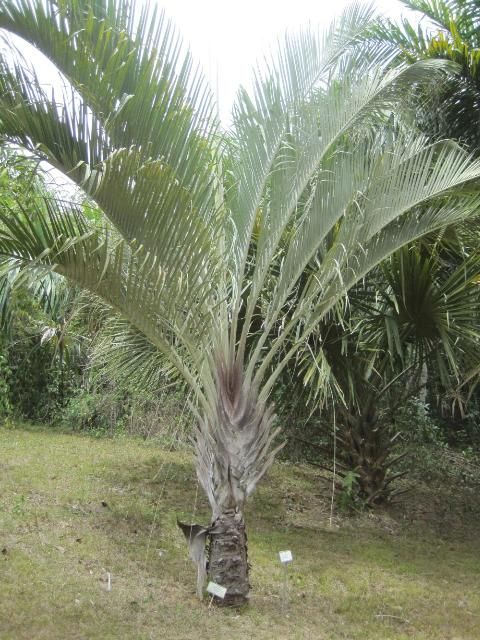
Credit: juniperus_scopulorum, CC BY-NC 2.0
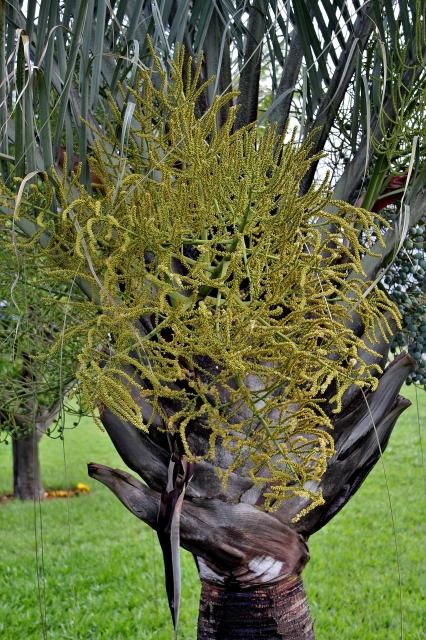
Credit: Mauricio Mercadante, CC BY-NC-SA 2.0
Applications
Commercial/Practical
In Madagascar, triangle palm seeds are harvested and sold in nurseries. This practice, coupled with its small endemic range, has contributed to the palm becoming threatened because it is not able to regenerate without an adequate seed source.
Horticultural
In the United States, triangle palms often are planted as buffer strips near highways and used to accent residential landscapes. Wherever the palm is planted, its blue-green fronds and single grey trunk add a warm look, though some find the natural appearance of its fronds to be shaggy or ragged looking. While this palm is tolerant of direct sunlight, sweltering heat, poor and dry soils, and windy conditions, it is a slow-growing palm and horticulturalists have noted that it seems to do better when grown in nutrient-rich soils with regular watering. This palm is naturally resistant to pests but may require regular fertilization to prevent yellowing caused by potassium deficiencies.
References
Gilman, E. F. 1997. Trees for urban and suburban landscapes. Albany, NY: Delmar Publishers.
Floridata.com. (1999). Neodypsis decaryi, Retrieved from http://www.floridata.com/ref/N/neod_dec.cfm
Riffle, R. L. and P. Craft. 2003. An encyclopedia of cultivated palms. Portland, OR: Timber Press, Inc.